
Market Report · July 15, 2026

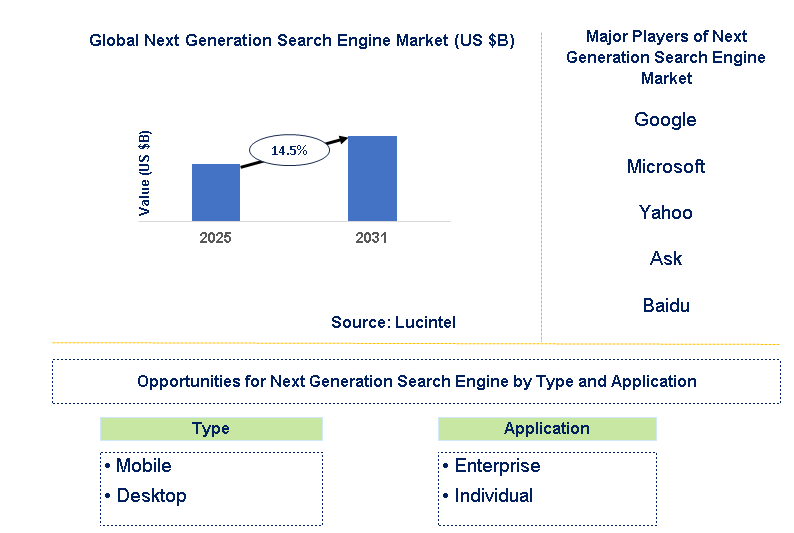
Key data points: The growth forecast = 14.5% annually for the next 7 years. Scroll below to get more insights. This market report covers trends, opportunities and forecasts in next generation search engine market to 2031 by type (mobile and desktop), application (enterprise and individual), and region (North America, Europe, Asia Pacific, and the Rest of the World)
We'll send your sample report shortly.
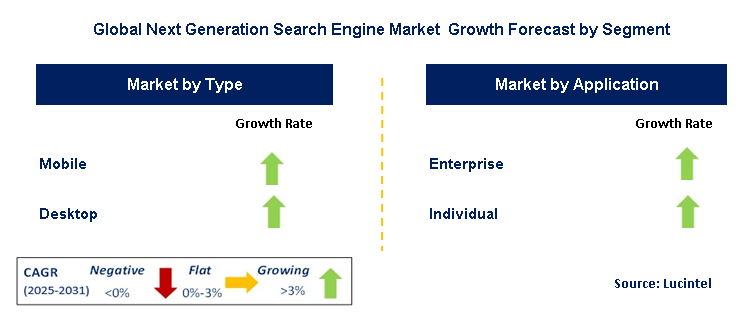
• Lucintel forecasts that, within the type category, mobile is expected to witness higher growth over the forecast period.
• Within the application category, enterprise is expected to witness higher growth.
• In terms of region, APAC is expected to witness the highest growth over the forecast period. Gain valuable insights for your business decisions with our comprehensive 150+ page report. Sample figures with some insights are shown below.
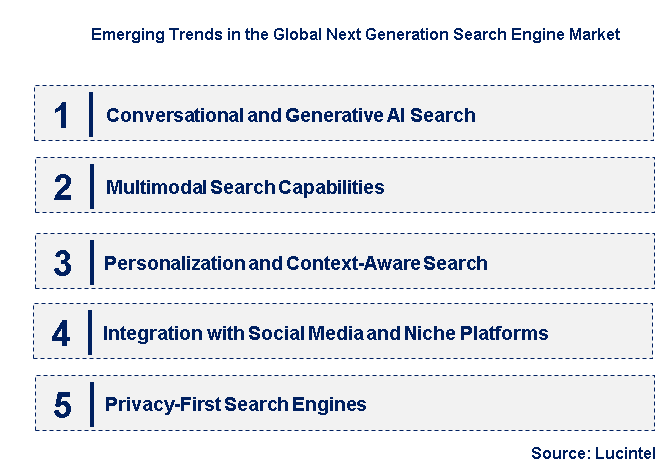
• Conversational and Generative AI Search: One of the emerging trends is the move away from keyword-driven search and toward conversational and generative AI search. This means employing large language models to interpret natural language queries and to respond with a synthesized answer instead of a set of links. The effect is a more natural and productive search experience where users are able to input complex, multi-step questions and be given a single, integrated answer. The movement is one of the biggest differentiators for emerging search engines and is compelling incumbents to quickly build out similar capabilities in order to stay relevant.
• Multimodal Search Capabilities: Another important trend is the creation of multimodal search, where users can search by a mix of text, images, voice, and video. For instance, a user may snap a picture of a plant and instruct the search engine to inform them what it is and how to care for it. The impact is a more natural and flexible search experience that reflects how people experience the world. This movement is creating new opportunities for search within e-commerce, education, and other domains, where visual and auditory signals play a role.
• Personalization and Context-Aware Search: The industry is moving towards more personalization and context-aware search. Future generation search engines are leveraging AI to assess a user’s past behavior, location, and preferences to produce more contextual and personalized search results. The effect is a more relevant and valuable search experience for the individual user. This trend is introducing a new level of competition, where how well a search engine can read and predict a users needs is a driving factor in success.
• Integration with Social Media and Niche Platforms: There is a growing tendency towards the integration of search with social media and other niche platforms. For instance, most users, especially Gen Z, now utilize platforms such as TikTok and Reddit as their go-to search engines for product reviews or travel tips. The effect is a fractured search market and the requirement that brands now optimize for these emerging platforms. This development is disrupting the historical hegemony of a limited number of dominant search engines and opening up new horizons for marketers and content creators.
• Privacy-First Search Engines: The industry is witnessing the emergence of privacy-first search engines. These engines do not collect user data, record history searches, or deploy personalized advertising. The effect is an expanding market niche that serves users who are privacy-minded in their online activities. Although these engines have only a small current market share, their expansion is a sign of a larger societal unease regarding the gathering of information and a threat to the advertising-supported business model of search engines. These new trends are altogether transforming the next generation search engine space by rendering it more intelligent, personalized, and diverse. The movement toward conversational and multimodal search is rendering the technology more intuitive and potent. The emphasis on personalization and the advent of niche platforms are dispersing the market and offering new channels for information discovery. The rise of privacy-first search engines is disrupting the traditional business model. The overall impact is a market that is more dynamic, more responsive to consumer needs, and more technologically sophisticated than ever before.
• Generative AI as Part of Search Results: One of the most recent developments is the extensive integration of generative AI into the search results page. Leading companies such as Google and Microsoft are employing large language models to produce abridged summaries and chat-like answers atop search results. The effect is a major shift in the user experience, since it enables users to receive explicit answers without the need to click on a link. This innovation is disrupting the conventional SEO paradigm and is compelling content creators to shift their tactics to be included in these emerging AI-driven summaries.
• Emergence of AI-First Search Engines: The market is witnessing a trend in which there’s an emergence of AI-first search engines and utilities, including Perplexity and ChatGPT, which are constructed on the premises of conversational AI. The utilities are aimed at directly answering questions, referencing sources, and having a conversation with the user. The result is a new competitive force in the market threatening the monopoly of conventional search engines. This evolution is providing consumers with new options and is moving the whole industry towards a more conversational orientation.
• Multimodal Search advancements: Another significant advancement is the improvement in multimodal search features. Search engines are getting better at interpreting and processing queries with a combination of text, images, and voice. The effect is a more natural and powerful search. This innovation is making new applications possible, like image-based shopping and video-based troubleshooting, that are broadening the reach of what a search engine can do and creating new market spaces.
• Strategic Collaborations and Partnerships: There have been dramatic advances in strategic partnerships and collaborations among technology firms. To illustrate, firms are collaborating on embedding AI models and search functionality into all manner of products and services, ranging from operating systems to e-commerce sites. The result is a more integrated and pervasive search experience. This trend is facilitating faster adoption of next generation search technology and building a more connected digital ecosystem.
• Personalization and User Intent Focus: The industry has witnessed an evolution where personalization and user intent are hotly focused on. New generation search engines are employing sophisticated machine learning to look beyond mere keywords and to examine a user’s context and history. The result is a more personalized and relevant search experience that stands a better chance of addressing the needs of a user. This advancement is one of the primary differentiators and is a core component of the long-term plan for all the key players. The latest developments in the next-gen search engine industry are all pushing it towards a smarter, more integrated, and user-focused direction. The convergence of generative AI and emergence of AI-first tools are revolutionizing the search experience at its very core. The innovations in multimodal search and personalization are opening up the abilities and usefulness of search. The strategic alliances are aiding in speeding up adoption. Overall, the effect is a more competitive, more dynamic marketplace that is fast changing to address the sophisticated needs of today’s internet users.
• Enterprise and Internal Search Solutions: One major opportunity for growth is offering next generation search solutions to businesses for their in-house search requirements. Businesses are finding it difficult to deal with huge volumes of in-house data, and conventional search products fall short. The opportunity is presenting AI-driven search engines that are capable of rapidly and precisely bringing up information from a firm’s internal documents, databases, and communication streams. This use can hugely enhance worker productivity and knowledge management, which is a high-margin market segment.
• Product Discovery and E-commerce: The e-commerce market is a huge growth area for next generation search. With online shopping becoming increasingly popular, there is high demand for more natural product discovery features. The potential is to build visual, voice, and conversational search features that enable users to discover products more conveniently. For instance, a user might snap an image of a shoe and discover a matching product on the web. This use can boost conversion and satisfaction, which makes search innovation a profitable market.
• Medical and Healthcare Research: The medical and healthcare research application is a strategic opportunity for growth. Medical professionals and researchers must be able to access large volumes of medical literature, patient information, and research papers instantaneously and accurately. The challenge is to make a specialized next-generation search engine which is trained on a medical corpus and which can deliver trustworthy, context-sensitive, and summarized information. Such an application can speed up medical research, enhance patient care, and give a high-value service to an important industry.
• Education and Academic Research: Education and research are a major growth area. Students and researchers must be able to navigate a huge amount of research papers, books, and learning material efficiently. The opportunity is to provide an AI-driven search engine that is not only able to find the right sources but also summarize sophisticated topics and assist in research work. This app can enhance the quality and efficiency of research, and it can emerge as a crucial tool for students and academic institutes.
• Voice Search and Intelligent Devices Integrated: The industry has a strategic opportunity for growth in voice search integrated with intelligent devices and the Internet of Things (IoT). As the use of smart speakers, smart home gadgets, and virtual assistants gains popularity, the need for voice-activated search is growing. The potential is to offer a seamless voice search experience that can be integrated into numerous devices. This product is on the leading edge of user interface technology and represents a high-growth opportunity for firms that can deliver a complete and intuitive solution. These growth opportunities are shaping the next generation search engine market by extending it well beyond its historic role as a consumer-oriented product to a wide range of high-value applications. By concentrating on enterprise and internal search, businesses are able to open a new source of revenue and enhance business efficiency. The potential in e-commerce, healthcare, and education is opening the market into new categories where intelligent search can deliver tremendous value. The integration with smart devices is getting search more pervasive and embedded into ordinary life. The net effect is a marketplace that is becoming more specialized, more diversified, and more integrated with the global digital economy.
• Microsoft
• Yahoo
• Ask
• Baidu
• YouTube
• DuckDuckGo
• Blekko
• WolframAlpha
• Yandex
• Mobile
• Desktop
• Enterprise
• Individual
• North America
• Europe
• Asia Pacific
• The Rest of the World
• United States: The US market leads the next-gen search engine revolution based on intense rivalry among technology giants like Google and Microsoft. The latest trends see widespread adoption of AI chatbots and generative AI in search returns, including Google’s AI Overviews and Microsoft’s Copilot in Bing. This is transforming user experience from a list of links to synthesized, conversational responses. The market is also witnessing the emergence of dedicated, AI-first search engines that are gaining users with a privacy focus and robust query handling.
• China: China’s marketplace is a world leader in next gen search, with a very competitive market dominated by local players such as Baidu. Recent trends revolve around the widespread use of AI and machine learning to improve search features. Baidu leads in this respect, using its AI capabilities to enable sophisticated features such as voice search, image recognition, and augmented reality on its search engine. The industry is also driven by the convergence of search with social media and e-commerce platforms, leading to an integrated and distinctive ecosystem for consumers.
• Germany: Germany’s next-generation search market is increasing at a steady pace, with a focus on data privacy and user-centered design. An increased interest in search engines that prioritize privacy and the usage of AI to enhance search relevance drive recent developments. Google continues to be the leader, but there is a growing momentum behind smaller, privacy-based search engines. The market is also experiencing growing emphasis on voice search optimization as smart speakers and virtual assistants become increasingly prevalent in German homes.
• India: India’s market is a fast-growing one, driven by a huge rise in smartphone and internet penetration. More recent developments are oriented around serving a multilinguistic and multicultural environment. Next generation search engines are more and more implementing regional languages and more emphasis on voice search to cater to a population that is sometimes more at ease speaking than typing. The market also witnesses growth of niche search engines specializing in narrow verticals such as e-commerce and local services.
• Japan: Japan’s market is highly technological and is exhibiting a high level of interest in next generation search solutions. The trends are driven by a growing prevalence of voice search and the conjunction of search with a range of connected devices. The industry is also witnessing emphasis on context-aware and personalized search, with businesses investing in artificial intelligence for understanding user behavior and delivering more relevant results. A high penetration of cellular devices and ongoing innovation in consumer electronics drive these trends.


• Microsoft
• Yahoo
• Ask
• Baidu
• YouTube
• DuckDuckGo
• Blekko
• WolframAlpha
• Yandex Q5. Which next generation search engine market segment will be the largest in future? Answer: Lucintel forecasts that, within the type category, mobile is expected to witness higher growth over the forecast period. Q6. In next generation search engine market, which region is expected to be the largest in next 5 years? Answer: In terms of region, APAC is expected to witness the highest growth over the forecast period. Q7. Do we receive customization in this report? Answer: Yes, Lucintel provides 10% customization without any additional cost.


Choose a license that fits your team. Instant PDF delivery.
Prices exclude taxes. Instant delivery. Custom licensing available on request.
Market Report · July 15, 2026
Market Report · June 26, 2026
Market Report · June 24, 2026
Trusted partner for strategic intelligence and business growth


Receive a complimentary market analysis tailored to your industry. Our analysts will identify key growth opportunities and competitive dynamics specific to your business.

Market size, growth rate, and key trend analysis for your specific sector.

Top competitor positioning and market share analysis.

Strategic recommendations backed by data-driven insights.
Get curated market intelligence and competitive moves straight to your inbox.
By subscribing, you agree to receive our monthly insights. Unsubscribe anytime.
Receive a complimentary market analysis tailored to your industry. Our analysts will identify key growth opportunities and competitive dynamics specific to your business.
Market size, growth rate, and key trend analysis for your specific sector.
Top competitor positioning and market share analysis.
Strategic recommendations backed by data-driven insights.
Get curated market intelligence, emerging trends, and competitive moves straight to your inbox each month.
By subscribing, you agree to receive our monthly insights. Unsubscribe anytime.
We'll send your sample report shortly.