
Market Report · July 15, 2026

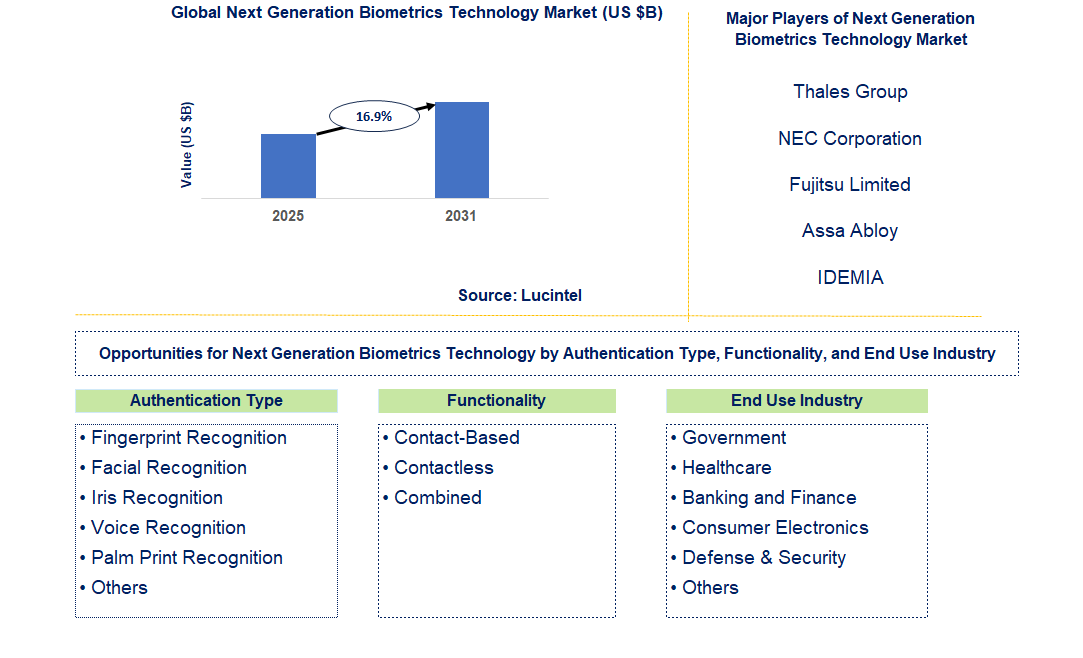
Key data points: The growth forecast = 16.9% annually for the next 7 years. Scroll below to get more insights. This market report covers Trends, opportunity and forecast in next generation biometrics technology market to 2031 by authentication type (fingerprint recognition, facial recognition, iris recognition, voice recognition, palm print recognition, and others), functionality (contact-based, contactless, and combined), end use industry (government, healthcare, banking and finance, consumer electronics, defense & security, and others), and region (North America, Europe, Asia Pacific, and the Rest of the World)
We'll send your sample report shortly.
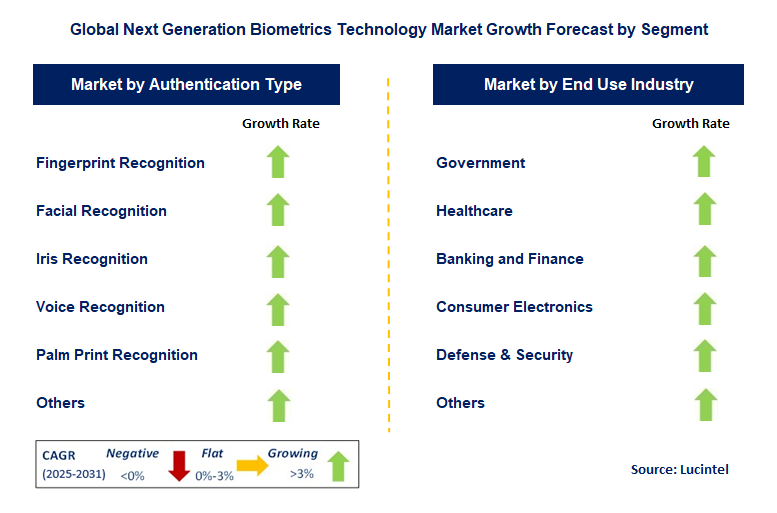
• Lucintel forecasts that, within the authentication type category, fingerprint recognition is expected to witness the highest growth over the forecast period.
• Within the end use industry category, the government is expected to witness the highest growth.
• In terms of region, APAC is expected to witness the highest growth over the forecast period. Gain valuable insights for your business decisions with our comprehensive 150+ page report. Sample figures with some insights are shown below.
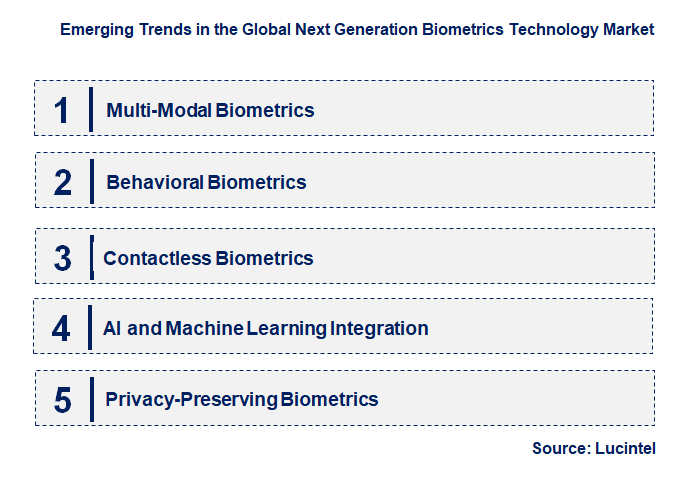
• Multi-Modal Biometrics: This means using two or more types of biometrics together, like face and iris scans, or fingerprints and voice. This makes the system much more accurate and secure because it covers the weaknesses of each individual method. If a face scan is bad because of lighting, the iris scan can still work. This is great for important things like border security and ID cards. It also stops people from tricking the system because it's way harder to fake multiple biometrics at once.
• Behavioral Biometrics: This looks at how you do things, like how you walk, talk, type, or move your mouse, to confirm who you are. Unlike regular biometrics, this constantly checks your behavior, so it's really good at spotting fraud in online banking and shopping. By seeing small changes in how fast you type, the rhythm, and how you move your mouse, the system can tell if someone else is using your account.
• Contactless Biometrics: This uses things like face recognition, iris scans, and voice recognition so you don't have to touch anything. Because of worries about germs and wanting things to be quick, this is becoming very popular. Face and iris scans are fast and easy without any touching, which is useful in busy places like airports. It also helps people with disabilities. COVID-19 made this even more important.
• AI and Machine Learning Integration: This uses AI to make biometric systems better at accuracy, speed, and changing to new situations. AI helps the systems learn from different biometric data and get more accurate over time. It also helps spot fake attempts and see patterns in behavioral biometrics. Plus, AI can process tons of information quickly, making real-time ID checks much faster.
• Privacy-Preserving Biometrics: This is about creating ways to protect people's privacy while still using biometrics effectively. This includes methods like homomorphic encryption and federated learning, which process biometric data without showing the actual data. This allows for secure checks while lowering the risk of data leaks and misuse. This is super important for getting people to trust and accept biometric technology. These trends are changing the next generation biometrics technology market by pushing new ideas in important areas. Multi-modal biometrics and AI are making things much more accurate and safe, while behavioral biometrics offer ongoing checks and better fraud findings. Contactless biometrics are making things easier and cleaner, and privacy-preserving methods are solving big data protection problems. These improvements are widening where we can use biometrics, making a market that is safer, easier to use, and more respectful of privacy.
• Advancements in 3D Facial Recognition: Moving beyond 2D images, 3D facial recognition uses depth sensors to create a detailed map of facial features. This enhances accuracy and spoofing resistance, as it's much harder to replicate a 3D model than a 2D image. This technology is being integrated into smartphones, border control systems, and access control solutions, offering improved security and convenience. Its impact includes reduced false positives and negatives, making it suitable for high-security applications.
• Rise of Voice and Speech Biometrics: Analyzing unique voice patterns and speech characteristics for authentication. This technology is increasingly used in call centers, voice assistants, and secure access systems. It offers a convenient and hands-free authentication method. Its impact includes improved customer service experiences, enhanced security for voice-activated devices, and accessibility for users with disabilities.
• Integration with Mobile Devices and IoT: Biometric authentication is becoming increasingly integrated into smartphones, wearables, and IoT devices. This enables secure access to personal data, mobile payments, and smart home systems. This trend is driven by the growing reliance on mobile devices and the increasing connectivity of IoT devices. Its impact includes enhanced security for personal data and transactions, seamless user experiences across devices, and new possibilities for smart home and IoT security.
• Focus on Liveness Detection: Develop sophisticated techniques to detect spoofing attempts, such as using printed photos or videos to impersonate someone. Liveness detection uses various methods, including analyzing skin texture, micro-movements, and blood flow. This is crucial for ensuring the integrity of biometric systems. Its impact includes increased trust in biometric authentication, reduced vulnerability to fraud, and improved security for sensitive applications.
• Development of Biometric Payment Systems: Integrating biometrics into payment systems for secure and convenient transactions. This includes using fingerprint, facial recognition, and other modalities for contactless payments. This trend is driven by the growth of digital payments and the demand for faster and more secure transaction methods. Its impact includes streamlined checkout processes, reduced fraud in payment transactions, and improved customer experiences. These developments are significantly impacting the next generation biometrics technology market by driving innovation and expanding its applications. Advancements in 3D facial recognition and voice biometrics are enhancing accuracy and user convenience. Integration with mobile devices and IoT is creating new opportunities for secure access and authentication. The focus on liveness detection is improving the reliability and trustworthiness of biometric systems. Finally, the development of biometric payment systems is transforming the way transactions are conducted. These trends are collectively shaping a market that is more secure, user-friendly, and integrated into everyday life.
• Government and Law Enforcement: Biometrics play a crucial role in border control, national ID programs, and criminal investigations. Advanced facial recognition, iris scanning, and DNA analysis are being deployed to enhance security and efficiency in these applications. This leads to improved border security, faster and more accurate identification of individuals, and more effective law enforcement operations.
• Banking, Financial Services, and Insurance (BFSI): Biometric authentication is being widely adopted in the BFSI sector for secure online banking, mobile payments, and fraud prevention. Fingerprint, facial recognition, and voice biometrics are used to verify customer identities and authorize transactions. This results in enhanced security for financial transactions, reduced fraud losses, and improved customer experience through convenient authentication methods.
• Healthcare: Biometrics are being used in healthcare for patient identification, secure access to medical records, and remote patient monitoring. Fingerprint, facial recognition, and iris scanning are used to ensure accurate patient identification and prevent medical errors. Wearable biometrics are also being used for continuous health monitoring. This leads to improved patient safety, enhanced data security, and more efficient healthcare delivery.
• Consumer Electronics: Biometric authentication is now commonplace in smartphones, laptops, and other consumer devices. Fingerprint, facial recognition, and voice biometrics are used for unlocking devices, authorizing app purchases, and securing personal data. This provides enhanced security for personal devices and data, as well as convenient and personalized user experiences.
• Travel and Immigration: Biometrics are increasingly used in airports and border crossings for automated border control and passenger processing. Facial recognition, iris scanning, and fingerprint biometrics are used to verify passenger identities and expedite immigration procedures. This leads to faster and more efficient border crossings, improved security, and enhanced passenger experience. These growth opportunities are significantly impacting the next generation biometrics technology market by driving innovation and expanding its reach. The increasing adoption of biometrics in government, BFSI, healthcare, consumer electronics, and travel is fueling market growth and attracting significant investment. These applications are driving the development of more accurate, secure, and user-friendly biometric solutions. This is leading to a market that is more diverse, competitive, and integrated into various aspects of everyday life.
• Thales Group
• NEC Corporation
• Fujitsu Limited
• Assa Abloy
• IDEMIA
• Precise Biometrics
• BIO-key International
• Cognitec Systems
• Fingerprint Cards
• Crossmatch Technologies
• Fingerprint Recognition
• Facial Recognition
• Iris Recognition
• Voice Recognition
• Palm Print Recognition
• Others
• Contact-based
• Contactless
• Combined
• North America
• Europe
• Asia Pacific
• The Rest of the World
• United States: The U.S. is a leader in biometric technology development, with significant investment from government agencies like the Department of Homeland Security and the FBI. Recent focus has been on improving accuracy and mitigating bias in facial recognition systems, alongside advancements in multi-modal biometrics for enhanced security in border control and national ID programs. There's also growing interest in behavioral biometrics for fraud prevention in the financial sector and the use of DNA analysis in law enforcement. The U.S. is also seeing increased adoption of biometrics in consumer electronics, with advanced fingerprint and facial recognition integrated into smartphones and laptops.
• China: China has rapidly adopted biometric technology, particularly in surveillance and public security applications. The country is investing heavily in facial recognition, iris scanning, and voice recognition technologies, deploying them on a large scale for citizen identification and monitoring. There's also significant research into gait analysis and other behavioral biometrics. While concerns about privacy and civil liberties exist, China's focus remains on leveraging biometrics for social management and enhanced security. The market is also driven by the rapid growth of digital payments and the need for secure authentication methods.
• Germany: Germany is characterized by a strong emphasis on data privacy and security, which influences its approach to biometrics. While facial recognition is used in some law enforcement applications, there's a greater focus on less intrusive methods like fingerprint and iris scanning for secure access control and border management. Germany is also actively researching and developing privacy-preserving biometric technologies, such as federated learning for biometric data processing. The focus is on balancing security needs with individual rights and data protection.
• India: The Indian Aadhaar program, a nationwide biometric identification system, has been a major driver for the adoption of biometrics. The program primarily relies on fingerprint and iris scanning and has facilitated various government services and financial inclusion initiatives. Recent developments include exploring the integration of facial recognition and other modalities into the Aadhaar ecosystem. There's also growing interest in using biometrics for digital payments and secure access control in various sectors. The focus is on leveraging biometrics to improve the efficiency and accessibility of public services.
• Japan: Japan is actively exploring the use of biometrics for various applications, including border control, national identification, and healthcare. There's a growing interest in facial recognition, fingerprint, and vein recognition technologies. The country is also focusing on developing contactless biometric solutions, especially in light of the COVID-19 pandemic. Japan is also exploring the use of biometrics for elderly care and other social services. The focus is on enhancing efficiency, security, and convenience in various sectors.


• Thales Group
• NEC Corporation
• Fujitsu Limited
• Assa Abloy
• IDEMIA
• Precise Biometrics
• BIO-key International
• Cognitec Systems
• Fingerprint Cards
• Crossmatch Technologies Q5. Which next generation biometrics technology market segment will be the largest in future? Answer: Lucintel forecasts that fingerprint recognition is expected to witness the highest growth over the forecast period. Q6. In next generation biometrics technology market, which region is expected to be the largest in next 5 years? Answer: APAC is expected to witness the highest growth over the forecast period. Q7. Do we receive customization in this report? Answer: Yes, Lucintel provides 10% customization without any additional cost.


Choose a license that fits your team. Instant PDF delivery.
Prices exclude taxes. Instant delivery. Custom licensing available on request.
Market Report · July 15, 2026
Market Report · June 26, 2026
Market Report · June 24, 2026
Trusted partner for strategic intelligence and business growth


Receive a complimentary market analysis tailored to your industry. Our analysts will identify key growth opportunities and competitive dynamics specific to your business.

Market size, growth rate, and key trend analysis for your specific sector.

Top competitor positioning and market share analysis.

Strategic recommendations backed by data-driven insights.
Get curated market intelligence and competitive moves straight to your inbox.
By subscribing, you agree to receive our monthly insights. Unsubscribe anytime.
Receive a complimentary market analysis tailored to your industry. Our analysts will identify key growth opportunities and competitive dynamics specific to your business.
Market size, growth rate, and key trend analysis for your specific sector.
Top competitor positioning and market share analysis.
Strategic recommendations backed by data-driven insights.
Get curated market intelligence, emerging trends, and competitive moves straight to your inbox each month.
By subscribing, you agree to receive our monthly insights. Unsubscribe anytime.
We'll send your sample report shortly.