
Market Report · July 22, 2026

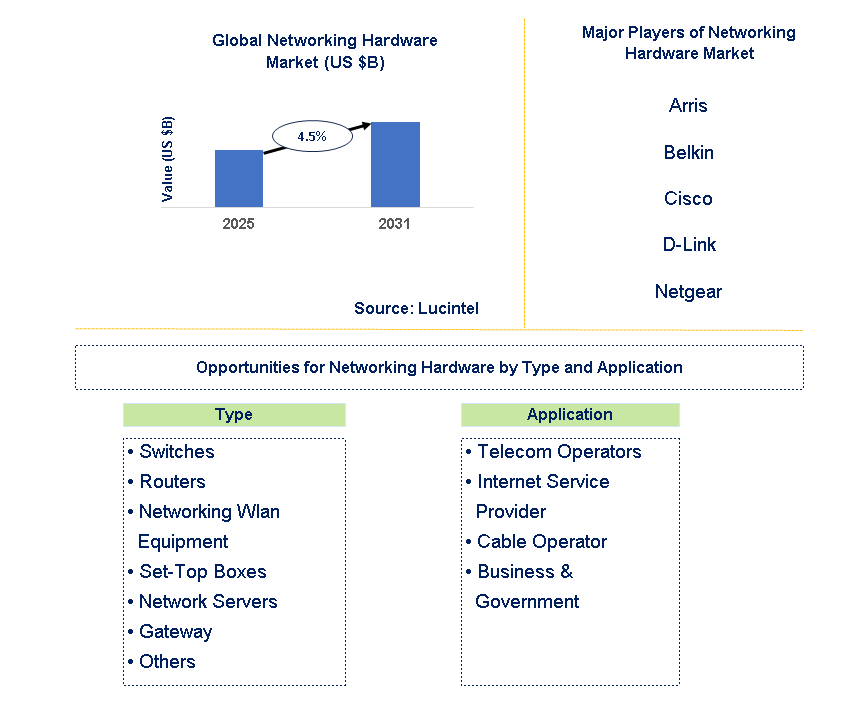
Key data points: The growth forecast = 4.5% annually for the next 7 years. Scroll below to get more insights. This market report covers Trends, opportunity and forecast in networking hardware market to 2031 by type (switches, routers, networking wlan equipment, set-top boxes, network servers, gateway, and others), application (telecom operators, internet service provider, cable operator, business & government, and personal user), and region (North America, Europe, Asia Pacific, and the Rest of the World)
We'll send your sample report shortly.
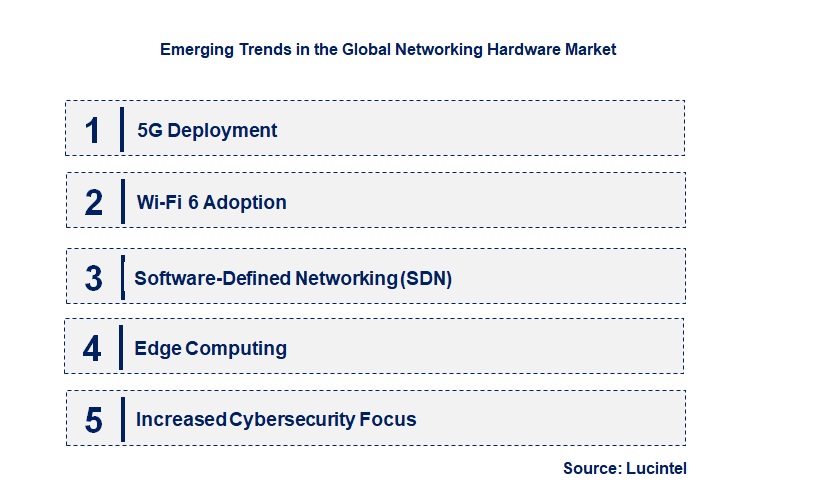
• 5G Deployment: This is among the most recent trends in networking hardware. 5G promises better speeds and latency, pushing demand for novel hardware solutions in a market already growing. Companies have taken the direction of developing new 5G-compatible devices, base stations, and antennas that are expected to handle increased connectivity between different industries and other businesses.
• Wi-Fi 6 Adoption: The adoption of Wi-Fi 6 technology is increasing since wireless connectivity is essential and becomes indispensable in most applications. Wi-Fi 6 provides faster speeds, greater capacity, and better performance in congested environments. Companies for networking hardware focus on making sure that these new devices, including routers and access points, meet high requirements for seamless, high-speed wireless connectivity.
• Software-Defined Networking (SDN): SDN is gaining momentum as companies are looking for more flexible and programmable networking solutions. This technology enables centralized control of networks, thus allowing for better resource utilization and easier management of complex networks. The shift towards SDN is creating an increased demand for hardware that supports this model, such as SDN-enabled switches and routers.
• Edge Computing: The need for real-time data processing is the primary driver for edge computing. It helps reduce latency and improves network efficiency by processing data closer to the source. Networking hardware manufacturers are investing in edge solutions that enable faster processing and lower reliance on centralized cloud data centers, which can lead to more efficient, scalable networks.
• Increased Cybersecurity Focus: The rise in data breaches and cyber-attacks has led to a growing demand for networking equipment that incorporates high security features. From hardware firewalls to intrusion detection systems, companies are focusing on developing secure networking solutions. This trend is pushing networking hardware companies to prioritize security in their product development to protect sensitive data. With the advent of 5G, Wi-Fi 6, SDN, edge computing, and cybersecurity, emerging trends are reshaping the networking hardware market. While these developments continue to push the boundaries of what companies can deliver and create a new demand for complex solutions, companies are compelled to innovate and keep pace with new technological and consumer requirements. This will ensure rapid changes in the market as these trends spread globally.
• 5G Infrastructure Investment: Significant investments in 5G infrastructure drive the networking hardware market. Network providers are installing new hardware, which includes base stations, antennas, and routers, to support faster speeds and lower latency promised by 5G technology. The expansion is supposed to accelerate global connectivity for industries like healthcare, automotive, and manufacturing that can utilize next-gen technologies.
• Wi-Fi 6 Expansion: Wi-Fi 6 technology has been widely expanding, especially with the increasing demand for wireless connectivity. The new generation of Wi-Fi technology provides faster speeds, better ranges, and greater capacities, making it suitable for crowded offices or public spaces. Hardware manufacturers are coming up with more Wi-Fi 6-enabled devices, such as routers, access points, or network adapters, to expand further into this increasing demand.
• SDN Solutions: Adoption of SDN has created a niche in more programmable, more flexible networks that are changing the rules and standards for the networking hardware market. This will allow businesses to centralize control over the network and improve its efficiency and scalability. The increasing complexity of modern network infrastructures will require more sophisticated hardware development for switches and routers compatible with SDN.
• Edge Computing Integration: The requirement for real-time data processing is driving the growth of edge computing solutions. Companies are integrating edge computing capabilities into networking hardware to process data closer to its source, reducing latency and increasing overall efficiency. This is particularly important for applications such as IoT, autonomous vehicles, and smart cities, which rely on quick data processing.
• Cybersecurity Hardware Solutions: The more the threats of cyberattacks, the more the companies are concerned about the development of secure networking hardware. This includes products with built-in encryption, firewalls, and advanced intrusion detection systems. The demand for cybersecurity hardware will increase as businesses seek to protect sensitive data from breaches and ensure the integrity of their networks. In fact, recent changes in the market, including the launch of 5G, Wi-Fi 6 expansion, and cybersecurity trends, are transforming the landscape. In turn, with further acceleration in technological advancement, networking hardware companies are introducing increasingly complex, secure, and efficient solutions that better serve businesses and consumers.
• Consumer Connectivity: Consumers want higher and faster speeds of the internet. In a wireless technology space, there are various ways this will evolve and advance with 5G. There will be many networking hardware opportunities here. High-speed internet, Wi-Fi 6, and 5G connectivity can enable seamless and reliable streaming, gaming, and smart home devices.
• Business Networks and SDN: Networking hardware companies stand to benefit immensely from the software-defined networking revolution. SDN makes it easier for businesses to develop flexible, scalable networks with low cost and high efficiency in management. Organizations increasingly look for compatible SDN devices like switches and routers that would make the network operate with improved operational efficiency and help scale growth.
• Telecommunications Infrastructure: The largest growth driver for the networking hardware market is the telecommunication sector, which is investing significantly in 5G and fiber-optic infrastructure. Networking hardware companies can take advantage of this expansion by offering high-performance hardware solutions that facilitate faster, more reliable communication networks for consumers and businesses.
• Internet of Things (IoT): As the IoT market grows, there is a need for networking hardware that can handle the massive volume of connected devices. Opportunities exist in developing specialized hardware to support IoT networks, including routers, gateways, and sensors that ensure fast, secure, and reliable communication between devices.
• Cloud Computing: Cloud computing is an opportunity for networking hardware companies as the companies are moving towards the cloud to store data and offer services. High-performance networking hardware is critical for ensuring speed and reliability in cloud networks. The trend can be exploited by manufacturers to develop hardware solutions that can support the increasing demand for cloud services. Networking hardware market is offering a large number of strategic growth opportunities, primarily in the consumer, business, telecommunications, IoT, and cloud computing segments. Innovating companies and those that could fulfill the ever-changing needs of these industries by SDN, 5G, and IoT solutions are very likely to do well in this fast-changing market.
• Arris
• Belkin
• Cisco
• D-Link
• Netgear
• Switches
• Routers
• Networking Wlan Equipment
• Set-Top Boxes
• Network Servers
• Gateway
• Others
• Telecom Operators
• Internet Service Provider
• Cable Operator
• Business & Government
• Personal User
• North America
• Europe
• Asia Pacific
• The Rest of the World
• United States: It is the hub of innovation where great leaps in networking hardware have been seen. The main factors driving this are increased demand for faster internet speeds, greater connectivity, and innovation in 5G, Wi-Fi 6, and software-defined networking (SDN). Companies are focusing on upgrading infrastructure to support increased data traffic from cloud services, AI, and the Internet of Things.
• China: China is investing heavily in next-gen networking infrastructure, especially in the deployment of 5G networks. The country is at the forefront of developing low-cost networking hardware, which will expand connectivity in rural and remote areas. China is also focusing on the development of 6G technology, which will set the stage for future networking hardware innovations.
• Germany: Networking hardware market in Germany is driven by a strong industrial base and demand for high-performance solutions. The focus will be on the integration of networking hardware with Industry 4.0, which requires robust, secure, and high-speed connections. There will be a drive for greater automation in networking and a move to next-generation wireless technologies like 5G for industrial applications.
• India: India's networking hardware market is booming, backed by the increasing penetration of the internet and the growth of digitally enabled services. With regards to 5G adoption by the country, there is a great demand for cheap networking hardware which can support this growing consumption of data. The diversification of the Indian tech sector into expansion is also leading to more locally produced hardware.
• Japan: Japan is putting emphasis on 5G infrastructure by promoting various hardware manufacturing companies to gain momentum on the newly formed wireless technology. Smart city initiatives in the country are also investments on advanced networking hardware to help IoT deployments, and the country's already robust tech sector continues using AI and cloud computing innovations to enhance networking capabilities.


• Arris
• Belkin
• Cisco
• D-Link
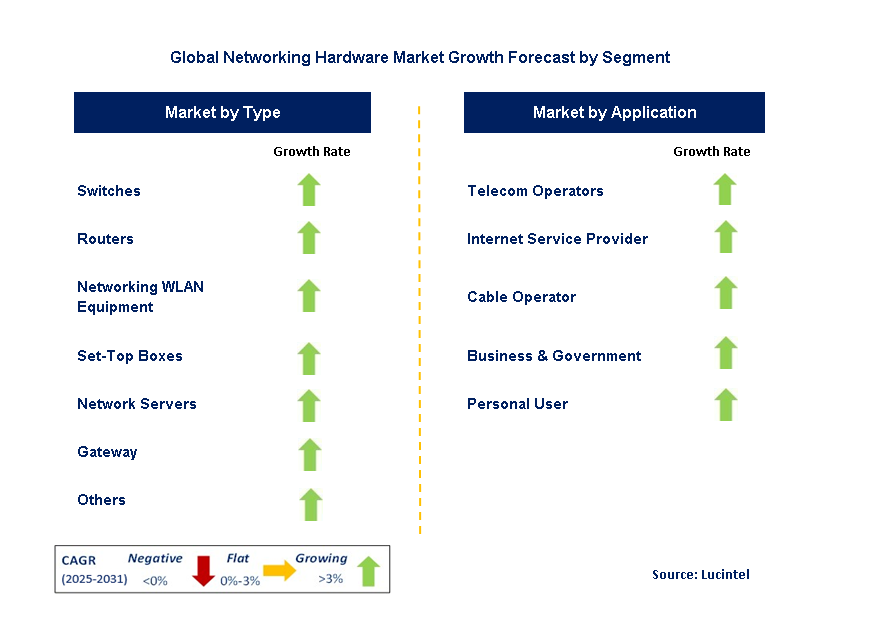
• Netgear Q5. Which networking hardware market segment will be the largest in future? Answer: Lucintel forecasts that switch is expected to witness higher growth over the forecast period. Q6. In networking hardware market, which region is expected to be the largest in next 5 years? Answer: APAC is expected to witness the highest growth over the forecast period. Q7. Do we receive customization in this report? Answer: Yes, Lucintel provides 10% customization without any additional cost.


Choose a license that fits your team. Instant PDF delivery.
Prices exclude taxes. Instant delivery. Custom licensing available on request.
Market Report · July 22, 2026
Market Report · July 17, 2026
Market Report · July 17, 2026
Trusted partner for strategic intelligence and business growth


Receive a complimentary market analysis tailored to your industry. Our analysts will identify key growth opportunities and competitive dynamics specific to your business.

Market size, growth rate, and key trend analysis for your specific sector.

Top competitor positioning and market share analysis.

Strategic recommendations backed by data-driven insights.
Get curated market intelligence and competitive moves straight to your inbox.
By subscribing, you agree to receive our monthly insights. Unsubscribe anytime.
Receive a complimentary market analysis tailored to your industry. Our analysts will identify key growth opportunities and competitive dynamics specific to your business.
Market size, growth rate, and key trend analysis for your specific sector.
Top competitor positioning and market share analysis.
Strategic recommendations backed by data-driven insights.
Get curated market intelligence, emerging trends, and competitive moves straight to your inbox each month.
By subscribing, you agree to receive our monthly insights. Unsubscribe anytime.
We'll send your sample report shortly.