
Market Report · July 29, 2026

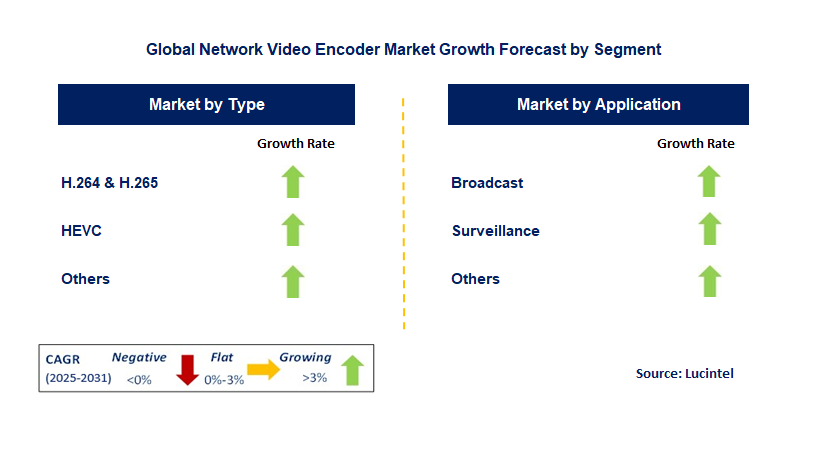
Key data points: The growth forecast = 7.2% annually for the next 7 years. Scroll below to get more insights. This market report covers Trends, opportunity and forecast in network video encoder market to 2031 by type (h.264 & h.265, HEVC, and others), application (broadcast, surveillance, and others), and region (North America, Europe, Asia Pacific, and the Rest of the World)
We'll send your sample report shortly.
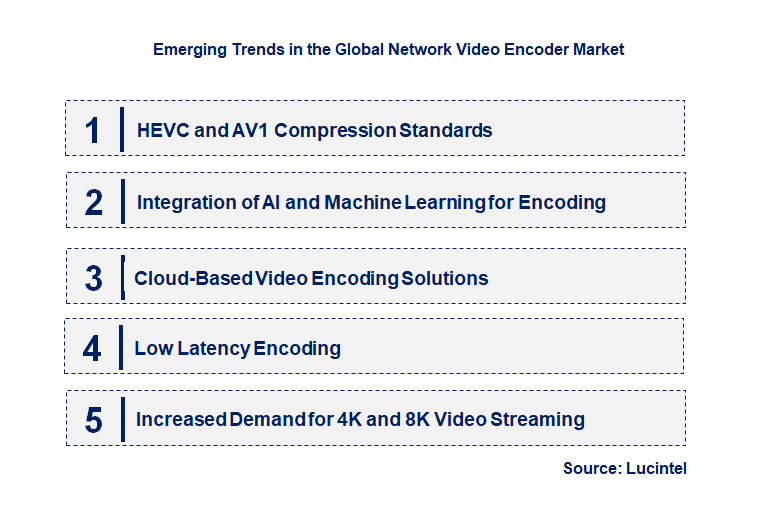
• HEVC and AV1 Compression Standards: HEVC (High-Efficiency Video Coding) and AV1 (A Media Video 1) compression standards are revolutionizing the video encoding landscape. It is enabling greater compression efficiency and reduced bandwidth use while improving video quality. Consumers demanding higher resolution videos, such as 4K and 8K, mean that video encoding solutions have to be optimized in order to efficiently stream and broadcast services.
• Integration of AI and Machine Learning for Encoding Optimization: AI and machine learning are becoming integral to video encoding technology. These advanced technologies help optimize encoding settings based on real-time data, ensuring that video quality is maintained while reducing the required bandwidth. AI-driven solutions are being used to automatically adjust encoding parameters, improving efficiency and delivering a better end-user experience, especially for live-streaming applications.
• Cloud-Based Video Encoding Solutions: Cloud-based video encoding fast becomes popular as it has enabled scalability, flexibility, and saving on cost comparatively with traditional on-premises hardware-based solutions. Cloud-based encoding lets businesses scale their operations without the need for large capital expenditure on infrastructure. With the growth of OTT platforms and cloud video services, this trend is reshaping how video content is encoded and distributed.
• Low Latency Encoding: In order to enable the streaming of video in real-time, low latency encoding is needed. It would be essential in the near future as the demands of the end-user increase in getting near-instant video delivery. This trend, however, poses a significant impact on network video encoders. In such applications, where there's an esports competition or live broadcast, even minor latency would impact viewer experience drastically.
• Increased Demand for 4K and 8K Video Streaming: As consumer demand for higher-quality video content grows, 4K and 8K video encoding is becoming a focal point for network video encoder manufacturers. These formats require significantly higher data rates, pushing the need for more efficient and powerful encoders that can handle the increased demand for resolution and frame rates. This trend is remolding the encoder market as it pushes the development of more advanced video compression technologies. The emerging trends are reshaping the network video encoder market by pushing the boundaries of video quality, efficiency, and scalability. With increasing demand for high-quality video content, these trends will drive further innovation in the video encoding industry.
• High Support for 4K and 8K Content: With the growth of 4K and 8K content demands, video encoders are advanced to handle data throughput required to support these new formats. Newly designed encoders are high resolutions to meet expectations of video quality in streaming and broadcasting applications that will be met with modern consumers' requirements.
• Improved Compression Technologies: More efficient video compression technologies like HEVC and AV1 have greatly improved the video encoding process. These technologies significantly reduce the bandwidth required for the streaming of high-quality video. This allows service providers to offer better services to consumers while keeping the operational costs down.
• Integration with Cloud Infrastructure: Cloud-based video encoding solutions are also receiving traction as businesses seek more scalable flexible options. Companies can also cut down infrastructure cost if they shift video encoding processes to the cloud. Scaling up operations is flexible due to this development on video content encoding.
• Live Video Encoding and Processing for Live Streaming: Real-time video encoding and processing demand has increased sharply, especially for live events such as sports or concerts. Advanced video encoding technology can now provide near-instant video delivery with minimal latency in live-streamed content to deliver a better experience to viewers.
• Distributed Video Encoding through Edge Computing: With edge computing, the video encoding at the edge of the network improves the efficiency and speed of video delivery, particularly in remote or underserved areas. It reduces latency by processing video at the edge of the network instead of relying on centralized data centers, thereby optimizing bandwidth consumption. These developments would be leading changes in the network video encoder market: they enable greater quality, scalability, and cost efficiency with video delivery. As the industry continues to advance, so will these innovative solutions play out to determine a new course in video streaming and broadcasting as well as surveillance.
• Over-the-Top (OTT) Video Streaming Services: OTT platforms, such as Netflix, Amazon Prime, and Hulu, are driving significant growth in the video encoding market. These platforms require efficient encoding technologies to handle a massive volume of video content and deliver high-quality video to users across multiple devices. The growing popularity of these platforms ensures continued demand for advanced video encoders.
• Broadcasting and Media Production: More broadcasting companies are opting for network video encoders to provide the best content in the market. In a bid to satisfy the demands of 4K and 8K content from broadcasters, there is a growth in the use of video encoders that support these formats. This application remains a great growth opportunity due to the increase in demand for live sports, news, and entertainment content.
• Surveillance Systems and Security Applications: With the increasing installation of surveillance cameras and security systems, the demand for video encoding solutions that can efficiently process and transmit high-quality video feeds is growing. This market segment is likely to grow with the increasing video surveillance integration with smart city initiatives and advanced security systems.
• Cloud Video Services: As the popularity of cloud computing grows, the cloud video encoding services have been widely accepted. This has opened doors for the provision of flexibility and scalability at affordable prices. In a bid to expand video encoding without spending on an infrastructure of high magnitude on premises, this becomes the fastest growing sector in the market.
• Video Conferencing and Remote Communication: This increased need for working remotely and communicating virtually has required better quality video conferencing, which is characterized by low latency. Network video encoders are fundamental to ensuring seamless video transmission for virtual meetings, webinars, and remote collaboration. This market segment is growing very fast as the demand for video communication tools by organizations continues. The network video encoder market is in the process of shaping its future by presenting more efficient, high-quality, and scalable video delivery for different industries. As the applications are getting video-centric in nature, then video encoding technologies will only see increased demand.
• Hikvision
• Cisco Systems
• VITEC
• Dahua
• Axis Communications
• Harmonic
• Flir Systems
• H.264 & H.265
• HEVC
• Others
• Broadcast
• Surveillance
• Others
• North America
• Europe
• Asia Pacific
• The Rest of the World
• United States: United States is one of the countries that still dominated the network video encoder market and will continue to have a significant presence of technology companies like Cisco, Harmonic, and Tele stream. Innovations would include high-efficiency video coding (HEVC) for higher compression and higher-quality video. Growth in the live streaming services area, such as OTT, is also pushing for advanced video encoding solutions to match the increasing demands in video content delivery.
• China: The video encoder market in China is expanding rapidly due to its very large number of internet users and sharply rising penetration of digital video streaming services. Chinese companies such as Huawei and Xiaomi are advancing their encoder offers for IPTV and 5G networks to give better quality and streaming efficiency. Online video platforms have become a key driver in accelerating the demand for network video encoders, particularly those capable of handling 4K content and beyond.
• Germany: The standard established in Germany is very high in terms of broadcast and media production. So, reflecting the network video encoder market, some of the companies are Rohde & Schwarz and Lawo. The focus of both of these companies has been in high-definition video encoding solutions for broadcast applications. German companies are producing advanced encoders, with HEVC, to enable efficient delivery and optimal video performance, as the demand for live sports streaming and high-quality video content continues to rise.
• India: In India, the network video encoder market is growing rapidly due to the increasing adoption of OTT platforms, mobile video streaming, and video surveillance applications. Indian companies such as Tata Communications and Bharti Airtel are adopting advanced video encoding technologies to support 5G infrastructure and enhance video streaming quality. Moreover, the demand for cost-effective video encoding solutions in the broadcasting and entertainment sectors is contributing to market growth in India.
• Japan: Japan has witnessed strong adoption of advanced video encoding technologies because of the rapid growth of digital entertainment and e-commerce platforms. Companies like Sony and Panasonic are enhancing their video encoding solutions to support high-quality video streaming, especially for sports and live events. As Japan also leads in 5G implementation, the demand for ultra-high-definition video content and low-latency streaming solutions continues to grow, further boosting the demand for advanced network video encoders.


• Hikvision
• Cisco Systems
• VITEC
• Dahua
• Axis Communications
• Harmonic
• Flir Systems Q5. Which network video encoder market segment will be the largest in future? Answer: Lucintel forecasts that, within the type category, h.264 & h.265 is expected to witness higher growth over the forecast period due to the widespread adoption, superior compression efficiency, and high-quality video delivery. Q6. In network video encoder market, which region is expected to be the largest in next 5 years? Answer: In terms of region, North America is expected to witness the highest growth over the forecast period. Q7. Do we receive customization in this report? Answer: Yes, Lucintel provides 10% customization without any additional cost.


Choose a license that fits your team. Instant PDF delivery.
Prices exclude taxes. Instant delivery. Custom licensing available on request.
Market Report · July 29, 2026
Market Report · July 20, 2026
Market Report · July 20, 2026
Trusted partner for strategic intelligence and business growth


Receive a complimentary market analysis tailored to your industry. Our analysts will identify key growth opportunities and competitive dynamics specific to your business.

Market size, growth rate, and key trend analysis for your specific sector.

Top competitor positioning and market share analysis.

Strategic recommendations backed by data-driven insights.
Get curated market intelligence and competitive moves straight to your inbox.
By subscribing, you agree to receive our monthly insights. Unsubscribe anytime.
Receive a complimentary market analysis tailored to your industry. Our analysts will identify key growth opportunities and competitive dynamics specific to your business.
Market size, growth rate, and key trend analysis for your specific sector.
Top competitor positioning and market share analysis.
Strategic recommendations backed by data-driven insights.
Get curated market intelligence, emerging trends, and competitive moves straight to your inbox each month.
By subscribing, you agree to receive our monthly insights. Unsubscribe anytime.
We'll send your sample report shortly.