
Market Report · July 29, 2026

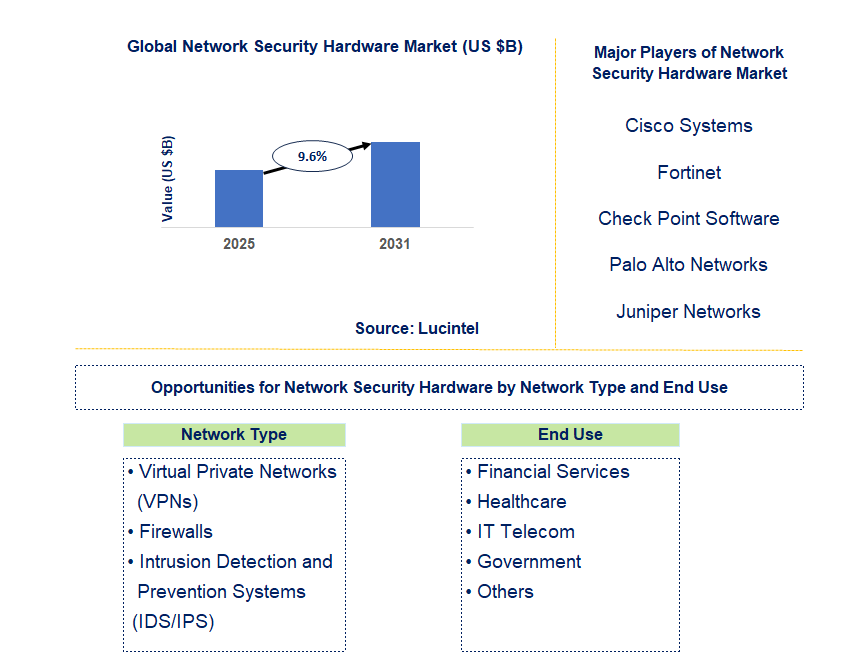
Key data points: The growth forecast = 9.6% annually for the next 7 years. Scroll below to get more insights. This market report covers Trends, opportunity and forecast in network security hardware market to 2031 by network type (virtual private networks (VPNs), firewalls, and intrusion detection and prevention systems (ids/ips)), end use (financial services, healthcare, it telecom, government, and others), and region (North America, Europe, Asia Pacific, and the Rest of the World)
We'll send your sample report shortly.
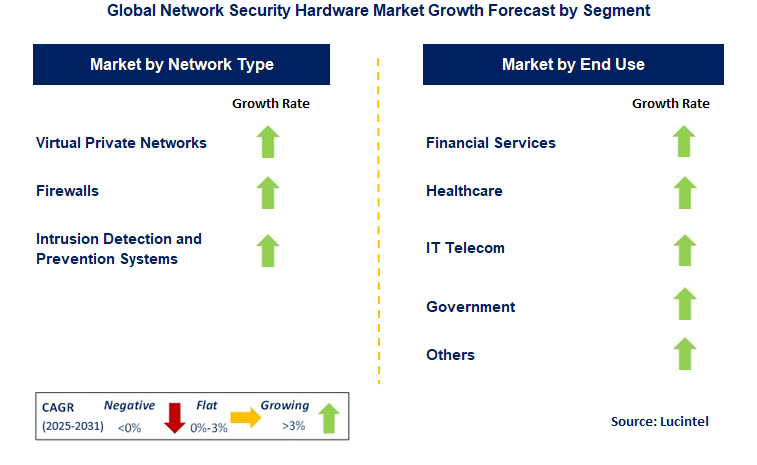
• Lucintel forecasts that, within the network type category, the virtual private network is expected to witness the highest growth over the forecast period.
• Within the end use category, financial service is expected to witness the highest growth.
• In terms of region, APAC is expected to witness the highest growth over the forecast period. Gain valuable insights for your business decisions with our comprehensive 150+ page report. Sample figures with some insights are shown below.
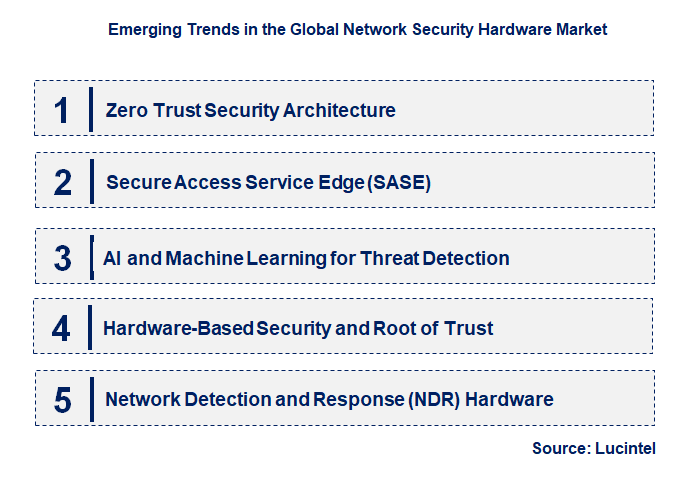
• Zero Trust Security Architecture: The adoption of Zero Trust security is a major trend. This security model assumes no implicit trust within or outside the network perimeter and requires verification for every access attempt. This impacts hardware by driving demand for solutions that support micro-segmentation, multi-factor authentication, and continuous monitoring. This enhances security posture by minimizing the impact of breaches.
• Secure Access Service Edge (SASE): SASE is converging network security functions (firewall, SWG, CASB, ZTNA) into a cloud-delivered service. This impacts hardware by shifting some security functions to the cloud, but also creates demand for edge devices that can connect securely to the SASE cloud and enforce security policies at the edge. This simplifies network security management for distributed workforces.
• AI and Machine Learning for Threat Detection: The use of AI and machine learning for threat detection and response is rapidly growing. This impacts hardware by driving demand for appliances with dedicated AI processing capabilities, such as GPUs and FPGAs. This enhances threat detection accuracy, automates incident response, and improves overall security posture by identifying and responding to threats more effectively.
• Hardware-Based Security and Root of Trust: There's a growing emphasis on hardware-based security features and root of trust mechanisms. This impacts hardware by requiring secure boot processes, hardware-backed encryption, and tamper-proof hardware designs. This provides a more robust and trustworthy security foundation, protecting against firmware attacks and other hardware-level threats.
• Network Detection and Response (NDR) Hardware: NDR solutions analyze network traffic to detect and respond to threats. This impacts hardware by creating demand for network visibility appliances that can capture and analyze network traffic at high speeds. This improves threat detection capabilities by identifying anomalous network behavior and malicious activity. These trends are significantly reshaping the network security hardware market by driving the adoption of more integrated, automated, and intelligent security solutions. The focus is shifting towards cloud-delivered security services, AI-powered threat detection, and hardware-based security features. This evolution is crucial for organizations to effectively protect their networks and data in the face of increasingly sophisticated cyber threats.
• XDR (Extended Detection and Response) Integration: XDR solutions correlate security data from various sources (endpoints, network, cloud) to provide a holistic view of threats. This impacts hardware by driving demand for appliances that can integrate with XDR platforms and provide rich network telemetry. This enhances threat visibility, improves detection accuracy, and enables faster incident response.
• Hardware Acceleration for Security Functions: Hardware acceleration is becoming more prevalent in handling increasing network traffic and complex security processing. This includes using FPGAs, ASICs, and specialized processors for tasks like encryption, deep packet inspection, and AI-based threat detection. This improves the performance and scalability of security appliances, enabling them to handle demanding workloads without impacting network performance.
• Zero Trust Network Access (ZTNA) Enforcement at the Edge: ZTNA enforces granular access control based on user identity, device posture, and context. This impacts hardware by driving demand for edge devices that can enforce ZTNA policies at the network perimeter or within micro-segmented networks. This enhances security by minimizing the attack surface and preventing unauthorized access to sensitive resources.
• Cloud-Native Security Hardware: As organizations migrate more workloads to the cloud, there's a growing need for security hardware designed for cloud environments. This includes virtual firewalls, cloud-native network security gateways, and other cloud-optimized security appliances. This enables consistent security policies and enforcement across on-premises and cloud infrastructure.
• Embedded Security in Network Infrastructure: Security features are increasingly being embedded directly into network infrastructure hardware, such as switches and routers. This includes hardware-based encryption, secure boot processes, and other security mechanisms. This provides a more robust and pervasive security posture by integrating security directly into the network fabric. These developments significantly impact the network security hardware market by driving the adoption of more integrated, automated, and intelligent security solutions. The focus is shifting toward comprehensive threat detection and response, hardware-accelerated security functions, and cloud-native security architectures. This evolution is crucial for organizations to effectively protect their networks and data in the face of increasingly sophisticated and pervasive cyber threats.
• Securing Cloud and Hybrid Cloud Environments: The increasing adoption of cloud computing and hybrid cloud architectures presents a significant growth opportunity. This requires cloud-native security hardware, virtual firewalls, cloud security posture management (CSPM) tools, and secure cloud access gateways. This drives demand for solutions that can seamlessly integrate with cloud environments, provide consistent security policies across on-premises and cloud infrastructure, and protect against cloud-specific threats.
• Protecting IoT and Industrial IoT (IIoT) Devices: The proliferation of IoT and IIoT devices expands the attack surface and creates new security challenges. This requires specialized security hardware designed for resource-constrained devices and industrial environments. This drives demand for lightweight firewalls, intrusion detection systems, and secure gateways that can protect IoT and IIoT devices from cyberattacks and ensure data integrity.
• Enabling Secure Remote Work and Zero Trust Access: The rise of remote work and the adoption of Zero Trust security models are driving demand for secure remote access solutions. This requires hardware that can enforce granular access control, provide multi-factor authentication, and support secure VPN connections. This drives demand for ZTNA appliances, secure SD-WAN gateways, and other solutions that can secure remote access to corporate resources.
• Enhancing Security for Small and Medium-Sized Businesses (SMBs): SMBs are increasingly becoming targets for cyberattacks, but often lack the resources and expertise to implement robust security measures. This creates opportunities for cost-effective and easy-to-manage security hardware designed specifically for SMBs. This drives demand for simplified firewalls, unified threat management (UTM) appliances, and cloud-managed security solutions.
• Supporting Network Detection and Response (NDR) and Security Analytics: The need for advanced threat detection and response capabilities is driving demand for hardware that can support NDR and security analytics solutions. This requires network visibility appliances that can capture and analyze network traffic, as well as hardware optimized for AI-based threat detection. This drives demand for high-performance network sensors, network traffic recorders, and security analytics platforms. These strategic growth opportunities are significantly impacting the network security hardware market by driving specialization and innovation. Vendors are focusing on developing tailored solutions for specific application needs, leading to a more diverse and competitive market. The emphasis is on cloud security, IoT security, secure remote access, SMB-focused solutions, and advanced threat detection and response capabilities. This application-driven approach is shaping the future of network security and enabling organizations to better protect themselves against evolving cyber threats.
• Cisco Systems
• Fortinet
• Check Point Software Technologies
• Palo Alto Networks
• Juniper Networks
• Huawei Technologies
• Dell EMC
• Trend Micro
• IBM Security
• Symantec
• Virtual Private Networks (VPNs)
• Firewalls
• Intrusion Detection and Prevention Systems (IDS/IPS)
• Financial Services
• Healthcare
• IT Telecom
• Government
• Others
• North America
• Europe
• Asia Pacific
• The Rest of the World
• United States: The US market is characterized by high adoption of advanced security technologies and a strong focus on zero trust security architectures. Key developments include advancements in next-generation firewalls (NGFWs) with deep packet inspection and intrusion prevention capabilities, increasing adoption of secure access service edge (SASE) solutions for secure remote access, and growing use of AI-powered threat detection and response platforms. There's also a strong emphasis on regulatory compliance and data privacy.
• China: The Chinese market is experiencing rapid growth, driven by government initiatives to strengthen cybersecurity and protect critical infrastructure. Key developments include increasing domestic production of security hardware and software, a focus on securing industrial control systems and critical infrastructure, and the development of advanced threat intelligence platforms. There's also a strong emphasis on data sovereignty and compliance with domestic cybersecurity regulations.
• Germany: The German market is characterized by a strong emphasis on data privacy, security, and compliance with strict European regulations like GDPR. Key developments include the adoption of advanced firewalls and intrusion prevention systems for protecting sensitive data, increasing use of secure communication protocols and encryption technologies, and a focus on security solutions for industrial automation and Industry 4.0.
• India: The Indian market is growing rapidly, driven by increasing digitalization and rising cyber threats. Key developments include growing adoption of firewalls, intrusion detection systems, and other security appliances by businesses of all sizes, increasing awareness of cybersecurity risks among organizations, and government initiatives to promote cybersecurity awareness and best practices.
• Japan: The Japanese market is characterized by a focus on high reliability, quality, and advanced security technologies. Key developments include the adoption of advanced threat detection and prevention systems, increasing use of AI-powered security analytics, and a focus on protecting critical infrastructure and sensitive data. There's also a strong emphasis on collaboration between government, industry, and academia to enhance cybersecurity.


• Cisco Systems
• Fortinet
• Check Point Software Technologies
• Palo Alto Networks
• Juniper Networks
• Huawei Technologies
• Dell EMC
• Trend Micro
• IBM Security
• Symantec Q5. Which network security hardware market segment will be the largest in future? Answer: Lucintel forecasts that the virtual private network is expected to witness the highest growth over the forecast period. Q6. In network security hardware market, which region is expected to be the largest in next 5 years? Answer: APAC is expected to witness the highest growth over the forecast period. Q7. Do we receive customization in this report? Answer: Yes, Lucintel provides 10% customization without any additional cost.


Choose a license that fits your team. Instant PDF delivery.
Prices exclude taxes. Instant delivery. Custom licensing available on request.
Market Report · July 29, 2026
Market Report · July 20, 2026
Market Report · July 20, 2026
Trusted partner for strategic intelligence and business growth


Receive a complimentary market analysis tailored to your industry. Our analysts will identify key growth opportunities and competitive dynamics specific to your business.

Market size, growth rate, and key trend analysis for your specific sector.

Top competitor positioning and market share analysis.

Strategic recommendations backed by data-driven insights.
Get curated market intelligence and competitive moves straight to your inbox.
By subscribing, you agree to receive our monthly insights. Unsubscribe anytime.
Receive a complimentary market analysis tailored to your industry. Our analysts will identify key growth opportunities and competitive dynamics specific to your business.
Market size, growth rate, and key trend analysis for your specific sector.
Top competitor positioning and market share analysis.
Strategic recommendations backed by data-driven insights.
Get curated market intelligence, emerging trends, and competitive moves straight to your inbox each month.
By subscribing, you agree to receive our monthly insights. Unsubscribe anytime.
We'll send your sample report shortly.