
Market Report · May 16, 2026

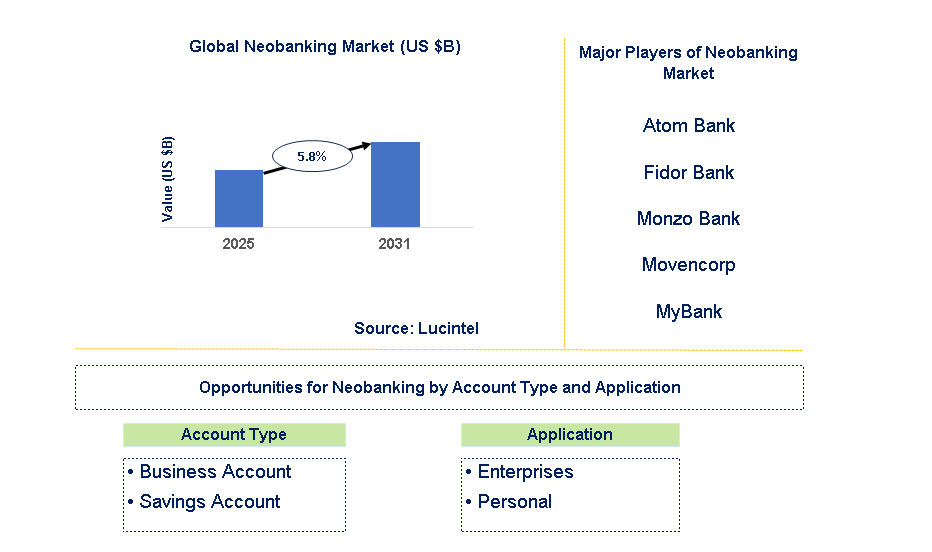
Key data points: The growth forecast = 5.8% annually for the next 7 years. Scroll below to get more insights. This market report covers trends, opportunities and forecasts in neobanking market to 2031 by account type (business account and savings account), application (enterprises and personal), and region (North America, Europe, Asia Pacific, and the Rest of the World)
We'll send your sample report shortly.
• Lucintel forecasts that, within the account type category, saving account is expected to witness higher growth over the forecast period.
• Within the application category, personal is expected to witness higher growth.
• In terms of region, APAC is expected to witness the highest growth over the forecast period. Gain valuable insights for your business decisions with our comprehensive 150+ page report. Sample figures with some insights are shown below.

• Embedded Finance and Banking-as-a-Service: Neobanks are increasingly extending their infrastructure and services to non-financial companies via APIs, allowing these businesses to embed financial products into their own products, generating new streams of revenue, and extending the reach of neobanking services. The integration makes the financial services more contextual and seamless.
• Hyper-Personalization and AI-Driven Insights: By using artificial intelligence and machine learning, neobanks are providing more personalized financial guidance, budgeting capabilities, and product suggestions based on users' own conduct and money goals, increasing customer interest and value. It is through this custom approach that they build better customer relationships.
• Focus on Sustainable and Ethical Banking: Increasingly, a section of neobanks is focusing on sustainability and ethics, providing choices such as tracking carbon footprint, investment in green projects, and open lending, appealing to green and socially aware consumers. This strikes a chord with an increasingly values-driven consumer base.
• Expansion into Cryptocurrency and Investment Services: Neobanks are adding cryptocurrency trading, investment platforms, and other wealth management services to their feature set, satisfying a wider range of financial demands and drawing customers seeking comprehensive financial solutions in a single platform. This diversification makes them more attractive as an initial financial home.
• Building Communities and Social Banking Features: Certain neobanks are creating a sense of community among their customers through social features such as shared accounts, peer-to-peer payments, and forums, with the aim of creating stronger customer loyalty and network effects. This social aspect distinguishes them from conventional banks. These trends are all combined to transform the neobanking market towards more integrated, personalized, sustainable, and community-oriented financial services, disrupting the conventional banking model and opening up new opportunities for growth and innovation.

• Shift Towards Profitability and Sustainable Business Models: Following a phase of aggressive user acquisition, most neobanks are now focusing on profitability through initiatives such as launching premium accounts, growing lending portfolios, and providing value-added services to their user base.
• Greater Emphasis on Regulatory Compliance and Licensing: As neobanks grow up and manage more customer money, there is greater pressure to obtain full banking licenses and comply with more stringent regulatory requirements across different jurisdictions.
• Enlargement of Product Offerings Beyond Fundamental Banking: Neobanks are expanding their products beyond current accounts and payment services to incorporate offerings such as lending (mortgages, personal loans), insurance, and investment products in order to emerge as complete financial platforms.
• Increasing Tie-Ups and Collaborations with Traditional Banks: Neobanks, being aware of the core competencies of traditional banks in regulatory affairs as well as developed infrastructure, are more frequently collaborating with traditional banks to augment their outreach and capabilities.
• Greater Regulation and Market Consolidation: With the maturation of the neobanking market, there is more scrutiny of their business models and the possibility of consolidation since some are unable to become profitable and scale up. The trends are shaping the neobanking market into one that is more mature, regulated, and offering a wider array of services, marking a shift from upstart disruptors to more entrenched players in the financial services segment.
• Serving Unbanked and Underbanked Customer Segments: Neobanks can penetrate the extensive unbanked and underbanked segments all over the world by providing affordable and accessible digital financial services, especially in countries with high mobile penetrance in the emerging economies.
• Offering Customized Solutions for Freelancers and SMEs: Small and medium-sized businesses (SMEs) and the increasing freelance population tend to struggle with mainstream banking. Neobanks can provide customized accounts, payment solutions, and financial management systems specific to their individual requirements.
• Merging Financial Services with E-commerce and Gig Economy Platforms: Integrating banking services into e-commerce platforms and the gig economy can provide frictionless financial experiences for merchants and workers, fueling user acquisition and engagement.
• Providing Niche Banking Services to Specific Communities: Creating neobanks targeting specific communities, like students, immigrants, or interest groups, with customized products and features can build deep loyalty and fill unmet needs.
• Using Open Banking APIs to Enhance Product Offerings: By integrating open banking APIs with other financial service providers, neobanks can provide a broader set of products and services, making the overall financial ecosystem more holistic and customized for customers. These strategic growth prospects point to the potential for neobanks to serve underserved markets, integrate into developing digital economies, and utilize open banking to build innovative and customer-focused financial products.
• Atom Bank
• Fidor Bank
• Monzo Bank
• Movencorp
• MyBank
• N26
• Revolut
• Simple Finance Technology Corporation
• Ubank Limited
• WeBank
• Business Account
• Savings Account
• Enterprises
• Personal
• North America
• Europe
• Asia Pacific
• The Rest of the World
• United States: Emphasis on profitability and niche market penetration. Recent trends have seen neobanks more and more emphasizing profitability in the form of diversified revenue bases such as lending and premium offerings. There has also been a trend towards neobanks targeting narrow niches such as freelancers or immigrant populations with customized financial products.
• China: Tech giants' dominance and integration with existing platforms. China's neobanking ecosystem is dominated to a great extent by the fintech subsidiaries of tech giants such as Alibaba (Ant Group's Alipay) and Tencent (WeChat Pay), which are heavily integrated into their huge existing digital platforms, providing an array of financial services to huge user bases.
• Germany: Completed fintech hub nurturing niche neobanks. Germany's well-established fintech ecosystem enables numerous neobanks with different focuses, from simple banking operations to niche platforms with investment, green finance, or niche customer focus. Clarity of regulation has been a growth driver.
• India: Explosive growth driven by digital adoption and UPI ecosystem. India's neobanking market is experiencing exponential growth, fueled by high mobile penetration, government initiatives promoting digital payments (like UPI), and a large unbanked or underbanked population seeking convenient and affordable financial solutions.
• Japan: Incremental uptake with collaborations and emphasis on customer experience. The Japanese neobanking industry is witnessing more conservative yet sustained growth, frequently through collaboration between incumbent banks and fintech firms. There is an emphasis on improving the customer experience as well as servicing a digitally attuned but at the same time also trust-based consumer base.


• Atom Bank
• Fidor Bank
• Monzo Bank
• Movencorp
• MyBank
• N26
• Revolut
• Simple Finance Technology Corporation
• Ubank Limited
• WeBank Q5. Which neobanking market segment will be the largest in future? Answer: Lucintel forecasts that, within the account type category, saving account is expected to witness higher growth over the forecast period. Q6. In neobanking market, which region is expected to be the largest in next 5 years? Answer: In terms of region, APAC is expected to witness the highest growth over the forecast period. Q7. Do we receive customization in this report? Answer: Yes, Lucintel provides 10% customization without any additional cost.


Choose a license that fits your team. Instant PDF delivery.
Prices exclude taxes. Instant delivery. Custom licensing available on request.
Market Report · May 16, 2026
Market Report · September 4, 2025
Market Report · June 11, 2025
Trusted partner for strategic intelligence and business growth


Receive a complimentary market analysis tailored to your industry. Our analysts will identify key growth opportunities and competitive dynamics specific to your business.

Market size, growth rate, and key trend analysis for your specific sector.

Top competitor positioning and market share analysis.

Strategic recommendations backed by data-driven insights.
Get curated market intelligence and competitive moves straight to your inbox.
By subscribing, you agree to receive our monthly insights. Unsubscribe anytime.
Receive a complimentary market analysis tailored to your industry. Our analysts will identify key growth opportunities and competitive dynamics specific to your business.
Market size, growth rate, and key trend analysis for your specific sector.
Top competitor positioning and market share analysis.
Strategic recommendations backed by data-driven insights.
Get curated market intelligence, emerging trends, and competitive moves straight to your inbox each month.
By subscribing, you agree to receive our monthly insights. Unsubscribe anytime.
We'll send your sample report shortly.