
Market Report · May 18, 2026

This market report covers trends, opportunities, and forecasts in the global navigation satellite chip market to 2031 by technology (navigation satellite system (gnss) chipsets, assisted gnss (a-gnss) chipsets, real-time kinematic (rtk) chipsets, differential gnss (dgnss) chipsets, and others), application (consumer electronics, automotive, national defense, and others), and region (North America, Europe, Asia Pacific, and the Rest of the World)
We'll send your sample report shortly.
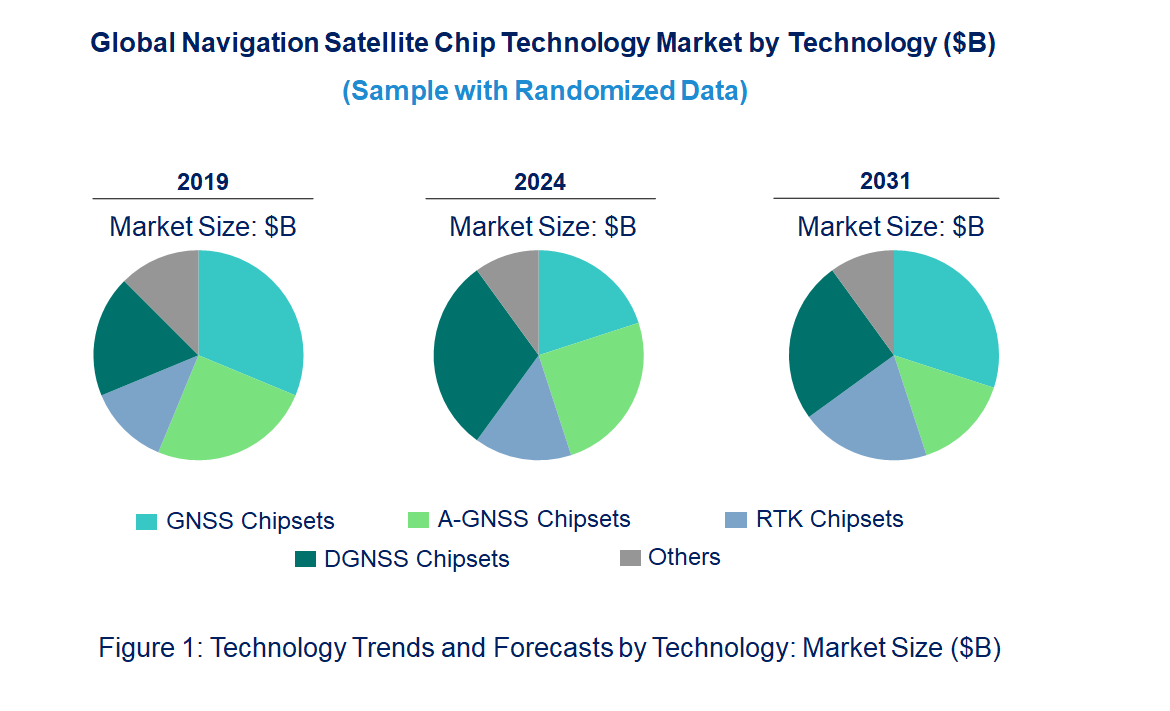
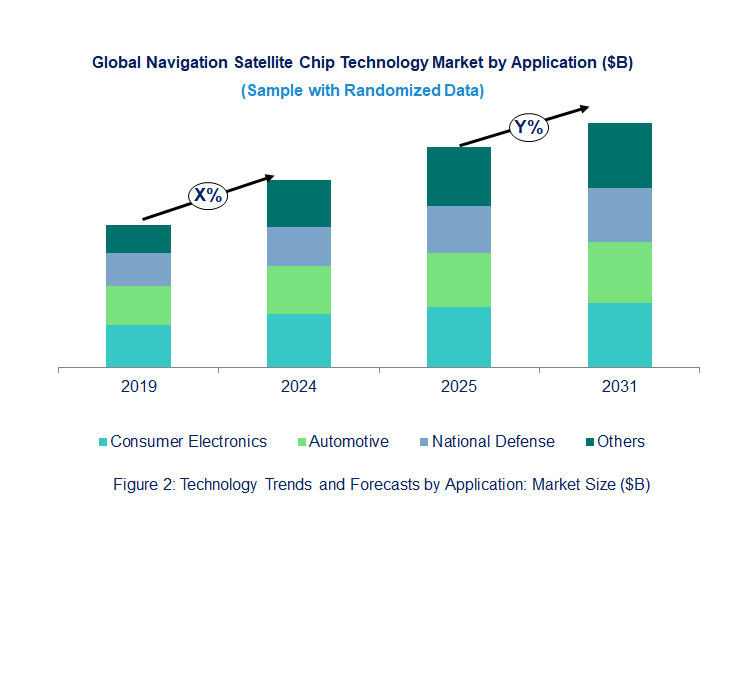
• Increased adoption of real-time kinematic (RTK) and differential GNSS (DGNSS) technologies: RTK and DGNSS technologies offer improved accuracy and are especially useful in the automotive, surveying, and agriculture sectors, where accurate positioning is required. RTK and DGNSS chipsets are set to revolutionize industries that need centimeter-level precision.
• A-GNSS with IoT Devices: Assisted GNSS technology is gradually integrating into IoT devices to improve the precision and speed of satellite fixes in poor visibility areas, such as indoors or urban canyons. Innovations in A-GNSS are being applied in smart cities and consumer electronics.
• Multi-Frequency GNSS Systems: Multi-frequency GNSS systems are increasingly being used in navigation chipsets. Multiple satellite frequencies provide greater robustness, improved interference rejection, and higher accuracy. This trend is particularly important for high-precision applications in autonomous vehicles and dynamic environments.
• Artificial Intelligence (AI) Integration to Enhance Performance: AI and machine learning are being integrated into navigation chipsets to improve the performance of GNSS systems. AI-based algorithms enhance satellite signal processing, improving accuracy, reducing errors, and increasing the reliability of positioning in challenging environments such as urban areas or dense forests. With trends like improvements in RTK, A-GNSS, and AI, the navigation satellite chip market is poised for advancements in accuracy, reliability, and miniaturization. These trends are expected to broaden the applicability of these technologies across various sectors, from consumer electronics to national defense. Several key players have already made significant strides in this area.
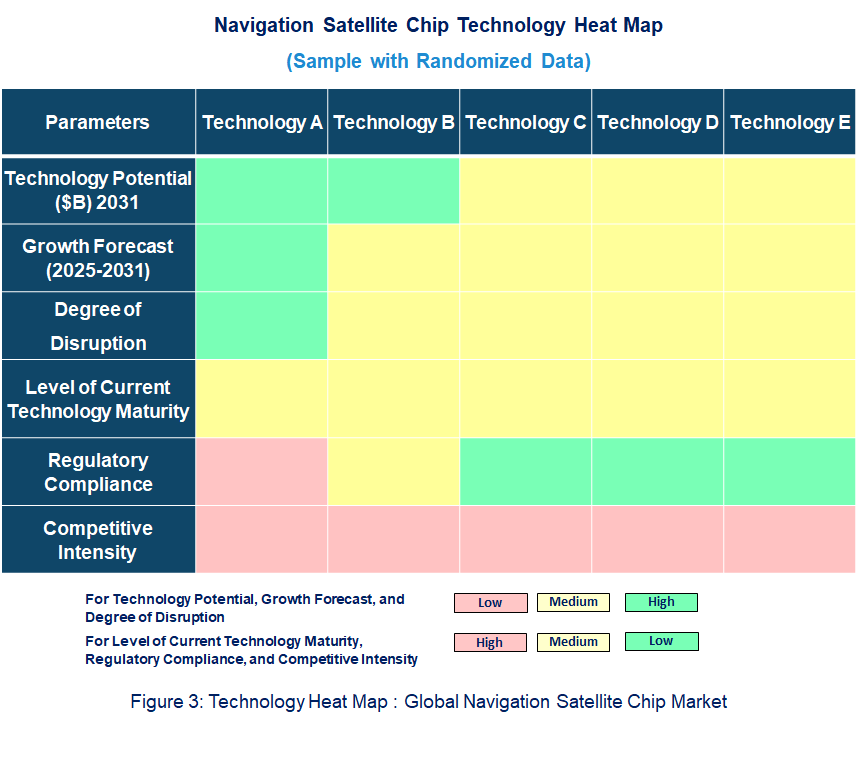
• Technology Potential: The potential of satellite navigation chips lies in their ability to revolutionize sectors such as autonomous vehicles, IoT devices, and smartphones. As satellite constellations like GPS, Galileo, and Beidou expand, these chips will offer higher accuracy and reliability for a variety of applications.
• Degree of Disruption: With the rise of autonomous technologies and next-generation GPS systems, navigation satellite chips have the potential to significantly disrupt industries such as transportation, logistics, and mobile communication. These chips enable new functionalities and reduce dependence on traditional, ground-based navigation systems.
• Level of Current Technology Maturity: Currently, the technology is highly mature, with several players offering reliable and cost-efficient solutions. Satellite navigation chips are already integrated into consumer electronics, automotive systems, and aviation technologies.
• Regulatory Compliance: Compliance with international standards and regulations is essential. Manufacturers must adhere to strict guidelines set by government agencies like the FCC, ESA, and ITU to ensure secure and reliable operations. The navigation satellite chip market is poised for continued growth, driven by technological potential, innovation, and regulatory oversight.
• Qualcomm Incorporated: Qualcomm has made considerable strides in improving its GNSS chipset technology by integrating multi-frequency GNSS support into its Snapdragon processors. This development enhances positioning accuracy for smartphones, wearables, and automotive systems, ensuring Qualcomm’s dominance in the high-performance navigation chipset market.
• STMicroelectronics: STMicroelectronics launched new GNSS chipsets for automotive, consumer electronics, and IoT applications. The company’s focus on integrating multi-constellation and multi-frequency GNSS into its chips ensures high reliability for applications like autonomous driving, smart cities, and industrial automation.
• Intel Corporation: Intel has advanced GNSS chipsets by integrating RTK and DGNSS technologies, providing precise positioning for commercial use in drones and autonomous vehicles. The company is also improving power efficiency to extend the lifespan of devices relying on these chips.
• Mediatek Inc: MediaTek’s navigation solutions incorporate A-GNSS and RTK technology, targeting the automotive and IoT segments. The company focuses on innovation to enhance location accuracy in smartphones, navigation systems, and wearable devices, aiming to take the market lead.
• Broadcom Corporation: Broadcom’s recent developments in GNSS technology focus on optimizing chipsets for satellite-based navigation in consumer electronics, especially smartphones and tablets. These chipsets are increasingly being adopted for navigation and location-based services, offering faster signal acquisition and better accuracy.
• Furuno Electric Company: Furuno Electric develops advanced receivers and chipsets for its marine and navigation solutions, enhancing the accuracy and reliability of satellite navigation in the maritime sector. These multi-frequency GNSS receiver-based products are rapidly being adopted in global maritime navigation systems.
• Skyworks Solutions: Skyworks has developed highly integrated GNSS solutions targeting automotive and consumer applications. Their advanced chipsets provide more accurate, low-latency positioning, which is crucial for autonomous vehicles, drones, and other IoT devices.
• Quectel Wireless Solutions: Quectel has focused on incorporating A-GNSS and RTK functionalities into its chipsets for the automotive, industrial, and consumer electronics sectors. The company’s advancements in low-power GNSS solutions position it as a key player in the growing market for location-based services.
• Navika Electronics: Navika Electronics offers precise, low-cost GNSS chipsets to industrial and defense users. Their multi-frequency, dual-antenna solutions cater to the needs of high-accuracy positioning in national defense and geospatial sectors. The developments by leading players in the navigation satellite chip market are driving improvements in accuracy, power efficiency, and the overall functionality of GNSS-based systems. These advancements will continue to push innovation and unlock new applications across various industries.
• Increasing demand for autonomous vehicles with high-accuracy requirements: The implementation of autonomous driving technology is rising, which demands high-precision GNSS chips, including RTK and DGNSS. These chips provide centimeter-level accuracy for safe and reliable navigation in autonomous systems.
• Growth of the Internet of Things (IoT): The rise of wearables, smart cities, and connected vehicles is increasing the demand for A-GNSS and low-power GNSS chips. These chips enable accurate and efficient location-based services, enhancing the functionality of IoT applications.
• National Defense: Governments worldwide are investing in defense and military applications that rely on GNSS for surveillance, navigation, and communication. This investment is driving demand for highly reliable and secure GNSS solutions.
• Expansion of Location-Based Services (LBS) in Consumer Electronics: The widespread use of smartphones, wearables, and other consumer electronics has led to increased demand for location-based services. Advanced GNSS solutions enable these devices to provide more accurate navigation and tracking capabilities. Challenges in the navigation satellite chips market include:
• Signal interference and jamming in GNSS systems: Signal interference, especially in cities or battlefronts, can significantly degrade the performance of GNSS systems. This presents a major challenge that could hinder market growth.
• High development and production costs: The design and manufacturing of advanced GNSS chipsets, particularly those that include multi-frequency and RTK capabilities, are costly. This poses challenges for smaller companies to remain competitive in the market.
• Regulatory and security concerns: As GNSS technology is used in both civilian and military domains, there are growing concerns about the security and integrity of these systems. Developing regulatory frameworks and standards is essential to protect the integrity of GNSS infrastructure. The demand for autonomous vehicles and IoT applications is driving market growth, challenges such as signal interference, production costs, and security concerns must be addressed to sustain this growth. Overcoming these challenges and capitalizing on opportunities will be key to the success of the navigation satellite chip market.
• Qualcomm Incorporated
• Stmicroelectronics
• Intel Corporation
• Mediatek Inc
• Broadcom Corporation
• Furuno Electric
• Technology Readiness by Type: GNSS chipsets are mature and widely deployed, with A-GNSS gaining adoption in consumer devices. RTK chipsets are advanced but cater to specialized applications like surveying and autonomous systems. DGNSS is used in high-precision sectors like aviation. Emerging technologies such as multi-frequency GNSS show promise in diverse sectors, offering better reliability and performance.
• Disruption Potential of Different Technologies: GNSS chipsets are essential for global positioning, while A-GNSS chipsets enhance speed and performance in challenging environments. RTK chipsets offer centimeter-level accuracy, disrupting industries like agriculture and autonomous vehicles. DGNSS chipsets improve accuracy with correction signals, ideal for precision navigation in specialized sectors. Emerging multi-constellation and hybrid systems further disrupt industries such as logistics, transportation, and geospatial data collection.
• Competitive Intensity and Regulatory Compliance: In navigation satellite chip the GNSS chip market is highly competitive, with companies striving for improved accuracy and cost-efficiency. A-GNSS is gaining traction due to its enhanced speed in urban areas, while RTK chipsets dominate niche markets. DGNSS chips face regulatory scrutiny, especially in aviation and maritime sectors. Regulatory compliance is stringent across all technologies, driven by global safety standards.
• Navigation Satellite System (GNSS) Chipsets
• Assisted GNSS (A-GNSS) Chipsets
• Real-Time Kinematic (RTK) Chipsets
• Differential GNSS (DGNSS) Chipsets
• Others
• Consumer Electronics
• Automotive
• National Defense
• Others
• North America
• Europe
• Asia Pacific
• The Rest of the World
• Latest Developments and Innovations in the Navigation Satellite Chip Technologies
• Companies / Ecosystems
• Strategic Opportunities by Technology Type


Choose a license that fits your team. Instant PDF delivery.
Prices exclude taxes. Instant delivery. Custom licensing available on request.
Market Report · May 18, 2026
Market Report · May 18, 2026
Market Report · May 18, 2026
Trusted partner for strategic intelligence and business growth


Receive a complimentary market analysis tailored to your industry. Our analysts will identify key growth opportunities and competitive dynamics specific to your business.

Market size, growth rate, and key trend analysis for your specific sector.

Top competitor positioning and market share analysis.

Strategic recommendations backed by data-driven insights.
Get curated market intelligence and competitive moves straight to your inbox.
By subscribing, you agree to receive our monthly insights. Unsubscribe anytime.
Receive a complimentary market analysis tailored to your industry. Our analysts will identify key growth opportunities and competitive dynamics specific to your business.
Market size, growth rate, and key trend analysis for your specific sector.
Top competitor positioning and market share analysis.
Strategic recommendations backed by data-driven insights.
Get curated market intelligence, emerging trends, and competitive moves straight to your inbox each month.
By subscribing, you agree to receive our monthly insights. Unsubscribe anytime.
We'll send your sample report shortly.