
Market Report · July 15, 2026

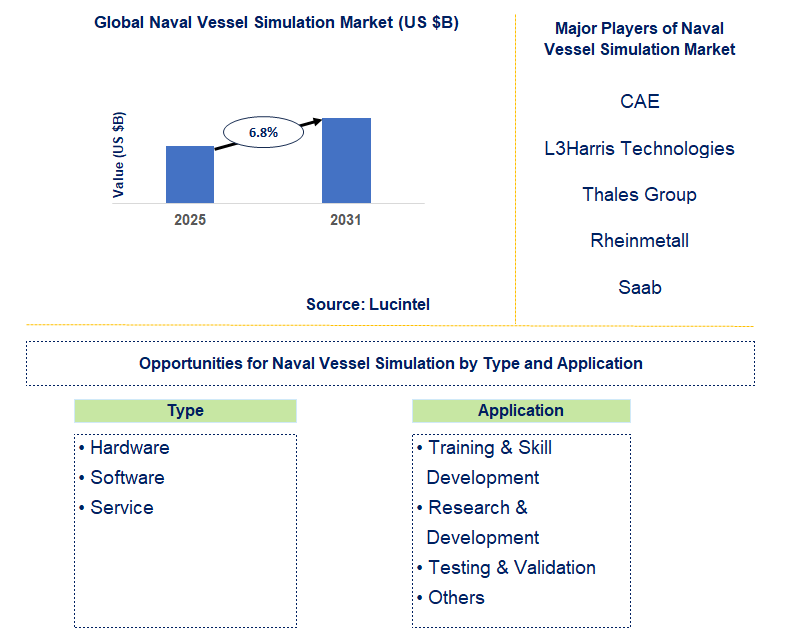
Key data points: The growth forecast = 6.8% annually for the next 7 years. Scroll below to get more insights. This market report covers trends, opportunities and forecasts in naval vessel simulation market to 2031 by type (hardware, software, and service), application (training & skill development, research & development, testing & validation, and others), and region (North America, Europe, Asia Pacific, and the Rest of the World)
We'll send your sample report shortly.
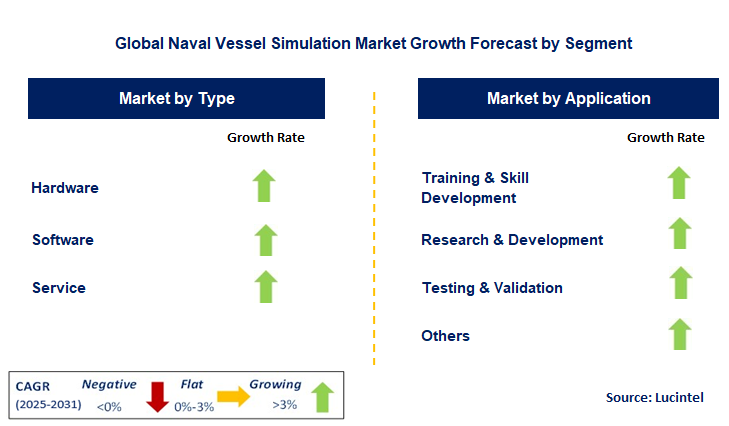
• Lucintel forecasts that, within the type category, software is expected to witness the highest growth over the forecast period.
• Within the application category, training & skill development is expected to witness the highest growth.
• In terms of region, APAC is expected to witness the highest growth over the forecast period. Gain valuable insights for your business decisions with our comprehensive 150+ page report. Sample figures with some insights are shown below.
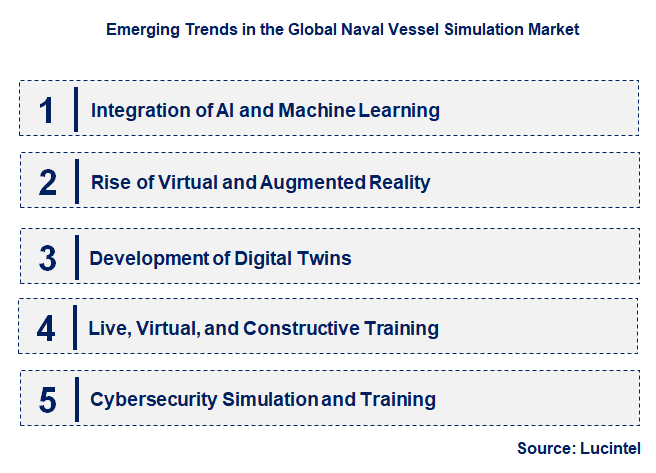
• Integration of AI and Machine Learning: A key trend is the integration of artificial intelligence (AI) and machine learning into naval simulation systems. AI is used to create dynamic, intelligent, and unpredictable adversaries in training scenarios, and to provide real-time feedback and performance analysis for trainees. This trend’s impact is significant as it makes training more realistic and adaptive, improving decision-making skills and preparing crews for complex and evolving threats.
• Rise of Virtual and Augmented Reality: The market is seeing a trend toward the use of virtual reality (VR) and augmented reality (AR) for more immersive and cost-effective training. VR can be used for full-mission simulations, while AR can overlay digital information onto real-world equipment for maintenance training. This trend is fundamentally changing the market by reducing the need for expensive physical mock-ups and allowing for more flexible, on-demand training.
• Development of Digital Twins: There is an emerging trend for naval forces to create "digital twins," or virtual replicas, of their vessels and systems. These digital twins can be used for crew training, system testing, and predictive maintenance. This trend is impacting the market by enabling engineers to test system upgrades and new combat strategies in a risk-free environment, which reduces costs and shortens development cycles.
• Live, Virtual, and Constructive Training: A major trend is the adoption of Live, Virtual, and Constructive (LVC) training frameworks. LVC combines real-world operations (Live), simulated environments (Virtual), and computer-generated forces (Constructive) into a single, cohesive exercise. This trend is reshaping the market by allowing for large-scale, multi-platform training that is more realistic and complex than traditional drills, preparing navies for large-scale conflicts.
• Cybersecurity Simulation and Training: The market is seeing a trend towards incorporating cybersecurity threats and scenarios into naval simulation. These systems train crews to detect and respond to cyber-attacks on a vessel’s combat and navigation systems. This trend is impacting the market by addressing a critical vulnerability in modern naval warfare, ensuring that crews are prepared to defend their vessels against a full spectrum of attacks, both kinetic and digital. These emerging trends are profoundly reshaping the naval vessel simulation market by driving innovation towards integrated, digital, and intelligent solutions. The focus on AI and cloud-based systems is critical for improving diagnostic accuracy and remote access, while the push for automation and interoperability is streamlining workflows. These trends collectively underscore a market-wide shift towards comprehensive and integrated digital diagnostic platforms.
• Deployment of Advanced Integrated Simulators: A key development is the deployment of new integrated simulation complexes by navies worldwide. These complexes combine multiple simulator types—from bridge and engine room simulators to tactical trainers—into a single, interconnected environment. This development’s impact is significant as it allows for cohesive, multi-crew training, ensuring that all personnel on a vessel can train together in a single simulated mission.
• Expansion of Unmanned Vessel Simulation: Another development is the increasing focus on creating simulation environments for unmanned naval vessels (USVs). These simulators are used to train operators on remote control, mission planning, and data analysis for USVs. The impact of this development is an acceleration in the adoption of unmanned systems by navies. It allows for the safe and efficient training of personnel on new, complex platforms without the risk and cost of real-world operations.
• Partnerships with Commercial Gaming Companies: The market is seeing a development in partnerships between defense contractors and commercial gaming companies. These collaborations leverage commercial gaming engines and expertise to create more immersive, realistic, and cost-effective simulation environments. This development is impacting the market by bringing a new level of visual fidelity and user-friendliness to naval simulators, which can improve trainee engagement and learning outcomes.
• Cloud-Based Simulation and Training: A major development is the shift towards cloud-based simulation platforms. These platforms allow for a shared, scalable training environment that can be accessed from different locations, enabling joint exercises with allied navies. This development is impacting the market by providing a more flexible and cost-effective solution for training, reducing the need for expensive, dedicated hardware at every training site.
• Introduction of AI for Performance Analytics: The market is seeing a development in the introduction of AI-powered analytics to measure trainee performance and provide personalized feedback. These systems can track a trainee’s decisions and movements, offering objective insights that were previously difficult to obtain. This development is impacting the market by enabling more targeted and effective training, which can help navies improve the skills and readiness of their personnel faster. These recent developments are collectively transforming the naval vessel simulation market by making the technology more powerful, accessible, and secure. The focus on high-capacity scanners and AI algorithms is improving efficiency and accuracy, while collaborations with cloud providers and regulatory clearances are driving widespread adoption. These advancements are critical for the future of pathology and patient care.
• Training for Complex Combat Systems: The increasing complexity of modern naval combat systems, such as Aegis and other integrated command and control systems, presents a primary growth opportunity. Naval forces require advanced simulators to train crews on the intricate operation and coordination of these systems. This opportunity’s impact is substantial, as it drives demand for highly specialized and high-fidelity simulation software and hardware to ensure crews are proficient and combat-ready.
• Design and Engineering of New Vessels: The use of simulation for the design and engineering of new naval vessels is a significant growth opportunity. Simulators can be used to test new vessel designs, assess ergonomics, and validate system integration before a physical prototype is built. This opportunity is impacting the market by reducing development costs and timelines. It allows for the identification of potential design flaws and improvements in a virtual environment.
• Joint Training and Interoperability: The need for joint training between different naval units and with allied forces is a key growth area. Simulation allows for the creation of shared virtual environments where multiple navies can train together on common procedures and tactics. The impact of this opportunity is the improvement of interoperability and a strengthening of military alliances, which is crucial for modern international security.
• Maintenance and Damage Control Training: The market for maintenance and damage control simulators is a growing opportunity. These simulators provide a safe, repeatable environment for crews to practice responding to critical failures, fires, and flooding. This opportunity is impacting the market by enhancing a vessel’s survivability. It ensures that crews can effectively manage high-stress emergencies without putting the ship or personnel at risk.
• Unmanned Vessel Operations: The growing trend toward unmanned naval vessels presents a strong growth opportunity. The market for simulators to train personnel on the remote operation, mission planning, and data analysis of USVs is expanding. This opportunity is impacting the market by providing a viable solution for electronic warfare systems to manage high volumes of samples, collaborate with specialists, and improve diagnostic turnaround times for animal healthcare. These strategic growth opportunities are defining the future of the naval vessel simulation market. The convergence of electric vehicles, engine efficiency, and advanced safety systems is creating a diverse and expanding demand for high-performance and integrated sensors. By focusing on these key application areas, market players can capitalize on the global push for technological advancement and position themselves for long-term success.
• CAE
• L3Harris Technologies
• Thales Group
• Rheinmetall
• Saab
• Kongsberg
• Wärtsilä
• ARI Simulation
• Cubic Corporation
• Dynautics Limited
• Hardware
• Software
• Service
• Training & Skill Development
• Research & Development
• Testing & Validation
• Others
• North America
• Europe
• Asia Pacific
• The Rest of the World
• United States: The U.S. market is a leader in naval simulation, with major investments in live, virtual, and constructive (LVC) training frameworks. Developments include the integration of AI to create more dynamic and realistic adversaries, and the use of cloud-based platforms for multi-site, multi-unit training exercises. The focus is on preparing crews for complex, multi-domain operations and adapting to new technologies like unmanned naval vessels.
• China: China’s market is rapidly expanding, fueled by ambitious naval modernization programs and a strong focus on domestic development. Recent developments include the deployment of advanced simulators for aircraft carriers and submarines. China is actively developing its own simulation software and hardware to reduce reliance on foreign technology and train a new generation of naval personnel for its growing fleet.
• Germany: The German market is a key European hub for high-tech simulation, with developments concentrated on high-fidelity engineering and combat simulators. The focus is on creating accurate digital twins of vessels for crew training and predictive maintenance. Germany’s strong engineering base and defense technology expertise are driving the development of specialized simulators for its U-boat and surface fleet.
• India: India’s market is in a growth phase, driven by government initiatives to enhance naval capabilities and indigenize defense technology. Developments are focused on upgrading existing simulation facilities and building new integrated simulator complexes. The Indian Navy is increasingly using simulators to train personnel on modern warships and submarines, preparing them for complex maritime operations and enhancing overall combat readiness.
• Japan: Japan’s market is mature and technology-driven, with a focus on high-performance and integrated simulation systems. Developments are concentrated on perfecting simulators for anti-submarine warfare (ASW) and destroyer operations, reflecting its strategic priorities. The market is supported by a strong electronics industry and a national focus on maritime security and defense modernization.


• CAE
• L3Harris Technologies
• Thales Group
• Rheinmetall
• Saab
• Kongsberg
• Wärtsilä
• ARI Simulation
• Cubic Corporation
• Dynautics Limited Q5. Which naval vessel simulation market segment will be the largest in future? Answer: Lucintel forecasts that, within the type category, software is expected to witness the highest growth over the forecast period. Q6. In naval vessel simulation market, which region is expected to be the largest in next 5 years? Answer: In terms of region, APAC is expected to witness the highest growth over the forecast period. Q7. Do we receive customization in this report? Answer: Yes, Lucintel provides 10% customization without any additional cost.


Choose a license that fits your team. Instant PDF delivery.
Prices exclude taxes. Instant delivery. Custom licensing available on request.
Market Report · July 15, 2026
Market Report · June 26, 2026
Market Report · June 24, 2026
Trusted partner for strategic intelligence and business growth


Receive a complimentary market analysis tailored to your industry. Our analysts will identify key growth opportunities and competitive dynamics specific to your business.

Market size, growth rate, and key trend analysis for your specific sector.

Top competitor positioning and market share analysis.

Strategic recommendations backed by data-driven insights.
Get curated market intelligence and competitive moves straight to your inbox.
By subscribing, you agree to receive our monthly insights. Unsubscribe anytime.
Receive a complimentary market analysis tailored to your industry. Our analysts will identify key growth opportunities and competitive dynamics specific to your business.
Market size, growth rate, and key trend analysis for your specific sector.
Top competitor positioning and market share analysis.
Strategic recommendations backed by data-driven insights.
Get curated market intelligence, emerging trends, and competitive moves straight to your inbox each month.
By subscribing, you agree to receive our monthly insights. Unsubscribe anytime.
We'll send your sample report shortly.