
Market Report · July 15, 2026

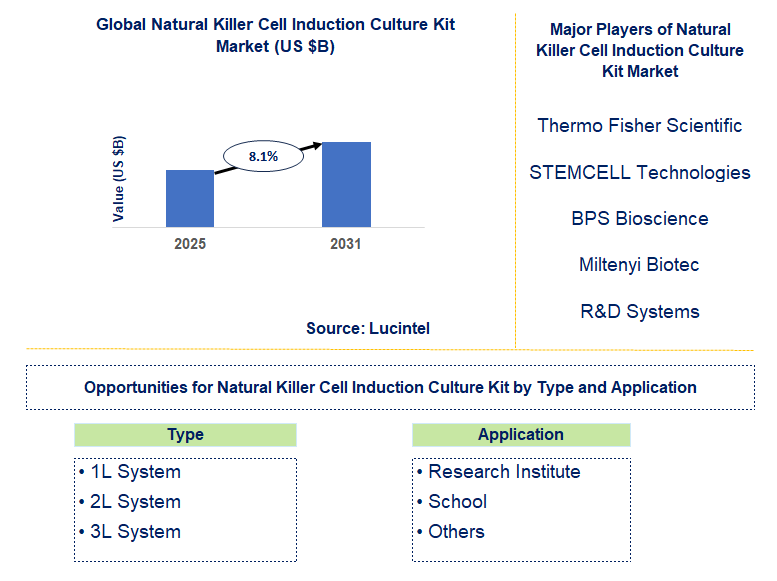
Key data points: The growth forecast = 8.1% annually for the next 7 years. Scroll below to get more insights. This market report covers trends, opportunities and forecasts in natural killer cell induction culture kit market to 2031 by type (1L system, 2L system, and 3L system), application (research institute, school, and others), and region (North America, Europe, Asia Pacific, and the Rest of the World)
We'll send your sample report shortly.
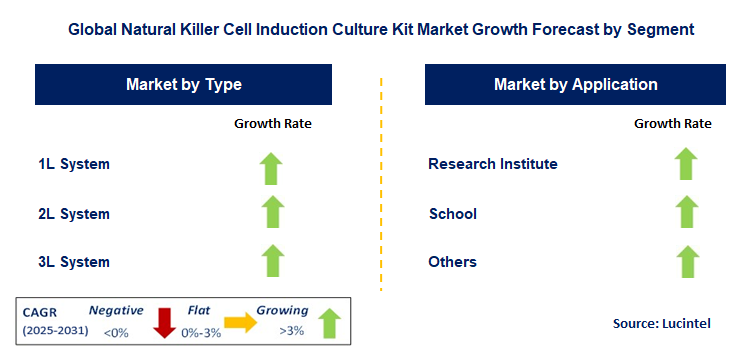
• Lucintel forecasts that, within the type category, 2L system is expected to witness the highest growth over the forecast period.
• Within the application category, research institute is expected to witness higher growth.
• In terms of region, APAC is expected to witness the highest growth over the forecast period. Gain valuable insights for your business decisions with our comprehensive 150+ page report. Sample figures with some insights are shown below.
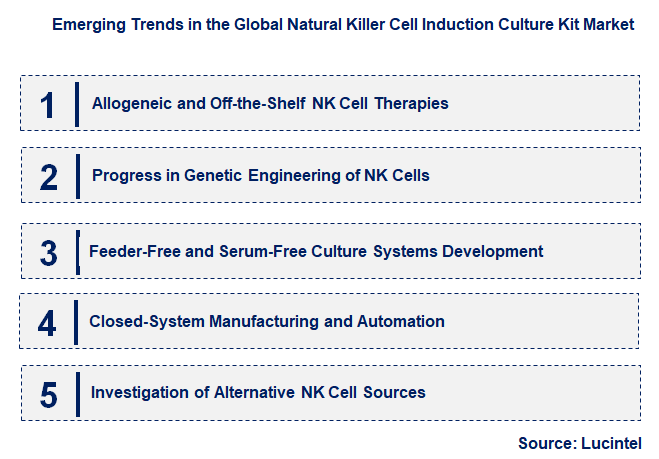
• Allogeneic and Off-the-Shelf NK Cell Therapies: Such a trend entails the creation of NK cell products from healthy donors or universal sources such as induced pluripotent stem cells (iPSCs), in contrast to patient-specific cells. Allogeneic treatments also bring major benefits in scalability, standardization, and availability for use in patients straight away. This minimizes the logistical complexity and waiting times inherent in autologous methods, thus ensuring NK cell therapies are more widely accessible and possibly less expensive. The emphasis is laid on reducing immunogenicity and making the safety and efficacy of these widely available cellular products a priority.
• Progress in Genetic Engineering of NK Cells: This trend is marked by the use of advanced genetic modification technologies, including CAR engineering and CRISPR/Cas9, to improve the function of NK cells. These alterations are made with the goal of enriching tumor-targeting specificity, body persistence, and cytotoxic activity of NK cells. By designing NK cells to carry certain receptors or be resistant to immunosuppressive tumor micro environments, scientists are creating more effective and long-lasting treatments, targeting more types of cancer, such as solid tumors, that have long been difficult for cell therapies.
• Feeder-Free and Serum-Free Culture Systems Development: Such a trend focuses on establishing well-defined culture media and systems that render feeder cells and animal-derived serum unnecessary. Conventional culture practices tend to utilize feeder layers or serum, which are sources of variability, raise the contamination risk, and create regulatory issues based on their possible xenogeneic content. Feeder-free and serum-free kits increase the safety, reproducibility, and compliance with Good Manufacturing Practices (GMP) of the product, and simplify the manufacturing process for clinical-grade NK cell therapies.
• Closed-System Manufacturing and Automation: This is a trend of building automation and closed-system technologies into the process of NK cell expansion. Manual operations are subject to human error and contamination, which restricts scalability and consistency. Automated, closed systems reduce the degree of human intervention, decrease the risk of contamination, and provide better process control and reproducibility. This is important for bulk production of NK cells for clinical trials and commercialization, maintaining product quality and allowing effective, standardized manufacturing.
• Investigation of Alternative NK Cell Sources: This is a trend of exploring and leveraging alternative sources for the generation of NK cells outside of peripheral blood. Induced pluripotent stem cells (iPSCs) provide an accessible, highly scalable source of NK cells, enabling production of homogeneous, clinical-grade batches. Cord blood is an alternative that offers a rich source of naïve NK cells amenable to expansion and engineering. These novel sources mitigate donor variability and cell numbers, opening the door for more consistent and potent NK cell therapies. These new trends are essentially transforming the natural killer cell induction culture kit market by more highly scaling up NK cell therapies, making them safer and more effective. The transition to allogeneic and engineered NK cells, combined with improvements in culture systems and automation for manufacturing, is driving forward research translation into the clinic. The discovery of new cell sources continues to expand the promise for these therapies and eventually will bring down costs, raise availability, and increase the therapeutic scope of NK cell-based treatments for many diseases.
• Growing Use of CAR-NK Cell Engineering: This advancement represents a significant step towards boosting NK cell effectiveness. Scientists are using Chimeric Antigen Receptors (CARs) more and more to re-direct NK cells to target cancer cells specifically, bypassing their inherent inability to recognize particular tumors. The engineering enables more targeted and effective anti-tumor reactions, rendering NK cell treatments viable for a wider range of malignancies, including those with difficulty-permeating tumor microenvironments, thus widening the therapeutic horizon and fueling demand for sophisticated culture kits.
• iPSC-Derived NK Cell Manufacturing Emergence: This breakthrough is a major step towards scalable and standardized NK cell production. Induced pluripotent stem cells (iPSCs) provide an unlimited and renewable source for the production of large numbers of highly pure and reproducible NK cells. This mitigates donor-to-donor variability and low numbers of cells generally found with primary NK cell isolation, opening the door to "off-the-shelf" allogeneic NK cell treatments and simplifying manufacturing challenges, directly influencing the composition and design of culture kits.
• Advances in Feeder-Cell Free Expansion Protocols: This innovation aims to de-risk and streamline the process of manufacturing NK cells. Conventional processes tend to utilize feeder cells, which can add impurities and make regulatory clearance more challenging. New developments in culture kit protocols and formulations now support the growth of strong NK cell populations in feeder cell-free conditions, resulting in cleaner products, fewer risks of contamination, and easier manufacturing processes, thereby improving the overall cost-effectiveness and safety of NK cell therapies.
• Integration of Automated Bioreactor Systems: This advance meets the important demand for high-scale, uniform, and low-cost NK cell manufacture. Automated bioreactors offer a controlled platform for cell cultivation, allowing for optimized growth conditions and minimizing the role of manual labor. This enables production of billions of needed NK cells for clinical doses while keeping batch-to-batch variability and human error to a minimum. Compatibility with automated systems promotes innovation in culture kit development.
• Emphasis on Augmenting NK Cell Persistence and Activity: This development highlights efforts to improve the therapeutic longevity and efficacy of NK cells once infused into patients. Recent research focuses on incorporating specific cytokines, gene modifications, or drug combinations within culture kits that prime NK cells for better survival, proliferation, and anti-tumor activity in the challenging in vivo environment. This directly impacts the composition and sophistication of culture kit media, aiming to deliver a more potent and lasting therapeutic effect. These recent advances are significantly influencing the natural killer cell induction culture kit market by driving the development of more advanced, efficient, and scalable devices for NK cell therapy. The use of CAR-NK engineering, iPSC-derived cells, feeder-free technology, automation, and in vivo persistence focus are all pushing the market towards developing safer, more affordable, and highly potent NK cell-based immunotherapies.
• Cancer Immunotherapy: Solid Tumors: This product is a considerable growth potential. While NK cell therapies have been exciting in hematologic malignancies, their success against solid tumors has been hindered by the suppressive tumor microenvironment and lack of cell invasion. Creating culture kits that increase NK cell homing, persistence, and function in solid tumors, perhaps through genetic modification or co-culture with supportive cells, will open up a massive market. These include brain, lung, breast, and pancreatic cancers, and constitute significant unmet needs.
• Cancer Immunotherapy: Hematological Malignancies: While NK cell therapies are currently used here, there is a lot of scope for expansion by increasing their efficacy. This means creating culture kits that produce NK cells with higher cytotoxic ability, better proliferation, and insusceptibility to inhibitory signals in the bone marrow or lymphoid organs. Opportunities exist for the optimization of induction regimens for particular subtypes of leukemia and lymphoma, with the results including improved response rates, diminished relapse rates, and an expanded use of NK cell therapy in refractory instances.
• Infectious Diseases: Chronic Viral Infections: This application is a new emerging field. NK cells are important in viral infection control. Culture kits that can produce highly active, memory-type NK cells with long-term antiviral watchfulness could be revolutionary for infections like HIV, hepatitis B, and hepatitis C. Potential is possible in creating kits that specialize in priming NK cells for strong and prolonged antiviral defense, providing a new therapeutic opportunity where treatments are lacking or carry important side effects.
• Autoimmune Diseases: Immune Response Modulation This submission investigates the immunomodulatory therapeutic potential of NK cells. While traditionally implicated in cytotoxicity, NK cells modulate adaptive immune function as well. Opportunity for growth is found in creating culture sets that enable the expansion of particular subsets of NK cells with immunoregulatory roles, potentially suppressing dysregulated immune responses in autoimmune disease such as lupus, rheumatoid arthritis, or multiple sclerosis. This is a paradigm shift from exclusively cytotoxic uses to exploiting the broader immunological functions of NK cells.
• Transplant Medicine: Graft-versus-Host Disease and Tumor Relapse Prevention: This product integrates two important elements of transplant success. NK cells, especially allogeneic NK cells, are being investigated to avoid GvHD during hematopoietic stem cell transplantation while also exerting a graft-versus-leukemia response. Strategic growth opportunities include establishing culture kits to provide optimum expansion of NK cells with particular killer immunoglobulin-like receptor (KIR) profiles that can recognize and kill remaining tumor cells without targeting normal host tissues, thus enhancing transplant success and patient survival. These strategic expansion opportunities are having a deep influence on the Natural Killer Cell Induction Culture Kit market by driving diversification and specialization in product design. An emphasis on particular areas of application such as solid tumors, chronic viral diseases, and autoimmune diseases, as well as beyond the historical hematological malignancies, requires the development of more customized and advanced culture kits. This growth into new therapeutic avenues will certainly generate innovation, draw additional investment, and heavily expand the market potential for NK cell induction and expansion technologies, meeting a greater variety of essential medical demands.
• Thermo Fisher Scientific
• STEMCELL Technologies
• BPS Bioscience
• Miltenyi Biotec
• R&D Systems
• Biotherapy Institute
• Creative Biolabs
• Hillgene
• Dakoway Biotech
• Jet Biotech
• 1L System
• 2L System
• 3L System
• Research Institute
• School
• Others
• North America
• Europe
• Asia Pacific
• The Rest of the World
• United States: The US market leads in NK cell therapy development, with high levels of research and development, heavy venture capital investment, and a favorable regulatory environment. Recent advances encompass the development of "off-the-shelf" allogeneic NK cell therapies using induced pluripotent stem cells (iPSCs) to provide standardized and scalable products. There is also extensive emphasis on genetically modifying NK cells with chimeric antigen receptors (CAR-NK) to improve their tumor-targeting ability and persistence, especially for solid tumors, which is a major hurdle in cancer immunotherapy.
• China: China is moving quickly towards the NK cell culture kit market, fueled by growing government promotion of biotechnology, a huge patient base, and rising clinical trials. Attention is centered on creating affordable and effective approaches for mass expansion of NK cells. There is also a keen focus on combining traditional Chinese medicine concepts with contemporary cell therapies, identifying new compounds and methodologies to promote NK cell activity and proliferation. Academic-institution and biopharmaceutical company collaboration is speeding up product development and penetration into the market.
• Germany: Germany’s NK cell induction culture kit market enjoys a robust biomedical research infrastructure and an established healthcare system. Recent advances include developments in closed-system manufacturing platforms and automation to control consistency and minimize risk of contamination in NK cell manufacture. There is also a significant drive for creation of feeder-free and serum-free culture conditions to optimize the safety profile and minimize the variability of NK cell products, compliance with rigorous European regulatory requirements for cell-based therapies.
• India: The Indian market is seeing growing interest in NK cell induction culture kits, fueled by the rising incidence of cancer and enhanced demand for advanced treatments. Although in its infancy stage as yet vis-a-vis developed countries, recent trends have included local firms working on improving affordable and accessible culture kits. There is also an emerging trend towards collaborations with global players to access advanced technology and expertise in order to build local manufacturing capabilities and address the unserved medical needs of its huge population.
• Japan: Japan is a leading country in the NK cell induction culture kit market, with specific expertise in iPSC technology advancement. The recent advancements emphasize the successful derivation of functional human iPSC-derived NK cells in feeder-free and serum-free systems. Japanese scientists are at the forefront in applying clinical-grade iPSCs for the expansion of NK cells, illustrating their enhanced cytotoxic capabilities against distinct cancer cell lines. The emphasis on iPSC-derived NK cells holds out the promise of a reliable and scalable source of off-the-shelf products for cancer immunotherapy.


• Thermo Fisher Scientific
• STEMCELL Technologies
• BPS Bioscience
• Miltenyi Biotec
• R&D Systems
• Biotherapy Institute
• Creative Biolabs
• Hillgene
• Dakoway Biotech
• Jet Biotech Q5. Which natural killer cell induction culture kit market segment will be the largest in future? Answer: Lucintel forecasts that, within the type category, 2L system is expected to witness the highest growth over the forecast period. Q6. In natural killer cell induction culture kit market, which region is expected to be the largest in next 5 years? Answer: In terms of region, APAC is expected to witness the highest growth over the forecast period. Q7. Do we receive customization in this report? Answer: Yes, Lucintel provides 10% customization without any additional cost.


Choose a license that fits your team. Instant PDF delivery.
Prices exclude taxes. Instant delivery. Custom licensing available on request.
Market Report · July 15, 2026
Market Report · May 18, 2026
Market Report · May 18, 2026
Trusted partner for strategic intelligence and business growth


Receive a complimentary market analysis tailored to your industry. Our analysts will identify key growth opportunities and competitive dynamics specific to your business.

Market size, growth rate, and key trend analysis for your specific sector.

Top competitor positioning and market share analysis.

Strategic recommendations backed by data-driven insights.
Get curated market intelligence and competitive moves straight to your inbox.
By subscribing, you agree to receive our monthly insights. Unsubscribe anytime.
Receive a complimentary market analysis tailored to your industry. Our analysts will identify key growth opportunities and competitive dynamics specific to your business.
Market size, growth rate, and key trend analysis for your specific sector.
Top competitor positioning and market share analysis.
Strategic recommendations backed by data-driven insights.
Get curated market intelligence, emerging trends, and competitive moves straight to your inbox each month.
By subscribing, you agree to receive our monthly insights. Unsubscribe anytime.
We'll send your sample report shortly.