
Market Report · May 18, 2026

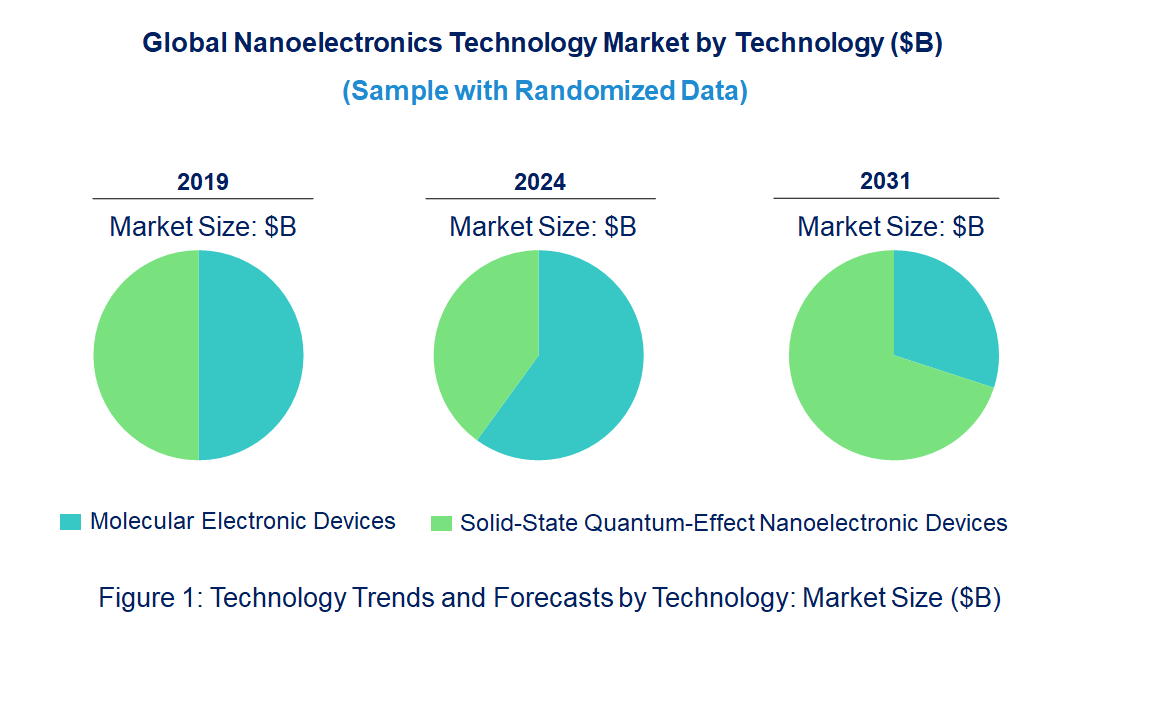
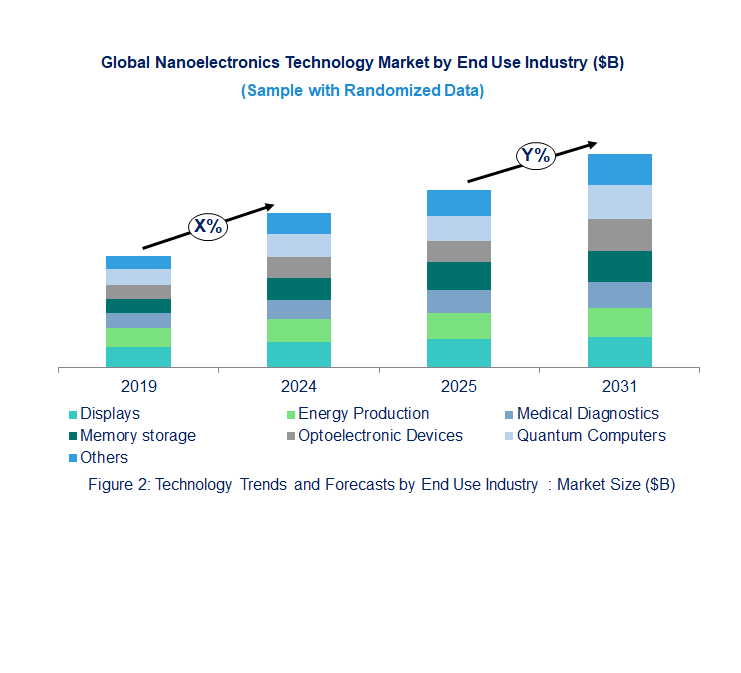
This market report covers trends, opportunities, and forecasts in the global nano electronics market to 2031 by technology (molecular electronic devices and solid-state quantum-effect nanoelectronic devices), end use industry (displays, energy production, medical diagnostics, memory storage, optoelectronic devices, quantum computers, and radios), and region (North America, Europe, Asia Pacific, and the Rest of the World)
We'll send your sample report shortly.
• Quantum Dot Technology: Quantum dots are gaining acceptance for their potential to improve the efficiency and performance of electronic devices. These nanomaterials are being used in display technologies, solar cells, and LEDs, with enhanced optical properties and energy efficiency.
• Flexible Electronics: Flexible electronics will change wearable technology, healthcare monitoring, and IoT applications. Advances in nanoelectronics will bring devices to the stage where they are flexible, stretchable, and foldable, and can seamlessly integrate into various products.
• Carbon Nanotubes and Graphene: In contrast to carbon-based nanomaterials, carbon nanotubes and graphene are looked at for their superior properties compared to other materials, electrically and mechanically. These breakthroughs in the high performance of transistors, sensors, and other forms of energy storage devices can well become a substitute for silicon in many applications. Neuromorphic computing, inspired by the neural networks of the human brain, is gaining popularity in nanoelectronics. These systems, by mimicking biological processes, offer the potential to deliver more efficient, energy-saving, and powerful computing, improving AI applications and machine learning.
• Self-Healing Materials: The development of self-healing materials within nanoelectronics is another emerging trend. These materials can automatically repair damage, improving the lifespan and reliability of electronic devices, particularly in flexible and wearable technologies. These technology trends are significantly molding the future of nanoelectronics by enhancing performance, energy efficiency, and the scope of applications. As such trends progress, they will give rise to smarter, more sustainable electronics that impact various industries in terms of innovation and growth in the global market.
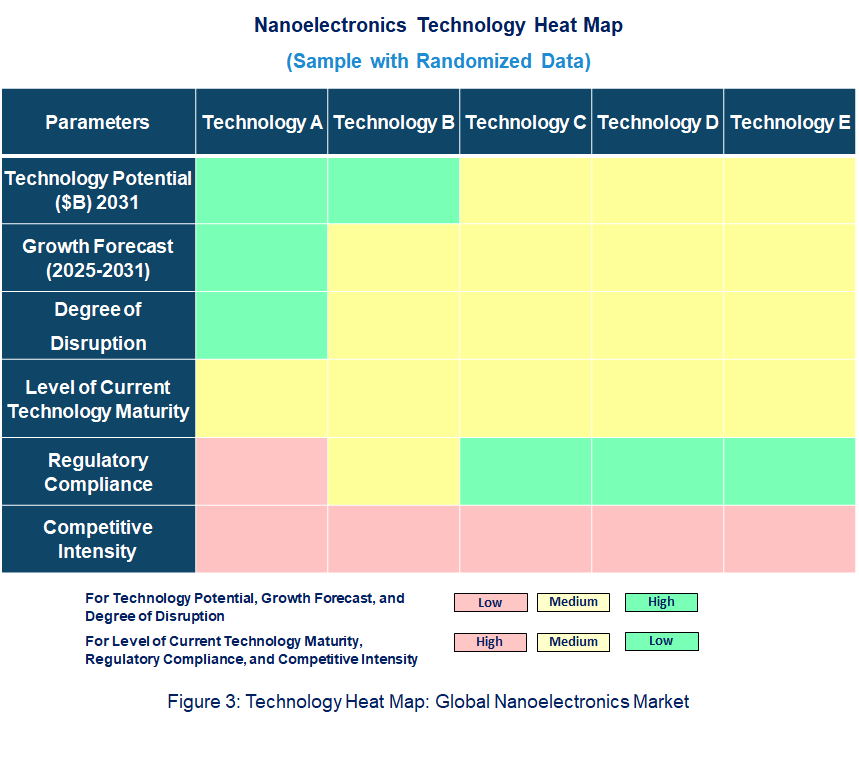
• Technology Potential: Nanoelectronics technology has huge potential to reduce power consumption, enhance computation speeds, and enable new applications such as quantum computing and flexible electronics. Developments in materials such as graphene and quantum dots are driving innovations in displays, sensors, and energy-efficient devices, opening up new horizons for their applications.
• Degree of Disruption: This technology is highly disruptive and therefore challenges traditional silicon-based electronics and opens up to even advanced materials and architectures. This technology allows breakthroughs in neuromorphic computing, IoT devices, and medical diagnostics, and changes them fundamentally.
• Technology Maturity Level: Nanoelectronics is at varying stages of maturity. Applications such as nano transistors are close to commercial viability, while others, like quantum computing, are still under research and development.
• Regulatory Compliance: With rapid growth, nanoelectronics is under regulatory scrutiny relating to environmental impact and material safety. For its sustainable and proper adoption, adherence to all global standards will be pertinent.
• Bruker Corporation: Bruker has developed advanced nanoscale characterization tools, including atomic force microscopy, for nanoelectronics. These tools provide the precise material analysis that is needed to design the next generation of electronic components.
• DuPont de Nemours: DuPont has introduced nanomaterials that are innovative in flexible and wearable electronics. Their solutions, such as conductive inks and films, open up new possibilities in IoT applications and increase the durability and functionality of the devices.
• eSpin Technologies: eSpin Technologies has concentrated on integrating nanofibers into electronic devices to improve their performance. These materials offer higher conductivity and flexibility, thus making breakthroughs possible in sensor technologies and energy storage solutions.
• Hewlett-Packard Development Company: HP has been a pioneer in memristor technology in nanoelectronics, which is changing the face of memory and computing systems. This is done by speeding up data processing and storage.
• Infineon Technologies: Infineon uses nano-scale semiconductors to enhance power efficiency in automotive and industrial applications. The innovations they are doing will be the core of developing energy-efficient and sustainable electronic solutions.
• Intel Corporation: Intel remains the pioneer in nano transistor development, striving to increase the computational power and reduce chip size. Their developments are crucial to sustain Moore's Law and serve AI and machine learning applications.
• International Business Machines Corporation (IBM): IBM research in quantum computing is expanding the frontiers of nanoelectronics. Their development of nanoscale quantum processors promises exponential improvements in computational power.
• KLA Corporation: KLA has launched advanced inspection and metrology tools for nanoelectronic manufacturing. Such solutions ensure high yields and accuracy in semiconductor manufacturing.
• Koninklijke Philips: Philips has been pioneering the use of nanoelectronic components in medical devices to allow precise diagnostics and minimally invasive procedures.
• Merck: Merck has added nanomaterials that improve OLED displays and photovoltaic cells to their portfolio. Its efforts are fundamental to pushing forward consumer electronics and renewable energy solutions. This development, in particular, highlights dynamic growth in the technology of nanoelectronics, where the main players are working to drive innovations across all types of applications, ranging from computing to healthcare.
• Advancements in Miniaturization: The demand for nanoelectronic components is growing due to the push for smaller, more efficient devices. These advancements are capable of high-performance computing, wearable technology, and IoT applications. Miniaturization reduces energy consumption while improving functionality, offering transformative potential across multiple sectors.
• Increased Demand for High-Performance Computing: With the advent of AI and machine learning, there is an increasing requirement for nano-scale transistors and processors. The components enhance processing speeds and computational power to support improvements in data-intensive applications, such as autonomous vehicles and cloud computing.
• Integration with Renewable Energy Solutions: Nanoelectronics is important in the optimization of renewable energy systems, for example, in improving photovoltaic cells. Such innovations in energy production help to maintain sustainable sources of energy, which support global efforts at carbon reduction.
• Flexibility and Wearable Electronics: Nanoelectronics in flexible and wearable devices are increasingly mainstream in consumer and healthcare applications. Innovations in materials and design continue to push new markets and improve user experience. Challenges
• Challenges in Manufacturing and Scalability: Despite technological progress, challenges in mass production and cost reduction remain significant. High initial investments and complex manufacturing processes hinder the widespread adoption of nanoelectronics. The opportunities in the nanoelectronics technology market are reshaping industries by enabling transformative applications in computing, healthcare, and energy. Overcoming manufacturing scalability challenges is crucial to unlock the full potential of this technology and drive sustained market growth.
• Bruker Corporation
• Dupont De Nemours
• Espin Technologies
• Hewlett Packard Development Company
• Infineon Technologies
• Intel Corporation
• Technology Readiness and Key Applications: Molecular electronic devices remain in a developmental stage while showing a range of possibilities for application: ultra-density memory, biochemical sensors, and flexible electronics. The solid-state quantum-effect device demonstrates higher maturity in advanced computing applications, secure communications, and high-precision measurement systems. The first is on breakthroughs at the materials level, but the latter establishes infrastructure on current semiconductor technologies in scaling innovations promptly.
• Competitive intensity and compliance with regulations: In nano electronics high competition between molecular and solid-state quantum-effect devices because both trying to revolutionize the same domains, for instance, advanced computing and sensors. Companies are putting heavy investments in R&D to get a market edge. Regulatory compliance is emerging that would focus on safety, reliability, and environmental sustainability. Nanomaterials, data security in quantum computing, and molecular stability have a bearing on market trust and legal conformity, which adds layers of complexity to commercial deployment.
• Disruption Potential: Molecular electronic devices and solid-state quantum-effect nanoelectronic devices possess a huge disruption potential for sectors. Molecular devices harness the unique properties of organic molecules to create ultra-small energy-efficient circuits, and quantum-effect devices use quantum mechanics for unprecedented computational power and memory density. These can make computing, healthcare diagnostics, and renewable energy completely new as they can reduce energy consumption sharply while allowing new functionalities. Of course, their complexity and very high development costs bar wider disruption.
• Molecular Electronic Devices
• Solid-State Quantum-Effect Nanoelectronic Devices
• Displays
• Energy Production
• Medical Diagnostics
• Memory storage
• Optoelectronic Devices
• Quantum Computers
• Radios
• North America
• Europe
• Asia Pacific
• The Rest of the World
• Latest Developments and Innovations in the Nanoelectronics Technologies
• Companies / Ecosystems
• Strategic Opportunities by Technology Type


Choose a license that fits your team. Instant PDF delivery.
Prices exclude taxes. Instant delivery. Custom licensing available on request.
Market Report · May 18, 2026
Market Report · May 18, 2026
Market Report · May 18, 2026
Trusted partner for strategic intelligence and business growth


Receive a complimentary market analysis tailored to your industry. Our analysts will identify key growth opportunities and competitive dynamics specific to your business.

Market size, growth rate, and key trend analysis for your specific sector.

Top competitor positioning and market share analysis.

Strategic recommendations backed by data-driven insights.
Get curated market intelligence and competitive moves straight to your inbox.
By subscribing, you agree to receive our monthly insights. Unsubscribe anytime.
Receive a complimentary market analysis tailored to your industry. Our analysts will identify key growth opportunities and competitive dynamics specific to your business.
Market size, growth rate, and key trend analysis for your specific sector.
Top competitor positioning and market share analysis.
Strategic recommendations backed by data-driven insights.
Get curated market intelligence, emerging trends, and competitive moves straight to your inbox each month.
By subscribing, you agree to receive our monthly insights. Unsubscribe anytime.
We'll send your sample report shortly.