
Market Report · July 15, 2026

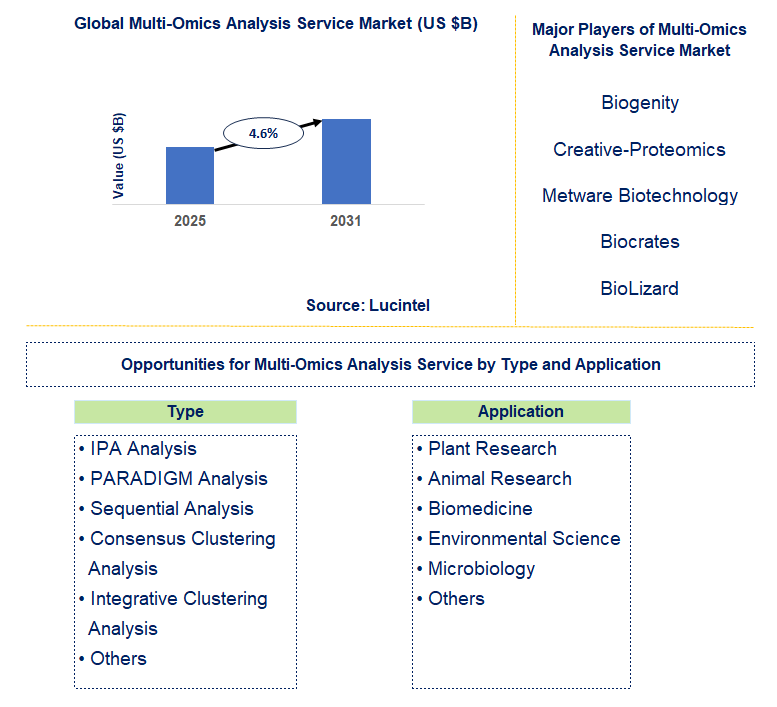
Key data points: The growth forecast = 4.6% annually for the next 7 years. Scroll below to get more insights. This market report covers trends, opportunities and forecasts in multi-omics analysis service market to 2031 by type (IPA analysis, PARADIGM analysis, sequential analysis, consensus clustering analysis, integrative clustering analysis, and others), application (plant research, animal research, biomedicine, environmental science, microbiology, and others), and region (North America, Europe, Asia Pacific, and the Rest of the World)
We'll send your sample report shortly.
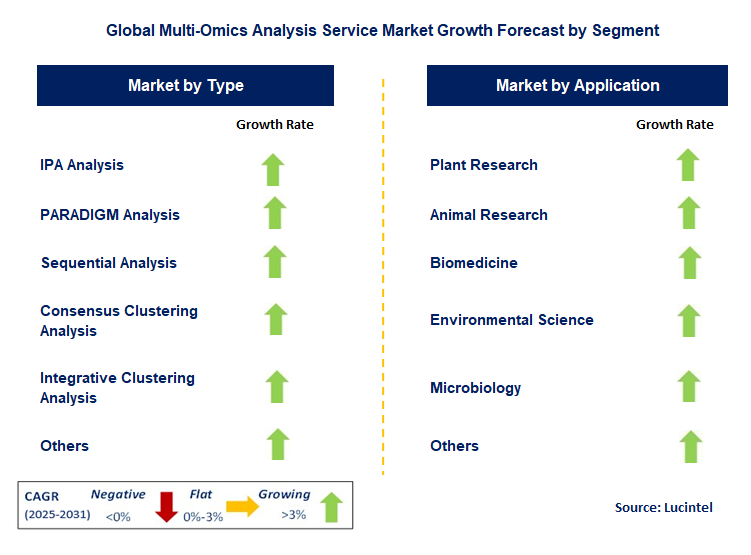
• Lucintel forecasts that, within the type category, integrative clustering analysis is expected to witness the highest growth over the forecast period.
• Within the application category, biomedicine is expected to witness the highest growth.
• In terms of region, APAC is expected to witness the highest growth over the forecast period. Gain valuable insights for your business decisions with our comprehensive 150+ page report. Sample figures with some insights are shown below.
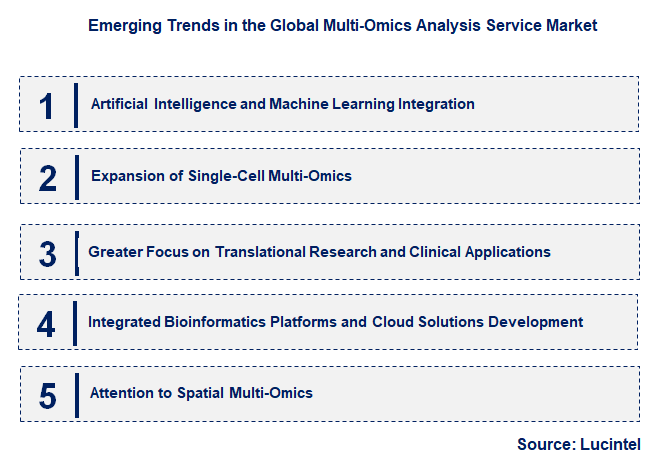
• Artificial Intelligence and Machine Learning Integration: One of the major upcoming trends is the intensified integration of Artificial Intelligence and Machine Learning algorithms for analysis of multi-omics data. As the volume of data from different layers of omics has exploded, AI/ML tools are becoming irreplaceable for pattern identification, data integration, and predictive modeling. These technologies allow scientists to reveal intricate biological correlations, discover new biomarkers, and predict clinical outcomes with improved precision. The effect is faster discovery in drug development, more accurate diagnostics, and the capacity to glean useful information from huge, complicated data sets, leading to more intelligent biological understanding.
• Expansion of Single-Cell Multi-Omics: Expansion of single-cell multi-omics is a major upcoming trend. Conventional bulk omics analyses pool signals from hundreds of thousands or millions of cells, obfuscating cellular heterogeneity. Single-cell multi-omics, on the other hand, enables the profiling of multiple omics layers (e.g., genomics, transcriptomics, proteomics) of individual cells simultaneously. This offers an unparalleled resolution for examining cell-to-cell variability, cellular differentiation, and disease mechanisms at a molecular level. The consequence is a more accurate view of disease pathology and drug response, enabling highly targeted therapies and personalized medicine strategies.
• Greater Focus on Translational Research and Clinical Applications: A new developing trend is an increasing focus on multi-omics beyond fundamental research to translational research and therapeutic applications. This includes using multi-omics data for the discovery of biomarkers, stratification of diseases, patient risk prediction, and therapeutic decision-making in clinics. The objective here is to turn abstract biology into useful clinical applications. The consequence is the acceleration of personalized medicine, where clinicians can make more accurate decisions based on an end-to-end understanding of a patient's molecular profile, and resulting in more efficacious and personalized treatments.
• Integrated Bioinformatics Platforms and Cloud Solutions Development: Development of integrated bioinformatics platforms and cloud solutions is a key trend in the making. Management and analysis of multi-omics data need advanced computational infrastructure and advanced software. Cloud-based systems provide scalability, accessibility, and collaborative spaces for data processing, storage, and analysis. Encompassed bioinformatics tools automate workflows, from raw data processing to advanced statistical analysis and visualization. The effect is improved access to multi-omics analysis for researchers everywhere, lowered computational burden, and improved collaboration, making multi-omics research more efficient and reproducible.
• Attention to Spatial Multi-Omics: A thrilling new trend is attention to spatial multi-omics. Spatial multi-omics technology makes it possible to study omics data and maintain the spatial context of cells and tissues. In contrast to conventional approaches that homogenize samples, spatial multi-omics offers insights into the distribution of genes, proteins, and metabolites within a tissue and provides essential information on cellular interactions and tissue architecture during health and disease. The influence is a deeper insight into intricate biological processes in their natural tissue context, which is crucial for disciplines such as developmental biology, neuroscience, and oncology. Such future trends are essentially rewriting the script for the multi-omics analysis service market by boosting analytical potential, streamlining data access, fueling precision in biological understanding, and expanding the scope of applications, thus fueling scientific breakthroughs and enabling advances in personalized medicine.
• Progress in Single-Cell Multi-Omics Technologies: A key recent advancement has been the rapid evolution of single-cell multi-omics technologies. Advances in instruments and assays now facilitate the simultaneous profiling of several omics layers (e.g., protein and RNA) from one cell at a time. This ability is transforming areas such as oncology and immunology by uncovering cell-to-cell heterogeneity that bulk analyses would otherwise overlook. The effect is a more nuanced view of disease development, mechanisms of drug resistance, and cellular differentiation processes, and thereby more focused research and therapeutic approaches.
• Advanced Data Integration and Bioinformatics Tools: Some of the latest additions include the arrival of progressively more advanced data integration and bioinformatics tools that are specifically tailored for multi-omics datasets. With increasing volume and complexity of omics data, specialist software and computational pipelines become essential for combining heterogeneous types of data (genomic, proteomic, metabolomic) and deciphering useful biological information. This evolution incorporates AI and machine learning algorithms for predictive modeling and pattern recognition. The consequence is enhanced data interpretation, accelerated biomarker discovery, and the capacity for constructing more detailed biological models.
• Emergence of Spatial Multi-Omics: Increased use of spatial multi-omics is another hallmark of recent advances. This new technology provides the capability to analyze multi-omics data simultaneously without compromising the native spatial organization of cells in tissues. Scientists can now realize the distribution of molecular profiles in different regions of a tissue and get valuable context for comprehending disease microenvironments, tumor heterogeneity, and developmental biology. The effect is a deeper and more contextualized view of biological phenomena, which was not possible using conventional approaches, and this greatly enhances areas such as pathology and neurobiology.
• Greater Emphasis on Clinical and Translational Uses: Recent progress emphasizes the increased focus on translating multi-omics studies into clinical and translational uses. Service providers are now providing multi-omics solutions that focus on biomarker discovery for disease diagnosis, prognosis, and prediction of treatment response. This transformation is fueled by the promise of multi-omics to transform personalized medicine, enabling personalized therapies based on an individual's own molecular signature. The effect is a linkage between basic research and tangible patient advantages, expediting precision diagnostics and therapeutics development.
• Cost Reduction and Accessibility of Omics Technologies: Another ongoing recent trend has been the substantial decline in the price of foundational omics technologies, most notably next-generation sequencing (NGS) and mass spectrometry. This decline, combined with growing access to multi-omics analysis services, has brought these highly effective tools into use for more researchers and institutions. The effect is democratizing multi-omics science, enabling smaller labs and developing markets to take advantage of these technologies, resulting in expanded scientific investigation and accelerating the discovery process in various biological fields. These advancements are significantly transforming the multi-omics analysis service market by increasing its functionality, widening its applications, and rendering it more affordable. The market is shifting towards offering more integrated, accurate, and clinically meaningful insights, promoting scientific innovation and restructuring healthcare.
• Precision Medicine and Personalized Therapeutics: A top strategic growth area is precision medicine and personalized therapeutics. Multi-omics information, by combining genomics, transcriptomics, proteomics, and metabolomics, is able to give a comprehensive molecular portrait of single patients. This enables us to identify targeted biomarkers, forecast response to therapy, and customize treatment regimens in order to have the greatest efficacy and least possible side effects. The rising need for personalized healthcare strategies will fuel major investment in multi-omics services for disease diagnosis, prognosis, and therapeutic decision-making, especially in oncology and orphan diseases.
• Drug Discovery and Development: Pharmaceutical and biotechnology industries offer a huge strategic growth opportunity. Multi-omics analysis services are vital for speeding up drug discovery and development pipelines. They allow identification of new drug targets, elucidation of disease mechanisms, drug efficacy and toxicity profiling, and patient population stratification for clinical trials. By delivering a complete molecular insight into disease and drug interaction, multi-omics services can appreciably curtail the time and expense involved in getting new drugs to market, driving innovation in therapeutic development.
• Biomarker Discovery and Diagnostics: Discovery of biomarkers and creation of next-generation diagnostics are another major strategic growth opportunity. Multi-omics analysis is particularly adept at finding new biomarkers for disease detection at an early stage, following the progression of disease, and forecasting response to treatment. Services on combining various types of omics data can reveal intricate biomarker patterns that are more stable and informative than those from individual-omics strategies. This is especially significant for multifactorial diseases such as cancer, neurodegenerative diseases, and autoimmune diseases, where the need for highly sensitive and specific diagnostic reagents is necessitated.
• Agricultural Biotechnology and Crop Improvement: Aside from human health, agricultural biotechnology presents a developing strategic potential. Multi-omics profiling services are increasingly employed in analyzing plant stress responses, enhancing crop yields, increasing nutritional value, and creating disease-resistant strains. By combining genomic, transcriptomic, and metabolomic information of plants, researchers can determine genes and pathways related to desirable characteristics. This use enables more efficient and targeted breeding programs and aids in food security worldwide as well as sustainable agriculture production.
• Microbiome Research and Therapeutic Development: The rapidly emerging microbiome research is a strong strategic growth sector. Multi-omics analysis is imperative to describe the intricate interactions in microbial communities (e.g., gut microbiome) and their influence on host health and disease. Services providing metagenomics, meta transcriptomics, and metaproteomic analysis can deconstruct the functional role of microbes and their metabolites. This insight is crucial for developing novel probiotics, prebiotics, and microbiome-modulating therapies for a wide range of conditions, from gastrointestinal disorders to metabolic diseases. These strategic growth opportunities are profoundly impacting the multi-omics analysis service market by driving its expansion into diverse and high-value application areas. They underscore the transformative potential of integrated omics approaches in advancing scientific understanding and delivering tangible benefits across healthcare, agriculture, and other critical sectors.
• Biogenity
• Creative-Proteomics
• Metware Biotechnology
• Biocrates
• BioLizard
• Aimed-Analytics
• Cmbio
• Abace-Biology
• Gmet
• RayBiotech
• IPA Analysis
• PARADIGM Analysis
• Sequential Analysis
• Consensus Clustering Analysis
• Integrative Clustering Analysis
• Others
• Plant Research
• Animal Research
• Biomedicine
• Environmental Science
• Microbiology
• Others
• North America
• Europe
• Asia Pacific
• The Rest of the World
• United States: The United States is a pioneering market for multi-omics analysis services, driven by high research and development spends and a strong biotechnology and pharma sector. Recent advances feature widespread use of single-cell multi-omics for deciphering cellular heterogeneity in diseases such as cancer. There is heavy emphasis on machine learning and artificial intelligence for deep data integration and interpretation to facilitate more accurate biomarker identification and personalized therapy approaches. Private enterprises and academic institutions are actively engaged in extending the frontiers of multi-omics science.
• China: Market for multi-omics analysis services in China is growing rapidly, fueled by high government expenditure on life science research and an emerging biotechnology industry. Recent advances involve heightened interest in using multi-omics for conventional Chinese medicine, with the aim to scientifically justify and increase its effectiveness. There is also a strong emphasis on indigenous development of cutting-edge sequencing and mass spectrometry technologies. Chinese service providers are enhancing their capacities to provide end-to-end integrated omics solutions for drug discovery and disease diagnosis.
• Germany: Germany's multi-omics data integration services market has a high focus on translational research and personalized medicine. The latest efforts are investments in combining multi-omics data for the purpose of personalized radiotherapy and cardiovascular disease research to achieve better diagnosis and treatment. German research and academic institutions are leading efforts in establishing cutting-edge computational tools for integrating multi-omics data and visualization, creating interdisciplinary collaborations to reveal enhanced biological insights.
• India: India's multi-omics analysis service market is growing substantially with rising research funding, an increase in the number of biotechnology and pharmaceutical enterprises, and an escalating awareness of personalized medicine. There have been recent developments where proteomics and genomics laboratories have expanded, providing sophisticated mass spectrometry and next-generation sequencing services. Indian scientists are using multi-omics technologies to investigate common diseases, crop improvement, and traditional Indian medical systems, pointing towards an emerging indigenous capability and demand for integrated biological analysis.
• Japan: Japan's multi-omics analysis service market remains on a growth trajectory, underpinned by its sophisticated healthcare infrastructure and robust research environment. Latest trends involve growing use of integrated omics platforms in drug discovery and biomarker identification, especially in the fields of oncology and regenerative medicine. Academic institutions and firms in Japan are concentrating on establishing innovative analytical instruments and bioinformatics tools to improve multi-omics data production and interpretation, leading to the evolution of precision medicine and fundamental biological study.


• Biogenity
• Creative-Proteomics
• Metware Biotechnology
• Biocrates
• BioLizard
• Aimed-Analytics
• Cmbio
• Abace-Biology
• Gmet
• RayBiotech Q5. Which multi-omics analysis service market segment will be the largest in future? Answer: Lucintel forecasts that, within the type category, integrative clustering analysis is expected to witness the highest growth over the forecast period. Q6. In multi-omics analysis service market, which region is expected to be the largest in next 5 years? Answer: In terms of region, APAC is expected to witness the highest growth over the forecast period. Q7. Do we receive customization in this report? Answer: Yes, Lucintel provides 10% customization without any additional cost.


Choose a license that fits your team. Instant PDF delivery.
Prices exclude taxes. Instant delivery. Custom licensing available on request.
Market Report · July 15, 2026
Market Report · May 18, 2026
Market Report · May 18, 2026
Trusted partner for strategic intelligence and business growth


Receive a complimentary market analysis tailored to your industry. Our analysts will identify key growth opportunities and competitive dynamics specific to your business.

Market size, growth rate, and key trend analysis for your specific sector.

Top competitor positioning and market share analysis.

Strategic recommendations backed by data-driven insights.
Get curated market intelligence and competitive moves straight to your inbox.
By subscribing, you agree to receive our monthly insights. Unsubscribe anytime.
Receive a complimentary market analysis tailored to your industry. Our analysts will identify key growth opportunities and competitive dynamics specific to your business.
Market size, growth rate, and key trend analysis for your specific sector.
Top competitor positioning and market share analysis.
Strategic recommendations backed by data-driven insights.
Get curated market intelligence, emerging trends, and competitive moves straight to your inbox each month.
By subscribing, you agree to receive our monthly insights. Unsubscribe anytime.
We'll send your sample report shortly.