
Market Report · July 24, 2026

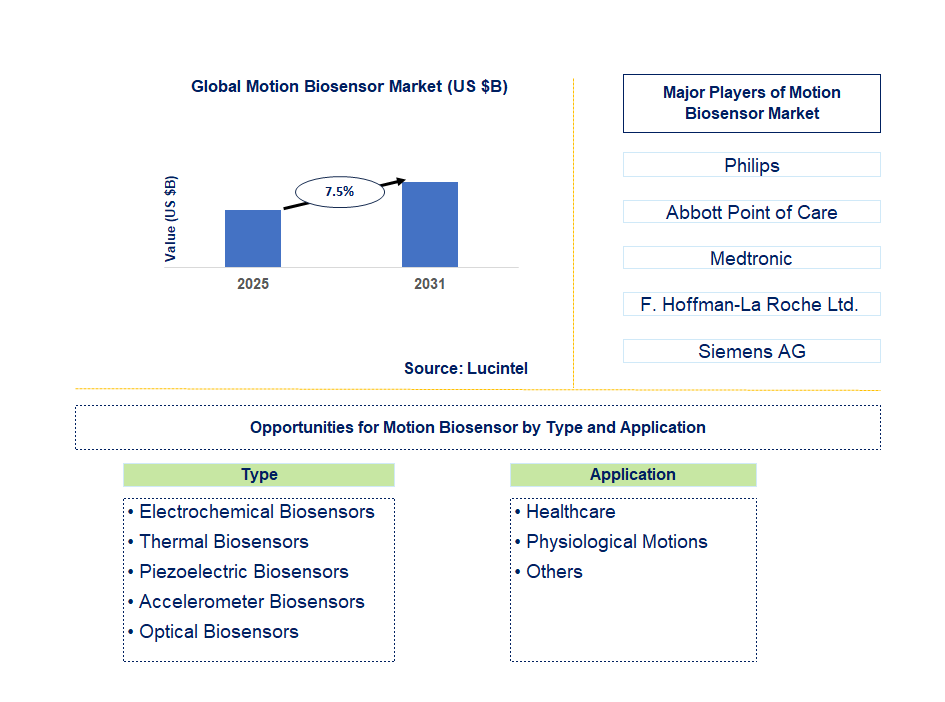
Key data points: The growth forecast = 7.5% annually for the next 7 years. Scroll below to get more insights. This market report covers Trends, opportunity and forecast in motion biosensor market to 2031 by type (electrochemical biosensors, thermal biosensors, piezoelectric biosensors, accelerometer biosensors, and optical biosensors), application (healthcare, physiological motions, and others), and region (North America, Europe, Asia Pacific, and the Rest of the World)
We'll send your sample report shortly.
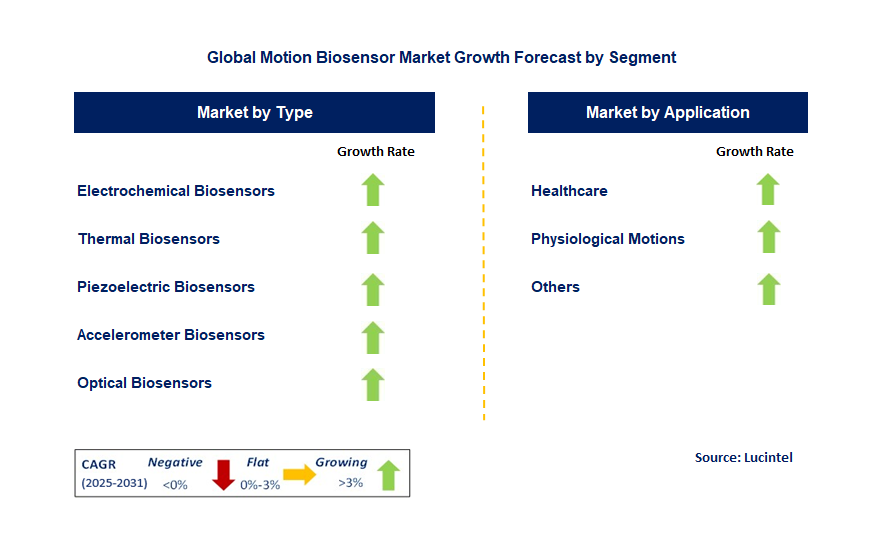
• Lucintel forecasts that, within the type category, electrochemical biosensors will remain the largest segment over the forecast period due to rising chronic illness requiring precise, real-time monitoring.
• Within the application category, healthcare will remain the larger segment due to broader application range.
• In terms of region, North America is expected to witness the highest growth over the forecast period. Gain valuable insights for your business decisions with our comprehensive 150+ page report. Sample figures with some insights are shown below.
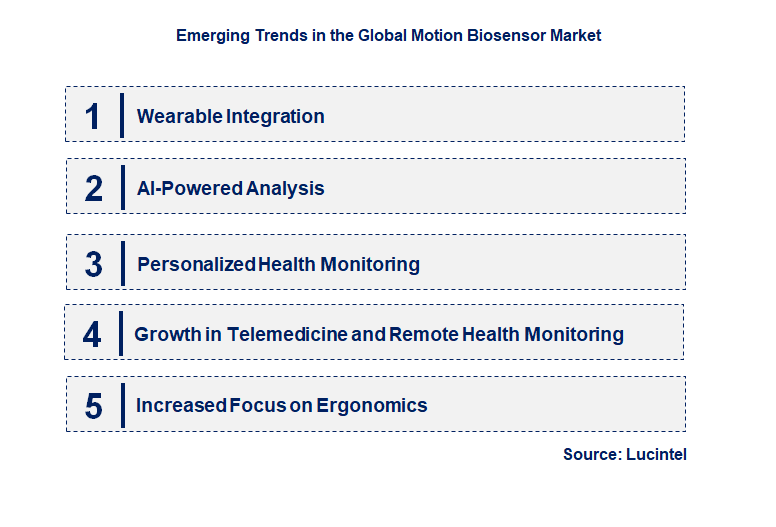
• Wearable Integration: The integration of motion biosensors with wearable devices such as smartwatches and fitness trackers is growing. These sensors are used to monitor physical activity, posture, and joint movements, providing real-time feedback and insights for fitness and health management. This trend is enabling users to monitor their health more conveniently and accurately.
• AI-Powered Analysis: The use of artificial intelligence for real-time data analysis from motion biosensors is increasing. Machine learning algorithms are being used to interpret complex movement data, identify patterns, and provide actionable insights. This trend is enhancing the usability of motion biosensors in healthcare, sports, and industrial applications.
• Personalized Health Monitoring: The trend towards personalized health management is driving the adoption of motion biosensors. These sensors provide detailed data on movement patterns, helping users to optimize their exercises, prevent injuries, and monitor chronic conditions. The ability to customize data analysis based on individual needs is becoming a significant factor in market growth.
• Growth in Telemedicine and Remote Health Monitoring: The COVID-19 pandemic accelerated the adoption of remote health monitoring solutions, including motion biosensors. These devices are used to monitor physical activity and movement from a distance, enabling continuous patient monitoring and providing healthcare providers with real-time data for effective management of chronic conditions.
• Increased Focus on Ergonomics: In industrial applications, motion biosensors are being used to optimize ergonomics and prevent workplace injuries. These sensors provide data on posture and movement, allowing for better design of workstations and reducing strain on workers’ bodies. This trend is driving demand in manufacturing and warehousing sectors. Emerging trends such as wearable healthcare integration, miniaturization, AI-driven analytics, and IoT connectivity are transforming the global motion biosensor market. These innovations are driving adoption across industries, enhancing user convenience, and enabling new possibilities in healthcare, fitness, and beyond.
• Launch of Advanced Multi-parameter Sensors: Manufacturers are launching new motion biosensors capable of tracking multiple body movements simultaneously. These sensors can monitor joint angles, muscle activity, and gait, providing comprehensive data for physical therapy and sports analytics. The ability to analyze complex movement data in real-time is improving user outcomes and driving adoption.
• Collaboration with Healthcare Providers: Partnerships between motion biosensor manufacturers and healthcare providers are increasing, allowing for integration into telemedicine platforms. These collaborations enable real-time data sharing, enhancing remote patient monitoring and treatment effectiveness. The integration of these sensors into clinical settings is facilitating better patient care management.
• Integration with Fitness Apps: The integration of motion biosensors with fitness applications is becoming more common. This development allows users to monitor their workouts more closely, track progress, and receive personalized feedback on performance. The convenience of using these sensors with mobile apps is driving market growth among fitness enthusiasts.
• Expansion into Industrial Applications: The use of motion biosensors in industrial settings is growing, particularly for optimizing workplace ergonomics and safety. These sensors are used to monitor posture, movement, and strain, helping to prevent injuries and improve efficiency in manufacturing environments. This trend is enhancing productivity and safety in workplaces.
• Advancements in Data Security: As motion biosensors collect more personal data, there is an increased focus on data security. Companies are implementing robust encryption and data anonymization techniques to protect user information. This trend is crucial for building consumer trust and ensuring regulatory compliance in various markets. Recent advancements, such as wearable innovation, flexible sensors, and VR integration, are broadening the motion biosensor market's scope. These developments enhance device functionality, attract new users, and fuel market growth.
• Healthcare: The use of motion biosensors in healthcare for physical therapy, injury prevention, and chronic disease management is growing. These sensors provide real-time data to healthcare providers, enabling personalized treatment plans and better patient outcomes. The trend towards remote health monitoring is further driving demand for these devices.
• Fitness and Wellness: In the fitness sector, motion biosensors are being used to monitor workouts, track performance, and provide real-time feedback. These sensors help users optimize their exercise routines, prevent injuries, and improve overall fitness. The integration with fitness apps is making these devices more accessible and user-friendly.
• Sports Performance: The adoption of motion biosensors in sports is increasing, particularly for tracking movement, posture, and muscle activity. These sensors provide valuable data for coaches and athletes to analyze performance, prevent injuries, and optimize training regimens. The trend towards personalized sports analytics is driving demand in this sector.
• Industrial Ergonomics: The use of motion biosensors in industrial settings for ergonomics and safety is growing. These sensors monitor movements and posture, providing data to prevent injuries and reduce workplace strain. The focus on worker safety and productivity in manufacturing and warehousing is driving adoption in this segment.
• Telemedicine and Remote Monitoring: The trend towards remote health monitoring is creating growth opportunities for motion biosensors in telemedicine. These devices allow for continuous monitoring of physical activity and movement patterns, enabling healthcare providers to offer timely interventions and personalized care from a distance. The global motion biosensor market is poised for significant growth across applications like healthcare, fitness, rehabilitation, industrial automation, and gaming. These opportunities underscore the market's expanding role in improving efficiency, convenience, and user engagement across sectors.
• Philips
• Abbott Point of Care
• Medtronic
• F. Hoffman-La Roche
• Siemens AG
• Electrochemical Biosensors
• Thermal Biosensors
• Piezoelectric Biosensors
• Accelerometer Biosensors
• Optical Biosensors
• Healthcare
• Physiological Motions
• Others
• North America
• Europe
• Asia Pacific
• The Rest of the World
• United States: In the United States, the motion biosensor market is witnessing rapid growth due to increasing adoption in healthcare and fitness sectors. Key advancements include the development of sensors that can track a wide range of motions, such as joint angles and muscle activity, providing valuable insights for physical therapy and rehabilitation. The integration of these sensors with smartphones and wearables is enhancing real-time data analysis and user feedback. Additionally, the growth of remote health monitoring solutions is driving demand for motion biosensors, particularly for applications in sports analytics and injury prevention.
• China: In China, the motion biosensor market is expanding rapidly, driven by government support for smart healthcare solutions and a rising focus on fitness and wellness. These sensors are widely used in sports and rehabilitation, especially for monitoring athletic performance and physical therapy exercises. The integration of motion biosensors with mobile devices and health apps is enabling real-time tracking and feedback, enhancing user engagement and effectiveness. The Chinese market is also seeing growth in smart manufacturing applications, where motion biosensors are used for quality control and ergonomics, reflecting the country’s emphasis on digital transformation.
• Germany: In Germany, the motion biosensor market is focused on advanced applications in healthcare and industrial sectors. The sensors are being utilized for precise tracking of movement patterns, aiding in the diagnosis and treatment of movement disorders and providing insights into physical rehabilitation. The integration of motion biosensors with wearable technology is enhancing user experience by providing real-time monitoring of activities. Additionally, there is growing interest in these sensors for use in industrial settings, such as in automation and ergonomics, to improve efficiency and safety on the factory floor.
• India: In India, the motion biosensor market is gaining momentum with increasing applications in sports and healthcare. These sensors are being used to monitor movement patterns during physical exercise and to provide real-time feedback for fitness tracking. The affordability and accessibility of these devices are making them popular among consumers who are increasingly conscious of health and wellness. The adoption of motion biosensors in telemedicine and remote health monitoring is also growing, particularly in rural areas, where these sensors enable continuous patient monitoring without the need for frequent in-person consultations.
• Japan: In Japan, the motion biosensor market is driven by a focus on healthcare, sports, and industrial applications. These sensors are widely used for monitoring physical activity, providing insights into gait, posture, and muscle activity. The integration of motion biosensors with AI-powered analytics is enhancing the ability to interpret complex movement data, enabling personalized health management and tailored physical therapy programs. The market is also seeing growth in industrial applications, particularly in ergonomics, where these sensors are used to optimize workplace design and prevent injuries among workers.


• Philips
• Abbott Point of Care
• Medtronic
• F. Hoffman-La Roche
• Siemens AG Q5. Which motion biosensor market segment will be the largest in future? Answer: Lucintel forecasts that electrochemical biosensors will remain the largest segment over the forecast period due to rising chronic illness requiring precise, real-time monitoring. Q6. In motion biosensor market, which region is expected to be the largest in next 5 years? Answer: North America is expected to witness the highest growth over the forecast period. Q7. Do we receive customization in this report? Answer: Yes, Lucintel provides 10% customization without any additional cost.


Choose a license that fits your team. Instant PDF delivery.
Prices exclude taxes. Instant delivery. Custom licensing available on request.
Market Report · July 24, 2026
Market Report · July 20, 2026
Market Report · July 20, 2026
Trusted partner for strategic intelligence and business growth


Receive a complimentary market analysis tailored to your industry. Our analysts will identify key growth opportunities and competitive dynamics specific to your business.

Market size, growth rate, and key trend analysis for your specific sector.

Top competitor positioning and market share analysis.

Strategic recommendations backed by data-driven insights.
Get curated market intelligence and competitive moves straight to your inbox.
By subscribing, you agree to receive our monthly insights. Unsubscribe anytime.
Receive a complimentary market analysis tailored to your industry. Our analysts will identify key growth opportunities and competitive dynamics specific to your business.
Market size, growth rate, and key trend analysis for your specific sector.
Top competitor positioning and market share analysis.
Strategic recommendations backed by data-driven insights.
Get curated market intelligence, emerging trends, and competitive moves straight to your inbox each month.
By subscribing, you agree to receive our monthly insights. Unsubscribe anytime.
We'll send your sample report shortly.