
Market Report · May 16, 2026

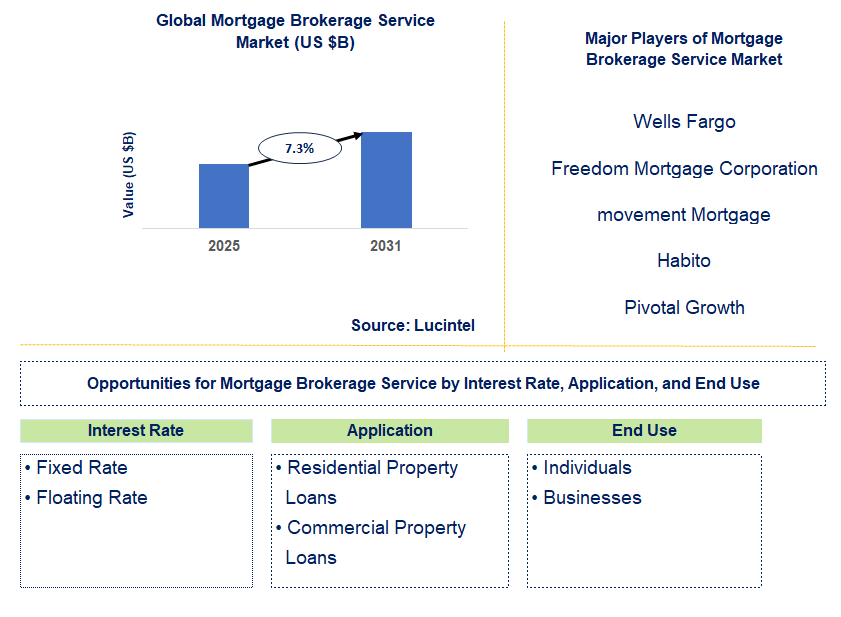
Key data points: The growth forecast = 7.3% annually for the next 7 years. Scroll below to get more insights. This market report covers trends, opportunities and forecasts in mortgage brokerage service market to 2031 by interest rate (fixed rate and floating rate), application (residential property loans and commercial property loans), end use (individuals and businesses), and region (North America, Europe, Asia Pacific, and the Rest of the World)
We'll send your sample report shortly.
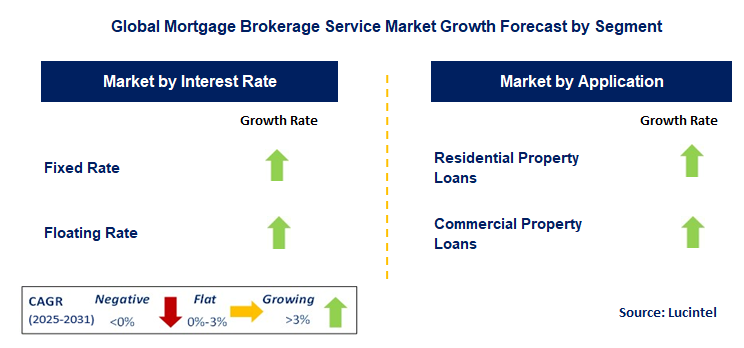
• Lucintel forecasts that, within the interest rate category, floating rate is expected to witness higher growth over the forecast period.
• Within the end use category, individual is expected to witness higher growth.
• In terms of region, APAC is expected to witness the highest growth over the forecast period. Gain valuable insights for your business decisions with our comprehensive 150+ page report. Sample figures with some insights are shown below.
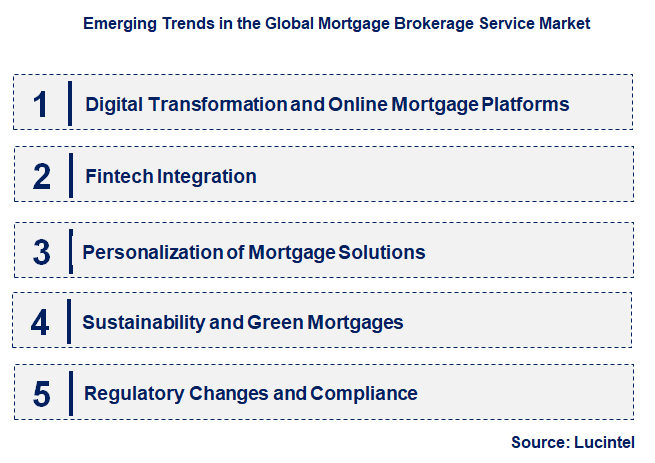
• Digital Transformation and Online Mortgage Platforms: Digital mortgage platforms adoption is a trend. Customers are more and more demanding the ease of applying for a mortgage online, comparing deals, and being instantly approved. Mortgage brokers are going digital to provide better service and improve processes. These platforms shorten the time to approval and facilitate the process of applying for a mortgage, enabling brokers to deal with more customers at lower costs.
• Fintech Integration: Fintech firms are increasingly integrated into the mortgage brokerage service business, with new avenues of innovation being offered. They are leveraging artificial intelligence (AI) and machine learning to process customer information and provide more customized mortgage solutions. The cooperation among legacy mortgage brokers and fintech firms is accelerating efficiency, enhancing the customer experience, and assisting borrowers with ease in finding suitable mortgage products. This trend is likely to persist as fintech solutions mature to meet the unique requirements of mortgage brokerage services.
• Personalization of Mortgage Solutions: Today, consumers want very personalized experiences, and mortgage brokers are reacting by providing tailored mortgage solutions. By employing data analytics, brokers can study consumer behavior and financial conditions to advise optimal mortgage products. Personalization serves to differentiate brokers in a competitive environment, improving customer satisfaction and retention. Personalization also reaches digital platforms, where consumers can customize mortgage proposals to their taste and affordability.
• Sustainability and Green Mortgages: Sustainability is becoming a necessary consideration in the mortgage industry as more consumers seek environmentally friendly mortgage products. Green mortgages, with preferential terms for energy-efficient properties, are gaining favor. Brokers are reacting by adding sustainability considerations into their offerings, offering borrowers choices to pay for homes with reduced carbon emissions. This movement will continue to expand as governments everywhere encourage green building and sustainability.
• Regulatory Changes and Compliance: Mortgage brokers are confronted by a more stringent regulatory landscape with new compliance criteria being implemented everywhere in the world. These regimes are designed to safeguard consumers as well as help to provide an open mortgage experience. Brokers have to be abreast with evolving legislation as well as conduct their business while conforming with local laws. This will become more prevalent going forward as authorities implement more severe requirements, and this is in lending practices, as well as data protection. The new trends in the mortgage brokerage service industry—digitalization, fintech collaboration, customized solutions, sustainability, and regulation—are transforming the business. These trends not only are improving customer experience but are also influencing innovation and efficiency. As the industry keeps transforming, mortgage brokers will have to respond to these trends to remain competitive and keep up with increasing demand for customized, accessible, and sustainable mortgage products.
• Expansion of Digital Mortgage Brokers: Online mortgage brokers are increasingly gaining momentum because they can offer fast, effective services to customers. These brokers use technology to automate the mortgage application process, which allows borrowers to compare quotes and get approvals easily. Online platforms have increased the transparency and ease of the mortgage process, allowing brokers to service a greater number of customers.
• Use of Artificial Intelligence: AI and machine learning are being incorporated into mortgage brokerage services more and more. AI enables brokers to review vast volumes of data, forecast market behavior, and make more precise mortgage recommendations to consumers. By maximizing data-driven decision-making, AI enhances the speed and accuracy of the mortgage process for both brokers and consumers. This innovation is assisting brokers in providing more personalized services and increasing customer satisfaction.
• Non-Bank Lenders Capturing Market Share: Non-bank lenders are capturing a growing share of the mortgage market, posing competition to conventional banks. These lenders tend to provide more accommodating terms and lower interest rates, making them attractive to customers who cannot qualify for conventional bank loans. Mortgage brokers are aligning themselves with these non-bank lenders to provide a wider array of mortgage products, thus increasing their service offerings and catering to a more diverse client base.
• Transition to Sustainable Mortgages: With sustainability gaining prominence among consumers, brokers are offering more and more green mortgages. Green mortgages are intended to promote energy-efficient house construction and repair by providing good terms on environmentally friendly constructions. The growing appeal of green mortgages is making brokers consider these options as part of their portfolios to cater to ecologically oriented customers.
• Expanded Regulatory Oversight: Mortgage broking business is currently under the grip of tightened regulative focus where governments have moved to adopt tightened regulations designed for consumer protection. Such regulations entailed lending practice transparency, intensified lending standards, and further enforced data protection principles. Brokers are compelled to conform to all these through assuring compliance along with taking in-place operational alignments to elicit legal as well as monetary penalty avoidance. These changes represent a quickly evolving mortgage brokerage market. The technological revolution, growth of non-bank lenders, sustainability currents, and increasing regulation are all working to create a more vibrant and competitive market. Those brokers who are able to adapt successfully to these shifts will be in an excellent position to succeed in this new world.
• Digital Mortgage Platforms: The transition to digital platforms is one of the most important growth opportunities for mortgage brokers. By providing end-to-end online mortgage application processes, brokers can serve tech-conscious consumers who value convenience and speed. The digital channels enable borrowers to compare quotes directly, upload papers, and monitor their application status with ease. This greater automation and transparency lead to a streamlined process that saves time and money. Brokers who invest in creating easy-to-use digital interfaces will be able to reach a wider customer base and increase overall satisfaction.
• Integration of AI and Data Analytics: Implementing AI and data analytics within mortgage brokerage services allows brokers to make more customized suggestions and streamline decision-making. With insights on consumer behavior and financial information, brokers can connect clients with the most appropriate mortgage options, driving higher conversion rates and customer satisfaction. AI also automates underwriting activities, lowering error rates and improving approval speed. Through such technological integration, brokers can stand out from competitors by delivering more customized, customer-oriented services and enhancing business efficiency.
• Non-Bank Lender Partnerships: Partnership with non-bank lenders is a significant business growth opportunity for mortgage brokers. Non-bank lenders tend to offer more attractive interest rates and more flexible terms than banks, which appeals to borrowers who may not be able to secure traditional loans. By forming alliances with these lenders, mortgage brokers are able to broaden their product line and attract more customers. These alliances also assist brokers in differentiating themselves in a competitive market, where they can emerge as trusted advisors with the ability to offer varied financing solutions.
• Green Mortgages and Sustainability: With growing environmental awareness among consumers, demand for green mortgages has increased. Green mortgages provide preferential terms for energy-efficient properties or buildings with sustainable aspects. Mortgage brokers can leverage this trend by providing these niche products to environmentally conscious buyers. Proactive brokers who inform consumers about green mortgages and sell these products will be well-placed to capture the increasing share of environmentally-aware borrowers. Moreover, matching up with sustainability trends improves a broker‘s brand image and reputation.
• Foraying into Emerging Markets: Foraying into emerging markets is an exciting growth opportunity for mortgage brokers. As developing countries‘ economies expand, so does homeownership demand. Brokers who can access these markets are able to enjoy early-mover benefits. The emerging markets, like those in Southeast Asia or Latin America, provide untapped potential as the number of individuals shifting from renting to homeownership increases. Through providing localized mortgage solutions that fit the needs and financial profiles of these markets, brokers can become important players in these fast-emerging markets. The strategic growth prospects in the mortgage brokerage service market are defined by digitalization, technological advancements, sustainability movements, and new entrants in the market. By adopting digital platforms, aligning with non-bank lenders, embracing AI-powered solutions, providing green mortgages, and entering new emerging markets, brokers can enhance their market share and provide improved value to their customers. These prospects are vital in meeting evolving consumer needs and maintaining sustainable growth in the competitive mortgage market.
• Wells Fargo
• Freedom Mortgage Corporation
• movement Mortgage
• Habito
• Pivotal Growth
• Aussie Home Loans
• loanDepot
• NerdWallet
• AIGB Financing Broker
• Flagstar Bank
• Fixed Rate
• Floating Rate
• Residential Property Loans
• Commercial Property Loans
• North America
• Europe
• Asia Pacific
• The Rest of the World
• United States: The mortgage brokerage service market in the United States has been increasingly powered by digitalization and changing regulations. The use of online platforms has increased, allowing brokers to access a wider market and streamline the mortgage application process. With the Federal Reserve‘s interest rate changes, mortgage rates have varied, influencing consumer borrowing behavior. Furthermore, there is an increasing need for tailored mortgage solutions, which has driven the growth of technology-based services like AI-based lending platforms. The market is also seeing a trend of moving towards non-bank lenders and fintech firms providing mortgage brokerage services.
• China: China‘s mortgage brokerage market is developing rapidly because of the increasing housing demand in cities, driven by the steady urbanization trend. The supportive policies of the government, such as low interest rates and first-time homebuyers‘ subsidies, have supported the growth of the market. Digital mortgage platforms are increasingly used as Chinese consumers increasingly adopt online financial services. This change is accompanied by tighter regulatory measures to contain the explosive growth in housing prices, to achieve more stable development of the mortgage market. Moreover, mortgage brokers in China are paying more and more attention to giving customized solutions to young tech-literate homebuyers.
• Germany: Mortgage broking in Germany is changing with the growing homeownership ratios and rising demand for mortgages, especially among millennials. Germany‘s mortgage market is distinguished by its high dependence on fixed-rate mortgages that have been appealing to borrowers in the face of volatile interest rates. The evolution of online brokerage firms is revolutionizing the conventional mortgage broking sector with more efficient services. More government programs launched to make homeownership more affordable have driven the market to grow, with brokers concentrating on providing customized mortgage products to serve various income brackets. Also, greater transparency in the mortgage process has benefited both lenders and borrowers.
• India: India‘s mortgage brokerage service market is expanding rapidly as urbanization keeps pace with developments and demand for homeownership rises. The government of India has launched various schemes, such as subsidizing affordable housing, to bring mortgages within the reach of more people. Brokers are increasingly using digital platforms to match lenders with borrowers and simplify the mortgage process. Nevertheless, the market is challenged by limited financial literacy among much of the population. Mortgage brokers are therefore emphasizing educating customers to their alternatives and offering more open, accessible services.
• Japan: Japan‘s mortgage brokerage industry has been experiencing gradual but sustained growth, stimulated by low interest rates and a demographic shift toward an aging population. As more young people choose mortgages to buy their first home, the market is shifting to accommodate a diverse group of borrowers. Japan‘s high level of regulatory control demands that brokers meet high standards, but the expansion of digital mortgage broker platforms is breaking down barriers and enhancing market access. The market is witnessing an increase in hybrid models that blend traditional brokerage services with digital solutions, providing customers with the flexibility and convenience they require.


• Wells Fargo
• Freedom Mortgage Corporation
• movement Mortgage
• Habito
• Pivotal Growth
• Aussie Home Loans
• loanDepot
• NerdWallet
• AIGB Financing Broker
• Flagstar Bank Q5. Which mortgage brokerage service market segment will be the largest in future? Answer: Lucintel forecasts that, within the interest rate category, floating rate is expected to witness higher growth over the forecast period. Q6. In mortgage brokerage service market, which region is expected to be the largest in next 5 years? Answer: In terms of region, APAC is expected to witness the highest growth over the forecast period. Q7. Do we receive customization in this report? Answer: Yes, Lucintel provides 10% customization without any additional cost.


Choose a license that fits your team. Instant PDF delivery.
Prices exclude taxes. Instant delivery. Custom licensing available on request.
Market Report · May 16, 2026
Market Report · September 4, 2025
Market Report · June 11, 2025
Trusted partner for strategic intelligence and business growth


Receive a complimentary market analysis tailored to your industry. Our analysts will identify key growth opportunities and competitive dynamics specific to your business.

Market size, growth rate, and key trend analysis for your specific sector.

Top competitor positioning and market share analysis.

Strategic recommendations backed by data-driven insights.
Get curated market intelligence and competitive moves straight to your inbox.
By subscribing, you agree to receive our monthly insights. Unsubscribe anytime.
Receive a complimentary market analysis tailored to your industry. Our analysts will identify key growth opportunities and competitive dynamics specific to your business.
Market size, growth rate, and key trend analysis for your specific sector.
Top competitor positioning and market share analysis.
Strategic recommendations backed by data-driven insights.
Get curated market intelligence, emerging trends, and competitive moves straight to your inbox each month.
By subscribing, you agree to receive our monthly insights. Unsubscribe anytime.
We'll send your sample report shortly.