
Market Report · July 29, 2026

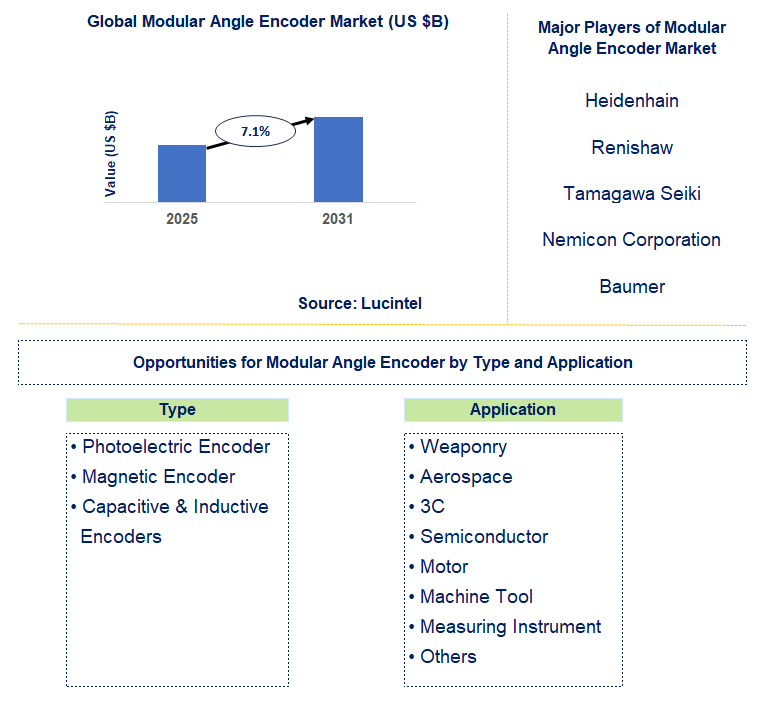
Key data points: The growth forecast = 7.1% annually for the next 7 years. Scroll below to get more insights. This market report covers trends, opportunities and forecasts in modular angle encoder market to 2031 by type (photoelectric encoder, magnetic encoder, and capacitive & inductive encoders), application (weaponry, aerospace, 3C, semiconductor, motor, machine tool, measuring instrument, and others), and region (North America, Europe, Asia Pacific, and the Rest of the World)
We'll send your sample report shortly.
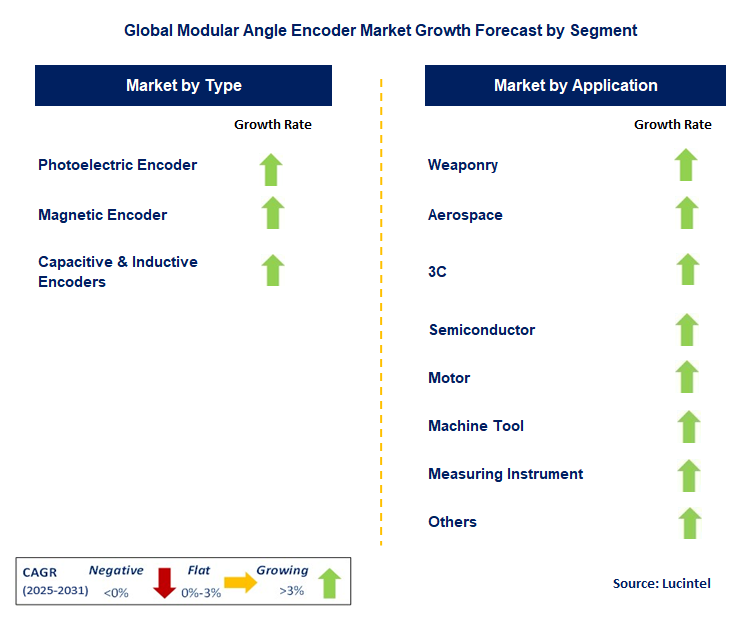
• Lucintel forecasts that, within the type category, magnetic encoder is expected to witness the highest growth over the forecast period.
• Within the application category, aerospace is expected to witness the highest growth.
• In terms of region, APAC is expected to witness the highest growth over the forecast period. Gain valuable insights for your business decisions with our comprehensive 150+ page report. Sample figures with some insights are shown below.
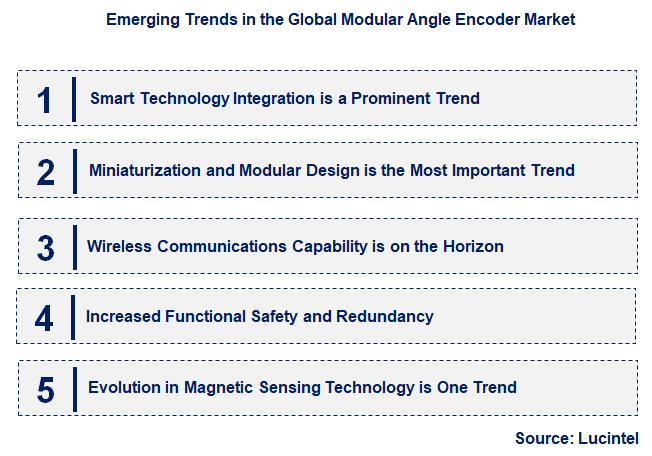
• Smart Technology Integration is a Prominent Trend: Encoders are no longer simple sensing devices; they’re becoming smart devices. This encompasses the integration of features such as embedded diagnostics, predictive maintenance functionality, and sophisticated communication protocols such as IO-Link. The effect is major, as it enables real-time monitoring of machine condition, minimizes downtime, and makes system integration easier. It converts the encoder’s function from a single-component to a central element of a larger Industrial Internet of Things (IoT) platform, empowering more intelligent and more efficient manufacturing processes.
• Miniaturization and Modular Design is the Most Important Trend: The need for miniaturization and compact machine and device size, especially in robots and medical devices, is compelling makers to design smaller, lighter encoders. Its effect is to enable the use of encoders in space-restricted applications where conventional, bulkier sensors were inappropriate. It also enables a modular system design that can be more readily replaced, upgraded, or repurposed, thus enhancing flexibility and decreasing overall size and weight of the finished product.
• Wireless Communications Capability is on the Horizon: Although not yet widespread, wireless technology integration into modular encoders is becoming more popular. The basis for this is the demand for less cable-intensive and more flexible installations, especially in mobile robotics and remote surveillance applications. The effect is that it makes installation easier by eliminating cumbersome cabling, minimizes points of failure, and allows encoders to be deployed in situations where physical connections are impossible or dangerous. This is an important step towards being seriously wireless and mobile automation.
• Increased Functional Safety and Redundancy: With encoders being applied to increasingly safety-critical applications, like Cobots that work alongside human operators, there is increasing demand for encoders with more safety features. This encompasses the creation of encoders with redundant tracks and with self-monitoring onboard. The effect is increased safety compliance and operation reliability, which is vital for businesses with stringent safety requirements. It guarantees that whenever a component malfunctions, there is a redundant system to avert accidents and ensure control.
• Evolution in Magnetic Sensing Technology is One Trend: While optical encoders have been the gold standard for high accuracy for many years, magnetic encoders are quickly closing the gap with similar accuracy and more durability and resistance to contamination from dust, dirt, and moisture. This is particularly critical for extreme industrial environments. The effect of this trend is that it offers a strong and frequently more economical substitute for optical encoders in a broader array of applications, democratizing access to high-precision motion control in harsh environments. These trends are essentially transforming the market for modular angle encoders by changing the value proposition from an entry-level sensor to a combined, smart, and rugged component. The interest is no longer only in delivering a rudimentary position signal but in presenting an end-to-end solution with diagnostics, connectivity, and greater safety features. This is making the market one in which encoders are more flexible, simpler to integrate, and better suited to address the needs of contemporary automation and intelligent manufacturing.
• The Advancement of High-Resolution, Compact Encoders. Manufacturers are now making encoders with resolutions as high as 100 million counts per revolution, all in ever-diminishing package sizes. The effect of this is staggering, as it allows machine builders to have a greater level of accuracy and control in their application, for example, in robotic arms and surgical instruments. This technology provides for more precise and reproducible movements, which is essential for operations calling for fine motor control. It also accommodates the miniaturization of more complex equipment without compromise in performance.
• The Integration of Embedded Diagnostic Functions: New encoders frequently feature onboard sensors and firmware that are able to read their own health, along with environmental conditions such as temperature and vibration. The effect is a drastic reduction in unplanned downtime. Through the delivery of real-time information on the condition of the encoder, routine maintenance can be planned ahead, avoiding disastrous failures. This also makes troubleshooting easier and lowers the cost of ownership by prolonging the life of the gear and minimizing interruption caused by maintenance.
• Implementation of New Communication Protocols: Adoption of such protocols as IO-Link, ProfNet, and Ether CAT is on the rise. The effect is a smoother and more efficient incorporation of encoders into an expanded industrial automation network. The protocols permit encoders to send not just position information but also diagnostics and configuration data, enabling a real Plug and Play experience. This. Simplifies the wiring, minimizes installation time, and facilitates a centralized control system to control multiple devices from a single source.
• Increased endurance in harsh conditions is an innovation worth mentioning. Encoders are being built with enhanced material and sealing technologies that hold up to very high temperatures, vibrations, and exposure to contaminants such as oil and dirt. The effect is that encoders can now be used confidently in a broader scope of harsh industrial applications, including mining, steel production, and heavy machinery. This ruggedness provides reliable performance and a longer lifetime, even under the most severe conditions, thus opening up the market to applications that were not previously accessible.
• Magnetic and inductive encoder technology advancements are a recent trend. This is through employing more advanced signal processing and sensor design for breaking the conventional precision limits of magnetic technology. The result is a robust, high-precision optical encoder alternative. Magnetic and inductive encoders are more shock and contamination-resistant by nature and thus best suited for applications where optical sensors would fail. This innovation presents a sturdy and affordable solution for most industrial uses, which makes the market more competitive and offers consumers more choice. These innovations overall are collectively driving the modular angle encoder market forward by advancing performance, reliability, and connectivity beyond previous limits. They are revolutionizing encoders from mere mechanical components into smart, rugged, and highly integrated devices. The emphasis on high resolution, diagnostics, and emerging communication protocols is addressing Industry 4.0 requirements head-on, while advances in durability and other technologies are opening up new, more challenging applications for the market.
• Collaborative Robotics: There is a huge demand for Cobots that can operate securely in collaboration with humans in the manufacturing sector. This is a major growth opportunity. Cobots need very reliable, safe, and accurate angle encoders to measure the position and velocity of their joints in order to be able to stop or travel safely when a human is in their vicinity. The effect of this is considerable, as it necessitates the use of encoders with high-end functional safety characteristics, including redundancy and in-built diagnostics. Manufacturers that are able to offer encoders that achieve such high levels of safety and performance will establish a solid presence in this fast-growing area of the robotics market.
• Medical Devices: The medical market is more and more using robotic systems for surgery, rehabilitation, and laboratory automation. These systems require extremely high-resolution and dependable encoders to achieve precise, repeatable movement. The application is a significant opportunity for encoders that are able to handle the exacting demands of medical regulations and deliver high levels of accuracy within a sterile and sensitive environment. The emphasis is on low-power, miniature encoders that can be embedded in a wide range of devices, from robotic surgery instruments to CT scanners, where reliability and precision cannot be compromised.
• Wind Turbine Technology: With the transition of the world towards renewable energy, the wind energy industry is growing. Wind turbines are dependent on encoders to regulate the pitch of their blades and the yaw of the nacelle in order to capture maximum energy and avoid damage from excessive winds. The result is a business opportunity for very rugged and long-lasting encoders that meet the tough environmental conditions found on a wind turbine, such as extreme temperatures, shock, and humidity. Encoders that have improved sealing, corrosion resistance, and a long run life are needed in substantial numbers to maintain the efficiency and dependability of these mission-critical infrastructure resources.
• Factory Automation and Logistics: The sustained drive for Industry 4.0 and intelligent factories is generating a huge market in factory automation and logistics. This spans applications in automated guided vehicles (AGVs), conveyor systems, and sorting machines. Such systems call for encoders for precise navigation, positioning, and control of speed. The effect is a market for encoders with a blend of ruggedness, high speed, and simplicity of integration. Demand is for encoders with standard communication interfaces and small size, allowing immediate and problem-free deployment in complex, networked manufacturing and warehouse installations.
• Electric Vehicle Manufacturing: The fast-expanding EV market is generating new opportunities for encoders, including applications in manufacturing operations and inside the vehicles themselves. Encoders are applied to the production of batteries, motor and chassis assembly lines, and for steering and throttle position sensing in the EVs. The application is a huge opportunity for encoders that are not only accurate and dependable but also affordable and scalable to mass production. The segment calls for a mix of cutting-edge technology and manufacturing efficiency, and this is a special challenge and a big payoff for creative encoder manufacturers. These strategic growth opportunities emphasize the broad and increasing uses for modular angle encoders. They reflect an unequivocal road for market expansion by concentrating on high-margin sectors undergoing a revolution in technology. By offering high-performance, application-specific encoders for collaborative robots, medical equipment, and wind turbines, and by providing durable, scalable solutions for factory automation and EVs, producers can access new revenue streams and establish themselves in the market.
• Heidenhain
• Renishaw
• Tamagawa Seiki
• Nemicon Corporation
• Baumer
• Dynaper
• Pepperl+Fuchs
• Sick
• Koyo Electronics
• Kübler Group
• Photoelectric Encoder
• Magnetic Encoder
• Capacitive & Inductive Encoders
• Weaponry
• Aerospace
• 3C
• Semiconductor
• Motor
• Machine Tool
• Measuring Instrument
• Others
• North America
• Europe
• Asia Pacific
• The Rest of the World
• United States: In the USA, the market for modular angle encoders is spurred by strong investments in industrial automation and aerospace. High-resolution, high-precision encoders for sophisticated systems such as robotic surgical equipment and autonomous cars are a major area of interest. The market is also trending toward increasingly integrated and miniature solutions, which are frequently embedded in motors or other parts. This is driven by the need for compact, efficient gearings and an intense presence of research centers and major players pushing technological advancements.
• China: China’s modular angle encoder market is rapidly growing, driven chiefly by China’s large manufacturing base and government policies such as "Made in China 2025." The market is dominated by a large demand volume for encoders in applications involving consumer electronics production, electric vehicles, and industrial robotics. While there is a dominant role played by international players, local manufacturers are working quickly to close the technological gap, providing competitive and affordable solutions.
• Germany: Germany is still a force to be reckoned with in the modular angle encoder market, thanks to its backbone in the automotive sector and sophisticated machinery production. The market is characterized by an overlying focus on precision, reliability, and functional safety. Leading German manufacturers take center stage in creating encoders that include integrated diagnostics and sophisticated communication protocols such as IO-Link and ProfNet, which are crucial to smooth integration into complicated Industry 4.0 scenarios.
• India: The Indian modular angle encoder market is on the rise, propelled by growing industrialization and uptake of automation in industries such as automotive and packaging. The market is in the growth phase, and there is an increasing demand for incremental and absolute encoders. Government programs to encourage domestic production are opening up new avenues for encoder producers. Although the market is price-conscious, there is a growing awareness of the importance of high-quality and dependable encoders to enhance productivity and efficiency. The tendency is shifting towards more advanced solutions as the industrial base becomes mature.
• Japan: Japan’s modular angle encoder market is characterized by a focus on high-tech manufacturing and precision engineering. The country is a major consumer of encoders for its semiconductor manufacturing equipment, robotics, and machine tools. The market places a high value on miniature, high-resolution, and high-speed encoders that meet stringent quality and performance standards. Japanese industry leads the world in creating new technologies, for example, encoders with higher signal quality and less noise, which are essential to maximize the dynamic performance of direct-drive motors. The market is mature, where incremental advances in performance and reliability result from ongoing innovation.


• Heidenhain
• Renishaw
• Tamagawa Seiki
• Nemicon Corporation
• Baumer
• Dynaper
• Pepperl+Fuchs
• Sick
• Koyo Electronics
• Kübler Group Q5. Which modular angle encoder market segment will be the largest in future? Answer: Lucintel forecasts that, within the type category, magnetic encoder is expected to witness the highest growth over the forecast period. Q6. In modular angle encoder market, which region is expected to be the largest in next 5 years? Answer: In terms of region, APAC is expected to witness the highest growth over the forecast period. Q7. Do we receive customization in this report? Answer: Yes, Lucintel provides 10% customization without any additional cost.


Choose a license that fits your team. Instant PDF delivery.
Prices exclude taxes. Instant delivery. Custom licensing available on request.
Market Report · July 29, 2026
Market Report · July 20, 2026
Market Report · July 20, 2026
Trusted partner for strategic intelligence and business growth


Receive a complimentary market analysis tailored to your industry. Our analysts will identify key growth opportunities and competitive dynamics specific to your business.

Market size, growth rate, and key trend analysis for your specific sector.

Top competitor positioning and market share analysis.

Strategic recommendations backed by data-driven insights.
Get curated market intelligence and competitive moves straight to your inbox.
By subscribing, you agree to receive our monthly insights. Unsubscribe anytime.
Receive a complimentary market analysis tailored to your industry. Our analysts will identify key growth opportunities and competitive dynamics specific to your business.
Market size, growth rate, and key trend analysis for your specific sector.
Top competitor positioning and market share analysis.
Strategic recommendations backed by data-driven insights.
Get curated market intelligence, emerging trends, and competitive moves straight to your inbox each month.
By subscribing, you agree to receive our monthly insights. Unsubscribe anytime.
We'll send your sample report shortly.