
Market Report · July 16, 2026

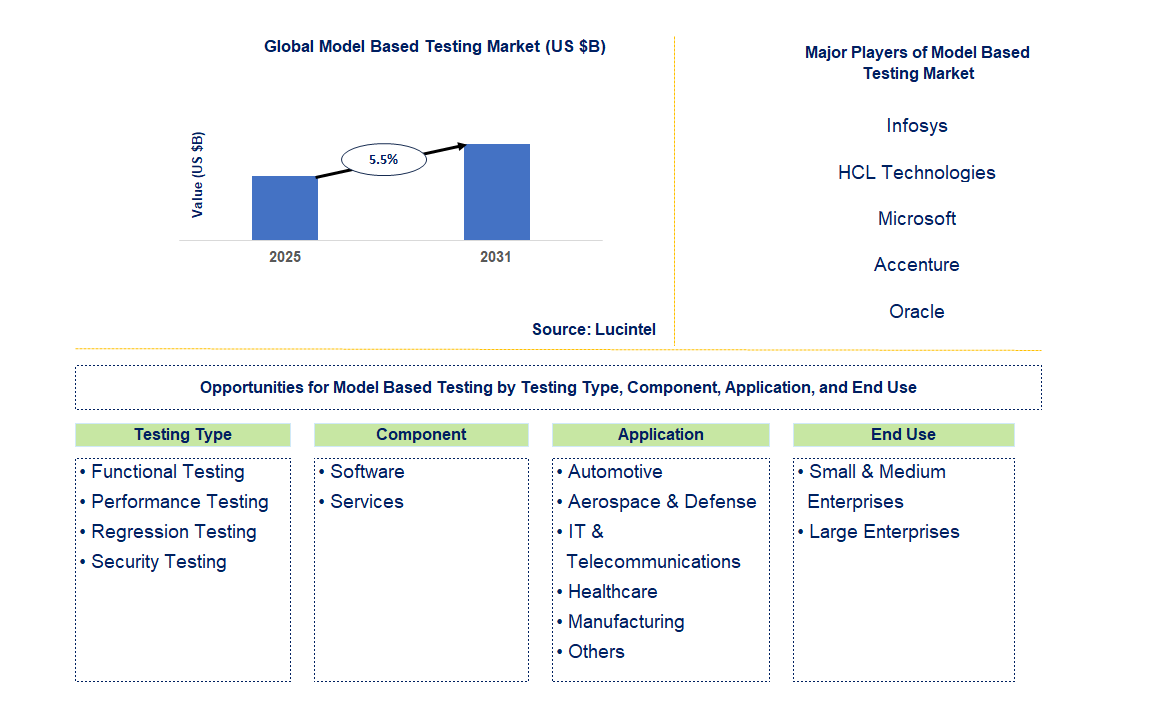
Key data points: The growth forecast = 5.5% annually for the next 7 years. Scroll below to get more insights. This market report covers trends, opportunities and forecasts in model based testing market to 2031 by testing type (functional testing, performance testing, regression testing, and security testing), component (software and services), application (automotive, aerospace & defense, IT & telecommunications, healthcare, manufacturing, and others), end use (small & medium enterprises and large enterprises), and region (North America, Europe, Asia Pacific, and the Rest of the World)
We'll send your sample report shortly.
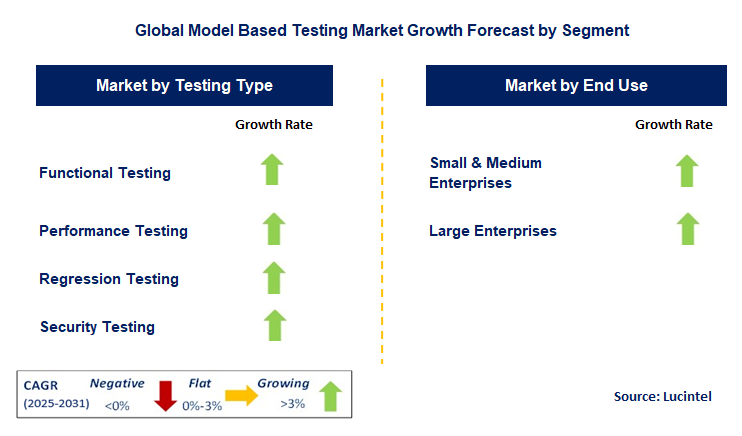
• Lucintel forecasts that, within the testing type category, security testing is expected to witness the highest growth over the forecast period.
• Within the end use category, small & medium enterprise is expected to witness higher growth.
• In terms of region, APAC is expected to witness the highest growth over the forecast period. Gain valuable insights for your business decisions with our comprehensive 150+ page report. Sample figures with some insights are shown below.
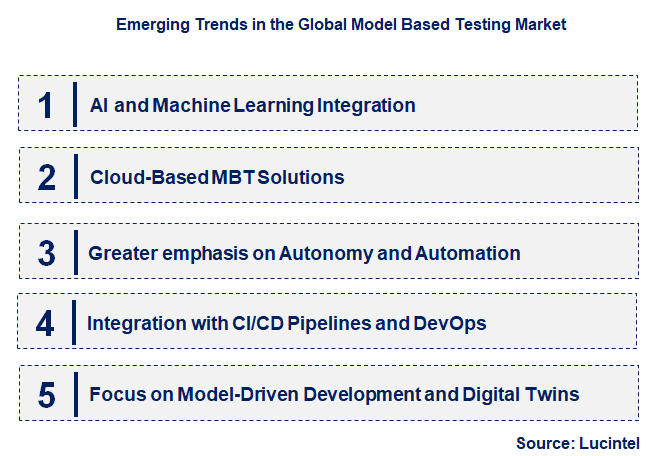
• AI and Machine Learning Integration: This involves incorporating artificial intelligence and machine learning algorithms into MBT tools. AI can model analysis to detect subtle patterns, forecast possible fault locations, and independently generate optimized test cases. This dramatically minimizes the manual work historically involved in test design and run time, resulting in accelerated testing cycles and better defect detection rates. Machine learning extends this even further by allowing tools to learn from historical test outcomes, perpetually improve test strategies, and accommodate changing system behaviors, making testing more intelligent and effective.
• Cloud-Based MBT Solutions: The cloud computing trend is deeply transforming the MBT space. Cloud-based MBT solutions provide unprecedented scalability, accessibility, and affordability. Businesses can use cloud infrastructure to execute sophisticated test scenarios, work on models and test cases geographically distributed teams, and utilize high-performance computing resources without heavy initial investment. This phenomenon makes MBT available to more businesses, including small and medium businesses, and enables smooth integration with other cloud-native development tools and services.
• Greater emphasis on Autonomy and Automation: The push towards automation in software development extends powerfully to MBT. This movement focuses on leveraging the maximum automatic generation of test artifacts, such as test cases, test scripts, and test data, based directly on models. The end goal is to have higher independence in the testing process, wherein tools can automatically determine testing requirements, create applicable tests, run them, and compare results with little or no human involvement. Such automation greatly quickens the testing phase, lessens human mistakes, and enables testers to concentrate on more involved and exploratory testing tasks.
• Integration with CI/CD Pipelines and DevOps: Current software development is largely dependent on DevOps practices and Continuous Integration/Continuous Delivery (CI/CD) pipelines. MBT is increasingly being used in direct integration with these automated pipelines so that continuous testing can be achieved across the entire development life cycle. This implies that the moment a change is introduced in the model or code, appropriate tests are automatically produced and run, giving immediate feedback on quality. This smooth blending ensures that testing is not an independent phase but a natural part of the continuous delivery process, allowing for quicker release cycles and better software quality.
• Focus on Model-Driven Development and Digital Twins: This trend calls attention to the harmony between MBT, Model-Driven Development, and the Digital Twins concept. MDD employs models as first-class development artifacts, and MBT subsequently follows as a natural extension of the same, employing these same models for testing. Digital twins, virtual replicas of real-world systems, take it to the next level by creating realistic environments for testing and simulation. By combining MBT and MDD and digital twins, organizations can have a more comprehensive and precise system validation approach, closing the gap between design, implementation, and actual performance, particularly in intricate cyber-physical systems. These new trends are basically remodeling the model-based testing market by making testing more intelligent, more efficient, more accessible, and more integrated. The higher automation and autonomy are speeding up test cycles and minimizing human effort, and cloud-based technologies are increasing accessibility and scalability. The greater DevOps and CI/CD pipeline integration is providing continuous quality assurance, and the integration with Model-Driven Development and Digital Twins is making it possible to validate more complex and realistic systems. Finally, these trends are making MBT a vital element of contemporary software engineering, essential for ensuring high-quality software at an unprecedented speed.
• Innovation in AI-Powered Test Generation: There have been considerable advancements with respect to combining artificial intelligence and machine learning algorithms with MBT tools for automatic test case generation. These AI algorithms can more intelligently examine system models, detect critical paths, and produce very effective test cases, including edge case and complex scenario test cases, with little human intervention. This innovation significantly minimizes the amount of time and effort traditionally invested in hand-crafting test design, which results in accelerated testing cycles, better test coverage, and a greater likelihood of detecting defects early in the development lifecycle.
• Rise of Cloud-Native MBT Platforms: The market has seen a significant growth in the availability and utilization of cloud-native Model-Based Testing platforms. These platforms use the scalability, flexibility, and accessibility of cloud infrastructure so that organizations are able to perform extensive testing without heavy on-premises hardware investments. Cloud-native MBT solutions allow distributed teams to easily collaborate, support simultaneous test execution, and provide pay-as-you-go options, making sophisticated testing functionality more affordable and accessible to more businesses, even smaller ones.
• Increased Integration with DevOps and CI/CD Toolchains: One of the developments is the integration of MBT tools deeper into current DevOps and Continuous Integration/Continuous Delivery toolchains. This supports automated and ongoing testing across the software development cycle. With the integration of MBT, organizations are able to automatically invoke test generation and run it on every commit of change, getting instant feedback on how these changes affect system quality. This seamless integration assists in moving testing left, catching defects earlier, and speeding up release cycles, aligning MBT with contemporary agile and DevOps methodologies.
• Domain-Specific MBT Solutions: There is increased emphasis on the creation of domain-specific Model-Based Testing solutions that address the specific needs of specific industries like automotive, aerospace, healthcare, and industrial automation. These specialized solutions include industry-specific standards, protocols, and regulatory compliance considerations, which are incorporated into MBT to make it more useful and applicable for complicated systems in these industries. This focused strategy improves the precision of models, the applicability of produced tests, and ultimately the dependability and safety of domain-specific software systems.
• Extension to Cyber-Physical Systems and IoT Testing: The latest trends indicate a vast extension of MBT applications to testing of Cyber-Physical Systems as well as Internet of Things (IoT) devices. With such systems becoming increasingly common and sophisticated, there is a strong need for strong and effective testing practices. MBT is best suited to take care of the interdependence of software and hardware, the real-time issues, and the extremely large number of states in CPS and IoT. MBT facilitates extensive testing of behavior, performance, and security of the overall system with assurance of reliability in highly integrated systems. These new advancements collectively influence the market for model-based testing to make it a more powerful, affordable, and inherent aspect of the software development process. The developments in AI are resulting in more intelligent and self-governing test generation, while cloud-native platforms are improving scalability and collaboration. The increased integration with DevOps and CI/CD pipelines is making continuous testing possible. In addition, the emphasis on domain-specific solutioning and growth into CPS and IoT is opening up the applicability and worth of MBT to a wider range of key industries, ultimately leading to increased efficiency, improved quality, and quicker delivery of complicated software systems.
• Automotive Industry: The automotive industry offers a tremendous growth area for Model-Based Testing with the fast pace of autonomous driving systems as well as Advanced Driver-Assistance Systems (ADAS). These are extremely complex and safety-critical systems, necessitating rigorous testing to guarantee reliability as well as conformance to strict regulations. MBT facilitates the early identification of defects, complete scenario coverage, and effective validation of intricate behavioral models, which is vital for the safety and performance of autonomous cars and sophisticated automotive software.
• Aerospace and Defense: Aerospace and defense markets present MBT with large growth opportunities because of the high complexity and mission-critical nature of their software systems, including avionics, flight control systems, and command-and-control systems. Failures in these systems can be disastrous. MBT offers a solid foundation for formal verification, high test coverage, and compliance with stringent safety standards like DO-178C. It facilitates complete testing of intricate interactions and provides the utmost degrees of reliability and security for essential airborne and defense systems.
• Healthcare and Medical Devices (Regulatory Compliance and Patient Safety): The healthcare industry, particularly in medical device development, is an emerging opportunity for MBT. Medical software has to meet stringent regulatory specifications and provide patient safety. Hope it helps. MBT enables strict testing, traceability of requirements to test cases, and extensive verification of device operation and safety features. It decreases the risk of software failure in medical devices and applications, thus supporting regulatory approvals and improving patient results through dependable and comprehensively tested medical technology.
• IoT and Industrial Automation (Interoperability and Real-Time Systems): The growth of Industrial Internet of Things (IoT) and sophisticated industrial automation systems offers a rich area for MBT development. Such environments entail intricate interaction between hardware, software, and real-time data, frequently between heterogeneous platforms. MBT is suited to test the interoperability, performance, and reliability of connected industrial systems and IoT devices. It allows the verification of complex control logic, sensor processing, and communication protocols to guarantee the safe and seamless operation of smart factories, smart grids, and other industrial automation applications.
• Banking, Financial Services, and Insurance: The BFSI industry is increasingly using MBT to guarantee the security, reliability, and transactional integrity of its mission-critical software applications. As digital banking, online trading facilities, and sophisticated financial products spread far and wide, strong testing becomes the need of the hour. MBT assists in the thorough validation of intricate business rules, security mechanisms, and high-speed transactional systems. It also assists in ensuring conformity with financial regulations and safeguarding against cyber assaults, thus ensuring customer confidence and business stability in a very dynamic financial environment. These strategic growth possibilities are substantially influencing the model based testing market by expanding its relevance and proving its essential value in various and challenging industries. Growing use in areas such as automotive, aerospace, healthcare, industrial automation, and BFSI underscores MBT’s ability to solve problematic testing issues, meet rigorous regulatory compliance, and support overall software system quality and reliability. This growth across core applications is pushing the innovation in MBT tools and methods, making it a must-have technology for organizations looking to drive digital transformation at speed while ensuring their highest level of software quality and safety.
• Infosys
• HCL Technologies
• Microsoft
• Accenture
• Oracle
• Capgemini
• Wipro
• Functional Testing
• Performance Testing
• Regression Testing
• Security Testing
• Software
• Services
• Automotive
• Aerospace & Defense
• IT & Telecommunications
• Healthcare
• Manufacturing
• Others
• Small & Medium Enterprises
• Large Enterprises
• North America
• Europe
• Asia Pacific
• The Rest of the World
• United States: The United States market for MBT is witnessing strong growth, spurred by tremendous investment in digitalization in industries such as automotive, aerospace, and healthcare. A major focus is to combine MBT with CI/CD pipelines and DevOps. The major developments involve the creation of AI-driven MBT tools that generate and optimize tests automatically, in addition to placing emphasis on cloud-based MBT solutions for scalability and ease of access. The need for ultra-dependable software in safety-critical infrastructure and high-tech products also drives market growth further.
• China: The Chinese MBT market is growing very fast, driven by the nation’s aggressive digitalization plans and the spillover of smart technologies. The government’s active promotion of home-grown software R&D and testing capacity is a strong driver. MBT is being adopted more and more by firms to enhance the quality of their fast-changing software products, particularly in fields such as telecommunications, consumer electronics, and industrial automation. There is increased interest in the use of big data and AI to make more intelligent and efficient test generation and analysis within MBT frameworks.
• Germany: Germany is a leader in MBT adoption, especially in its robust automotive and industrial automation industries. The "Industry 4.0" movement is critically dependent on strong and dependable software, and MBT is the go-to tool. German corporations are interested in creating very integrated MBT solutions that integrate perfectly into their current engineering flow. A strong trend toward marrying MBT with formal verification methods exists to guarantee ultimate levels of safety and security in sophisticated systems. Adherence to very demanding regulatory requirements is another force behind MBT adoption.
• India: The Indian MBT market is experiencing significant growth, mainly on account of its thriving IT services industry and greater use of agile development practices. Indian companies are using MBT to make their testing more efficient and effective for overseas clients. Emphasis is placed on cost-effective and scalable MBT solutions that can service various project needs. The growth of digital transformation initiatives across banking, financial services, and telecom is generating tremendous opportunities for the adoption of MBT, with increasing focus on upskilling employees in MBT tools and methodologies.
• Japan: The Japanese MBT industry is driven by a high focus on quality and accuracy, especially in sectors like automotive, robotics, and consumer electronics. Japanese firms are enthusiastic about adopting state-of-the-art MBT solutions to guarantee the dependability and safety of their high-tech products. An increasing tendency towards applying MBT in combination with model-driven development methodologies is targeted at attaining greater automation levels and shorter development times. Pressure for innovation within networking and autonomics also speeds up the drive for solid MBT frameworks able to deal with complex situations.


• Infosys
• HCL Technologies
• Microsoft
• Accenture
• Oracle
• Capgemini
• Wipro Q5. Which model based testing market segment will be the largest in future? Answer: Lucintel forecasts that, within the testing type category, security testing is expected to witness the highest growth over the forecast period. Q6. In model based testing market, which region is expected to be the largest in next 5 years? Answer: In terms of region, APAC is expected to witness the highest growth over the forecast period. Q7. Do we receive customization in this report? Answer: Yes, Lucintel provides 10% customization without any additional cost.


Choose a license that fits your team. Instant PDF delivery.
Prices exclude taxes. Instant delivery. Custom licensing available on request.
Market Report · July 16, 2026
Market Report · May 18, 2026
Market Report · May 18, 2026
Trusted partner for strategic intelligence and business growth


Receive a complimentary market analysis tailored to your industry. Our analysts will identify key growth opportunities and competitive dynamics specific to your business.

Market size, growth rate, and key trend analysis for your specific sector.

Top competitor positioning and market share analysis.

Strategic recommendations backed by data-driven insights.
Get curated market intelligence and competitive moves straight to your inbox.
By subscribing, you agree to receive our monthly insights. Unsubscribe anytime.
Receive a complimentary market analysis tailored to your industry. Our analysts will identify key growth opportunities and competitive dynamics specific to your business.
Market size, growth rate, and key trend analysis for your specific sector.
Top competitor positioning and market share analysis.
Strategic recommendations backed by data-driven insights.
Get curated market intelligence, emerging trends, and competitive moves straight to your inbox each month.
By subscribing, you agree to receive our monthly insights. Unsubscribe anytime.
We'll send your sample report shortly.