
Market Report · July 15, 2026

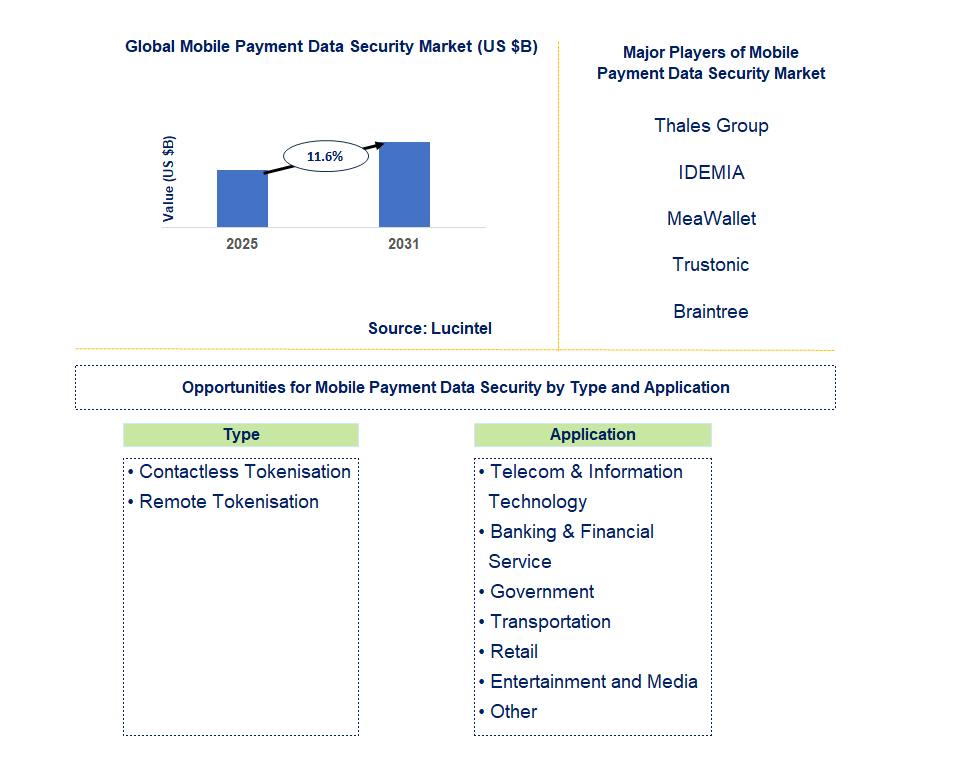
Key data points: The growth forecast = 11.6% annually for the next 7 years. Scroll below to get more insights. This market report covers Trends, opportunity and forecast in mobile payment data security market to 2031 by type (contactless tokenisation and remote tokenisation), application (telecom & information technology, banking & financial service, government, transportation, retail, entertainment and media, and other), and region (North America, Europe, Asia Pacific, and the Rest of the World)
We'll send your sample report shortly.
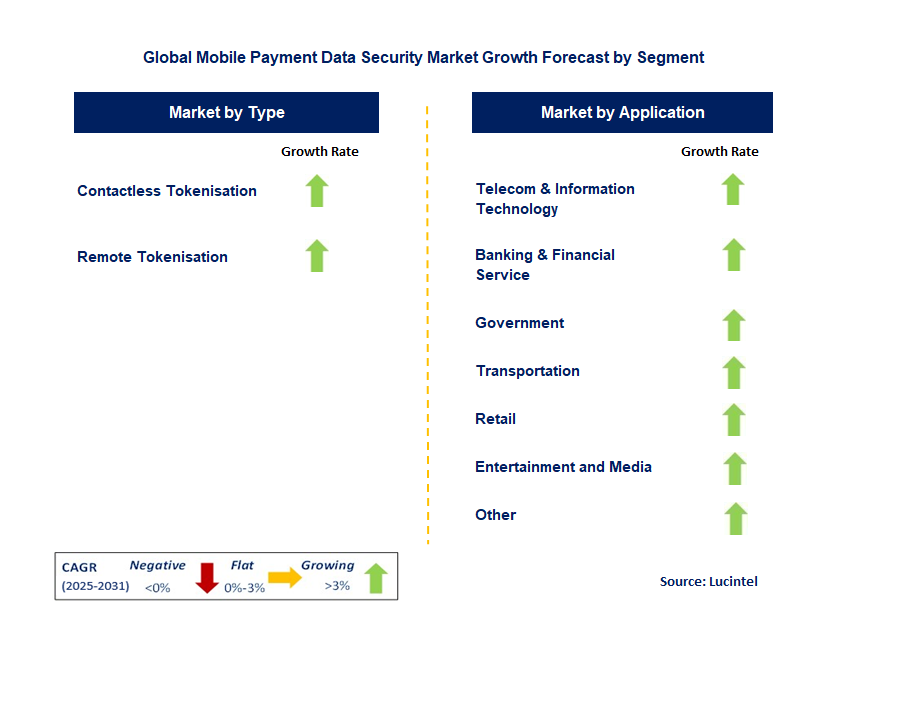
• Lucintel forecasts that, within the type category, remote tokenisation is expected to witness higher growth over the forecast period.
• Within the application category, banking & financial services are expected to witness the highest growth.
• In terms of region, APAC is expected to witness the highest growth over the forecast period. Gain valuable insights for your business decisions with our comprehensive 150+ page report. Sample figures with some insights are shown below.
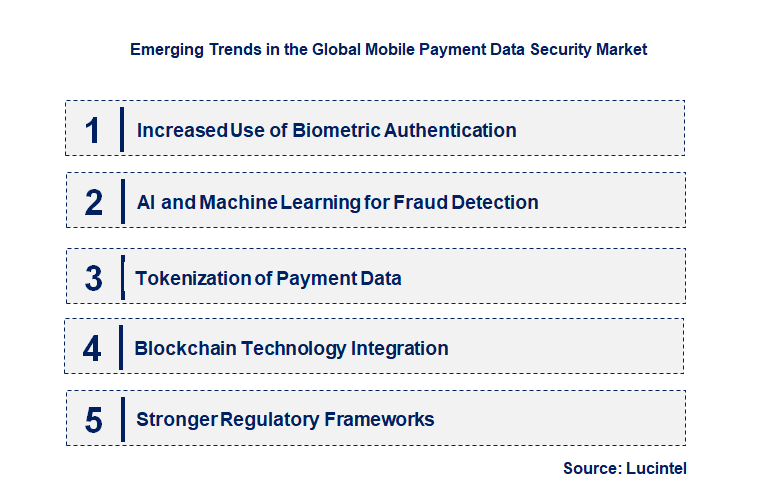
• Increased Use of Biometric Authentication: Biometric technologies, such as fingerprint recognition and facial scanning, are being adopted more widely as a means of securing mobile payment transactions. These methods are more secure and convenient compared to traditional password-based systems.
• AI and Machine Learning for Fraud Detection: Artificial intelligence and machine learning are being used to monitor transactions in real-time and detect fraudulent activity. These technologies can analyze patterns in transaction data to identify suspicious behavior and prevent potential fraud.
• Tokenization of Payment Data: Tokenization is becoming a standard security measure in mobile payments, where sensitive payment information is replaced with a unique identifier or "token." This reduces the risk of data breaches since actual payment details are not stored or transmitted during the transaction.
• Blockchain Technology Integration: Blockchain offers a decentralized, secure way to store and verify transactions. Its application in mobile payments is increasing as it ensures transparency, reduces fraud, and secures the transfer of funds.
• Stronger Regulatory Frameworks: Governments worldwide are strengthening regulations around mobile payment security, ensuring that businesses comply with strict data protection standards. This includes adherence to frameworks such as the General Data Protection Regulation (GDPR) in the EU and the California Consumer Privacy Act (CCPA) in the US. These trends are reshaping the mobile payment data security market by encouraging innovation and collaboration among industry players. As security measures improve, consumer trust in mobile payments will continue to grow, leading to broader adoption of these technologies.
• Implementation of End-to-End Encryption: Mobile payment providers are increasingly adopting end-to-end encryption, ensuring that sensitive data is encrypted from the moment a payment is initiated until it is received by the payment processor. This significantly reduces the risk of data theft during transactions.
• Adoption of Multi-Factor Authentication (MFA): To further secure mobile payments, many companies are integrating multi-factor authentication (MFA) into their payment systems. MFA provides an added layer of security by requiring multiple forms of identification before granting access to a payment service.
• Use of Artificial Intelligence in Fraud Detection: The integration of AI and machine learning technologies into mobile payment systems is allowing real-time fraud detection. These technologies analyze patterns and flag suspicious transactions, helping to prevent fraud before it occurs.
• Expansion of Tokenization: Tokenization has become a key solution for securing payment data. By replacing sensitive information with non-sensitive tokens, the risk of data breaches is minimized, as the actual payment details are never transmitted or stored.
• Stricter Regulatory Compliance: Governments around the world are implementing stricter data protection regulations to ensure that mobile payment providers adhere to high security standards. Compliance with regulations such as GDPR and PCI DSS is now mandatory for mobile payment businesses. These developments are collectively improving the security of mobile payment systems, providing greater protection for consumers, and fostering trust in digital transactions. As these technologies evolve, the landscape of mobile payment data security will continue to adapt to emerging threats.
• Enhancing Security for Mobile Wallets: With the increasing adoption of mobile wallets, there is a significant opportunity to enhance security features, such as biometric authentication and real-time fraud detection, to ensure the safety of stored payment information.
• Expanding Secure Mobile Payment Solutions in Emerging Markets: In emerging markets, mobile payments are gaining popularity, presenting an opportunity for companies to provide secure solutions tailored to local regulatory and security requirements.
• Developing Blockchain-Based Payment Systems: Blockchain technology offers a secure and transparent way to handle mobile payments. The development of blockchain-based payment systems presents an opportunity to revolutionize the market by providing more secure, decentralized solutions.
• Integrating AI for Predictive Security: The integration of AI for predictive security is a growing trend. AI-driven systems can predict potential security threats and proactively address them, reducing the likelihood of breaches and improving overall security.
• Compliance and Certification Services: As regulatory requirements become stricter, there is a growing demand for certification and compliance services for mobile payment providers. Offering services to help companies meet compliance standards will be a lucrative opportunity. These growth opportunities are significantly impacting the mobile payment data security market, driving innovation, and ensuring that security measures evolve in tandem with growing consumer demand for safe digital transactions.
• Thales Group
• IDEMIA
• MeaWallet
• Trustonic
• Braintree
• Contactless Tokenisation
• Remote Tokenisation
• Telecom & Information Technology
• Banking & Financial Service
• Government
• Transportation
• Retail
• Entertainment and Media
• Other
• North America
• Europe
• Asia Pacific
• The Rest of the World
• United States: In the United States, recent developments in mobile payment data security have focused heavily on advanced encryption methods and multi-factor authentication. The adoption of tokenization has increased as a way to ensure that sensitive customer data, such as credit card details, is never stored on mobile devices. Additionally, stricter regulations, including updates to the Payment Card Industry Data Security Standard (PCI DSS), have been introduced to enhance security measures. The push toward biometrics, including facial recognition and fingerprint authentication, is also gaining traction in response to the growing concerns over data breaches.
• China: China has experienced a significant surge in mobile payment adoption, driven by apps like Alipay and WeChat Pay. As mobile payments become a staple in daily life, ensuring the security of consumer data has become paramount. The Chinese government has ramped up efforts to strengthen cybersecurity regulations, mandating companies to comply with higher standards for data protection. In addition, China is integrating advanced artificial intelligence (AI) and machine learning into its security protocols, enabling real-time fraud detection and prevention. The use of biometric authentication is also expanding as a reliable security feature for mobile payments.
• Germany: Germany is seeing significant improvements in mobile payment data security, particularly as mobile wallets like Apple Pay and Google Pay gain popularity. The country’s commitment to data protection, driven by the General Data Protection Regulation (GDPR), has played a critical role in shaping the security landscape. Security measures such as end-to-end encryption and two-factor authentication are now standard in mobile payments. Furthermore, Germany is focusing on the development of blockchain-based solutions to enhance transaction transparency and minimize the risk of fraud, positioning itself as a leader in secure mobile payment solutions within Europe.
• India: India is experiencing rapid growth in mobile payments, thanks to government initiatives such as Digital India and the proliferation of smartphones. However, security concerns remain a significant challenge. To address this, the Indian government has introduced the Personal Data Protection Bill, which emphasizes stricter data privacy regulations. The use of multi-layered security protocols, including encryption, tokenization, and biometric authentication, is becoming more common in mobile payments. Additionally, Indian fintech companies are investing in AI-powered fraud detection systems to safeguard transactions and prevent cybercrime in the expanding mobile payment ecosystem.
• Japan: In Japan, mobile payment data security is becoming increasingly critical as consumers embrace digital payment options like PayPay and Rakuten Pay. The Japanese government has enacted stronger cybersecurity laws to protect personal data, and the private sector is following suit by adopting cutting-edge encryption techniques. There is also a growing trend toward integrating biometric authentication, such as fingerprint and facial recognition, into mobile payment platforms. Japan is focusing on securing cross-border mobile payments and ensuring that its security measures align with international standards to facilitate global trade and protect data privacy.


• Thales Group
• IDEMIA
• MeaWallet
• Trustonic
• Braintree Q5. Which mobile payment data security market segment will be the largest in future? Answer: Lucintel forecasts that remote tokenisation is expected to witness higher growth over the forecast period. Q6. In mobile payment data security market, which region is expected to be the largest in next 5 years? Answer: APAC is expected to witness the highest growth over the forecast period. Q7. Do we receive customization in this report? Answer: Yes, Lucintel provides 10% customization without any additional cost.


Choose a license that fits your team. Instant PDF delivery.
Prices exclude taxes. Instant delivery. Custom licensing available on request.
Market Report · July 15, 2026
Market Report · June 26, 2026
Market Report · June 24, 2026
Trusted partner for strategic intelligence and business growth


Receive a complimentary market analysis tailored to your industry. Our analysts will identify key growth opportunities and competitive dynamics specific to your business.

Market size, growth rate, and key trend analysis for your specific sector.

Top competitor positioning and market share analysis.

Strategic recommendations backed by data-driven insights.
Get curated market intelligence and competitive moves straight to your inbox.
By subscribing, you agree to receive our monthly insights. Unsubscribe anytime.
Receive a complimentary market analysis tailored to your industry. Our analysts will identify key growth opportunities and competitive dynamics specific to your business.
Market size, growth rate, and key trend analysis for your specific sector.
Top competitor positioning and market share analysis.
Strategic recommendations backed by data-driven insights.
Get curated market intelligence, emerging trends, and competitive moves straight to your inbox each month.
By subscribing, you agree to receive our monthly insights. Unsubscribe anytime.
We'll send your sample report shortly.