
Market Report · July 15, 2026

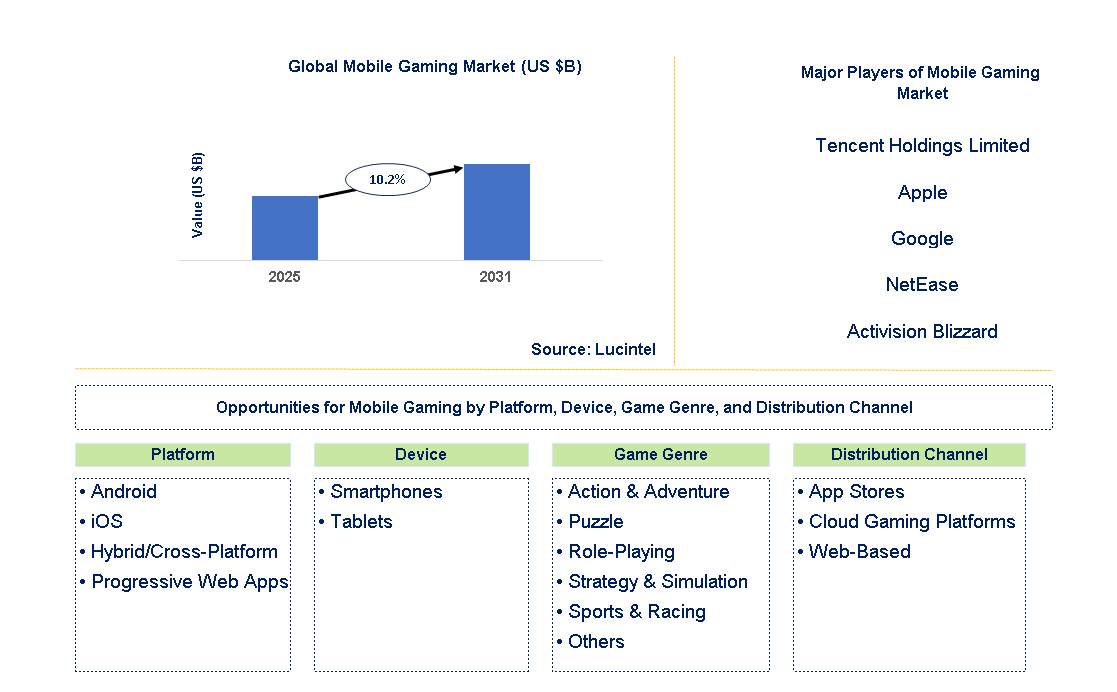
Key data points: The growth forecast = 10.2% annually for the next 7 years. Scroll below to get more insights. This market report covers trends, opportunities and forecasts in mobile gaming market to 2031 by platform (android, iOS, hybrid/cross-platform, and progressive web apps), device (smartphones and tablets), game genre (action & adventure, puzzle, role-playing, strategy & simulation, sports & racing, and others), distribution channel (app stores, cloud gaming platforms, and web-based), and region (North America, Europe, Asia Pacific, and the Rest of the World)
We'll send your sample report shortly.
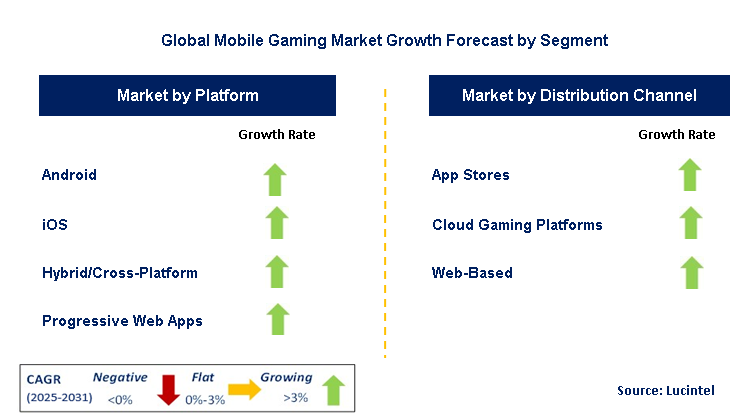
• Lucintel forecasts that, within the platform category, android is expected to witness the highest growth over the forecast period.
• Within the distribution channel category, app store is expected to witness the highest growth.
• In terms of region, APAC is expected to witness the highest growth over the forecast period. Gain valuable insights for your business decisions with our comprehensive 150+ page report. Sample figures with some insights are shown below.
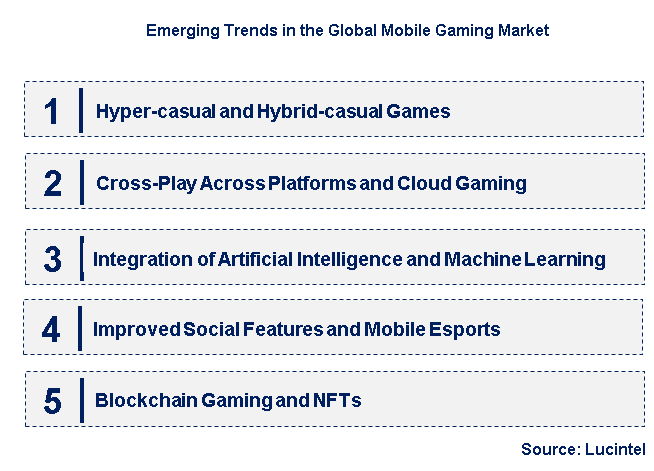
• Hyper-casual and Hybrid-casual Games: Hyper-casual games provide basic, hooky gameplay with minimal barriers to entry, usually heavily monetized by way of advertising. Hybrid-casual games combine the accessible mechanics with deeper progression systems and in-app purchases. The trend caters to the need for fast, fun diversions while offering doors for longer-term engagement and monetization. Their influence is broadening the appeal for mobile gaming, drawing in casual players who may not touch more complicated titles.
• Cross-Play Across Platforms and Cloud Gaming: The expanding capability to play games natively across many devices, from mobile, PC, and console, to cloud gaming services that stream games onto mobile devices, is a dominant trend. It eliminates hardware constraints and gives players more flexibility. The effect is better accessibility and convenience so that players can resume their games wherever they left off. It also creates bigger, more cohesive player bases for each platform, increasing social interaction.
• Integration of Artificial Intelligence and Machine Learning: AI and ML are being increasingly used in mobile game development for purposes ranging from more intelligent non-player characters NPCs and dynamic gameplay environments to user personalization and optimal monetization techniques. The effect is more engaging and customized gameplay, whereby games respond to individual player patterns. It is also possible to develop games more efficiently and run targeted advertising, maximizing overall player retention and revenue.
• Improved Social Features and Mobile Esports: Mobile games are increasingly adding strong social features, such as chat in-game, guilds, and co-op multiplayer modes, in order to build community and increase engagement. At the same time, mobile esports are quickly evolving into a global professional competition with big tournaments and prize pools. The result is higher player stickiness and loyalty as games become communities. Mobile esports generate large viewership and sponsorships, professionalizing mobile gaming as a competitive sport.
• Blockchain Gaming and NFTs: The advent of blockchain in games, especially via non-fungible tokens NFTs for in-game goods and play-to-earn systems, is a budding but increasing phenomenon. This provides customers with real ownership of digital goods and the chance to make real-world value. The effect is the possibility of new economic systems inside games, giving the customer digital ownership and new avenues of monetization. This trend continues to develop, but it's a major change in the design of games and player motivation. These trends are very much rewriting the formula for the mobile gaming business by fueling innovation, varying the experience of games, and broadening its audience. They are making the mobile gaming business a more networked, personalized, and economically vibrant business that is constantly evolving with technology and changing player needs.
• Sophisticated Mobile Hardware and Graphics: The latest advancements in smartphone technology, such as faster processors, better graphics processing units GPUs, and high-refresh-rate screens, have made mobile games capable of rendering console-like visuals and intricate gameplay mechanics. The effect is a richer and better-looking gaming experience on phones. This enables developers to craft advanced games, drawing in hardcore PC and console gamers as well as converging the differences between gaming platforms.
• Move Towards Live Service and Long-Term Interaction: A significant trend is the industry's shift towards live service models, where games are regularly updated with fresh content, events, and features after launch. This motivates long-term play and recurring revenue streams through in-app purchases. The result is higher player retention and the move away from one-time purchases to continuous monetization. This model creates thriving game communities and a constant flow of revenue for developers.
• Evolution of Hybrid Monetization Models: The market has witnessed a rush of hybrid monetization models, blending free-to-play availability with some combination of in-app purchases IAP, subscriptions, and rewarded ads. This offers several sources of revenue and allows for accommodating a variety of player preferences. The result is maximized revenue capture without loss of accessibility to a wide population. It offers players the ability to play games without initial expenditure, while providing methods for more immersive interaction and personalization through purchases.
• Mergers and Strategic Takeovers: There has been a significant pattern of acquisitions and mergers within the mobile gaming market, with big companies taking over smaller studios and intellectual properties. The motive is to consolidate portfolios, eliminate competition, and win market share. The effect is a more consolidated market with fewer but bigger players holding sway. This tends to result in more investment in acquired games and extend the global reach of successful franchises.
• Emergence of Regulatory Scrutiny and Privacy Changes: Recent trends have been rising regulatory scrutiny on in-app purchases, loot boxes, and data privacy, especially in Western countries. Such changes as Apple's App Tracking Transparency ATT have influenced user acquisition and ad strategies. The effect is increased focus on ethical monetization strategies and strong data protection controls. This compels developers to get creative with user acquisition and retention as well as adhere to changing privacy rules. These trends are deeply affecting the mobile games industry by improving game quality, increasing revenue streams, and concentrating industry influence. They are breaking new ground in mobile technology, making games more engaging and immersive, and challenging business and monetization models to adapt to a more sophisticated and regulated world.
• Hyper-casual to Mid-core Progression: A major growth potential exists in creating methods to transform hyper-casual players into mid-core players. This means creating games with easy entry points that progress toward more complex mechanics, encouraging longer play and increased monetization. The effect is to maximize player lifetime value by providing a straightforward progression funnel for users. This approach expands the popularity of games yet maintains an engaged user base, closing the gap between casual and hardcore gaming.
• Leveraging Cross-Platform and Cloud Gaming Technologies: Taking advantage of cross-platform play and cloud gaming apps is a high-value area of growth. This makes it easier for developers to produce games that can be played perfectly on smartphones, tablets, PCs, and consoles, expanding the possible audience. The effect is greater accessibility and user convenience, drawing in players who appreciate flexibility. It also creates opportunities for new monetization strategies, like subscription services for cloud gaming, and enhances brand ecosystems overall.
• In-Game Advertising and Brand Partnerships Integration: Strategic expansion is possible through sophisticated in-game advertising platforms and collaborations with non-gaming companies for in-game placements. This goes beyond the usual banner ads to cover playable ads, rewarded videos, and sponsored virtual items. The effect is diversified revenue streams complementing in-app purchases. This offers extra monetization opportunities while presenting brands with special options for reaching a highly interactive audience within the gaming ecosystem.
• Regionalized Content and Regional Market Penetration: With a focus on creating content that is uniquely localized for emerging markets, such as language, cultural nuances, and local payments, lies tremendous growth. Markets such as India, Southeast Asia, and Latin America are seeing huge mobile gaming uptake. The effect is tapping huge, untapped player bases and taking large shares of the market in fast-growing territories. Localization builds relevance and greater connection with varied audiences, resulting in higher downloads and revenue.
• Mobile Esports and Competitive Gaming Ecosystems: Investment and production of mobile games with high competitive potential for esports uses is a significant growth area. This means building strong multiplayer modes, having competitive leagues, and establishing a professional esports ecosystem. The effect is heightened player engagement, community formation, and high viewership. Mobile esports create substantial revenues from sponsorships, media rights, and in-game purchases connected to competitive gameplay, raising the profile of mobile gaming. These growth opportunities of a strategic nature are profoundly influencing the mobile games market by propelling innovation within various fields of application. Through their emphasis on player development, technological innovation, diversified monetization strategies, international expansion, and competitive gaming, companies can tap into emerging sources of revenue, reach wider demographics, and establish themselves in this fast-moving and changing industry.
• Tencent Holdings Limited
• Apple
• NetEase
• Activision Blizzard
• Electronic Arts
• Nintendo
• Take-Two Interactive Software
• Roblox Corporation
• Supercell
• Android
• iOS
• Hybrid/Cross-Platform
• Progressive Web Apps
• Smartphones
• Tablets
• North America
• Europe
• Asia Pacific
• The Rest of the World
• United States: The American mobile gaming industry remains a significant source of revenue with high consumer spend on in-app purchases. Recent trends indicate a robust performance by hybrid-casual games, combining easy mechanics and deeper monetization. Mobile esports are growing rapidly, with titles such as PUBG Mobile and Call of Duty: Mobile featuring huge tournaments. Developers are emphasizing live operations and content updates to enhance player retention and lifetime value, with substantial growth in cross-platform play.
• China: China is still the world's biggest mobile gaming market in terms of player base and revenue, although it has experienced some regulatory changes. Local gaming behemoths Tencent and NetEase hold sway, with a focus on social-focused titles and competitive esports aspects. Innovation in game design and monetization strategies continues to be emphasized. Despite previous regulatory challenges, the market is strong, with a huge and active user base generating considerable in-app purchase revenues.
• Germany: The German mobile gaming market is slowly expanding, and more players are indulging in casual and mid-core titles. There is high demand for high-quality visuals and immersive gameplay experiences. Subscriptions such as Apple Arcade and Google Play Pass are on the rise, providing ad-free gaming. Data privacy rules are an important aspect for developers in this market, affecting user acquisition and monetization.
• India: India is witnessing explosive mobile gaming growth, fueled by cheap smartphones and internet penetration. It has emerged as the globe's second-largest market for mobile gaming downloads. Free-to-play and hyper-casual games are especially favored. Localized content and regional language support are paramount. The growth of mobile esports and streaming also adds to higher engagement and monetization potential in this fast-growing market.
• Japan: As an established mobile gaming market, Japan keeps high on its agenda unique and exceptional gaming experiences. Role-playing games RPGs and gauche-based designs are extremely popular, with a considerable focus on character collection and story. The market is high ARPU, fueled by passionate players. Developers tend to prioritize solid intellectual properties and rich gameplay systems in order to maintain their strongly committed audience.


• Tencent Holdings Limited
• Apple
• NetEase
• Activision Blizzard
• Electronic Arts
• Nintendo
• Take-Two Interactive Software
• Roblox Corporation
• Supercell Q5. Which mobile gaming market segment will be the largest in future? Answer: Lucintel forecasts that, within the platform category, android is expected to witness the highest growth over the forecast period. Q6. In mobile gaming market, which region is expected to be the largest in next 5 years? Answer: In terms of region, APAC is expected to witness the highest growth over the forecast period. Q7. Do we receive customization in this report? Answer: Yes, Lucintel provides 10% customization without any additional cost.


Choose a license that fits your team. Instant PDF delivery.
Prices exclude taxes. Instant delivery. Custom licensing available on request.
Market Report · July 15, 2026
Market Report · June 26, 2026
Market Report · June 24, 2026
Trusted partner for strategic intelligence and business growth


Receive a complimentary market analysis tailored to your industry. Our analysts will identify key growth opportunities and competitive dynamics specific to your business.

Market size, growth rate, and key trend analysis for your specific sector.

Top competitor positioning and market share analysis.

Strategic recommendations backed by data-driven insights.
Get curated market intelligence and competitive moves straight to your inbox.
By subscribing, you agree to receive our monthly insights. Unsubscribe anytime.
Receive a complimentary market analysis tailored to your industry. Our analysts will identify key growth opportunities and competitive dynamics specific to your business.
Market size, growth rate, and key trend analysis for your specific sector.
Top competitor positioning and market share analysis.
Strategic recommendations backed by data-driven insights.
Get curated market intelligence, emerging trends, and competitive moves straight to your inbox each month.
By subscribing, you agree to receive our monthly insights. Unsubscribe anytime.
We'll send your sample report shortly.