
Market Report · July 15, 2026

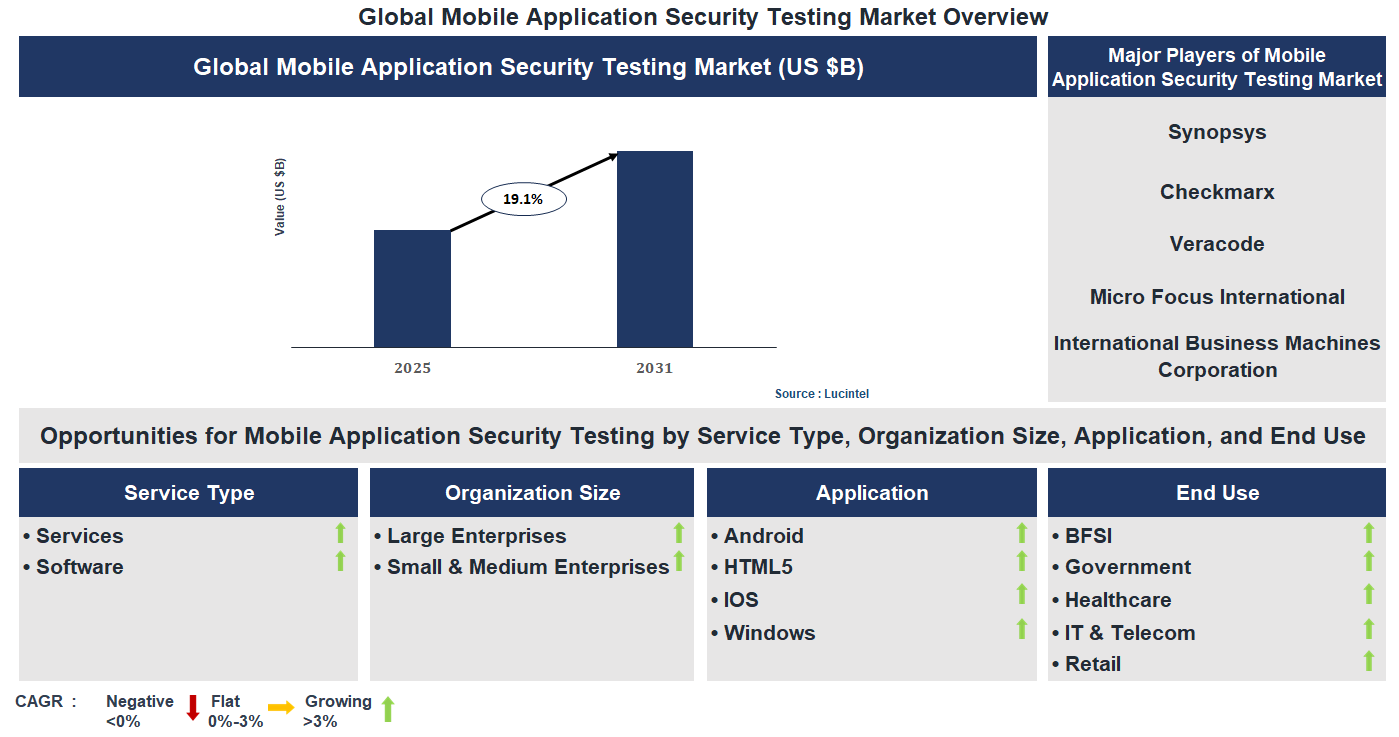
Key data points: The growth forecast = 19.1% annually for the next 7 years. Scroll below to get more insights. This market report covers trends, opportunities and forecasts in mobile application security testing market to 2031 by service type (services and software), organization size (large enterprises and small & medium enterprises), application (android, HTML5, IOS, and windows), end use (BFSI, government, healthcare, IT & telecom, and retail), and region (North America, Europe, Asia Pacific, and the Rest of the World)
We'll send your sample report shortly.
• Lucintel forecasts that, within the service type category, service is expected to witness higher growth over the forecast period.
• Within the end use category, BFSI is expected to witness the highest growth.
• In terms of region, APAC is expected to witness the highest growth over the forecast period. Gain valuable insights for your business decisions with our comprehensive 150+ page report. Sample figures with some insights are shown below.
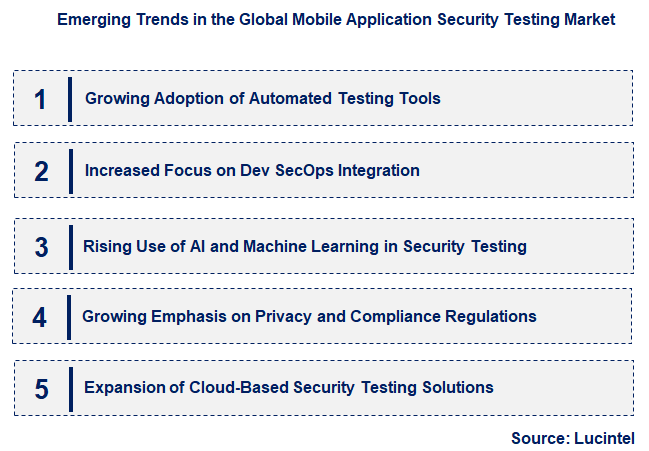
• Growing Adoption of Automated Testing Tools: Automation is revolutionizing mobile app security testing by enabling faster, more accurate vulnerability detection. Automated tools reduce manual effort, increase testing frequency, and improve coverage, allowing developers to identify and fix security flaws early in the development cycle. This trend enhances overall security posture, reduces time-to-market, and lowers costs associated with manual testing. As automation technology advances, its integration with AI and machine learning will further improve threat detection capabilities, making security testing more efficient and reliable.
• Increased Focus on Dev SecOps Integration: Dev SecOps combines development, security, and operations to embed security practices into the software development lifecycle. This trend promotes continuous security testing, real-time vulnerability assessment, and automated security checks within CI/CD pipelines. By integrating security early in the development process, organizations can prevent security flaws from reaching production, reducing risks and compliance issues. The shift towards Dev SecOps fosters a security-first mindset, accelerates deployment cycles, and enhances overall application resilience against cyber threats.
• Rising Use of AI and Machine Learning in Security Testing: Artificial intelligence and machine learning are increasingly being incorporated into mobile app security testing tools. These technologies enable predictive analytics, anomaly detection, and adaptive threat identification, which are essential for combating sophisticated cyber attacks. AI-driven testing can analyze vast amounts of data to identify patterns and vulnerabilities that traditional methods might miss. This trend improves the accuracy and speed of security assessments, providing organizations with proactive defense mechanisms and reducing false positives, ultimately strengthening mobile app security.
• Growing Emphasis on Privacy and Compliance Regulations: With the implementation of regulations like GDPR, CCPA, and others, organizations are prioritizing privacy and compliance in their security strategies. Mobile app security testing now includes rigorous assessments to ensure data protection, user privacy, and regulatory adherence. This trend drives the development of specialized testing tools that verify compliance requirements, audit data handling processes, and identify potential privacy breaches. Ensuring compliance not only avoids legal penalties but also builds user trust and brand reputation in a competitive market.
• Expansion of Cloud-Based Security Testing Solutions: Cloud-based security testing platforms are gaining popularity due to their scalability, flexibility, and cost-effectiveness. These solutions enable remote testing, continuous monitoring, and rapid deployment of security assessments across diverse mobile environments. Cloud platforms facilitate collaboration among security teams and provide real-time insights into vulnerabilities. As mobile applications increasingly integrate with cloud services, cloud-based testing becomes essential for comprehensive security coverage, allowing organizations to adapt quickly to emerging threats and maintain robust security postures. In summary, these emerging trends are reshaping the mobile application security testing market by fostering automation, integrating security into development workflows, leveraging advanced technologies like AI, emphasizing compliance, and adopting scalable cloud solutions. Together, they enable organizations to proactively identify vulnerabilities, ensure regulatory adherence, and deliver secure mobile applications in an increasingly complex digital landscape.
• Adoption of AI and Machine Learning: Integration of AI and ML in testing tools has enhanced threat detection accuracy and automated vulnerability identification, reducing manual effort and increasing efficiency. This development allows for real-time security assessments, enabling quicker responses to emerging threats and improving overall application security posture.
• Rise of Automated Testing Solutions: Automated security testing tools have become more sophisticated, offering continuous testing capabilities that fit into DevSecOps pipelines. This automation accelerates the testing process, reduces human error, and ensures consistent security checks throughout the development lifecycle, leading to more secure mobile applications.
• Increased Focus on Compliance and Regulatory Standards: Stringent regulations like GDPR, HIPAA, and PCI DSS have prompted organizations to adopt security testing practices that ensure compliance. This focus has driven demand for specialized testing solutions that verify adherence to legal requirements, thereby reducing legal risks and enhancing consumer trust.
• Expansion of Cloud-Based Testing Services: Cloud-based security testing platforms have gained popularity due to their scalability, cost-effectiveness, and ease of deployment. They enable organizations to perform comprehensive testing without significant infrastructure investments, facilitating faster deployment and broader access to advanced testing tools.
• Development of Penetration Testing and Threat Simulation: Advanced penetration testing and threat simulation tools now provide realistic attack scenarios to identify vulnerabilities before malicious actors do. This proactive approach helps organizations strengthen their defenses, reduce potential breaches, and improve overall security resilience. In summary, these developments are significantly transforming the mobile application security testing market by making security measures more intelligent, automated, compliant, scalable, and proactive. As a result, organizations are better equipped to protect their mobile applications against evolving cyber threats, ensuring data integrity and maintaining user trust in an increasingly mobile-centric world.
• Enhanced Security Protocols : Financial institutions are increasingly adopting mobile security testing to safeguard sensitive data and transactions, reducing fraud risks and ensuring compliance with regulations. This growth improves customer trust and operational resilience.
• Protecting Patient Data : The healthcare sector is prioritizing mobile app security to prevent data breaches and ensure patient confidentiality. Advanced testing solutions help meet regulatory standards like HIPAA, fostering secure telemedicine and health management apps.
• Securing Customer Information : Retailers are deploying mobile security testing to protect customer payment data and personal information. This reduces fraud and enhances consumer confidence in mobile shopping platforms.
• Strengthening Network Security : Telecom providers are integrating mobile security testing to defend against evolving cyber threats targeting mobile networks and devices. This ensures service continuity and safeguards user data.
• Securing Business Operations : Enterprises are focusing on mobile app security testing to protect corporate data accessed via mobile devices. This supports remote work, enhances productivity, and mitigates insider threats. In summary, these growth opportunities are significantly impacting the mobile application security testing market by driving innovation, expanding application scope, and increasing demand for tailored security solutions. They enable organizations across industries to better protect their mobile assets, comply with regulations, and build customer trust, ultimately fueling market expansion and technological advancement.
• Increasing Mobile Device Usage: The exponential growth in mobile device adoption across consumers and enterprises has expanded the attack surface for cyber threats. As mobile applications become integral to daily operations, the need for security testing to prevent data breaches and ensure user privacy has become paramount. This surge necessitates advanced testing tools capable of identifying vulnerabilities early in the development cycle, thereby driving market demand. The proliferation of mobile banking, e-commerce, and enterprise apps further amplifies the importance of security testing to maintain trust and compliance.
• Rising Cybersecurity Threats: The escalation of sophisticated cyber threats targeting mobile applications has created an urgent need for comprehensive security testing. Attack vectors such as malware, data leaks, and unauthorized access pose significant risks to organizations and users alike. As cybercriminals employ more advanced techniques, developers and security teams are compelled to adopt rigorous testing methodologies to identify and mitigate vulnerabilities proactively. This ongoing threat landscape fuels innovation in testing tools and services, bolstering market growth.
• Growing Adoption of DevSecOps: The integration of security practices within the DevOps framework, known as DevSecOps, is transforming mobile application development. This approach emphasizes continuous security testing throughout the development lifecycle, enabling early detection of vulnerabilities. As organizations aim to accelerate deployment without compromising security, the demand for automated and integrated testing solutions increases. The shift towards DevSecOps practices encourages vendors to develop more sophisticated tools, thereby expanding the market scope and adoption rates.
• Technological Advancements in Testing Tools: Innovations such as AI, machine learning, and automation are revolutionizing mobile application security testing. These technologies enable faster, more accurate vulnerability detection and reduce manual effort. Automated testing tools can simulate various attack scenarios, identify hidden flaws, and ensure compliance with security standards efficiently. The adoption of advanced testing solutions enhances overall security posture, encourages organizations to invest more in security testing, and drives market expansion.
• Regulatory and Compliance Requirements: Stringent regulations like GDPR, HIPAA, and industry-specific standards compel organizations to implement robust security measures for mobile applications. Compliance mandates necessitate regular security testing to identify and remediate vulnerabilities, avoid penalties, and protect user data. These regulatory pressures motivate organizations to adopt comprehensive testing solutions, thereby fueling market growth. Additionally, evolving legal frameworks require continuous updates to testing methodologies, encouraging innovation and investment in advanced security testing tools. The challenges facing mobile application security testing market include:
• Rapidly Evolving Cyber Threat Landscape: The dynamic nature of cyber threats presents a significant challenge for mobile application security testing. Attack techniques evolve rapidly, requiring constant updates to testing tools and methodologies. Keeping pace with emerging vulnerabilities and zero-day exploits demands substantial investment in research and development. Organizations may struggle to adapt quickly, leading to potential security gaps. This ongoing evolution complicates the development of comprehensive testing strategies and increases the risk of overlooked vulnerabilities, impacting overall market effectiveness.
• Complexity of Mobile Application Ecosystems: The diverse and fragmented mobile ecosystem, including various operating systems, devices, and app architectures, complicates security testing. Ensuring compatibility and comprehensive vulnerability assessment across multiple platforms is resource-intensive and technically challenging. This complexity can lead to inconsistent testing results, missed vulnerabilities, and increased costs. Vendors must develop versatile tools capable of handling this heterogeneity, which can slow down market growth and hinder widespread adoption of security testing solutions.
• Regulatory Compliance and Standardization Challenges: While regulations drive demand, they also pose challenges due to varying standards across regions and industries. Achieving compliance requires tailored testing approaches, which can be complex and costly. The lack of unified standards for mobile application security testing complicates the development of universally accepted solutions. Organizations may face difficulties in aligning their testing practices with diverse regulatory requirements, leading to potential non-compliance risks and limiting market expansion. In summary, the mobile application security testing market is propelled by technological innovations, increasing mobile usage, and regulatory pressures, which collectively foster growth. However, challenges such as evolving cyber threats, ecosystem complexity, and compliance hurdles pose significant obstacles. Addressing these drivers and challenges effectively will determine the market's trajectory, with ongoing innovation and adaptive strategies essential for sustained success. The market's future depends on balancing rapid technological advancements with robust security frameworks to meet the growing demand for secure mobile applications.
• Synopsys
• Checkmarx
• Veracode
• Micro Focus International
• International Business Machines Corporation
• Rapid7
• Broadcom
• WhiteHat Security
• Invicti Security Limited
• NowSecure
• Services
• Software
• Large Enterprises
• Small & Medium Enterprises
• Android
• HTML5
• IOS
• Windows
• BFSI
• Government
• Healthcare
• IT & Telecom
• Retail
• North America
• Europe
• Asia Pacific
• The Rest of the World
• United States: The US market has seen significant investments in automated security testing tools and AI-driven solutions, enhancing the detection of vulnerabilities. Major tech firms are integrating advanced security features into their app development processes, driven by strict compliance standards like GDPR and CCPA. The adoption of DevSecOps practices is accelerating, promoting proactive security measures. Additionally, government initiatives are promoting secure mobile app development, fostering innovation and collaboration among cybersecurity firms.
• China: China’s market is rapidly expanding with a focus on integrating security testing within its large-scale app ecosystems. Local companies are developing proprietary testing tools tailored to regional apps and platforms. The government’s emphasis on cybersecurity laws has led to increased compliance requirements, prompting firms to adopt more rigorous testing protocols. There is also a surge in investments toward AI-powered security solutions to combat sophisticated cyber threats targeting mobile applications.
• Germany: Germany’s market emphasizes compliance with strict data protection regulations such as GDPR. Companies are adopting comprehensive security testing frameworks that include static and dynamic analysis. The focus is on ensuring privacy and security in mobile banking and enterprise applications. Germany is also witnessing growth in collaborative efforts between industry and academia to develop innovative testing methodologies, alongside increased adoption of cloud-based security testing services.
• India: The Indian market is experiencing rapid growth due to the proliferation of mobile apps across various sectors like banking, e-commerce, and healthcare. Local firms are adopting cost-effective security testing solutions, often leveraging open-source tools. The government’s Digital India initiative is encouraging secure app development, with a focus on building local cybersecurity capabilities. Startups are innovating with AI and machine learning to enhance testing efficiency and detect vulnerabilities more accurately.
• Japan: Japan’s market is characterized by a focus on securing mobile applications used in critical infrastructure and financial services. Companies are investing in advanced security testing tools that incorporate AI and machine learning for real-time vulnerability detection. Regulatory frameworks are promoting secure development practices, and there is a strong emphasis on user privacy and data security. Collaboration between industry and government agencies is fostering innovation in mobile app security testing solutions.


• Synopsys
• Checkmarx
• Veracode
• Micro Focus International
• International Business Machines Corporation
• Rapid7
• Broadcom
• WhiteHat Security
• Invicti Security Limited
• NowSecure Q5. Which mobile application security testing market segment will be the largest in future? Answer: Lucintel forecasts that, within the service type category, service is expected to witness higher growth over the forecast period. Q6. In mobile application security testing market, which region is expected to be the largest in next 5 years? Answer: In terms of region, APAC is expected to witness the highest growth over the forecast period. Q7. Do we receive customization in this report? Answer: Yes, Lucintel provides 10% customization without any additional cost.


Choose a license that fits your team. Instant PDF delivery.
Prices exclude taxes. Instant delivery. Custom licensing available on request.
Market Report · July 15, 2026
Market Report · June 26, 2026
Market Report · June 24, 2026
Trusted partner for strategic intelligence and business growth


Receive a complimentary market analysis tailored to your industry. Our analysts will identify key growth opportunities and competitive dynamics specific to your business.

Market size, growth rate, and key trend analysis for your specific sector.

Top competitor positioning and market share analysis.

Strategic recommendations backed by data-driven insights.
Get curated market intelligence and competitive moves straight to your inbox.
By subscribing, you agree to receive our monthly insights. Unsubscribe anytime.
Receive a complimentary market analysis tailored to your industry. Our analysts will identify key growth opportunities and competitive dynamics specific to your business.
Market size, growth rate, and key trend analysis for your specific sector.
Top competitor positioning and market share analysis.
Strategic recommendations backed by data-driven insights.
Get curated market intelligence, emerging trends, and competitive moves straight to your inbox each month.
By subscribing, you agree to receive our monthly insights. Unsubscribe anytime.
We'll send your sample report shortly.