
Market Report · July 16, 2026

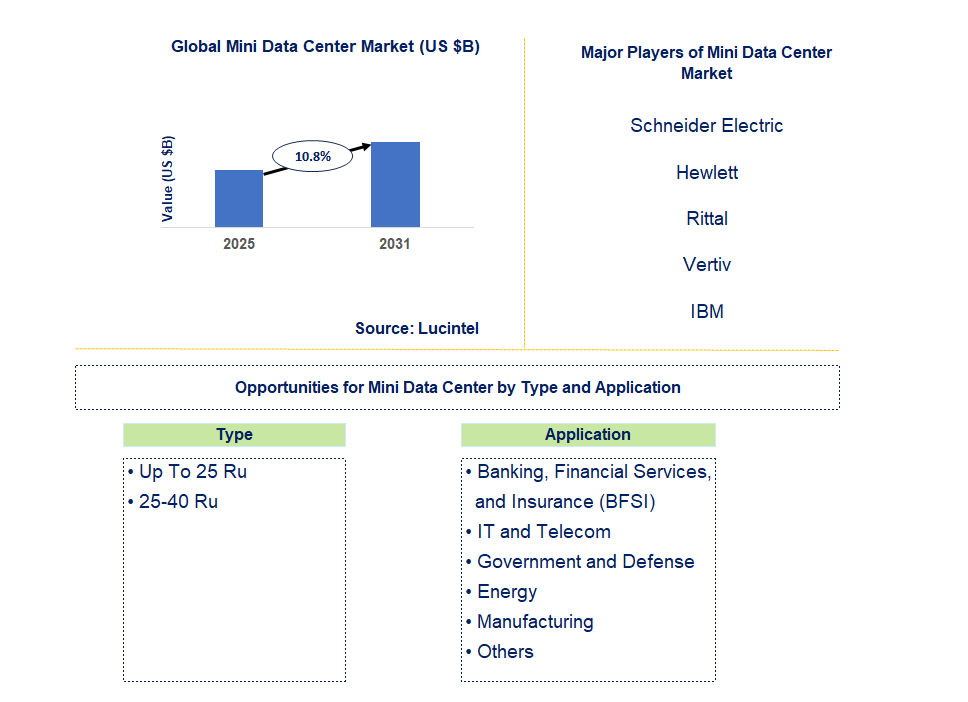
Key data points: The growth forecast = 10.8% annually for the next 7 years. Scroll below to get more insights. This market report covers Trends, opportunity and forecast in mini data center market to 2031 by type (up to 25 ru and 25-40 ru), application (banking, financial services, and insurance (BFSI), IT and telecom, government and defense, energy, manufacturing, and others), and region (North America, Europe, Asia Pacific, and the Rest of the World)
We'll send your sample report shortly.
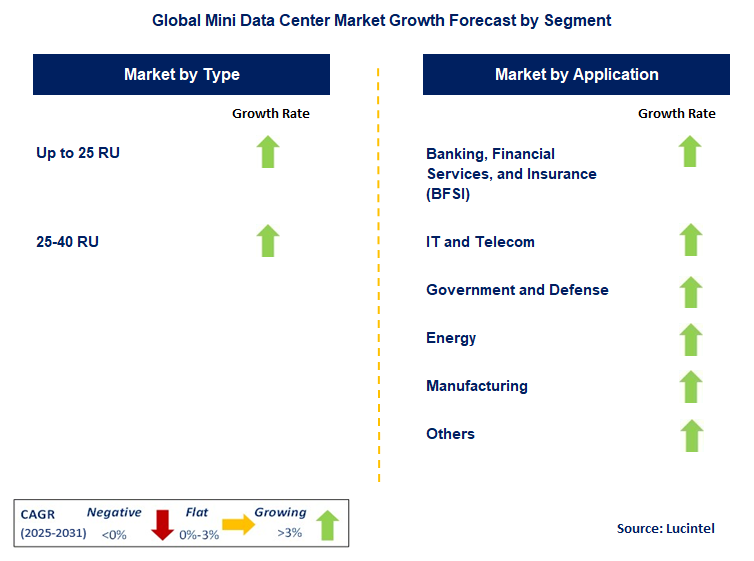
• Lucintel forecasts that, within the type category, up to 25 ru is expected to witness higher growth over the forecast period.
• Within the application category, banking will remain the largest segment.
• In terms of region, APAC will remain the largest region over the forecast period. Gain valuable insights for your business decisions with our comprehensive 150+ page report. Sample figures with some insights are shown below.
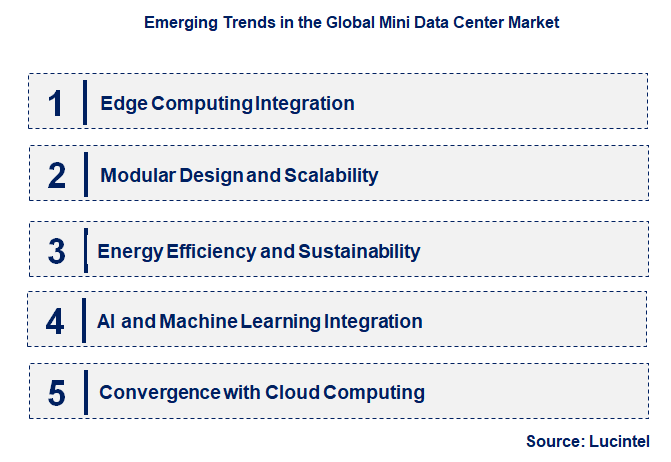
• Edge Computing Integration: Mini data centers are increasingly being deployed at the edge of networks to support real-time data processing. Edge computing brings computation and storage closer to the data source, reducing latency and improving speed. This trend is vital for applications such as IoT, autonomous vehicles, and smart cities, where fast data processing is critical. By integrating edge computing capabilities, mini data centers can handle large amounts of data generated locally, minimizing the need for transmission to centralized data centers. This reduces bandwidth usage and enhances overall operational efficiency.
• Modular Design and Scalability: The modular design of mini data centers allows for easy expansion and customization based on business needs. These systems are designed to be scalable, with additional units or components added as required. Modular mini data centers provide businesses with the flexibility to start small and expand gradually, avoiding over-investment in infrastructure. This scalability is particularly advantageous for growing businesses or those with fluctuating data needs. As a result, modular mini data centers offer cost-effectiveness, efficiency, and adaptability, which are crucial for businesses seeking to optimize their IT infrastructure.
• Energy Efficiency and Sustainability: Energy efficiency is a significant focus in the mini data center market as businesses strive to minimize operational costs and reduce their carbon footprint. Mini data centers are designed with energy-efficient cooling systems, optimized power usage, and renewable energy sources. Innovations in energy-saving technologies, such as liquid cooling and AI-powered energy management, are helping to improve sustainability. By prioritizing energy efficiency, mini data centers are becoming more environmentally friendly while reducing operational costs. This trend is important for businesses looking to lower energy expenses and aligns with global sustainability goals.
• AI and Machine Learning Integration: Artificial intelligence (AI) and machine learning (ML) are playing an increasingly important role in mini data centers. These technologies are being integrated into data center operations to optimize resource management, predict maintenance needs, and improve system efficiency. AI algorithms can monitor the performance of mini data centers, identify anomalies, and make real-time adjustments to optimize performance. The integration of AI and ML helps enhance the reliability of mini data centers while reducing downtime and maintenance costs. This trend is enabling mini data centers to become more intelligent and self-sufficient.
• Convergence with Cloud Computing: The convergence of mini data centers with cloud computing is creating hybrid infrastructure models that offer businesses the benefits of both localized and centralized solutions. By combining the power of cloud computing with the proximity of mini data centers, businesses can achieve greater flexibility, scalability, and efficiency. This hybrid approach enables businesses to store and process sensitive data locally in mini data centers while leveraging cloud computing for larger-scale operations and remote access. As cloud services continue to grow, this convergence is allowing mini data centers to serve as essential components of modern IT ecosystems. The emerging trends in the mini data center market are reshaping the landscape of data processing and storage. By embracing edge computing, modular design, energy efficiency, AI integration, and cloud convergence, mini data centers are becoming more adaptable, efficient, and sustainable. These trends are enabling businesses to optimize their IT infrastructure, enhance performance, and reduce operational costs. As the digital environment continues to evolve, mini data centers will play a pivotal role in supporting the next generation of computing needs.
• Rise of Edge Computing: The rise of edge computing has played a significant role in the expansion of the mini data center market. By processing data closer to where it is generated, businesses can reduce latency and enhance performance. Mini data centers are increasingly being deployed at the edge of networks to meet the demand for faster data processing. This development is crucial for industries such as autonomous vehicles, smart cities, and manufacturing, where real-time data analysis is essential. The growing need for edge computing is positioning mini data centers as a key component of modern infrastructure.
• Modular and Scalable Solutions: The demand for modular and scalable solutions has led to the design of mini data centers that can be easily expanded as needed. These modular units allow businesses to scale their data processing capacity without the need for significant upfront investment. This flexibility is particularly attractive for small to medium-sized enterprises (SMEs) that require efficient and cost-effective data storage and processing solutions. By enabling on-demand scaling, modular mini data centers are helping businesses reduce costs and increase operational efficiency, contributing to their growing adoption.
• Energy Efficiency and Sustainability: Energy efficiency and sustainability are becoming key priorities in the design of mini data centers. As businesses look to minimize their environmental footprint, mini data centers are being developed with energy-efficient components, such as advanced cooling systems and low-power servers. This development helps businesses reduce operational costs while contributing to sustainability goals. Additionally, many mini data centers are incorporating renewable energy sources, such as solar or wind power, to further reduce their impact on the environment. The focus on sustainability is likely to drive further innovations in the market.
• Increased Adoption of AI and Automation: Artificial intelligence (AI) and automation are being integrated into mini data centers to improve operational efficiency and performance. AI algorithms are used for tasks such as predictive maintenance, workload optimization, and energy management. By leveraging AI and automation, mini data centers can operate more efficiently, reducing the need for human intervention and minimizing downtime. This development is particularly beneficial for industries that rely on continuous operations, such as healthcare, finance, and telecommunications, where uninterrupted access to data is critical.
• Improved Security Features: As cyber threats become more sophisticated, the security of mini data centers has become a major focus. Recent advancements have led to the integration of advanced security features, such as multi-factor authentication, encryption, and physical security measures, to protect sensitive data. This focus on security is crucial as businesses increasingly store and process valuable data in mini data centers. With the rise of data breaches and cyberattacks, improving security is essential to ensure the integrity and confidentiality of data, driving further growth in the market. Recent developments in the mini data center market are reshaping how businesses approach data storage and processing. From the rise of edge computing and modular solutions to advancements in energy efficiency, AI integration, and improved security features, these innovations are making mini data centers more efficient, scalable, and secure. As businesses continue to embrace digital transformation, these developments are positioning mini data centers as an essential part of modern IT infrastructure, helping companies meet the growing demands for data processing and real-time insights.
• Edge Computing Expansion: Edge computing is a major driver of growth in the mini data center market. As more devices are connected to the internet, the need for real-time processing of data close to its source increases. Mini data centers are ideal for edge computing because they provide localized processing power, reducing latency and improving response times. This allows businesses to handle vast amounts of data efficiently, particularly in industries such as manufacturing, healthcare, and transportation. As edge computing continues to expand, mini data centers will play a crucial role in supporting this trend by offering high-performance, decentralized infrastructure.
• IoT Device Growth: The Internet of Things (IoT) is expanding rapidly, creating a massive influx of data from connected devices. Mini data centers are well-suited to handle the processing and storage needs of IoT applications due to their compact size and scalability. With IoT devices generating data at the edge, mini data centers can efficiently process this data, ensuring that businesses can derive actionable insights without the need for extensive cloud infrastructure. The continued growth of IoT will drive demand for mini data centers, particularly in industries such as smart cities, agriculture, and retail, where real-time data processing is essential.
• Remote and Distributed Operations: The rise of remote and distributed workforces has spurred the need for mini data centers in remote locations. Organizations require efficient data processing capabilities at branch offices, remote locations, or even in temporary setups, and mini data centers provide an ideal solution. These compact centers allow businesses to deploy localized computing resources without relying on centralized data centers. As remote work continues to grow in popularity, mini data centers will become a key component in providing secure, scalable, and resilient data storage and processing solutions for businesses operating in remote or dispersed environments.
• Cost Efficiency for Small and Medium Enterprises (SMEs): Small and medium enterprises (SMEs) are increasingly looking for affordable and scalable IT infrastructure solutions. Mini data centers offer a cost-effective alternative to traditional data centers by providing the required computing power in a smaller form factor, lowering operational costs. With reduced energy consumption and lower upfront costs, SMEs can access high-performance data center capabilities without investing in large-scale infrastructure. The growth of SMEs, particularly in emerging markets, will drive the demand for mini data centers, as they provide businesses with the ability to scale their operations without significant capital expenditures.
• Data Privacy and Security Concerns: Data privacy and security are becoming critical concerns for businesses, especially as data protection regulations tighten globally. Mini data centers offer an advantage in this regard by enabling businesses to maintain control over their sensitive data. By deploying mini data centers on-site or at localized locations, organizations can ensure that their data remains secure and comply with local data protection laws. The increasing importance of data privacy will continue to drive the demand for mini data centers, particularly in sectors such as healthcare, finance, and government, where data security is paramount. The mini data center market is benefiting from several key growth opportunities driven by the rise of edge computing, IoT, remote operations, cost-effective solutions for SMEs, and growing concerns over data privacy and security. As businesses increasingly adopt these compact and efficient data center solutions, the market for mini data centers is expected to continue its rapid expansion, providing organizations with scalable, secure, and high-performance infrastructure to meet the demands of the digital age.
• Schneider Electric
• Hewlett
• Rittal
• Vertiv
• IBM
• Eaton
• Delta Power Solutions
• Up to 25 Ru
• 25-40 Ru
• Banking, Financial Services, and Insurance (BFSI)
• IT and Telecom
• Government and Defense
• Energy
• Manufacturing
• Others
• North America
• Europe
• Asia Pacific
• The Rest of the World
• United States: In the United States, the mini data center market is thriving, supported by the increasing adoption of edge computing and 5G networks. Major companies like Schneider Electric and Vertiv are driving innovation, offering modular, scalable mini data center solutions for businesses requiring localized computing power. These solutions cater to industries such as telecommunications, retail, and healthcare, offering reduced latency and improved network performance. The U.S. government’s push for digital infrastructure and the need for data localization has further accelerated the growth of mini data centers nationwide.
• China: China has seen significant developments in the mini data center market, with local companies like Huawei and Alibaba investing heavily in edge computing and data center solutions. The Chinese government’s focus on enhancing digital infrastructure and promoting technological self-sufficiency has encouraged the growth of mini data centers, especially in rural and remote areas. Additionally, China’s rapid expansion of 5G networks has created demand for distributed computing, further driving the adoption of mini data centers. These solutions help address the country’s massive data processing needs, improving efficiency and network performance.
• Germany: In Germany, the mini data center market is growing as businesses seek cost-effective and energy-efficient solutions. Companies like Rittal and Siemens are leading the charge in providing modular, pre-configured mini data center systems for high-performance and low energy consumption. The demand for localized data processing, driven by Industry 4.0, has spurred growth in the sector. Furthermore, Germany’s strong emphasis on environmental sustainability has led to developing energy-efficient mini data centers that meet stringent energy usage and carbon footprint reduction standards.
• India: The Indian mini data center market is expanding rapidly, fueled by the country’s growing demand for localized data storage and computing capabilities. The increasing adoption of cloud computing, digital transformation, and the government’s push for infrastructure development has driven the growth of mini data centers. Companies like Tata Communications and HCL are deploying mini data center solutions to meet the needs of businesses in sectors like telecommunications, retail, and education. These data centers are crucial in providing low-latency services and meeting the data processing needs of remote and underserved areas.
• Japan: The Japanese mini data center market is evolving with a focus on high-performance and reliable infrastructure. Companies like NEC and Fujitsu are offering modular solutions to support industries such as manufacturing, telecommunications, and finance. The Japanese government’s emphasis on smart city initiatives and the deployment of 5G networks has accelerated the need for localized computing solutions. Mini data centers play a crucial role in enhancing data processing capabilities, reducing latency, and supporting the country’s digital transformation. Furthermore, Japan’s advanced technological expertise ensures that these solutions are built with high reliability and performance standards.


• Schneider Electric
• Hewlett
• Rittal
• Vertiv
• IBM
• Eaton
• Delta Power Solutions Q5. Which mini data center market segment will be the largest in future? Answer: Lucintel forecasts that up to 25 ru is expected to witness higher growth over the forecast period. Q6. In mini data center market, which region is expected to be the largest in next 5 years? Answer: APAC will remain the largest region over the forecast period. Q7. Do we receive customization in this report? Answer: Yes, Lucintel provides 10% customization without any additional cost.


Choose a license that fits your team. Instant PDF delivery.
Prices exclude taxes. Instant delivery. Custom licensing available on request.
Market Report · July 16, 2026
Market Report · May 18, 2026
Market Report · May 18, 2026
Trusted partner for strategic intelligence and business growth


Receive a complimentary market analysis tailored to your industry. Our analysts will identify key growth opportunities and competitive dynamics specific to your business.

Market size, growth rate, and key trend analysis for your specific sector.

Top competitor positioning and market share analysis.

Strategic recommendations backed by data-driven insights.
Get curated market intelligence and competitive moves straight to your inbox.
By subscribing, you agree to receive our monthly insights. Unsubscribe anytime.
Receive a complimentary market analysis tailored to your industry. Our analysts will identify key growth opportunities and competitive dynamics specific to your business.
Market size, growth rate, and key trend analysis for your specific sector.
Top competitor positioning and market share analysis.
Strategic recommendations backed by data-driven insights.
Get curated market intelligence, emerging trends, and competitive moves straight to your inbox each month.
By subscribing, you agree to receive our monthly insights. Unsubscribe anytime.
We'll send your sample report shortly.