
Market Report · July 24, 2026

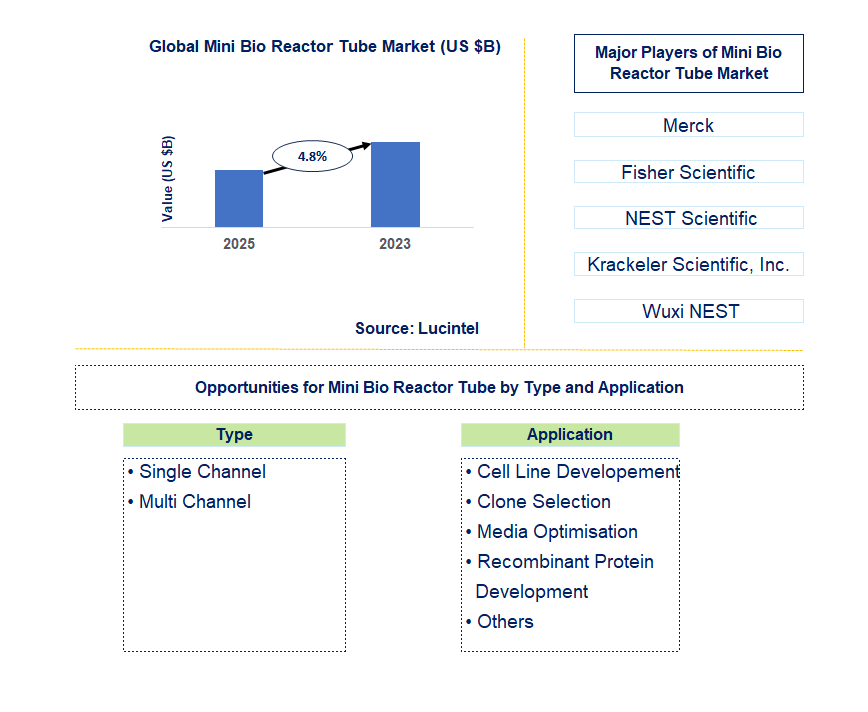
Key data points: The growth forecast = 4.8% annually for the next 7 years. Scroll below to get more insights. This market report covers Trends, opportunity and forecast in mini bio reactor tube market to 2031 by type (single channel and multi channel), application (cell line developement, clone selection, media optimisation, recombinant protein development, and others), and region (North America, Europe, Asia Pacific, and the Rest of the World)
We'll send your sample report shortly.
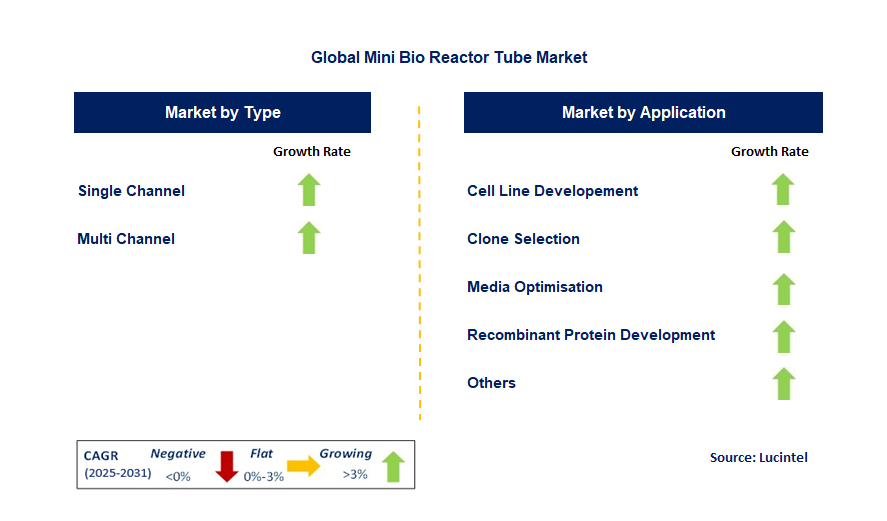
• Lucintel forecasts that, within the type category, multi channel is expected to witness higher growth over the forecast period due to increased throughput and scalability..
• Within the application category, recombinant protein development is expected to witness the highest growth due to high demand for therapeutic and research proteins..
• In terms of region, APAC is expected to witness the highest growth over the forecast period due to rising biopharmaceutical demand and industry growth.. Gain valuable insights for your business decisions with our comprehensive 150+ page report. Sample figures with some insights are shown below.
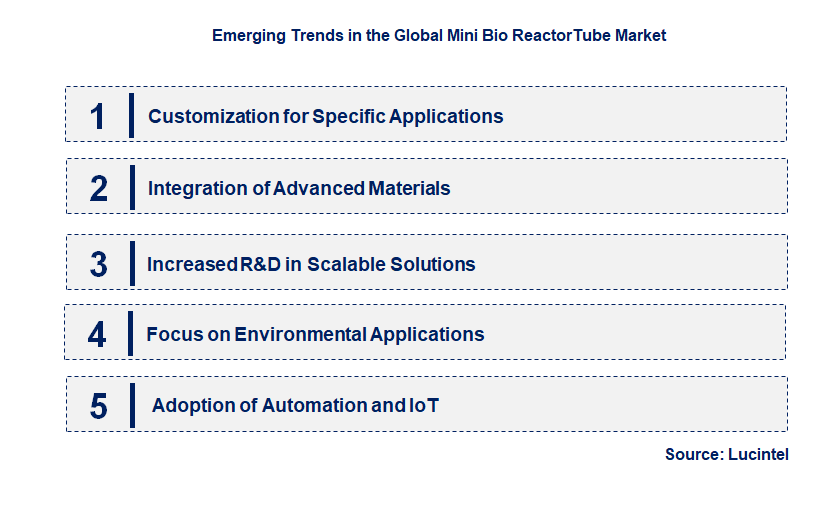
• Customization for specific applications - There is a growing trend towards customized reactor tubes designed to meet specific application needs, such as pharmaceutical production and environmental research. These customized solutions offer better control over biological processes, improving efficiency and yield.
• Integration of advanced materials - The use of advanced materials, including specialized polymers and ceramics, is becoming more prevalent in reactor tube designs. These materials enhance durability, resistance to chemical corrosion, and efficiency under varying conditions, driving innovation in mini bio reactors.
• Increased R&D in scalable solutions - The market is witnessing a rise in R&D efforts aimed at developing scalable mini bio reactor systems that can be easily adapted for different biotechnological processes. This trend supports the growing need for biomanufacturing and research in pharmaceuticals and industrial biotechnology.
• Focus on environmental applications - Mini bio reactors are increasingly being used for environmental applications, such as waste treatment and water purification. The trend is driven by the need for sustainable solutions in biotechnology, particularly in regions with stringent environmental regulations.
• Adoption of automation and IoT - The integration of automation and IoT technologies into mini bio reactor systems is becoming more common. This trend allows for real-time monitoring and control of biological processes, enhancing efficiency and reducing manual intervention in biotechnological applications. These trends are reshaping the mini bio reactor tube market by expanding the scope of applications and improving the efficiency and adaptability of mini bio reactors.
• Introduction of high-performance materials - The development of mini bio reactor tubes using advanced materials, such as high-performance polymers and ceramics, has enhanced durability and chemical resistance. These materials are critical for applications in pharmaceuticals, biofuels, and environmental research.
• Expansion of customized solutions - The market is seeing a rise in customized mini bio reactors tailored for specific applications, such as synthetic biology and personalized medicine. This development allows researchers to conduct precise biological experiments and scale up production processes efficiently.
• Growth of biomanufacturing applications - There is an increasing adoption of mini bio reactors in biomanufacturing processes, particularly for the production of pharmaceuticals and biofuels. These reactors offer better control over fermentation processes, improving yield and consistency.
• Focus on sustainability in reactor design - Recent advancements include the development of mini bio reactors designed with sustainability in mind, using materials that are biodegradable and recyclable. This trend is particularly important for applications in environmental biotechnology and waste treatment.
• Enhanced automation and monitoring - The integration of automation and real-time monitoring systems in mini bio reactors is helping researchers and operators maintain optimal conditions for biological processes. This development improves the accuracy and efficiency of experiments, reducing operational costs. These developments are significantly impacting the mini bio reactor tube market by expanding the range of applications and enhancing the performance of mini bio reactors in various sectors.
• Pharmaceutical production - The use of mini bio reactors in pharmaceutical production is growing due to their ability to handle precise biological processes. This growth opportunity is driven by the need for scalability and customization in drug development and manufacturing, supporting the trend towards personalized medicine.
• Environmental biotechnology - Mini bio reactors are increasingly used in environmental biotechnology for waste treatment, water purification, and soil remediation. This application is growing rapidly due to the demand for sustainable solutions to address environmental challenges.
• Biofuels production - The adoption of mini bio reactors in biofuels production is driven by the need for efficient and controlled fermentation processes. This growth opportunity is aligned with the global push for renewable energy sources and the reduction of carbon emissions.
• Food and beverage industry - In the food and beverage industry, mini bio reactors are being used for the production of enzymes, probiotics, and other bioactive compounds. This trend is driven by the demand for clean label products and natural ingredients.
• Agricultural research - Mini bio reactors are playing a crucial role in agricultural research, particularly in the development of biofertilizers and biopesticides. This growth opportunity is aligned with the need to improve crop yield and soil health while reducing the use of chemical inputs. These strategic growth opportunities are reshaping the mini bio reactor tube market by expanding applications in diverse sectors and driving innovation in biotechnological research and production processes.
• Merck
• Fisher Scientific
• NEST Scientific
• Krackeler Scientific, Inc.
• Wuxi NEST Biotechnology Co.
• Single Channel
• Multi Channel
• Cell Line Developement
• Clone Selection
• Media Optimisation
• Recombinant Protein Development
• Others
• North America
• Europe
• Asia Pacific
• The Rest of the World
• United States: In the United States, the mini bio reactor tube market is expanding rapidly, driven by advancements in biotechnology and significant investment in R&D. Key developments include the use of advanced materials to enhance durability and efficiency, making reactors more versatile for various applications, from pharmaceuticals to biofuels. The growing emphasis on personalized medicine and synthetic biology is also driving demand for customized reactors that can handle diverse biological processes. Increased funding from government and private sectors is supporting these advancements, encouraging innovation in mini bio reactor tube technology.
• China: China’s mini bio reactor tube market is growing rapidly, fueled by increased investment in biotechnology and life sciences. Recent developments include the adoption of advanced materials such as titanium and high-performance polymers, enhancing the performance and durability of reactor tubes. These innovations are crucial for applications in pharmaceutical production, food safety, and environmental biotechnology. Chinese research institutions and industries are collaborating to develop new applications for mini bio reactors, focusing on scalability and cost-effectiveness. The market is also benefiting from government incentives aimed at promoting innovation and supporting domestic R&D efforts.
• Germany: In Germany, the mini bio reactor tube market is driven by strong demand from the pharmaceutical and biotechnology sectors. Recent developments include the introduction of customized reactor tubes made from advanced materials like glass, stainless steel, and specialized polymers. These materials offer improved resistance to chemical corrosion and temperature changes, making them suitable for various applications in bio-manufacturing and environmental research. The German market is characterized by high investment in R&D and collaboration between industry players and research institutions. This development is fostering innovation in reactor design and material selection, contributing to the growth of the market.
• India: In India, the mini bio reactor tube market is growing as the country focuses on improving agricultural productivity and environmental sustainability. Recent developments include the use of bio-reactors for the production of biofertilizers and biopesticides, enhancing soil health and crop yield. Indian manufacturers are increasingly adopting advanced materials to produce durable and efficient reactor tubes that meet local requirements. The government’s support through initiatives like “Make in India” is driving domestic production and reducing dependency on imported technologies. These developments are crucial for advancing research in environmental biotechnology and agrochemicals in India.
• Japan: In Japan, the mini bio reactor tube market is influenced by the country’s commitment to technological innovation and environmental sustainability. Recent developments include the integration of high-performance polymers and advanced ceramics in reactor tube designs, improving their efficiency and resistance to harsh conditions. These innovations are aimed at enhancing the reliability and versatility of mini bio reactors in various applications, such as pharmaceuticals, food processing, and environmental management. Japanese companies are also investing in R&D to develop specialized reactor tubes for emerging biotechnologies, contributing to the market’s growth in Asia and globally.


• Merck
• Fisher Scientific
• NEST Scientific
• Krackeler Scientific, Inc.
• Wuxi NEST Biotechnology Co. Q5. Which mini bio reactor tube market segment will be the largest in future? Answer: Lucintel forecasts that multi channel is expected to witness higher growth over the forecast period due to increased throughput and scalability.. Q6. In mini bio reactor tube market, which region is expected to be the largest in next 5 years? Answer: APAC is expected to witness the highest growth over the forecast period due to rising biopharmaceutical demand and industry growth.. Q7. Do we receive customization in this report? Answer: Yes, Lucintel provides 10% customization without any additional cost.


Choose a license that fits your team. Instant PDF delivery.
Prices exclude taxes. Instant delivery. Custom licensing available on request.
Market Report · July 24, 2026
Market Report · July 20, 2026
Market Report · July 20, 2026
Trusted partner for strategic intelligence and business growth


Receive a complimentary market analysis tailored to your industry. Our analysts will identify key growth opportunities and competitive dynamics specific to your business.

Market size, growth rate, and key trend analysis for your specific sector.

Top competitor positioning and market share analysis.

Strategic recommendations backed by data-driven insights.
Get curated market intelligence and competitive moves straight to your inbox.
By subscribing, you agree to receive our monthly insights. Unsubscribe anytime.
Receive a complimentary market analysis tailored to your industry. Our analysts will identify key growth opportunities and competitive dynamics specific to your business.
Market size, growth rate, and key trend analysis for your specific sector.
Top competitor positioning and market share analysis.
Strategic recommendations backed by data-driven insights.
Get curated market intelligence, emerging trends, and competitive moves straight to your inbox each month.
By subscribing, you agree to receive our monthly insights. Unsubscribe anytime.
We'll send your sample report shortly.