
Market Report · May 18, 2026

This market report covers trends, opportunities, and forecasts in the global milliohm meter market to 2031 by technology (four-wire (kelvin) measurement, bridge method, dc micro-ohmmeter, ac milliohm, and pulse milliohm), end use industry (automotive, electronics manufacturing, electrical utilities, aerospace & defense, and others), and region (North America, Europe, Asia Pacific, and the Rest of the World)
We'll send your sample report shortly.


• Increasing adoption of Four-wire (Kelvin) measurement for enhanced accuracy and noise reduction, critical in automotive and electronics sectors.
• Integration of Pulse Milliohm technology enabling faster and more precise resistance measurements in complex components.
• Growing preference for digital and IoT-enabled milliohm meters to support remote monitoring and data analytics.
• Development of compact, portable devices enhancing usability in field operations and maintenance.
• Enhanced focus on multi-functionality combining AC and DC measurement capabilities to widen application scope. These trends are driving the milliohm meter market toward smarter, more versatile instruments, offering higher reliability and connectivity, thus transforming measurement practices across industries.
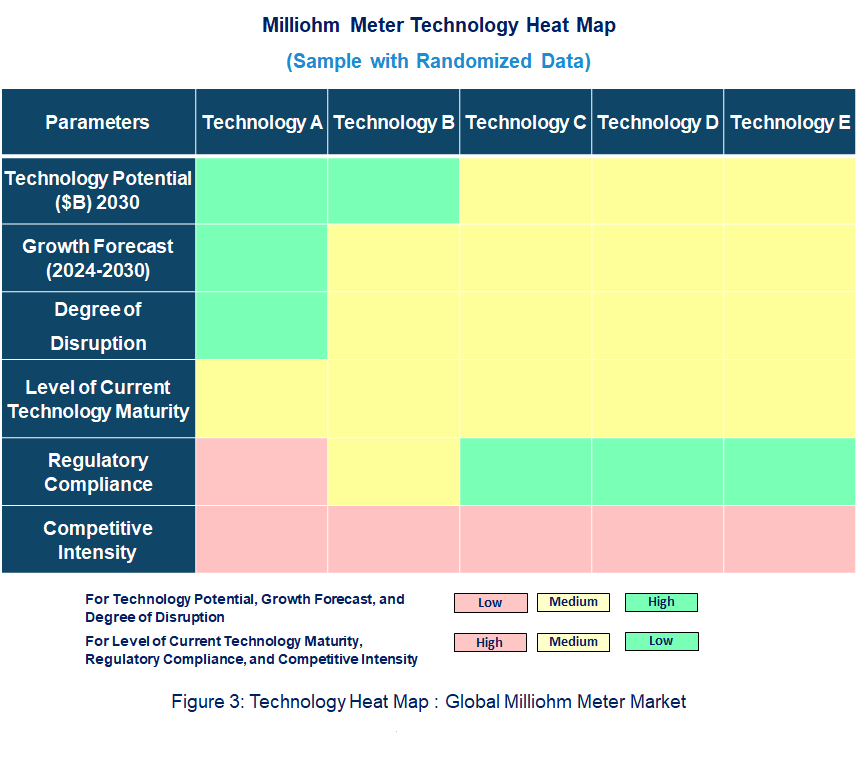
• Technology Potential: The milliohm meter market's technological potential centers on delivering precise low-resistance measurements essential for quality control in automotive, electronics, and energy sectors. Among the technologies, four-wire (Kelvin) measurement stands out for its high accuracy and maturity, widely adopted due to its ability to minimize lead resistance errors.
• Current Technology Maturity Level: Pulse milliohm technology is emerging as a disruptive force by offering rapid and precise measurements suitable for complex components and assemblies, though it remains relatively nascent compared to established methods. Bridge Method and DC Micro-Ohmmeter techniques maintain moderate maturity but face challenges in speed and adaptability to modern digital systems.
• Degree of Disruption: Four-Wire (Kelvin) Measurement offers moderate disruption with its precise, widely used method, while Bridge Method shows low disruption due to its traditional, slower approach. AC Milliohm has low to moderate disruption in niche applications, whereas Pulse Milliohm technology is highly disruptive with rapid, precise measurements suited for advanced uses.
• Regulatory Compliance: Four-Wire (Kelvin) measurement faces high competition due to mature, cost-effective solutions meeting strict standards, while Bridge Method sees low to moderate competition with a focus on calibration accuracy. DC Micro-Ohmmeter and AC Milliohm technologies experience moderate competition in specialized and niche sectors, respectively. Pulse Milliohm technology faces moderate to high competition driven by innovation and regulatory emphasis on reliability and data integrity.
• Extech Instruments launched compact and portable milliohm meters with improved accuracy and user-friendly interfaces, enhancing field measurement capabilities.
• Megger introduced advanced four-wire milliohm meters with enhanced connectivity options, facilitating seamless integration into industrial IoT platforms.
• AEMC expanded its product range by integrating pulse measurement technology, targeting automotive and electronics testing sectors.
• B&K Precision developed hybrid milliohm meters combining AC and DC measurement modes, improving versatility across applications.
• PCE Instruments enhanced digital milliohm meters with cloud-based data management, supporting remote diagnostics and regulatory compliance. These advancements are bolstering market competitiveness, driving technological progress, and meeting evolving user requirements.
• Rising adoption of electric vehicles drives demand for accurate resistance measurement in battery and motor components.
• Increasing industrial automation calls for integrated milliohm meters with IoT connectivity for predictive maintenance.
• Stringent regulatory requirements push manufacturers to adopt high-precision measurement tools.
• Technological advancements in pulse and four-wire measurement enhance operational efficiency. Challenges
• Challenges include high costs of advanced meters and the need for skilled operators. These drivers and challenges collectively shape market dynamics, fostering innovation while requiring focus on cost optimization and ease of use.
• Extech Instruments
• Megger
• Aemc
• B&K Precision
• Pce Instruments
• Technology Readiness by Type: Four-wire (Kelvin) measurement is highly mature and dominant in low-resistance testing across industries like automotive and aerospace. The bridge method, though technologically mature, is less adopted due to bulkiness and complexity. DC micro-ohmmeters are commercially ready, widely used in industrial maintenance and electronics QA. AC Milliohm meters are growing in readiness, with expanding roles in precision electronics and transformer testing. Pulse milliohm meters are emerging, with pilot-stage adoption in high-speed and safety-critical applications. Competitiveness is strongest in DC and Kelvin methods due to broad vendor presence and user familiarity. Regulatory adherence is highest for Kelvin and Bridge types. Key applications span PCB trace testing, battery pack validation, relay contact integrity, and low-resistance bonding in aircraft and rail.
• Competitive Intensity and Regulatory Compliance: The milliohm meter market shows moderate-to-high competition, especially for four-wire and DC micro-ohmmeters, as multiple vendors offer comparable specs. Bridge methods see limited competition, focused on metrology and standards labs. AC and Pulse milliohm technologies face niche competition with rising interest in EV and aerospace industries. Regulatory compliance varies—Four-Wire and Bridge technologies must align with ISO/IEC calibration standards. Instruments used in aerospace, medical, and defense must meet additional standards like MIL-STD and FDA traceability. Electromagnetic compatibility (EMC) and safety certifications (CE, UL) are critical for broader market acceptance, while increased miniaturization demands rigorous quality assurance protocols.
• Disruption Potential: Milliohm meter technologies each bring varying disruption levels to precision resistance measurement. Four-wire (Kelvin) measurement is highly disruptive due to its elimination of lead resistance, becoming the gold standard in low-resistance applications. The bridge method, though older, remains moderately disruptive in metrology due to its accuracy in laboratory settings. DC micro-ohmmeters offer reliable disruption for industrial applications with portability and simplicity. AC milliohm meters reduce thermal EMF errors, a moderate improvement for electronics testing. Pulse milliohm meters introduce innovation by enabling fast, non-destructive testing, ideal for sensitive components like batteries and connectors. These advancements help shift testing from lab-only to real-time, in-process environments, enhancing diagnostic speed and accuracy.
• Four-Wire (Kelvin) Measurement
• Bridge Method
• DC Micro-Ohmmeter
• AC Milliohm
• Pulse Milliohm
• Automotive
• Electronics Manufacturing
• Electrical Utilities
• Aerospace & Defense
• Others
• North America
• Europe
• Asia Pacific
• The Rest of the World
• Latest Developments and Innovations in the Milliohm Meter Technologies
• Companies / Ecosystems
• Strategic Opportunities by Technology Type


Choose a license that fits your team. Instant PDF delivery.
Prices exclude taxes. Instant delivery. Custom licensing available on request.
Market Report · May 18, 2026
Market Report · May 18, 2026
Market Report · May 18, 2026
Trusted partner for strategic intelligence and business growth


Receive a complimentary market analysis tailored to your industry. Our analysts will identify key growth opportunities and competitive dynamics specific to your business.

Market size, growth rate, and key trend analysis for your specific sector.

Top competitor positioning and market share analysis.

Strategic recommendations backed by data-driven insights.
Get curated market intelligence and competitive moves straight to your inbox.
By subscribing, you agree to receive our monthly insights. Unsubscribe anytime.
Receive a complimentary market analysis tailored to your industry. Our analysts will identify key growth opportunities and competitive dynamics specific to your business.
Market size, growth rate, and key trend analysis for your specific sector.
Top competitor positioning and market share analysis.
Strategic recommendations backed by data-driven insights.
Get curated market intelligence, emerging trends, and competitive moves straight to your inbox each month.
By subscribing, you agree to receive our monthly insights. Unsubscribe anytime.
We'll send your sample report shortly.