Military Logistics Market Report: Trends, Forecast and Competitive Analysis to 2035

Key data points: The market size in 2035 = $58 billion, growth forecast = 7.8% annually for the next 8 years. Scroll below to get more insights. This market report covers trends, opportunities and forecasts in military logistics market to 2035 by type (logistics & distribution, facility management, and services), application (roadways, railways, waterways, and airways), and region (North America, Europe, Asia Pacific, and the Rest of the World)

Publisher: Lucintel Last Updated: July 2026
See Pricing

Download Sample Report

| ✨ New Download Sample report — Get instant insights! | ✨ New Download Sample report — Get instant insights!

Military Logistics Market Report: Trends, Forecast and Competitive Analysis to 2035

Military Logistics Market

The future of the global military logistics market looks promising with opportunities in the roadway, railway, waterway, and airway markets. The global military logistics market is expected to reach an estimated $58 billion by 2035 with a CAGR of 7.8% from 2026 to 2035. The major drivers for this market are the increasing demand for efficient defense supply chains, the rising military deployment transportation requirements, and the growing defense inventory management operations.

  • Lucintel forecasts that, within the type category, logistic & distribution is expected to witness the highest growth over the forecast period due to the increasing demand for efficient supply chain management solutions.
  • Within the application category, airway is expected to witness the highest growth due to the growing need for rapid military transportation support.
  • In terms of regions, North America is expected to witness the highest growth over the forecast period due to the rising defense spending and logistics infrastructure development.

Gain valuable insights for your business decisions with our comprehensive 150+ page report. Sample figures with some insights are shown below.
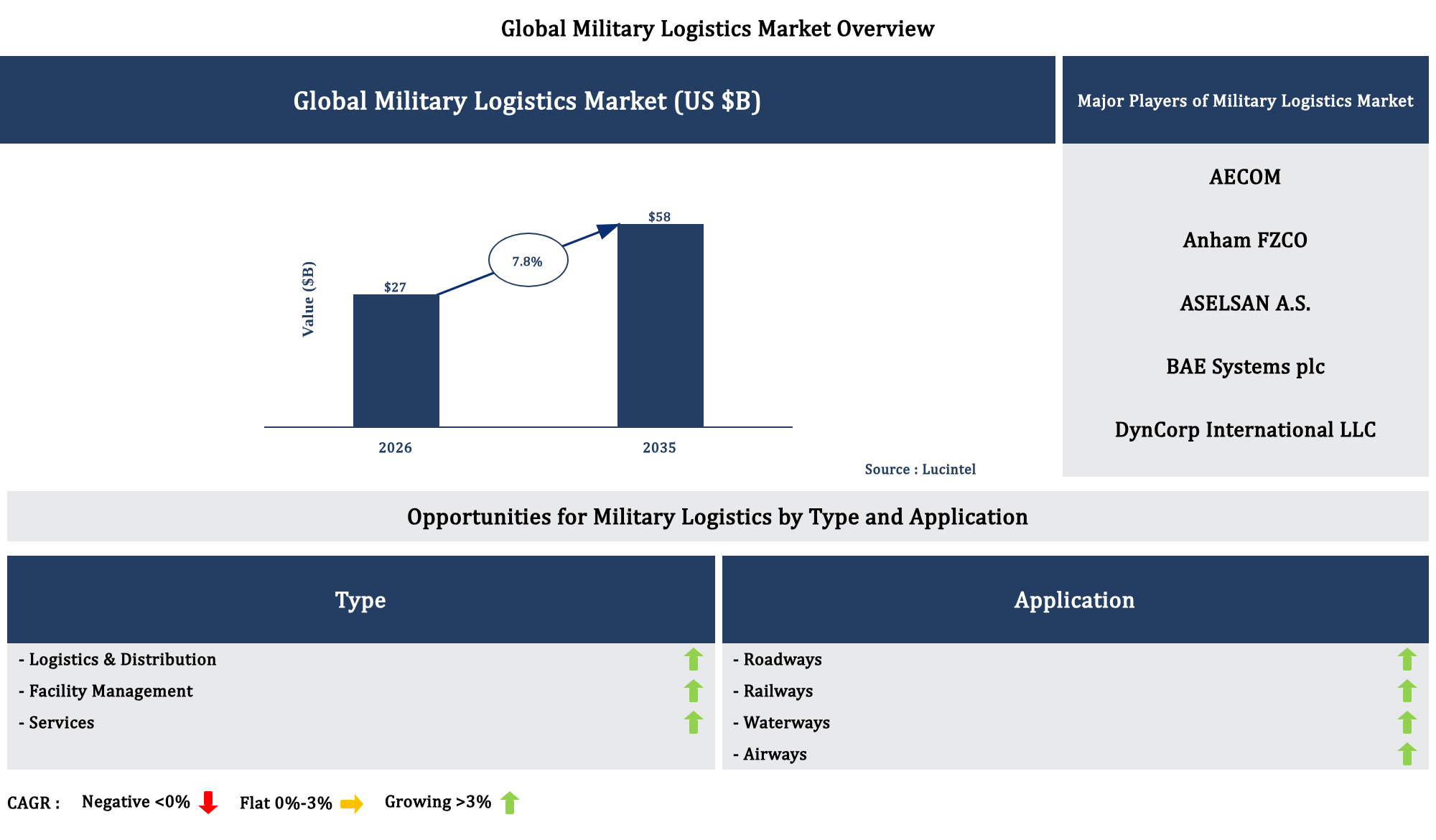
Military Logistics Market

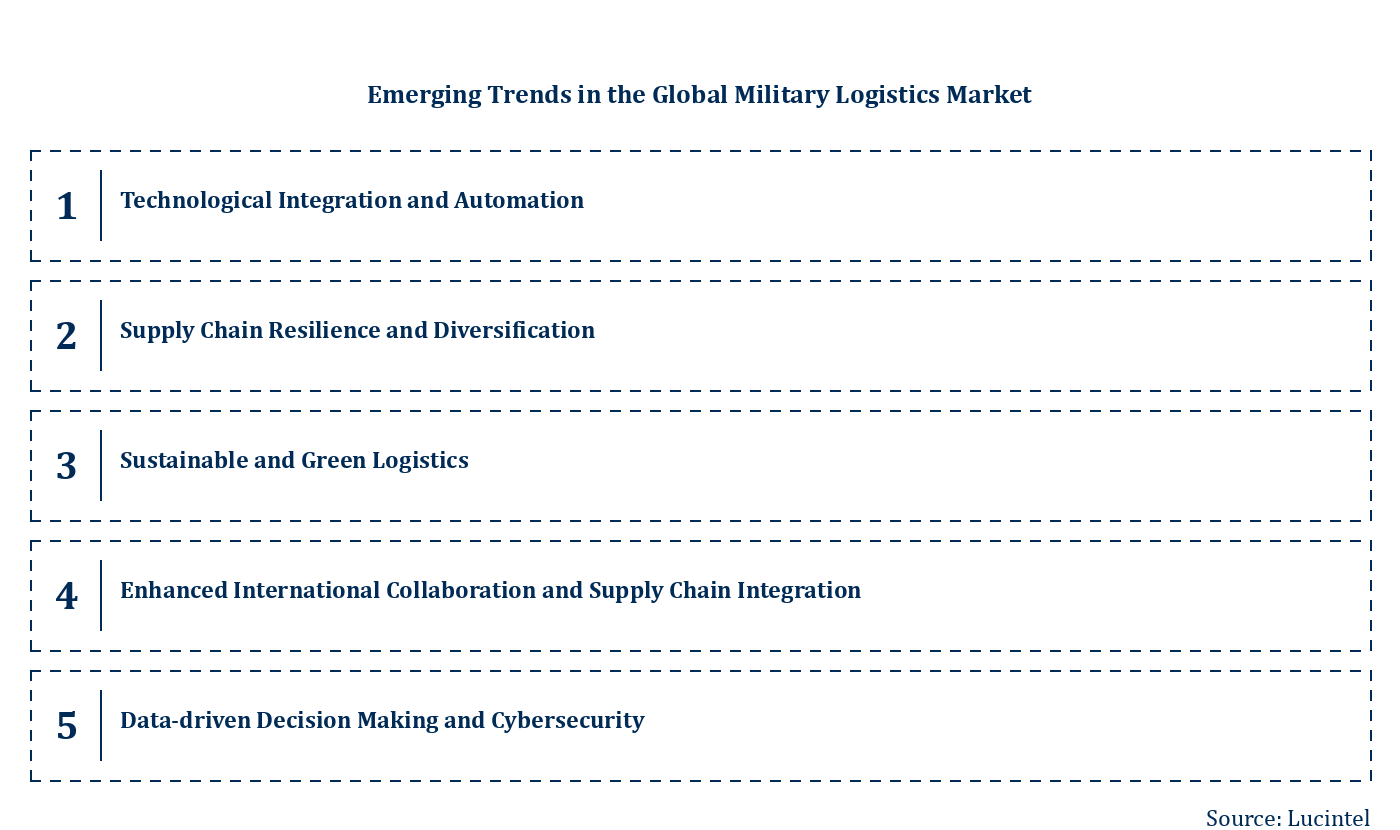
Emerging Trends in the Military Logistics Market

The military logistics market is experiencing rapid transformation driven by technological advancements, geopolitical shifts, and evolving defense strategies. As nations seek more efficient, resilient, and innovative logistics solutions, the industry is adapting to meet these new demands. Emerging trends are shaping the future landscape, influencing procurement, operational efficiency, and strategic planning. These developments are not only enhancing military capabilities but also creating opportunities for technological integration and international collaboration. Understanding these key trends is essential for stakeholders aiming to stay competitive and responsive in this dynamic environment.

  • Technological Integration and Automation: The adoption of advanced technologies such as AI, IoT, and robotics is revolutionizing military logistics. Automated systems improve supply chain efficiency, reduce human error, and enable real-time tracking of assets. AI-driven analytics optimize inventory management and predictive maintenance, ensuring readiness and reducing downtime. Drones and autonomous vehicles are increasingly used for reconnaissance and delivery in challenging terrains. This integration enhances operational speed, accuracy, and safety, ultimately leading to more agile and responsive logistics networks that can adapt swiftly to changing battlefield conditions.
  • Supply Chain Resilience and Diversification: In response to geopolitical tensions and supply chain disruptions, militaries are focusing on diversifying their supply sources and building resilient logistics networks. This includes establishing multiple supplier relationships, localizing key components, and creating strategic stockpiles. Resilience strategies also involve flexible transportation options such as multi-modal logistics, which combine air, sea, and land routes to mitigate risks. Strengthening supply chain resilience ensures continuous operational capability during crises, reduces dependency on single sources, and enhances overall national security by maintaining steady logistics support under adverse conditions.
  • Sustainable and Green Logistics: Environmental concerns and the need for sustainable operations are influencing military logistics strategies. The adoption of eco-friendly fuels, electric vehicles, and energy-efficient equipment reduces carbon footprints. Green logistics initiatives include optimizing routes to minimize fuel consumption, utilizing renewable energy sources, and implementing eco-conscious packaging. These efforts not only align with global sustainability goals but also reduce operational costs and logistical vulnerabilities related to fuel supply disruptions. Sustainable logistics practices are becoming integral to modern military planning, ensuring long-term operational viability and environmental responsibility.
  • Enhanced International Collaboration and Supply Chain Integration: Increasing geopolitical complexities are prompting greater international cooperation in military logistics. Countries are forming alliances to share resources, infrastructure, and intelligence, leading to integrated supply chains. Joint logistics exercises and shared logistics hubs improve interoperability and reduce redundancies. This collaboration enhances strategic flexibility, accelerates deployment times, and strengthens collective defense capabilities. By integrating supply chains across nations, militaries can better respond to global crises, improve resource utilization, and foster diplomatic relations, ultimately creating a more cohesive and resilient defense logistics ecosystem.
  • Data-Driven Decision Making and Cybersecurity: The proliferation of digital technologies necessitates robust data management and cybersecurity measures. Military logistics now rely heavily on data analytics for strategic planning, inventory management, and operational execution. Real-time data enables rapid decision-making and adaptive logistics responses. However, increased digitalization also exposes logistics networks to cyber threats, requiring advanced cybersecurity protocols to protect sensitive information and infrastructure. Strengthening data security ensures operational integrity and maintains strategic advantage. This trend underscores the importance of integrating cybersecurity into logistics modernization efforts to safeguard national security interests.

These emerging trends are fundamentally reshaping the military logistics market by fostering technological innovation, enhancing resilience, promoting sustainability, encouraging international cooperation, and emphasizing cybersecurity. Together, they are creating more agile, efficient, and secure logistics systems that are better equipped to meet the complex demands of modern defense operations.
Military Logistics Market by country

Recent Developments in the Military Logistics Market

The military logistics market is experiencing rapid transformation driven by technological advancements, geopolitical shifts, and increased defense budgets worldwide. These developments are reshaping supply chains, enhancing operational efficiency, and fostering innovation in logistics solutions. As nations prioritize military readiness, the market is poised for significant growth, with new opportunities emerging across various segments. Stakeholders are focusing on integrating digital technologies, improving supply chain resilience, and adopting sustainable practices to meet evolving defense needs.

  • Digital Transformation in Military Logistics: Enhancing Efficiency and Speed: The integration of AI, IoT, and data analytics is revolutionizing military logistics by enabling real-time tracking, predictive maintenance, and automated supply chain management. These technologies reduce delays, optimize resource allocation, and improve decision-making processes. As a result, military operations become more agile and responsive, ensuring timely deployment of assets. This digital shift is attracting investments and fostering innovation, ultimately strengthening national defense capabilities.
  • Supply Chain Resilience and Risk Management: Strengthening Security and Continuity: Recent developments focus on building resilient supply chains to withstand geopolitical tensions, cyber threats, and natural disruptions. Strategies include diversifying suppliers, establishing strategic stockpiles, and implementing advanced cybersecurity measures. These efforts ensure uninterrupted logistics support during crises, enhancing operational readiness. Improved risk management practices are also reducing vulnerabilities, safeguarding critical military assets, and maintaining strategic advantage in volatile global environments.
  • Adoption of Sustainable and Green Logistics Solutions: Reducing Environmental Impact: The military logistics sector is increasingly adopting eco-friendly practices, such as electric vehicles, renewable energy sources, and sustainable packaging. These initiatives aim to reduce carbon footprints, comply with environmental regulations, and promote energy efficiency. Green logistics also contribute to cost savings and enhance the military's public image. As environmental concerns grow, sustainable practices are becoming integral to long-term strategic planning and operational sustainability.
  • Expansion of Autonomous and Unmanned Systems: Improving Operational Capabilities: The deployment of drones, autonomous vehicles, and robotic systems is transforming military logistics by enabling safer, faster, and more efficient transportation of supplies. These systems reduce human risk, increase precision, and operate in challenging environments. Their integration supports rapid deployment, disaster response, and logistical support in remote areas. The ongoing development of autonomous technologies is expected to further enhance logistical agility and operational effectiveness.
  • Global Defense Spending and Market Growth: Driving Investment and Innovation: Increasing defense budgets worldwide are fueling market expansion, with governments investing heavily in modernizing logistics infrastructure and systems. This financial boost supports research, development, and procurement of advanced logistics solutions. Growing geopolitical tensions and the need for rapid deployment capabilities are also driving demand. The markets growth is attracting private sector participation, fostering innovation, and creating new opportunities across the military logistics value chain.

The overall impact of these developments is a more resilient, efficient, and technologically advanced military logistics market. These opportunities are enabling nations to enhance operational readiness, reduce costs, and adapt to emerging threats. As a result, the market is poised for sustained growth, with innovations driving competitive advantages and strategic superiority in global defense landscapes.

Strategic Growth Opportunities in the Military Logistics Market

The military logistics market is experiencing rapid growth driven by technological advancements, increasing defense budgets, and the need for efficient supply chain management in modern warfare. As nations modernize their armed forces, the demand for integrated logistics solutions, automation, and real-time tracking systems is expanding. This presents significant opportunities for market players to innovate and capture new revenue streams across various military applications, including supply chain management, transportation, and maintenance. Strategic investments and partnerships are crucial to capitalize on these evolving needs and ensure operational readiness.

  • Integration of Advanced Supply Chain Management Systems: The adoption of AI, IoT, and blockchain technologies in military logistics enhances transparency, efficiency, and real-time tracking of supplies. These systems enable predictive maintenance, inventory optimization, and streamlined procurement processes, reducing costs and delays. As militaries seek more resilient and agile logistics networks, the deployment of integrated digital solutions across supply chains will be a key growth driver, especially in large-scale operations and remote deployments.
  • Expansion of Autonomous Transportation and Drones: The development and deployment of autonomous vehicles, drones, and unmanned systems are transforming military logistics. These technologies facilitate rapid, safe, and cost-effective transportation of supplies in challenging terrains and combat zones. The increasing focus on reducing human risk and improving operational efficiency is fueling investments in autonomous logistics solutions, with applications spanning cargo delivery, reconnaissance, and surveillance, opening new market segments.
  • Adoption of Modular and Flexible Logistics Platforms: Modular logistics systems that can be quickly adapted to different operational needs are gaining traction. These platforms enable rapid deployment, scalability, and customization for various military missions, including humanitarian aid, disaster relief, and combat support. The trend toward flexible logistics infrastructure supports diverse applications, from field maintenance units to mobile command centers, creating opportunities for innovative product development and strategic partnerships.
  • Growth in Maintenance, Repair, and Overhaul (Maintenance, Repair, and Operations (MRO)) Services: As military fleets and equipment age, there is an increasing demand for comprehensive Maintenance, Repair, and Operations (MRO) services to ensure operational readiness. The integration of predictive analytics and remote diagnostics enhances maintenance efficiency and reduces downtime. The expansion of Maintenance, Repair, and Operations (MRO) segments, including spare parts management and lifecycle support, offers lucrative opportunities for service providers to establish long-term contracts and develop advanced maintenance solutions.
  • Increasing Focus on Cybersecurity and Data Protection: With the digitization of military logistics, safeguarding sensitive information and operational data is critical. The rising threat of cyberattacks necessitates robust cybersecurity measures, including encryption, intrusion detection, and secure communication networks. Investing in cybersecurity solutions not only protects military assets but also builds trust in digital logistics systems, creating a significant growth avenue for specialized security providers and technology developers.

These strategic growth opportunities are set to significantly shape the future of the military logistics market by enhancing operational efficiency, safety, and adaptability. Embracing technological innovations, expanding service offerings, and strengthening cybersecurity will enable market players to meet evolving defense needs. As nations prioritize modernization and digital transformation, the market is poised for sustained expansion, offering substantial potential for growth, innovation, and competitive advantage across diverse military applications.

Military Logistics Market Drivers and Challenges

The military logistics market is influenced by a complex interplay of technological advancements, economic conditions, and regulatory frameworks. As modern warfare evolves, the need for efficient supply chain management, rapid deployment, and secure communication systems becomes paramount. Governments and defense organizations are investing heavily in innovative solutions to enhance operational readiness and logistical efficiency. However, the market also faces challenges such as regulatory hurdles, geopolitical tensions, and technological integration issues. These factors collectively shape the growth trajectory and strategic direction of the market, requiring stakeholders to adapt swiftly to changing conditions and emerging threats.

The factors responsible for driving the military logistics market include:-

  • Technological Innovation: The integration of advanced technologies such as AI, IoT, and automation enhances supply chain efficiency, real-time tracking, and predictive maintenance, leading to faster, more reliable logistics operations. This reduces costs and improves response times during military missions, making logistics more resilient and adaptable to complex scenarios.
  • Increasing Defense Budgets: Governments worldwide are increasing defense spending to modernize their armed forces, which directly boosts investments in military logistics infrastructure, equipment, and services. This financial commitment supports the development of sophisticated logistics networks capable of supporting large-scale military operations.
  • Geopolitical Tensions and Conflicts: Rising geopolitical tensions and regional conflicts necessitate rapid deployment and supply chain resilience. This drives demand for advanced logistics solutions that can ensure timely delivery of supplies, equipment, and personnel, thereby strengthening military readiness and operational effectiveness.
  • Focus on Supply Chain Security: Ensuring the security of supply chains against cyber threats, sabotage, and theft is critical. Investments in secure communication channels, encrypted data sharing, and resilient logistics networks are fueling market growth, as defense agencies prioritize safeguarding their logistical operations.

The challenges in the military logistics market are:

  • Regulatory and Compliance Barriers: Stringent government regulations, export controls, and compliance requirements can delay procurement processes and limit the adoption of new technologies. Navigating these complex legal frameworks often increases costs and hampers swift deployment of innovative logistics solutions.
  • Technological Integration and Compatibility: Integrating new technologies with existing military systems poses significant challenges. Compatibility issues, cybersecurity concerns, and the need for extensive training can hinder seamless implementation, affecting overall efficiency and operational readiness.
  • Geopolitical and Economic Instability: Political tensions, trade restrictions, and economic downturns can disrupt supply chains, limit funding, and create uncertainties in procurement and deployment. Such instability hampers long-term planning and investment, impacting market growth and technological advancement.

The military logistics market is driven by technological progress, increased defense spending, geopolitical tensions, and a focus on security. However, regulatory complexities, integration challenges, and geopolitical instability pose significant hurdles. These drivers and challenges collectively influence the market’s growth, pushing stakeholders to innovate while navigating a complex regulatory and geopolitical landscape. The market’s future will depend on how effectively these factors are managed to ensure resilient, secure, and efficient military logistics operations.

List of Military Logistics Market Companies

Companies in the market compete on the basis of product quality offered. Major players in this market focus on expanding their manufacturing facilities, R&D investments, infrastructural development, and leverage integration opportunities across the value chain. Through these strategies military logistics market companies cater increasing demand, ensure competitive effectiveness, develop innovative products & technologies, reduce production costs, and expand their customer base. Some of the military logistics market companies profiled in this report include-

  • AECOM
  • Anham FZCO
  • ASELSAN A.S.
  • BAE Systems plc
  • DynCorp International LLC
  • Fluor Corporation
  • Honeywell
  • KBR Inc.
  • Lockheed Martin Corporation
  • THALES GROUP

Military Logistics Market by Segment

The study includes a forecast for the global military logistics market by type, application, and region.

  • Military Logistics Market by Type [Value from 2019 to 2035]:
    • Logistics & Distribution
    • Facility Management
    • Services
  • Military Logistics Market by Application [Value from 2019 to 2035]:
    • Roadways
    • Railways
    • Waterways
    • Airways
  • Military Logistics Market by Region [Value ($B) from 2019 to 2035]:
    • North America
    • Europe
    • Asia Pacific
    • The Rest of the World

Country Wise Outlook for the Military Logistics Market

The military logistics market has experienced significant shifts driven by technological advancements, geopolitical tensions, and evolving defense strategies worldwide. Countries are investing heavily in modernization efforts to enhance supply chain efficiency, integrate advanced technologies like AI and automation, and improve rapid deployment capabilities. These developments reflect a broader trend toward increased military readiness and strategic autonomy. As nations seek to strengthen their defense infrastructure, the market is witnessing innovations in transportation, inventory management, and supply chain resilience. The following summaries highlight recent key developments in the United States, China, Germany, India, and Japan within this dynamic sector.

  • United States: The US military logistics sector has focused on integrating AI and automation to streamline supply chains, reduce response times, and enhance operational efficiency. Recent investments include upgrading transportation fleets with advanced tracking systems and expanding the use of autonomous vehicles for logistics support. The Department of Defense is also emphasizing cybersecurity measures to protect supply networks from cyber threats, alongside initiatives to improve interoperability among allied forces. These efforts aim to maintain technological superiority and rapid deployment capabilities.
  • China: China has accelerated its military logistics modernization, emphasizing the development of integrated supply chain systems and digital platforms. Recent advancements include deploying smart logistics hubs and expanding the use of robotics and automation in warehousing and transportation. The Chinese military is also investing in high-speed rail and air logistics networks to improve rapid deployment across vast territories. These developments aim to enhance strategic mobility and logistical resilience amid regional tensions and evolving security challenges.
  • Germany: Germany's military logistics market has seen a focus on sustainability and technological innovation. Recent initiatives include upgrading transport infrastructure with eco-friendly solutions and implementing digital logistics management systems. The Bundeswehr is also investing in modular and flexible supply chain solutions to adapt to various operational scenarios. Additionally, Germany is enhancing its cooperation with NATO allies to improve joint logistics capabilities, emphasizing interoperability and shared technological advancements.
  • India: India has prioritized modernizing its military logistics infrastructure to support its expanding defense capabilities. Recent developments include establishing integrated logistics support centers and deploying advanced inventory management systems. The Indian military is also investing in autonomous vehicles and drone technology for reconnaissance and supply delivery in challenging terrains. Efforts are underway to improve logistics connectivity across border regions, aiming to bolster rapid response and strategic mobility in the face of regional security concerns.
  • Japan: Japan's military logistics market has focused on enhancing resilience against natural disasters and regional threats. Recent advancements include deploying advanced supply chain management systems and expanding the use of robotics and automation in logistics operations. Japan is also strengthening its maritime logistics capabilities to support its Self-Defense Forces' rapid deployment and sustainment efforts. Collaborations with allied nations are increasing to improve interoperability and joint logistical operations, ensuring readiness in the Asia-Pacific region.

Features of the Military Logistics Market

  • Market Size Estimates: Military logistics market size estimation in terms of value ($B).
  • Trend and Forecast Analysis: Market trends (2019 to 2025) and forecast (2026 to 2035) by various segments and regions.
  • Segmentation Analysis: Military logistics market size by type, application, and region in terms of value ($B).
  • Regional Analysis: Military logistics market breakdown by North America, Europe, Asia Pacific, and Rest of the World.
  • Growth Opportunities: Analysis of growth opportunities in different types, applications, and regions for the military logistics market.
  • Strategic Analysis: This includes M&A, new product development, and competitive landscape of the military logistics market.
  • Analysis of competitive intensity of the industry based on Porter’s Five Forces model.

Top 5 Companies

  • AECOM
  • Anham FZCO
  • ASELSAN A.S.
  • BAE Systems plc
  • DynCorp International LLC

Table of Contents

1. Executive Summary
13.1 Competitive Analysis Overview

List of Figures

List of Tables

Methodology

Lucintel has been in the business of market research and management consulting since 2000 and has published over 1000 market intelligence reports in various markets / applications and served over 1,000 clients worldwide. This study is a culmination of four months of full-time effort performed by Lucintel's analyst team. The analysts used the following sources for the creation and completion of this valuable report:

  • In-depth interviews of the major players in this market
  • Detailed secondary research from competitors' financial statements and published data
  • Extensive searches of published works, market, and database information pertaining to industry news, company press releases, and customer intentions
  • A compilation of the experiences, judgments, and insights of Lucintel's professionals, who have analyzed and tracked this market over the years.

Extensive research and interviews are conducted across the supply chain of this market to estimate market share, market size, trends, drivers, challenges, and forecasts. Below is a brief summary of the primary interviews that were conducted by job function for this report.

Lucintel's methodology for market research

Thus, Lucintel compiles vast amounts of data from numerous sources, validates the integrity of that data, and performs a comprehensive analysis. Lucintel then organizes the data, its findings, and insights into a concise report designed to support the strategic decision-making process. The figure below is a graphical representation of Lucintel's research process.

Primary interviews by job function

Buy Now

Choose a license that fits your team. Instant PDF delivery.

Market Report

1 User PDF

$4,850
Buy Now

Market Report

2-5 Users PDF

$6,700
Buy Now

Market Report

Corporate PDF

$8,850
Buy Now

Market Report

Global PDF

$10,000
Buy Now

Prices exclude taxes. Instant delivery. Custom licensing available on request.

Frequently Asked Questions

What is the military logistics market size?
The global military logistics market is expected to reach an estimated $58 billion by 2035.
What is the growth forecast for military logistics market?
The global military logistics market is expected to grow with a CAGR of 7.8% from 2026 to 2035.
What are the major drivers influencing the growth of the military logistics market?
The major drivers for this market are the increasing demand for efficient defense supply chains, the rising military deployment transportation requirements, and the growing defense inventory management operations.
What are the major segments for military logistics market?
The future of the military logistics market looks promising with opportunities in the roadway, railway, waterway, and airway markets.
Who are the key military logistics market companies?

Some of the key military logistics companies are as follows:

  • AECOM
  • Anham FZCO
  • ASELSAN A.S.
  • BAE Systems plc
  • DynCorp International LLC
  • Fluor Corporation
  • Honeywell
  • KBR Inc.
  • Lockheed Martin Corporation
  • THALES GROUP
Which military logistics market segment will be the largest in future?
Lucintel forecasts that, within the type category, logistic & distribution is expected to witness the highest growth over the forecast period.
In military logistics market, which region is expected to be the largest in next 8 years?
In terms of region, North America is expected to witness the highest growth over the forecast period.
Do we receive customization in this report?
Yes, Lucintel provides 10% customization without any additional cost.

Key Questions

  • What are some of the most promising, high-growth opportunities for the military logistics market by type (logistics & distribution, facility management, and services), application (roadways, railways, waterways, and airways), and region (North America, Europe, Asia Pacific, and the Rest of the World)?
  • Which segments will grow at a faster pace and why?
  • Which region will grow at a faster pace and why?
  • What are the key factors affecting market dynamics? What are the key challenges and business risks in this market?
  • What are the business risks and competitive threats in this market?
  • What are the emerging trends in this market and the reasons behind them?
  • What are some of the changing demands of customers in the market?
  • What are the new developments in the market? Which companies are leading these developments?
  • Who are the major players in this market? What strategic initiatives are key players pursuing for business growth?
  • What are some of the competing products in this market and how big of a threat do they pose for loss of market share by material or product substitution?
  • What M&A activity has occurred in the last 5 years and what has its impact been on the industry?
Why Choose Us

The Lucintel Advantage

Trusted partner for strategic intelligence and business growth

25+ Years Excellence

25+ Years Excellence

Quarter century of proven expertise in management consulting and market research across global markets.
Game-Changer Ideas

Game-Changer Ideas

Innovative strategies and actionable insights that help clients become the smartest in their industry.
Global Reach

Global Reach

Extensive coverage across 50+ industries and markets worldwide with localized expertise.
Start Your Growth Journey

Get Your Free
Market Intelligence
Briefing

Receive a complimentary market analysis tailored to your industry. Our analysts will identify key growth opportunities and competitive dynamics specific to your business.

Custom Market Snapshot

Market size, growth rate, and key trend analysis for your specific sector.

Competitive Landscape Overview

Top competitor positioning and market share analysis.

Growth Opportunity Identification

Strategic recommendations backed by data-driven insights.

Subscribe

Subscribe to our Newsletter

Get curated market intelligence and competitive moves straight to your inbox.

By subscribing, you agree to receive our monthly insights. Unsubscribe anytime.

Industry Trends Market Signals Opportunities Competitor Moves