Military Cargo Drone Market Report: Trends, Forecast and Competitive Analysis to 2035

Key data points: The market size in 2035 = $411 million, growth forecast = 20.2% annually for the next 8 years. Scroll below to get more insights. This market report covers trends, opportunities and forecasts in military cargo drone market to 2035 by type (fixed-wing drone, heavy-lift multirotor drone, helicopter drone, and others), application (battlefield supply, emergency material transportation, coordinated operations, and others), and region (North America, Europe, Asia Pacific, and the Rest of the World)

Publisher: Lucintel Last Updated: July 2026
See Pricing

Download Sample Report

| ✨ New Download Sample report — Get instant insights! | ✨ New Download Sample report — Get instant insights!

Military Cargo Drone Market Report: Trends, Forecast and Competitive Analysis to 2035

Military Cargo Drone Market

The future of the global military cargo drone market looks promising with opportunities in the battlefield supply, emergency material transportation, and coordinated operation markets. The global military cargo drone market is expected to reach an estimated $411 million by 2035 with a CAGR of 20.2% from 2026 to 2035. The major drivers for this market are the increasing need for rapid military supply delivery, the rising adoption of unmanned cargo transport, and the growing investment in autonomous drone technologies.

  • Lucintel forecasts that, within the type category, fixed-wing drone is expected to witness the highest growth over the forecast period due to longer range, higher payload capacity, and better endurance for logistics missions.
  • Within the application category, battlefield supply is expected to witness the highest growth due to increasing demand for rapid, autonomous delivery of critical supplies in combat zones.
  • In terms of regions, APAC is expected to witness the highest growth over the forecast period due to rising defense modernization programs and expanding military UAV adoption.

Gain valuable insights for your business decisions with our comprehensive 150+ page report. Sample figures with some insights are shown below.
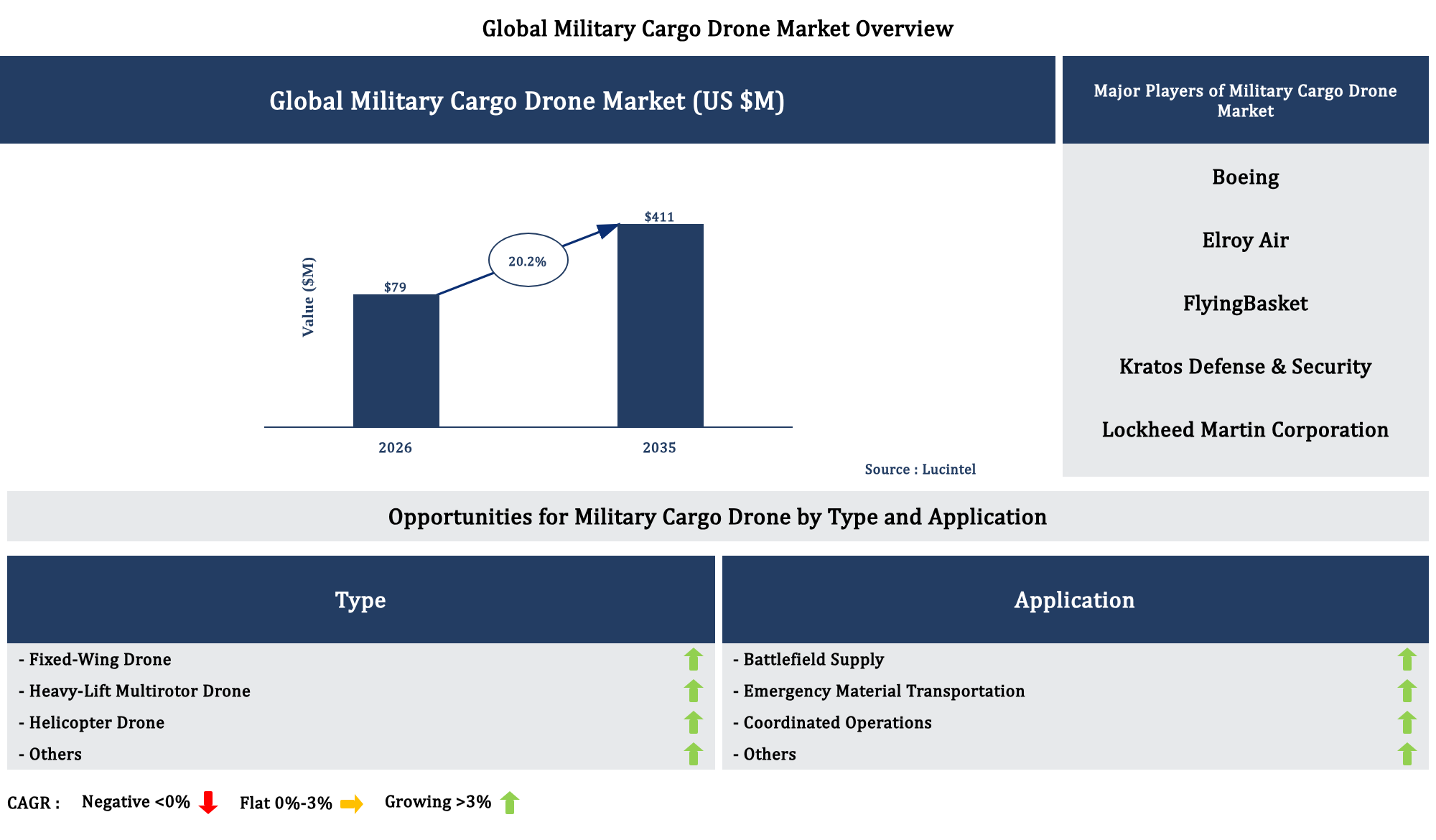
Military Cargo Drone Market

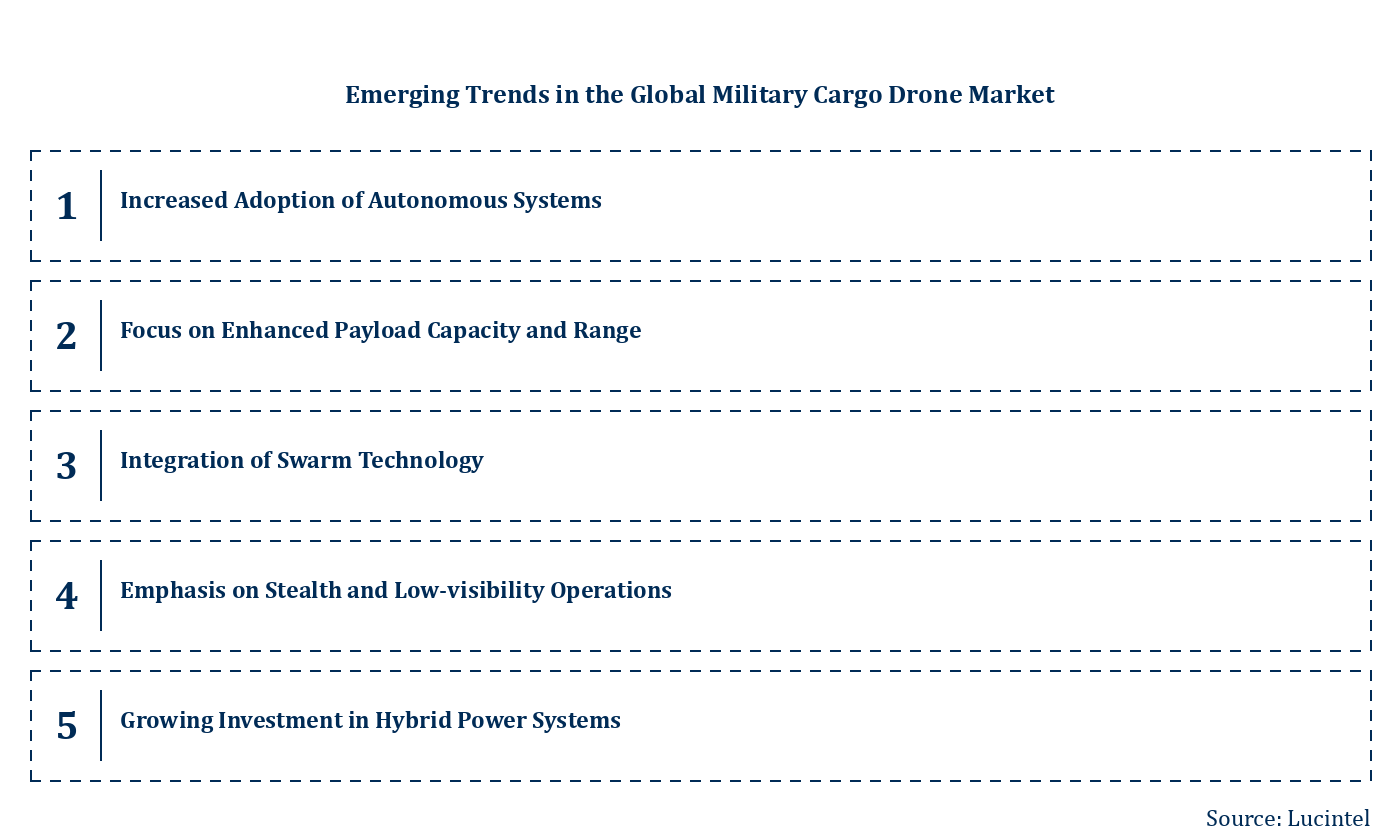
Emerging Trends in the Military Cargo Drone Market

The military cargo drone market is experiencing rapid evolution driven by technological advancements, changing defense strategies, and increasing demand for efficient logistics solutions. As nations seek to enhance their military capabilities, cargo drones are becoming vital for rapid deployment, supply chain resilience, and operational flexibility. These developments are reshaping traditional military logistics, reducing reliance on manned transport, and enabling access to challenging terrains. The markets growth is also influenced by geopolitical tensions, budget allocations, and innovations in drone design and autonomy. Understanding these emerging trends is crucial for stakeholders aiming to capitalize on the evolving landscape and maintain strategic advantages in modern warfare.

  • Increased Adoption of Autonomous Systems: Military cargo drones are increasingly equipped with advanced autonomous navigation and control systems. This trend enhances operational efficiency by reducing the need for human pilots, minimizing errors, and enabling missions in hazardous or inaccessible areas. Autonomous capabilities also allow for real-time decision-making, improved coordination, and faster deployment. As technology matures, autonomous cargo drones are expected to handle complex logistics tasks, support rapid troop movements, and deliver supplies with minimal human intervention, significantly transforming military logistics operations.
  • Focus on Enhanced Payload Capacity and Range: There is a significant push to develop drones with higher payload capacities and extended operational ranges. This trend addresses the need for transporting heavier supplies over longer distances without relying on traditional transport methods. Improved payload and range capabilities enable military forces to supply remote or contested zones efficiently, reduce logistical bottlenecks, and support large-scale operations. Innovations in battery technology, fuel efficiency, and drone design are key drivers, making cargo drones more versatile and capable of supporting diverse mission requirements.
  • Integration of Swarm Technology: The deployment of drone swarms is emerging as a strategic trend in military logistics. Swarm technology allows multiple drones to operate collaboratively, performing complex tasks such as coordinated supply drops, reconnaissance, and area coverage. This approach enhances operational redundancy, reduces the risk of mission failure, and increases the speed of logistics operations. Swarm systems also provide scalability and flexibility, enabling military units to adapt quickly to changing battlefield conditions and logistical demands, thereby offering a significant tactical advantage.
  • Emphasis on Stealth and Low-Visibility Operations: As military operations become more sophisticated, there is a growing emphasis on developing stealthy cargo drones capable of operating covertly. These drones feature low radar cross-sections, noise reduction, and advanced camouflage techniques to evade detection. Stealth capabilities are crucial for delivering supplies in contested environments, supporting special operations, and maintaining strategic surprise. The focus on low-visibility drones enhances operational security, reduces the risk of enemy interception, and expands the tactical options available to military planners.
  • Growing Investment in Hybrid Power Systems: The market is witnessing increased investment in hybrid power systems that combine traditional fuel sources with electric propulsion. This trend aims to improve energy efficiency, extend operational endurance, and reduce logistical burdens related to fuel supply. Hybrid systems also contribute to quieter operations and lower emissions, which are advantageous in sensitive or covert missions. Advancements in battery technology and hybrid engine design are making these systems more viable, enabling cargo drones to undertake longer missions with greater reliability and sustainability.

These emerging trends are fundamentally reshaping the military cargo drone market by enhancing operational capabilities, increasing logistical efficiency, and providing strategic advantages. The integration of autonomous systems, improved payload and range, swarm technology, stealth features, and hybrid power solutions collectively contribute to a more agile, resilient, and technologically advanced military logistics landscape. These developments are set to redefine how armed forces plan, execute, and sustain their operations in the future.
Military Cargo Drone Market by country

Recent Developments in the Military Cargo Drone Market

The military cargo drone market is experiencing rapid growth driven by technological advancements, increasing defense budgets, and the need for efficient logistics in remote and hostile environments. Governments worldwide are investing in unmanned aerial systems to enhance operational capabilities, reduce risks to personnel, and improve supply chain management. These developments are transforming military logistics, enabling faster deployment, and expanding operational reach. As the market evolves, key opportunities are emerging that promise to reshape defense strategies and supply chain efficiency globally.

  • Growing Adoption of Autonomous Cargo Drones: The integration of autonomous technology in military cargo drones is revolutionizing logistics by enabling precise, reliable, and efficient supply delivery in complex terrains. This reduces reliance on manned missions, minimizes risks, and enhances operational speed. Autonomous systems also allow for real-time data collection and adaptive routing, improving mission success rates. Governments are investing heavily in these technologies, which are expected to significantly boost military logistics capabilities and operational flexibility worldwide.
  • Increasing Defense Budgets and Strategic Investments: Rising defense budgets across major nations are fueling the development and procurement of advanced cargo drone systems. Countries are prioritizing unmanned aerial logistics to support military operations, humanitarian aid, and disaster relief efforts. Strategic investments are focused on enhancing payload capacity, endurance, and stealth features. This financial commitment is accelerating innovation, expanding market competition, and enabling militaries to deploy more sophisticated cargo drone fleets, ultimately strengthening their logistical and tactical advantages.
  • Technological Advancements in Payload Capacity and Endurance: Innovations in drone design, battery technology, and materials are significantly increasing payload capacities and flight endurance. These advancements allow military cargo drones to carry heavier loads over longer distances, supporting diverse operational needs. Enhanced endurance reduces the number of sorties required, saving time and resources. Such technological progress is critical for missions in remote or hostile environments, making cargo drones more versatile and reliable, and expanding their application scope in modern military logistics.
  • Rising Demand for Rapid Supply Chain Deployment in Remote Areas: The need for quick and reliable supply chain solutions in inaccessible or hostile regions is driving demand for military cargo drones. These drones can bypass ground obstacles, deliver supplies swiftly, and operate in dangerous zones without risking personnel. This capability is vital for humanitarian missions, disaster response, and combat support. The ability to rapidly deploy essential supplies enhances operational readiness, reduces logistical delays, and provides strategic advantages in conflict zones and remote locations.
  • Development of Swarm and Networked Drone Systems: The emergence of drone swarms and interconnected systems is transforming military logistics by enabling coordinated, large-scale supply operations. Swarm technology allows multiple drones to work collaboratively, increasing efficiency, redundancy, and coverage. Networked systems facilitate real-time communication, command, and control, improving mission adaptability and resilience. These innovations are expected to revolutionize supply chain management, reduce operational costs, and provide a tactical edge in complex military environments.

These developments are significantly impacting the military cargo drone market by enhancing operational efficiency, expanding strategic capabilities, and reducing logistical risks. Increased technological innovation, strategic investments, and evolving operational needs are driving market growth and competitiveness. As these opportunities mature, they will reshape military logistics, enabling faster, safer, and more flexible supply chain solutions, ultimately strengthening defense readiness and operational effectiveness worldwide.

Strategic Growth Opportunities in the Military Cargo Drone Market

The military cargo drone market is experiencing rapid growth driven by technological advancements, increasing defense budgets, and the need for efficient logistics in remote or hostile environments. As militaries seek to enhance operational capabilities, cargo drones offer strategic advantages such as reduced risk to personnel and faster deployment of supplies. This evolving landscape presents numerous opportunities for innovation, collaboration, and market expansion, shaping the future of military logistics and operational efficiency worldwide.

  • Expanding Use of Cargo Drones for Remote and Hazardous Area Supply Missions: Military forces are increasingly deploying cargo drones to deliver supplies to remote, inaccessible, or hazardous zones, reducing risk to personnel and ensuring timely logistics support. These drones can operate in challenging terrains and adverse weather conditions, providing a reliable alternative to traditional supply methods. The demand for such autonomous solutions is driven by the need for rapid, safe, and cost-effective logistics in conflict zones and disaster response scenarios.
  • Integration of Advanced Technologies To Enhance Drone Capabilities: Incorporating AI, machine learning, and autonomous navigation systems into military cargo drones significantly improves their operational efficiency, accuracy, and safety. These technological advancements enable real-time decision-making, obstacle avoidance, and optimized flight paths, reducing human intervention. As technology evolves, military drones will become more adaptable, capable of complex missions, and better suited to dynamic battlefield environments, opening new avenues for strategic deployment.
  • Increasing Defense Budgets and Government Investments in Drone Technology: Governments worldwide are allocating substantial funds toward drone research and development to modernize their armed forces. This financial support accelerates innovation, expands production, and facilitates the deployment of advanced cargo drone systems. Growing defense budgets also enable procurement of larger fleets, integration with existing military infrastructure, and development of specialized drone models tailored to specific operational needs.
  • Growing Adoption of Cargo Drones for Humanitarian and Disaster Relief Operations: Beyond military applications, cargo drones are increasingly used in humanitarian aid and disaster relief efforts to deliver essential supplies quickly to affected areas. Their ability to bypass damaged infrastructure and reach inaccessible locations makes them invaluable during emergencies. This expanding use case encourages military organizations to adapt drone technology for dual-purpose missions, fostering collaboration between defense agencies and humanitarian organizations to improve crisis response capabilities.
  • Strategic Collaborations and Partnerships To Accelerate Market Growth: Collaborations between defense contractors, technology firms, and government agencies are vital for advancing military cargo drone capabilities. These partnerships facilitate knowledge sharing, joint development projects, and faster commercialization of innovative solutions. Strategic alliances also help standardize drone systems, improve interoperability, and expand market reach, ultimately driving growth and ensuring that military forces stay at the forefront of drone technology innovation.

The overall impact of these growth opportunities is a transformative shift in military logistics, enhancing operational efficiency, safety, and strategic flexibility. As technological, financial, and collaborative efforts converge, the military cargo drone market is poised for significant expansion, enabling armed forces to meet modern challenges with innovative, reliable, and cost-effective solutions. This evolution will redefine logistics and operational paradigms across defense sectors globally.

Military Cargo Drone Market Drivers and Challenges

The military cargo drone market is influenced by a variety of technological, economic, and regulatory factors that shape its growth trajectory. Advances in drone technology, increased defense budgets, and evolving military strategies are key drivers. Simultaneously, regulatory hurdles, geopolitical tensions, and logistical challenges pose significant obstacles. The interplay of these factors determines the markets expansion and innovation pace. As nations seek more efficient and cost-effective military logistics solutions, the market is poised for rapid development. However, concerns over security, regulatory compliance, and technological integration remain critical challenges. Understanding these drivers and challenges is essential for stakeholders aiming to capitalize on emerging opportunities in this dynamic sector.

The factors responsible for driving the military cargo drone market include:-

  • Technological Advancements: The rapid development of drone technology, including improved payload capacities, autonomous navigation, and enhanced endurance, is a primary driver. These innovations enable military forces to conduct logistics operations more efficiently, reducing reliance on traditional transport methods. The integration of AI and machine learning further enhances operational capabilities, making cargo drones more reliable and versatile. As technology continues to evolve, military applications expand, fostering market growth and attracting investments from defense agencies worldwide.
  • Increasing Defense Budgets: Many countries are increasing their defense spending to modernize armed forces and enhance logistical capabilities. Governments recognize the strategic advantages of deploying cargo drones for supply chain management, especially in remote or conflict zones. This financial commitment supports research, development, and procurement of advanced drone systems, fueling market expansion. The trend reflects a broader shift towards adopting innovative, cost-effective military solutions, which is expected to sustain demand for cargo drones over the coming years.
  • Geopolitical Tensions and Security Concerns: Rising geopolitical tensions and regional conflicts drive the need for rapid, reliable military logistics solutions. Cargo drones offer a strategic advantage by enabling quick deployment of supplies and equipment in contested or inaccessible areas. This capability enhances operational readiness and reduces risks to personnel. As global security concerns intensify, military forces are increasingly investing in drone technology to maintain strategic superiority, thereby propelling market growth and encouraging innovation in drone design and deployment strategies.
  • Cost-Effectiveness and Operational Efficiency: Cargo drones provide a more economical alternative to traditional transportation methods, such as helicopters and trucks, especially in challenging terrains. They reduce logistical costs, delivery times, and manpower requirements. This cost-effectiveness appeals to defense budgets seeking efficient resource utilization. Additionally, drones can operate in hazardous environments, minimizing risks to personnel. The emphasis on operational efficiency and cost savings is a significant driver, prompting military organizations to adopt drone technology for routine and emergency logistics operations.
  • Regulatory and Policy Support: Governments and international bodies are increasingly establishing regulatory frameworks to facilitate the deployment of military cargo drones. Supportive policies, standards, and guidelines help streamline development, testing, and deployment processes. Regulatory clarity reduces uncertainties for manufacturers and military planners, encouraging innovation and investment. As regulatory environments become more conducive, the market is expected to experience accelerated growth, with increased adoption of drone technology across various military applications.

The challenges facing the military cargo drone market include:-

  • Regulatory and Legal Barriers: Despite supportive policies, complex regulatory environments and legal restrictions pose significant hurdles. Variations in drone regulations across countries can delay deployment and increase compliance costs. Security concerns related to drone misuse or hacking further complicate regulatory approval processes. These barriers hinder rapid adoption and limit the integration of cargo drones into military logistics systems, requiring ongoing efforts to harmonize standards and develop secure operational protocols.
  • Technological Limitations and Security Risks: While technological advancements are ongoing, current drone systems face limitations such as limited payload capacity, range, and vulnerability to cyber-attacks or jamming. These issues threaten operational reliability and security. Ensuring secure communication links and resilient hardware is critical to prevent adversaries from hijacking or disrupting drone operations. Overcoming these technological challenges is essential for widespread adoption and trust in military cargo drone systems.
  • Operational and Logistical Challenges: Integrating cargo drones into existing military logistics frameworks presents logistical complexities. Challenges include establishing suitable infrastructure, maintenance protocols, and training personnel. Additionally, environmental factors such as weather conditions can impact drone performance. Addressing these operational hurdles requires significant planning, investment, and coordination, which can slow down market growth and limit immediate deployment in diverse operational scenarios.

The military cargo drone market is driven by technological innovation, increased defense spending, geopolitical tensions, cost efficiencies, and supportive policies. However, regulatory complexities, technological vulnerabilities, and operational challenges pose significant obstacles. The overall impact of these drivers and challenges will shape the markets evolution, with growth likely to accelerate as technological solutions mature and regulatory frameworks become more streamlined. Strategic investments and collaborative efforts are essential to overcoming hurdles and unlocking the full potential of military cargo drone applications in modern defense strategies.

List of Military Cargo Drone Market Companies

Companies in the market compete on the basis of product quality offered. Major players in this market focus on expanding their manufacturing facilities, R&D investments, infrastructural development, and leverage integration opportunities across the value chain. Through these strategies military cargo drone market companies cater increasing demand, ensure competitive effectiveness, develop innovative products & technologies, reduce production costs, and expand their customer base. Some of the military cargo drone market companies profiled in this report include-

  • Boeing
  • Elroy Air
  • FlyingBasket
  • Kratos Defense & Security
  • Lockheed Martin Corporation
  • Silent Arrow
  • Tengdun Science and Technology Innovation
  • Beijing ZhongHangZhi Technology
  • Northrop Grumman Corporation
  • General Atomics Aeronautical Systems, Inc.

Military Cargo Drone Market by Segment

The study includes a forecast for the global military cargo drone market by type, application, and region.

  • Military Cargo Drone Market by Type [Value from 2019 to 2035]:
    • Fixed-Wing Drone
    • Heavy-Lift Multirotor Drone
    • Helicopter Drone
    • Others
  • Military Cargo Drone Market by Application [Value from 2019 to 2035]:
    • Battlefield Supply
    • Emergency Material Transportation
    • Coordinated Operations
    • Others
  • Military Cargo Drone Market by Region [Value ($M) from 2019 to 2035]:
    • North America
    • Europe
    • Asia Pacific
    • The Rest of the World

Country Wise Outlook for the Military Cargo Drone Market

The military cargo drone market has experienced significant growth driven by technological advancements, increasing defense budgets, and the need for rapid logistical support in modern warfare. Countries are investing heavily in developing autonomous, high-capacity drones to enhance operational efficiency and reduce reliance on traditional supply chains. Innovations include improved payload capacities, longer endurance, and enhanced stealth features. The market is also witnessing collaborations between defense agencies and private aerospace firms to accelerate development. As geopolitical tensions rise, nations are prioritizing the integration of cargo drones into their military strategies, making this sector a critical component of future defense infrastructure.

  • United States: The US military has made substantial progress in deploying advanced cargo drones, focusing on autonomous operations and increased payload capacities. Recent developments include the testing of large-scale drones capable of carrying heavy equipment over long distances, enhancing logistical efficiency in combat zones. The US has also invested in integrating AI for better navigation and mission planning, aiming to reduce human intervention and improve safety. Collaborations with private aerospace companies like Boeing and Lockheed Martin have accelerated innovation, with several prototypes moving toward operational deployment. The emphasis remains on creating versatile, reliable, and stealthy cargo drone systems for diverse military needs.
  • China: China has rapidly advanced its military drone capabilities, emphasizing the development of high-capacity cargo drones to support its expanding defense operations. Recent innovations include the deployment of large, autonomous drones capable of carrying substantial payloads over extended ranges, suitable for logistical support in remote areas. The Chinese government has increased funding for drone research, focusing on improving endurance, payload, and stealth features. Strategic collaborations with domestic tech firms have facilitated rapid prototyping and deployment. China’s focus on integrating cargo drones into its military logistics network aims to enhance rapid deployment and sustainment capabilities, especially in contested regions.
  • Germany: Germany has been progressing in integrating cargo drones into its military logistics framework, emphasizing interoperability and technological reliability. Recent developments include the testing of medium-sized autonomous drones designed for supply missions within European theaters. The German defense sector is investing in drone automation, sensor integration, and secure communication systems to ensure operational security. Collaborations with European partners aim to standardize drone technology and create a cohesive logistics network. Germany’s focus remains on enhancing the efficiency of supply chains, reducing risks to personnel, and ensuring rapid response capabilities in crisis scenarios through advanced cargo drone systems.
  • India: India has accelerated its efforts to develop indigenous military cargo drone technology, aiming to bolster its logistical independence and operational reach. Recent advancements include the successful testing of medium to large autonomous drones capable of carrying supplies across challenging terrains like the Himalayas. The Indian defense sector is prioritizing endurance, payload capacity, and stealth features to support border security and remote operations. Collaborations with domestic aerospace firms and defense research organizations have led to the development of cost-effective, reliable cargo drones. India’s strategic focus is on enhancing rapid deployment capabilities and reducing reliance on foreign technology, especially in border regions and conflict zones.
  • Japan: Japan has been focusing on integrating cargo drones into its defense logistics, emphasizing safety, reliability, and technological innovation. Recent developments include the deployment of small to medium-sized autonomous drones for supply missions in remote and disaster-affected areas. Japan is investing in advanced navigation systems, AI, and secure communication networks to ensure operational security and efficiency. The country is also exploring collaborations with private tech firms to develop cutting-edge drone solutions tailored to its unique geographic and strategic needs. Japan’s goal is to enhance disaster response, logistical support, and national security through the adoption of advanced cargo drone systems.

Features of the Military Cargo Drone Market

  • Market Size Estimates: Military cargo drone market size estimation in terms of value ($M).
  • Trend and Forecast Analysis: Market trends (2019 to 2025) and forecast (2026 to 2035) by various segments and regions.
  • Segmentation Analysis: Military cargo drone market size by type, application, and region in terms of value ($M).
  • Regional Analysis: Military cargo drone market breakdown by North America, Europe, Asia Pacific, and Rest of the World.
  • Growth Opportunities: Analysis of growth opportunities in different types, applications, and regions for the military cargo drone market.
  • Strategic Analysis: This includes M&A, new product development, and competitive landscape of the military cargo drone market.
  • Analysis of competitive intensity of the industry based on Porter’s Five Forces model.

Top 5 Companies

  • Boeing
  • Elroy Air
  • FlyingBasket
  • Kratos Defense & Security
  • Lockheed Martin Corporation

Table of Contents

1. Executive Summary
13.1 Competitive Analysis Overview

List of Figures

List of Tables

Methodology

Lucintel has been in the business of market research and management consulting since 2000 and has published over 1000 market intelligence reports in various markets / applications and served over 1,000 clients worldwide. This study is a culmination of four months of full-time effort performed by Lucintel's analyst team. The analysts used the following sources for the creation and completion of this valuable report:

  • In-depth interviews of the major players in this market
  • Detailed secondary research from competitors' financial statements and published data
  • Extensive searches of published works, market, and database information pertaining to industry news, company press releases, and customer intentions
  • A compilation of the experiences, judgments, and insights of Lucintel's professionals, who have analyzed and tracked this market over the years.

Extensive research and interviews are conducted across the supply chain of this market to estimate market share, market size, trends, drivers, challenges, and forecasts. Below is a brief summary of the primary interviews that were conducted by job function for this report.

Lucintel's methodology for market research

Thus, Lucintel compiles vast amounts of data from numerous sources, validates the integrity of that data, and performs a comprehensive analysis. Lucintel then organizes the data, its findings, and insights into a concise report designed to support the strategic decision-making process. The figure below is a graphical representation of Lucintel's research process.

Primary interviews by job function

Buy Now

Choose a license that fits your team. Instant PDF delivery.

Market Report

1 User PDF

$4,850
Buy Now

Market Report

2-5 Users PDF

$6,700
Buy Now

Market Report

Corporate PDF

$8,850
Buy Now

Market Report

Global PDF

$10,000
Buy Now

Prices exclude taxes. Instant delivery. Custom licensing available on request.

Frequently Asked Questions

What is the military cargo drone market size?
The global military cargo drone market is expected to reach an estimated $411 million by 2035.
What is the growth forecast for military cargo drone market?
The global military cargo drone market is expected to grow with a CAGR of 20.2% from 2026 to 2035.
What are the major drivers influencing the growth of the military cargo drone market?
The major drivers for this market are the increasing need for rapid military supply delivery, the rising adoption of unmanned cargo transport, and the growing investment in autonomous drone technologies.
What are the major segments for military cargo drone market?
The future of the military cargo drone market looks promising with opportunities in the battlefield supply, emergency material transportation, and coordinated operation markets.
Who are the key military cargo drone market companies?

Some of the key military cargo drone companies are as follows:

  • Boeing
  • Elroy Air
  • FlyingBasket
  • Kratos Defense & Security
  • Lockheed Martin Corporation
  • Silent Arrow
  • Tengdun Science and Technology Innovation
  • Beijing ZhongHangZhi Technology
  • Northrop Grumman Corporation
  • General Atomics Aeronautical Systems, Inc.
Which military cargo drone market segment will be the largest in future?
Lucintel forecasts that, within the type category, fixed-wing drone is expected to witness the highest growth over the forecast period.
In military cargo drone market, which region is expected to be the largest in next 8 years?
In terms of region, APAC is expected to witness the highest growth over the forecast period.
Do we receive customization in this report?
Yes, Lucintel provides 10% customization without any additional cost.

Key Questions

  • What are some of the most promising, high-growth opportunities for the military cargo drone market by type (fixed-wing drone, heavy-lift multirotor drone, helicopter drone, and others), application (battlefield supply, emergency material transportation, coordinated operations, and others), and region (North America, Europe, Asia Pacific, and the Rest of the World)?
  • Which segments will grow at a faster pace and why?
  • Which region will grow at a faster pace and why?
  • What are the key factors affecting market dynamics? What are the key challenges and business risks in this market?
  • What are the business risks and competitive threats in this market?
  • What are the emerging trends in this market and the reasons behind them?
  • What are some of the changing demands of customers in the market?
  • What are the new developments in the market? Which companies are leading these developments?
  • Who are the major players in this market? What strategic initiatives are key players pursuing for business growth?
  • What are some of the competing products in this market and how big of a threat do they pose for loss of market share by material or product substitution?
  • What M&A activity has occurred in the last 5 years and what has its impact been on the industry?
Why Choose Us

The Lucintel Advantage

Trusted partner for strategic intelligence and business growth

25+ Years Excellence

25+ Years Excellence

Quarter century of proven expertise in management consulting and market research across global markets.
Game-Changer Ideas

Game-Changer Ideas

Innovative strategies and actionable insights that help clients become the smartest in their industry.
Global Reach

Global Reach

Extensive coverage across 50+ industries and markets worldwide with localized expertise.
Start Your Growth Journey

Get Your Free
Market Intelligence
Briefing

Receive a complimentary market analysis tailored to your industry. Our analysts will identify key growth opportunities and competitive dynamics specific to your business.

Custom Market Snapshot

Market size, growth rate, and key trend analysis for your specific sector.

Competitive Landscape Overview

Top competitor positioning and market share analysis.

Growth Opportunity Identification

Strategic recommendations backed by data-driven insights.

Subscribe

Subscribe to our Newsletter

Get curated market intelligence and competitive moves straight to your inbox.

By subscribing, you agree to receive our monthly insights. Unsubscribe anytime.

Industry Trends Market Signals Opportunities Competitor Moves