
Market Report · July 17, 2026

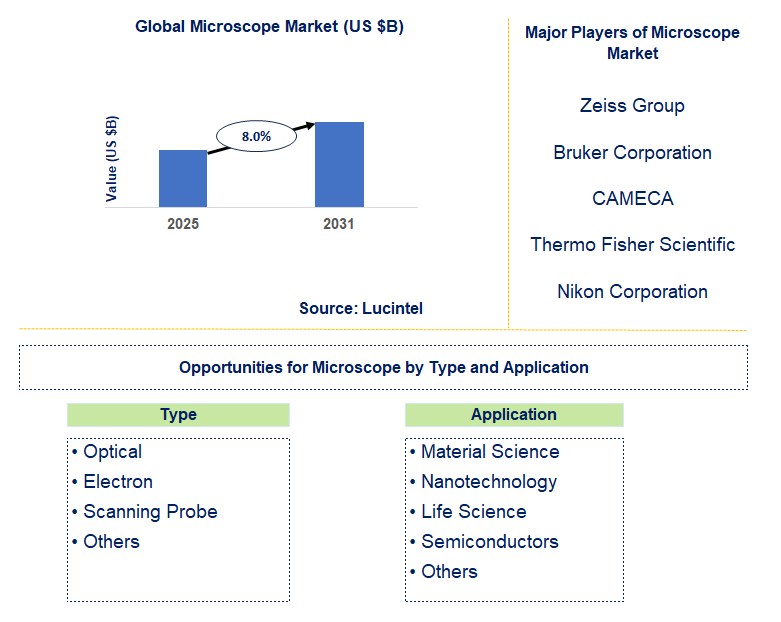
Key data points: The growth forecast = 8.0% annually for the next 7 years. Scroll below to get more insights. This market report covers trends, opportunities and forecasts in microscope market to 2031 by type (optical, electron, scanning probe, and others), application (material science, nanotechnology, life science, semiconductors, and others), and region (North America, Europe, Asia Pacific, and the Rest of the World)
We'll send your sample report shortly.
• Lucintel forecasts that, within the type category, electron is expected to witness the highest growth over the forecast period.
• Within the application category, nanotechnology is expected to witness the highest growth.
• In terms of region, APAC is expected to witness the highest growth over the forecast period. Gain valuable insights for your business decisions with our comprehensive 150+ page report. Sample figures with some insights are shown below.

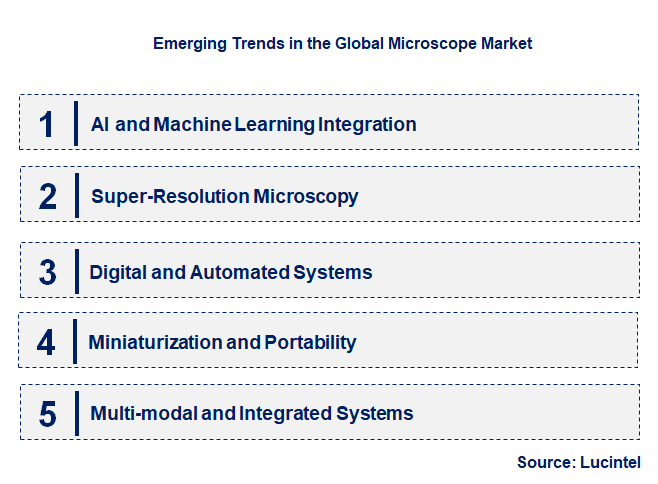
• AI and Machine Learning Integration: The incorporation of artificial intelligence and machine learning is revolutionizing image analysis. AI algorithms can automate image processing, enhance resolution, and rapidly identify and quantify specific features within a sample. This trend significantly reduces manual labor, accelerates research workflows, and provides more objective and consistent results, enabling breakthroughs in fields like pathology and materials science.
• Super-Resolution Microscopy: Super-resolution microscopy overcomes the traditional resolution limits of conventional optical microscopes, allowing for visualization of nanoscale structures. This advancement is critical for understanding cellular processes and molecular dynamics in living cells. It enables researchers to see minute details previously inaccessible, pushing the boundaries of life science and biomedical research.
• Digital and Automated Systems: The shift from analog to digital is a major trend, enabling real-time imaging and remote collaboration. Digital microscopes with automation capabilities can perform high-throughput screening and repetitive tasks with minimal human intervention. This trend improves efficiency, reduces human error, and facilitates the sharing of data and expertise across different locations, which is invaluable for both research and industrial quality control.
• Miniaturization and Portability: The development of compact and portable microscopes, including on-chip and smartphone-based devices, is making microscopy more accessible. These innovations are lowering the cost and physical footprint of instruments. This trend is crucial for applications in remote diagnostics, field research, and education, bringing high-resolution imaging to underserved areas and democratizing scientific inquiry.
• Multi-modal and Integrated Systems: Modern microscopes are no longer single-function tools. The trend toward multi-modal systems involves combining different imaging techniques, such as optical and electron microscopy, into a single platform. This provides a more comprehensive view of the sample by capturing complementary information. It allows for a more holistic understanding of complex biological and material systems. These emerging trends are collectively reshaping the microscope market from one of specialized, expensive instruments to a more accessible, intelligent, and versatile ecosystem. The integration of AI, the push for higher resolution, and the drive for portability are not just incremental improvements; they are fundamentally changing how microscopy is used, making it faster, more powerful, and more widely available for a vast range of new applications and users.
• Cryo-Electron Microscopy Advancements: Cryo-EM is revolutionizing structural biology by allowing scientists to visualize biological molecules in their native, near-atomic state. Recent developments have focused on improving automation and data processing, making this technique more accessible and faster. This enables rapid determination of protein structures for drug discovery and vaccine development, significantly accelerating biomedical research.
• Integration of AI and Machine Learning: AI integration is a major development that automates and optimizes various aspects of microscopy. This includes AI-powered image segmentation, autofocus, and analysis, which reduces manual effort and improves diagnostic accuracy. This development has a significant impact on fields like digital pathology, where AI can assist in the rapid and precise identification of diseases, improving patient outcomes.
• Expansion of Super-Resolution Imaging: Super-resolution microscopy is moving beyond the research lab and into clinical and industrial settings. Advancements in techniques like STED and STORM are providing unprecedented resolution, allowing for the observation of sub-cellular structures and processes in living samples. This development is driving innovation in cell biology and neuroscience, providing new insights into disease mechanisms at the molecular level.
• Development of Smart Microscopes: Smart microscopes with integrated sensors and software are emerging as a key development. These systems can automatically adjust settings, track samples, and manage data. Their impact is seen in increased efficiency and reproducibility in research, as they minimize human error and streamline complex imaging workflows, making advanced microscopy techniques more user-friendly for a wider range of scientists.
• Miniaturization for Point-of-Care Applications: The miniaturization of microscopes, creating portable and handheld devices, is a significant development for global health. These low-cost, portable instruments can be used for on-site diagnostics in remote areas, for example, detecting blood-borne parasites. This development has a profound impact on democratizing access to diagnostic tools and improving healthcare delivery in resource-limited settings. These key developments, from the revolutionary power of Cryo-EM to the accessibility of miniaturized devices, are driving the microscope market forward. They are collectively enhancing precision, automation, and portability, thereby expanding the market’s reach into new applications and geographies. This evolution is reshaping microscopy from a niche, high-end tool to a more integrated and accessible technology essential for diverse fields.
• Life Sciences and Drug Discovery: The life sciences sector is a primary growth engine, with a high demand for advanced microscopes for cell biology, genetics, and drug discovery. High-end systems like confocal, super-resolution, and cryo-electron microscopes are essential for visualizing cellular processes and protein structures. This opportunity is driven by rising R&D investment in biotechnology, personalized medicine, and pharmaceuticals, accelerating the development of new treatments and therapies.
• Semiconductors and Electronics: As electronic components become smaller and more complex, there is a growing need for microscopes to ensure quality control and failure analysis. Electron microscopes and scanning probe microscopes are critical for inspecting semiconductor wafers at the nanoscale. This growth opportunity is fueled by the continuous miniaturization of microchips, the development of new materials, and the need for precision manufacturing in the electronics industry.
• Nanotechnology and Materials Science: The burgeoning fields of nanotechnology and materials science present a significant opportunity. Microscopes are used to characterize and manipulate materials at the atomic and molecular levels, from developing advanced composites to creating new nanomaterials. This opportunity is driven by government funding and private sector investment in novel material research, as researchers seek to engineer materials with new and enhanced properties.
• Clinical Diagnostics and Pathology: The shift toward digital pathology is creating a strategic growth opportunity in clinical settings. Digital microscopes and automated slide scanners are enabling remote pathology and rapid, AI-assisted diagnosis. This is transforming traditional workflows, improving diagnostic accuracy, and reducing turnaround times. This opportunity is driven by the increasing demand for efficient and accurate disease diagnosis, particularly in cancer and infectious diseases.
• Forensic and Environmental Analysis: Microscopes are increasingly being used in forensic science for evidence analysis and in environmental studies for identifying microorganisms and pollutants. Specialized microscopes are needed to examine trace evidence and analyze water and air samples. This opportunity is driven by the need for high-precision tools in crime scene investigation and the growing global focus on environmental monitoring and conservation. These strategic growth opportunities across key applications are collectively driving the evolution of the microscope market. The increasing need for high-resolution imaging and sophisticated analysis in diverse fields is pushing the boundaries of what is possible, leading to a more dynamic and innovative market. Capitalizing on these opportunities is essential for sustained growth and technological leadership.
• Zeiss Group
• Bruker Corporation
• CAMECA
• Thermo Fisher Scientific
• Nikon Corporation
• Olympus Corporation
• NT-MDT
• Hitachi High-Tech Corporation
• JEOL
• Oxford Instruments
• Optical
• Electron
• Scanning Probe
• Others
• Material Science
• Nanotechnology
• Life Science
• Semiconductors
• Others
• North America
• Europe
• Asia Pacific
• The Rest of the World
• United States: The U.S. microscope market is growing with a strong focus on life sciences and drug discovery. The market is benefiting from significant government and private funding for research and development. Key developments include the widespread adoption of AI-powered imaging and super-resolution microscopy, which are crucial for advanced cellular and molecular biology research.
• China: China’s microscope market is experiencing rapid expansion, fueled by increasing government investment in scientific research and a burgeoning healthcare sector. The country is a major hub for the production and adoption of electron microscopes. Innovations in user-friendly interfaces and automation are particularly prominent, helping to drive market penetration and growth.
• Germany: As a traditional leader in optics and engineering, Germany’s microscope market is characterized by a strong emphasis on high-precision and high-end systems. The market is driven by robust demand from academic research and industrial applications. German companies are at the forefront of developing advanced optical and electron microscopy solutions, with a focus on integrating them into complex research workflows.
• India: The Indian market is driven by a growing healthcare infrastructure and increasing awareness of disease diagnosis. Recent developments include the creation of cost-effective, indigenous solutions like the "Mu-Scope," the world’s smallest on-chip microscope. The establishment of cryo-electron microscopy facilities also indicates a rising focus on advanced life science research.
• Japan: Japan’s market is highly developed, with a strong focus on high-tech sectors like semiconductors, electronics, and nanotechnology. It is the fastest-growing market for super-resolution microscopes in the Asia Pacific region. Strategic government support for nanotechnology R&D and a high demand for high-resolution imaging instruments are key drivers for market growth.


• Zeiss Group
• Bruker Corporation
• CAMECA
• Thermo Fisher Scientific
• Nikon Corporation
• Olympus Corporation
• NT-MDT
• Hitachi High-Tech Corporation
• JEOL
• Oxford Instruments Q5. Which microscope market segment will be the largest in future? Answer: Lucintel forecasts that, within the type category, electron is expected to witness the highest growth over the forecast period. Q6. In microscope market, which region is expected to be the largest in next 5 years? Answer: In terms of region, APAC is expected to witness the highest growth over the forecast period. Q7. Do we receive customization in this report? Answer: Yes, Lucintel provides 10% customization without any additional cost.


Choose a license that fits your team. Instant PDF delivery.
Prices exclude taxes. Instant delivery. Custom licensing available on request.
Market Report · July 17, 2026
Market Report · July 16, 2026
Market Report · July 10, 2026
Trusted partner for strategic intelligence and business growth


Receive a complimentary market analysis tailored to your industry. Our analysts will identify key growth opportunities and competitive dynamics specific to your business.

Market size, growth rate, and key trend analysis for your specific sector.

Top competitor positioning and market share analysis.

Strategic recommendations backed by data-driven insights.
Get curated market intelligence and competitive moves straight to your inbox.
By subscribing, you agree to receive our monthly insights. Unsubscribe anytime.
Receive a complimentary market analysis tailored to your industry. Our analysts will identify key growth opportunities and competitive dynamics specific to your business.
Market size, growth rate, and key trend analysis for your specific sector.
Top competitor positioning and market share analysis.
Strategic recommendations backed by data-driven insights.
Get curated market intelligence, emerging trends, and competitive moves straight to your inbox each month.
By subscribing, you agree to receive our monthly insights. Unsubscribe anytime.
We'll send your sample report shortly.