
Market Report · July 22, 2026

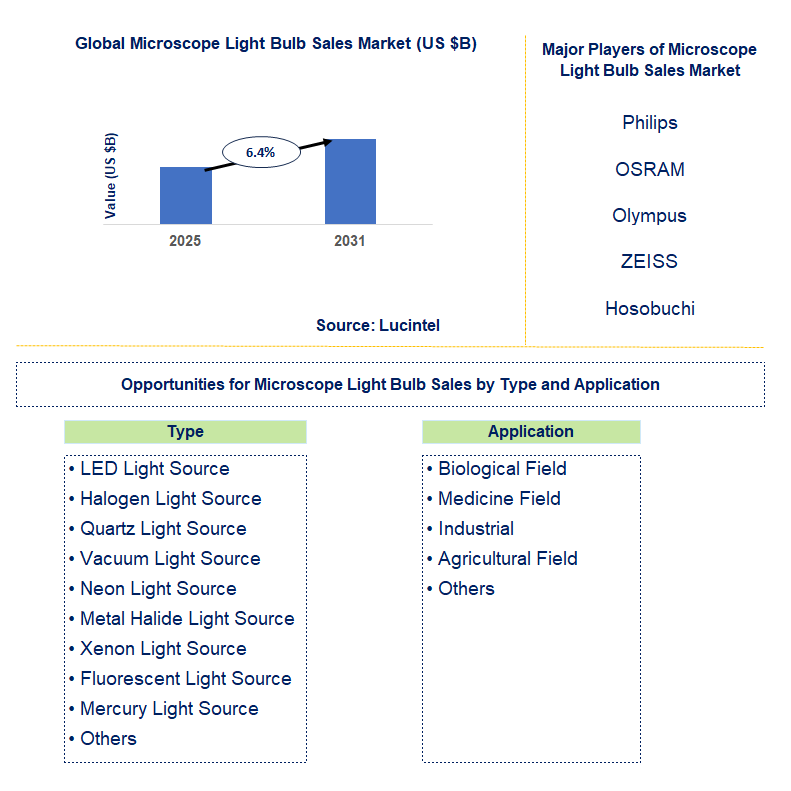
Key data points: The growth forecast = 6.4% annually for the next 7 years. Scroll below to get more insights. This market report covers Trends, opportunities and forecasts in microscope light bulb sales market to 2031 by type (LED light source, halogen light source, quartz light source, vacuum light source, neon light source, metal halide light source, xenon light source, fluorescent light source, mercury light source, and others), application (biological field, medicine field, industrial, agricultural field, and others), and region (North America, Europe, Asia Pacific, and the Rest of the World)
We'll send your sample report shortly.
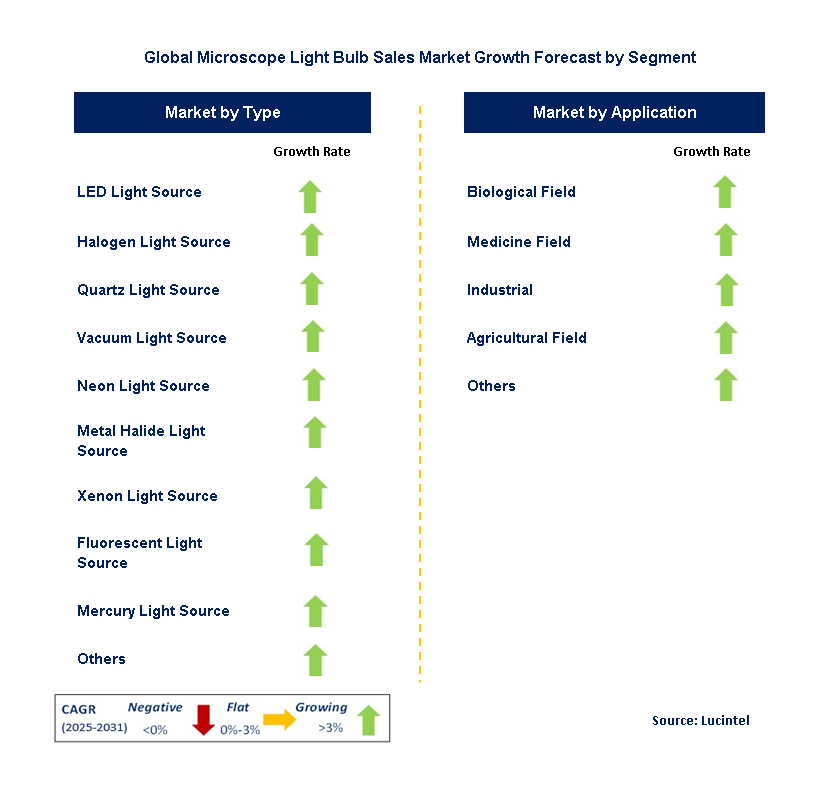
• Lucintel forecasts that, within the type category, LED light source is expected to witness the highest growth over the forecast period due to the increasing energy efficiency.
• Within the application category, medicine field is expected to witness the highest growth due to the increasing demand for medical diagnostics.
• In terms of region, APAC is expected to witness the highest growth over the forecast period due to the growing healthcare infrastructure in this region.
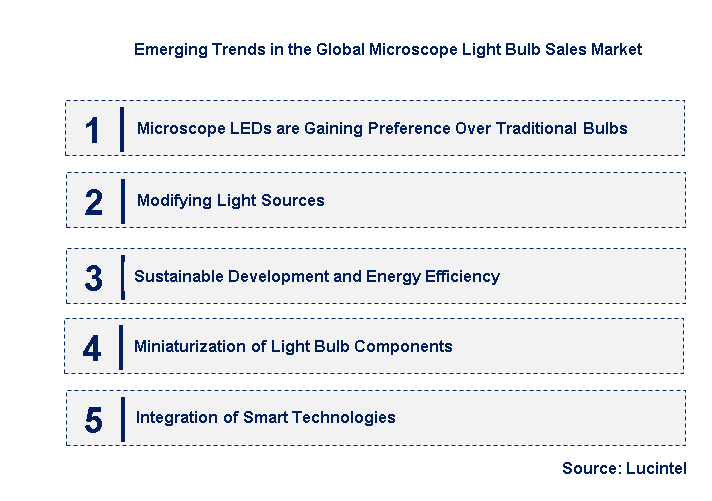
• Microscope LEDs are Gaining Preference Over Traditional Bulbs: The changes in the usage of lighting technology in microscopes is one of the most notable trends. Instead of traditional bulbs, it is now possible to use LED light bulbs, which is proving to be more sustainable, economical, and reliable. Moreover, LEDs are now considered better due to their low energy consumption, longer life, and lesser heat emission. In addition, today’s researchers and laboratories are really shifting into focusing on sustainability which makes LED light bulbs much more popular compared to incandescent and halogen bulbs. For high precision work, LED light bulbs are best because they provide ideal brightness and good color temperature control.
• Modifying Light Sources: It is a significant trend to modify laboratory microscopes’ light sources to suit specific research and diagnostic purposes. Different bulb types are being offered to fit the various microscopy methods. These include variable color temperatures, direct control of light intensity, and adequate fluorescence interference for advanced microscopy techniques. As microscopy techniques become more sophisticated, the need for appropriate customization of illumination has come forward to enable researchers to improve imaging techniques, and consequently, the results of their work.
• Sustainable Development and Energy Efficiency: The growing concern of sustaining the environment is shifting the primary trend of microscope light bulb sales towards energy saving illumination devices. There is an increasing legislative and popular demand for environmentally safe alternatives like low energy, durable light sources, especially LEDs. Moreover, the use of energy saving light bulbs helps not only minimize operational costs, but also reduces the negative influence of laboratory activities on the environment. As global attention to sustainability rises, there is more investment from manufacturers to create efficient performing lighting systems that require minimal energy.
• Miniaturization of Light Bulb Components: As the development of new types of microscopes continues, there is a trend towards shrinking light bulb parts to fit capsule and portable microscopy systems. This trend is highly applicable to handheld or portable microscopes needed in field research or medical diagnosis. The improving capacity to fit more compact, effective light sources within portable systems is increasing the usefulness and adaptability of microscopes to more users. The miniature dimension of light bulb parts offers new possibilities for the sales of microscope light bulbs in mobile and compact microscopy instruments.
• Integration of Smart Technologies: The convergence of smart technologies with microscope lighting systems is growing and seems to be changing the market. Automatic increase of brightness, remote control, and connectivity through the internet are common features of advanced microscopy systems. Smart technologies facilitate enhanced control over lighting and improves the quality of imaging, lowering peripheral errors. With the continued digitalization and automation of research institutes and medical facilities, we expect an increase in the demand of smart microscope light bulbs for better and easier services. Changes in light source customization, energy efficiency, LED lighting, miniaturization, and smart technologies are some emerging trends in the sale of microscope light bulbs. These trends demonstrate the growing need in microscopy for advanced and economical sustainable lighting solutions. It is evident that as technology improves, there will be added demand in the microscope light bulb market because new features are added to improve the experience of users in the healthcare and research sectors.
• Progress in Led Innovation: Innovation in LED applications has transformed the market for microscope light bulbs as manufacturers have created high-efficiency LED light bulbs that are brighter, more color accurate, and last longer than conventional light bulbs. These new LEDs are also more energy efficient and produce better quality microscopic images because of improved light uniformity. As LED technology becomes cheaper and more widely used, it is bound to take over the market and replace older lighting technologies in the majority of microscopy systems.
• Introduction of Multi-Spectral Light Bulbs: The introduction of the multi-spectral microscope light bulb has transformed the market. These light bulbs can emit a large range of light wavelengths required for advanced microscopy techniques which includes fluorescence microscopy. Multi-spectral light bulbs allow the researchers to perform more imaging tasks with accuracy, leading to better results in cellular biology and material science. This change is increasing the need in the market for specialized lighting in research and medical diagnostics.
• New Developments in Hybrid Lighting Systems: More advanced microscopes are now commonly using hybrid lighting systems that integrate multiple light sources like LEDs and halogen bulbs. These systems enable users to switch to a preferred light source based on their requirements, allowing for better imaging control and flexibility. Hybrid lighting systems are particularly useful for high intensity bright field imaging and fluorescence imaging, and thus serve as an all-in-one tool for different microscopy methods.
• Shift Towards Fiber Optic Lighting: The use of fiber optic lighting systems is increasing for microscope bulbs because of their adjustable and focused lighting capabilities. For live-cell imaging and high-resolution microscopy, fiber optic lights are the perfect solution. Because fiber optic systems are so flexible, researchers are now able to change the direction and intensity of the light with precision. This feature combined with its popularity makes it an ideal choice for advanced microscopy work in research and medical institutions.
• Improved durability and longevity of light bulbs: There is also an advanced market for microscope bulbs that are more durable and longer-lasting. The new light bulbs are constructed in a manner that they can be used for longer periods of time without much dip in performance. Manufacturers are looking at ways to improve the quality of light emitted by the bulbs over longer periods of time. These bulbs which last longer reduces the frequency with which they have to be replaced which reduces the costs of operating the equipment and increases the efficiency of the microscopy equipment as a whole. The advances in the LED and multi-spectral lightbulbs together with the new features of the hybrid and fiber optic lightings and the new sturdiness have widened the scope of performance and functionality of microscopes making the sales of the bulbs more promising. This is achieving the high expectations set to researchers and medical practitioners as far as the quality, energy consumption, and sturdiness of the lights are concerned and helps the industry grow.
• Possibilities in Research Laboratories: Microscope light bulb manufacturers would benefit greatly from the growth opportunities offered in research laboratories, especially in cellular biology, material science, and medical research. Light imaging has become increasingly more sophisticated, calling for more precise and better quality lighting solutions. Manufacturers can help drive market growth by developing customized lighting solutions specific to research labs.
• Healthcare Sector Expansion: In addition to hospitals and diagnostic centers, the healthcare sector as a whole offers plenty of new opportunities to sell microscope light bulbs. As medicine and medical research becomes more sophisticated, the need for high quality light in energy-efficient and robust bulbs also increases. Manufacturers can capture the healthcare segment through effective illumination products that enable superior imaging for diagnostic procedures.
• Development of Mobile and Portable Microscopes: Microscope light bulb manufacturers stand to benefit greatly from the development of mobile and portable microscopes. With the rise in field research and medical diagnostic techniques, compact and energy-efficient light sources are in greater demand. The need for portable microscopes and subsequently portable light bulbs rises with the increasing popularity of these devices.
• Adoption in Education and Training Institutions: Both universities and technical colleges have potential for light bulb sales expansion due to the increasing reliance on microscopes in biology and chemistry classes. The increasing use of microscopes in educational institutions also requires the provision of reliable and reasonably priced durable bulbs. The manufacturers servicing this market may concentrate on developing educational bulbs.
• Focus on Green Technologies: There is an emerging opportunity in the microscope light bulb industry as a result of the growing concern towards light energy efficiency and environmental protection. Sustained manufacturing of more eco-friendly and long lasting light bulbs, such as LED, will assist in meeting the increased environmental concern. Manufacturers who employ green technology will be able to offer their products to those institutions and organizations which support protection of the environment. In the sale light bulbs for microscopes, there are different strategies to maximize sale volume, which cover a number of areas, such as research laboratories, health care, mobile microscopes, education, and even eco-friendly technologies. Concentrating on these areas can sometimes help expand the scope and scale of the whole industry of light bulbs for microscopes.
• Philips
• OSRAM
• Olympus
• ZEISS
• Hosobuchi
• Leica Microsystems
• MSHOT
• Meiji Techno
• AmScope
• SCHOTT
• LED Light Source
• Halogen Light Source
• Quartz Light Source
• Vacuum Light Source
• Neon Light Source
• Metal Halide Light Source
• Xenon Light Source
• Fluorescent Light Source
• Mercury Light Source
• Others
• Biological Field
• Medicine Field
• Industrial
• Agricultural Field
• Others
• North America
• Europe
• Asia Pacific
• The Rest of the World
• USA: The sales of microscope light bulbs in the US are motivated by improvements in the technology used for illumination. In addition, the usage of LED light bulbs that are energy saving and have a long life span is being adopted in microscopy equipment. The increasing level of scientific research and medical diagnostics has also brought about an increase in the use of specialized lighting in microscopes. Furthermore, U.S. manufacturers are focusing on producing bulbs with higher color fidelity and uniform light distribution to improve imaging quality of the microscope. In addition, the growth of the market is supported by governmental funding of research projects and the widening of the healthcare industry.
• China: Led by the manufacturing industry’s increasing technological capabilities and greater investments in R&D, China’s market for microscope light bulbs is expanding rapidly. As the nation seeks to solidify its position as a global leader in scientific research particularly in biotechnology and medical diagnostics, the need for advanced microscope lighting systems is increasing. To help meet both local and overseas demand, Chinese manufacturers are concentrating on the inexpensive production of light bulbs, especially LEDs. The domestic market is being helped by government policies aimed at stimulating scientific research. China is on pace to becoming a dominant producer of microscope light bulbs.
• Germany: Germany, well known for its growing research and technological proficiency, is experiencing a gradual increase in the sales of microscope light bulbs. Sales are being driven by increased precision engineering and innovation in the laboratory equipment sector. There is high demand Microscope light systems due to the extensive usage of LED and halogen bulbs because of their superior light quality. German manufacturers are actively investing in R&D to enhance these products quality and durability. Over recent years Germany placed stronger focus on healthcare and research activities, and as a result, it is becoming a leader in the development of advanced lighting equipment for microscopes.
• India: The sales of microscope lightbulbs in India is growing due to the increase in demand for quality medical diagnostics and life science research. The developing medical and scientific professionals in the country are creating the need for better illumination in microscopes. The shift away from traditional bulbs into more energy saving and longer lasting options like LEDs is increasing. Indian makers are concentrating on providing economically priced and dependable microscope lightening system. Due to the increase in research institutions together with health care facilities, the demand is bound to grow which will serve the microscope light bulb market in India generously with affordable and effective solutions.
• Japan: Japan's sales of microscope light bulbs have sharply increased due to his country being on top of technology development, specifically in advanced optics and microscope. Japanese makers are the first to introduce high performance LED microscope light bulbs, which has low energy consumption and high illumination. The powerful health care and research services in the country supports the use of these goods. Also, there is a greater application of microscope lightbulbs in material science and nanotechnology. The market is gaining more and more for advanced microscope lighting because of innovation and sustainability.


• Philips
• OSRAM
• Olympus
• ZEISS
• Hosobuchi
• Leica Microsystems
• MSHOT
• Meiji Techno
• AmScope
• SCHOTT Q5. Which microscope light bulb sales market segment will be the largest in future? Answer: Lucintel forecasts that, within the type category, LED light source is expected to witness the highest growth over the forecast period due to the increasing energy efficiency. Q6. In microscope light bulb sales market, which region is expected to be the largest in next 5 years? Answer: In terms of region, APAC is expected to witness the highest growth over the forecast period due to the growing healthcare infrastructure in this region. Q7. Do we receive customization in this report? Answer: Yes, Lucintel provides 10% customization without any additional cost.


Choose a license that fits your team. Instant PDF delivery.
Prices exclude taxes. Instant delivery. Custom licensing available on request.
Market Report · July 22, 2026
Market Report · July 22, 2026
Market Report · July 17, 2026
Trusted partner for strategic intelligence and business growth


Receive a complimentary market analysis tailored to your industry. Our analysts will identify key growth opportunities and competitive dynamics specific to your business.

Market size, growth rate, and key trend analysis for your specific sector.

Top competitor positioning and market share analysis.

Strategic recommendations backed by data-driven insights.
Get curated market intelligence and competitive moves straight to your inbox.
By subscribing, you agree to receive our monthly insights. Unsubscribe anytime.
Receive a complimentary market analysis tailored to your industry. Our analysts will identify key growth opportunities and competitive dynamics specific to your business.
Market size, growth rate, and key trend analysis for your specific sector.
Top competitor positioning and market share analysis.
Strategic recommendations backed by data-driven insights.
Get curated market intelligence, emerging trends, and competitive moves straight to your inbox each month.
By subscribing, you agree to receive our monthly insights. Unsubscribe anytime.
We'll send your sample report shortly.