
Porter's Five Forces · July 20, 2026

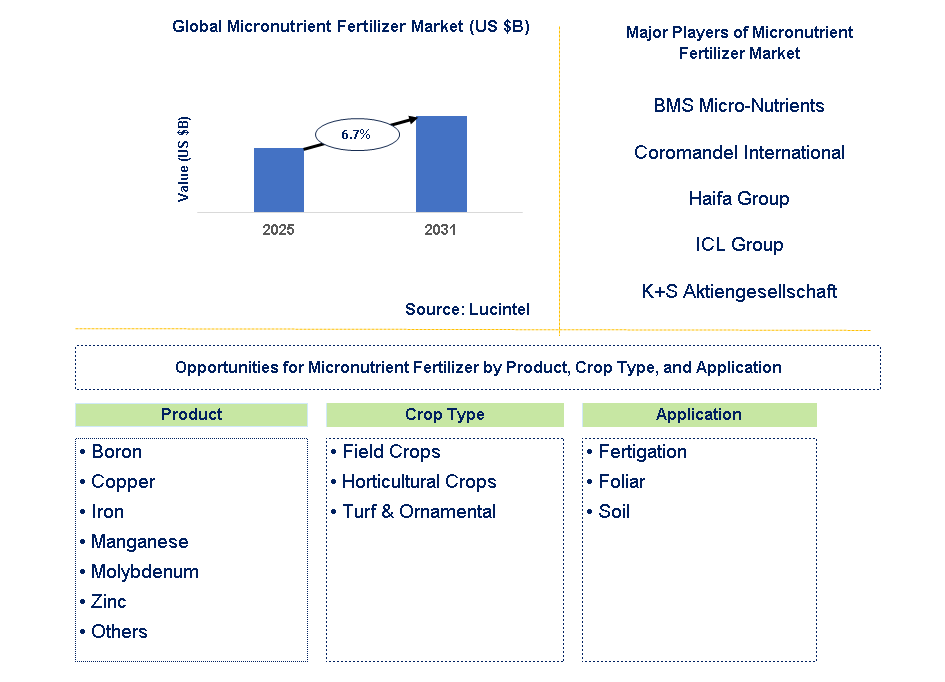
Key data points: The growth forecast = 6.7% annually for the next 7 years. Scroll below to get more insights. This market report covers trends, opportunities and forecasts in micronutrient fertilizer market to 2031 by product (boron, copper, iron, manganese, molybdenum, zinc, and others), crop type (field crops, horticultural crops, and turf & ornamental), application (fertigation, foliar, and soil), and region (North America, Europe, Asia Pacific, and the Rest of the World)
We'll send your sample report shortly.
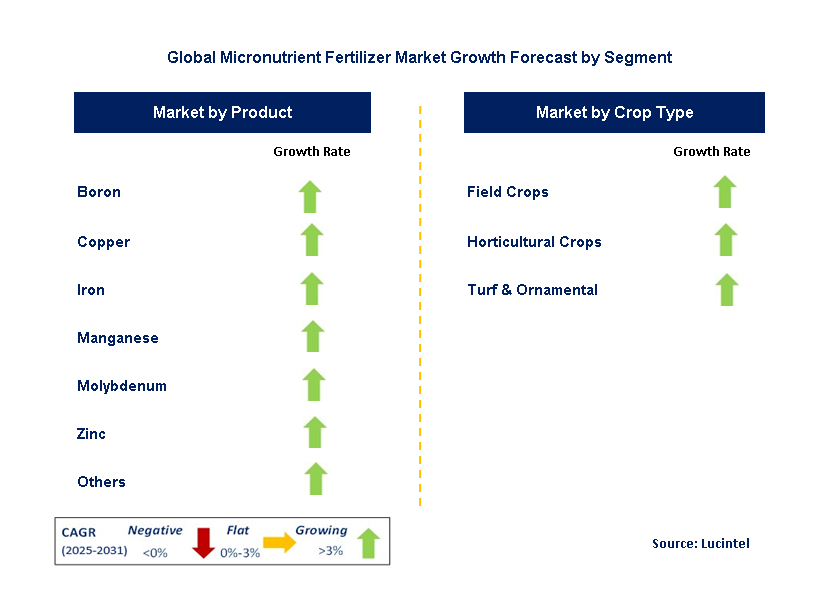
• Lucintel forecasts that, within the product category, zinc is expected to witness the highest growth over the forecast period.
• Within the crop type category, horticultural crop is expected to witness the highest growth.
• In terms of region, APAC is expected to witness the highest growth over the forecast period. Gain valuable insights for your business decisions with our comprehensive 150+ page report. Sample figures with some insights are shown below.
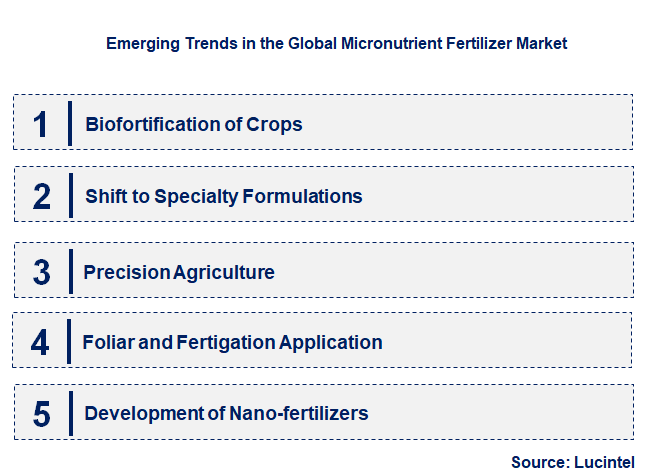
• Biofortification of Crops: A major trend is the use of micronutrient fertilizers for biofortification. This involves increasing the micronutrient content of staple food crops, like wheat and rice, to address widespread "hidden hunger" in human populations. This trend is creating a new, socially impactful market segment and is gaining support from international health and agricultural organizations.
• Shift to Specialty Formulations: The market is seeing a significant trend towards specialty formulations. This includes chelated, granulated, and liquid fertilizers that are more efficient at delivering nutrients to plants. These formulations protect micronutrients from being locked in the soil, ensuring higher nutrient uptake and better crop performance with less waste.
• Precision Agriculture: An emerging trend is the integration of micronutrient fertilizers with precision agriculture technologies. Farmers are using soil sensors, drones, and data analytics to identify specific nutrient deficiencies in real-time. This allows for the precise application of micronutrients, which reduces costs and minimizes environmental impact.
• Foliar and Fertigation Application: The market is increasingly adopting foliar and fertigation applications. These methods bypass the soil, delivering micronutrients directly to the plant’s leaves or roots through irrigation systems. This trend provides a rapid and highly efficient way to correct nutrient deficiencies, especially in high-value horticultural crops.
• Development of Nano-fertilizers: The development of nano-fertilizers is a new trend. These products use nanoparticles to deliver nutrients in a highly absorbable form. Nano-fertilizers are more effective at lower doses, which reduces material costs and minimizes environmental runoff. This trend represents a major technological leap in nutrient management. These emerging trends are profoundly reshaping the micronutrient fertilizer market by making it more precise, efficient, and health-focused. By leveraging technology and focusing on biofortification, advanced formulations, and precision application, the industry is moving from a commodity-based model to a high-value, knowledge-intensive one.
• Innovation in Chelated Fertilizers: A key development is the innovation in chelated fertilizers. New chelating agents, including biodegradable ones, are being developed to improve the stability and availability of micronutrients in the soil. This development is crucial for ensuring that nutrients are not immobilized and can be efficiently absorbed by plants, especially in alkaline soils.
• Focus on Bio-based Micronutrients: The market is seeing a major development in the focus on bio-based micronutrients derived from natural sources like seaweed extracts and humic acids. This is driven by the growing demand for organic and sustainable farming inputs, creating a new segment that appeals to environmentally conscious farmers and consumers.
• Launch of Coated Fertilizers: A notable development is the launch of coated micronutrient fertilizers. These products are designed to release nutrients slowly over a longer period. This controlled-release mechanism ensures a steady supply of micronutrients to the plant, reducing the need for frequent applications and minimizing nutrient loss through leaching.
• Expansion of Soil Testing Services: Recent developments show a trend of major fertilizer companies expanding their soil testing services. By providing farmers with precise data on their soil’s nutrient profile, companies can offer customized micronutrient solutions. This development is transforming the business model from product sales to a value-added service.
• Strategic Partnerships and Acquisitions: The market is seeing a development in strategic partnerships and acquisitions between large fertilizer companies and smaller specialty firms. This is driven by the need to acquire new technologies, expand product portfolios, and gain a competitive edge in the fast-growing micronutrient segment, leading to market consolidation. These developments are fundamentally impacting the micronutrient fertilizer market by making it more scientifically advanced, integrated, and customer-focused. By enhancing product efficiency, expanding service offerings, and leveraging strategic partnerships, the market is better equipped to meet the complex demands of modern agriculture.
• High-Value Crops: A key growth opportunity lies in the application of micronutrient fertilizers to high-value crops, such as fruits, vegetables, and specialty nuts. These crops have a high economic return and are highly responsive to micronutrient application. By providing tailored products for these crops, companies can serve a premium, high-margin market.
• Developing Economies: The developing economies of Asia, Africa, and Latin America present a significant growth opportunity. As these regions modernize their agricultural sectors and address widespread soil deficiencies, the demand for micronutrient fertilizers is surging. Companies can grow by providing cost-effective and easy-to-use solutions tailored to local farming practices.
• Organic and Sustainable Farming: The organic and sustainable farming sector is a major growth opportunity. As demand for organic food increases, so does the need for inputs that are compliant with organic standards. By developing certified organic micronutrient products, companies can tap into this rapidly expanding market, which commands premium prices.
• Urban and Vertical Farming: The rise of urban and vertical farming offers a new growth opportunity. These systems require precise and controlled nutrient delivery. By providing water-soluble and liquid micronutrient formulations for hydroponics and aeroponics, companies can serve a niche, technology-driven market that is focused on efficiency and minimal waste.
• Fortification of Staple Crops: The fortification of staple crops like wheat and rice is a strategic opportunity. Governments and international organizations are promoting the use of micronutrient fertilizers to combat "hidden hunger." By partnering with these bodies, companies can secure large-scale contracts and contribute to a global health initiative. These strategic growth opportunities are reshaping the micronutrient fertilizer market by driving it toward high-value, application-specific products and services. By focusing on premium crops, emerging markets, and sustainable farming, the market is transforming from a traditional commodity business into a knowledge-intensive industry that provides crucial support for global food systems.
• BMS Micro-Nutrients
• Coromandel International
• Haifa Group
• ICL Group
• K+S Aktiengesellschaft
• Koch Industries
• Nouryon
• Boron
• Copper
• Iron
• Manganese
• Molybdenum
• Zinc
• Others
• Field Crops
• Horticultural Crops
• Turf & Ornamental
• Fertigation
• Foliar
• Soil
• North America
• Europe
• Asia Pacific
• The Rest of the World
• United States: The U.S. market is highly advanced, with recent developments focusing on precision agriculture. Companies are utilizing soil testing and data analytics to create site-specific fertilizer blends. There’s a strong demand for chelated micronutrients, particularly zinc, to ensure effective nutrient delivery in varying soil conditions, and the market is moving towards products that are easy to apply.
• China: China, as a major food producer, is addressing widespread soil micronutrient deficiencies, especially for zinc. Recent developments include government-led initiatives to promote balanced fertilization and the use of specialized products to improve food security. There’s a growing market for high-efficiency chelated and water-soluble micronutrients, especially in the horticulture sector, to boost crop quality for export and domestic markets.
• Germany: Germany’s market is highly influenced by strict EU regulations on environmental impact. Recent developments are focused on developing low-impact and highly efficient formulations to reduce nutrient runoff. The market is also seeing a rise in the use of micronutrients in combination with organic and bio-based fertilizers to improve soil health and support sustainable farming practices.
• India: India is a major market for micronutrient fertilizers, with recent developments driven by government initiatives to improve soil health. Programs like the Nutrient Based Subsidy (NBS) scheme are encouraging the use of zinc and boron. There’s also a growing demand for advanced formulations, including nano-fertilizers and chelated products, to address widespread deficiencies and boost agricultural productivity.
• Japan: Japan’s market is highly specialized, with a strong emphasis on product quality and intensive farming practices. Recent developments include the use of foliar and fertigation applications of micronutrients for quick and efficient nutrient delivery. The market is also seeing a rise in specialized products designed for high-value crops, which require precise nutrient management to achieve premium quality.


• BMS Micro-Nutrients
• Coromandel International
• Haifa Group
• ICL Group
• K+S Aktiengesellschaft
• Koch Industries
• Nouryon Q5. Which micronutrient fertilizer market segment will be the largest in future? Answer: Lucintel forecasts that, within the product category, zinc is expected to witness the highest growth over the forecast period. Q6. In micronutrient fertilizer market, which region is expected to be the largest in next 5 years? Answer: In terms of region, APAC is expected to witness the highest growth over the forecast period. Q7. Do we receive customization in this report? Answer: Yes, Lucintel provides 10% customization without any additional cost.


Choose a license that fits your team. Instant PDF delivery.
Prices exclude taxes. Instant delivery. Custom licensing available on request.
Porter's Five Forces · July 20, 2026
Trusted partner for strategic intelligence and business growth


Receive a complimentary market analysis tailored to your industry. Our analysts will identify key growth opportunities and competitive dynamics specific to your business.

Market size, growth rate, and key trend analysis for your specific sector.

Top competitor positioning and market share analysis.

Strategic recommendations backed by data-driven insights.
Get curated market intelligence and competitive moves straight to your inbox.
By subscribing, you agree to receive our monthly insights. Unsubscribe anytime.
Receive a complimentary market analysis tailored to your industry. Our analysts will identify key growth opportunities and competitive dynamics specific to your business.
Market size, growth rate, and key trend analysis for your specific sector.
Top competitor positioning and market share analysis.
Strategic recommendations backed by data-driven insights.
Get curated market intelligence, emerging trends, and competitive moves straight to your inbox each month.
By subscribing, you agree to receive our monthly insights. Unsubscribe anytime.
We'll send your sample report shortly.