
Market Report · July 20, 2026

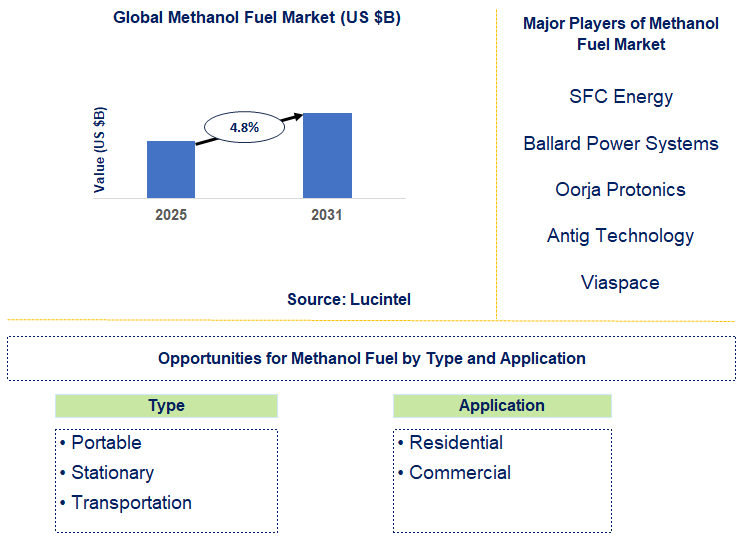
Key data points: The growth forecast = 4.8% annually for the next 7 years. Scroll below to get more insights. This market report covers Trends, opportunities and forecasts in methanol fuel market to 2031 by type (portable, stationary, and transportation), application (residential and commercial), and region (North America, Europe, Asia Pacific, and the Rest of the World)
We'll send your sample report shortly.
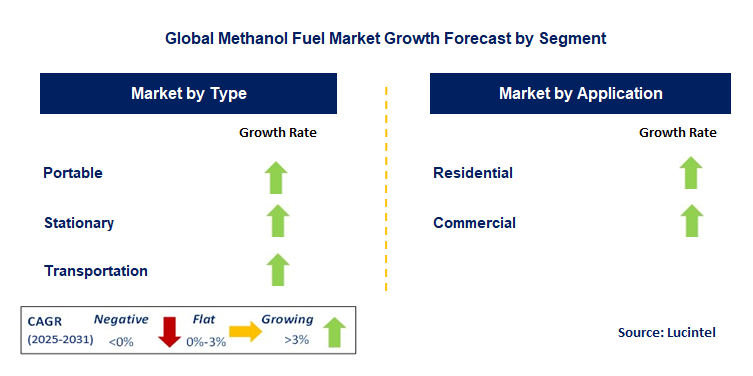
• Lucintel forecasts that, within the type category, transportation is expected to witness the highest growth over the forecast period due to the rising adoption of methanol as a cleaner fuel alternative.
• Within the application category, commercial is expected to witness higher growth due to the growing need for sustainable energy solutions.
• In terms of region, APAC is expected to witness the highest growth over the forecast period due to the rising demand for clean fuel options.
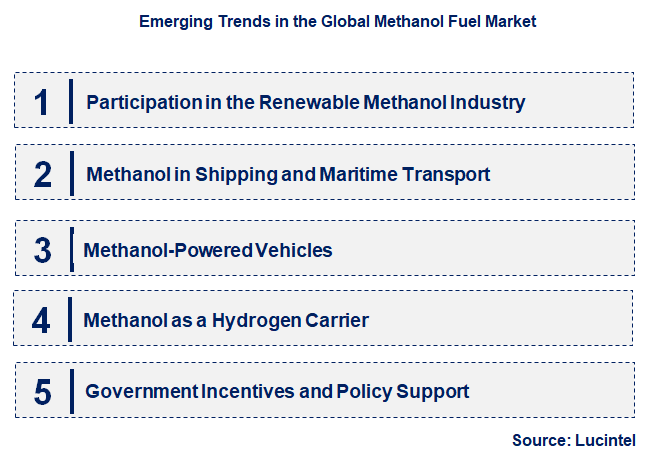
• Participation in the Renewable Methanol Industry: As countries attempt to decarbonize industries and shift away from fossil fuels, renewable methanol is emerging as a significant trend. Renewable methanol comes from renewable energy sources, such as wind, solar, and biomass. Alternative sources of methanol are cleaner than traditional methods of producing methanol, making this fuel a better option. This renewable methanol can be used in transportation and power generation, offering significant CO2 emissions reduction. Countries are moving towards renewable sources to achieve sustainability and carbon neutrality targets, contributing to the global use of clean energy.
• Methanol in Shipping and Maritime Transport: Recently, methanol is being researched as an alternative fuel to comply with emission regulations in the maritime industry. The ship building industries of China and Japan are focusing on pilot projects concerning the use of methanol-powered vessels. The clean burning properties of methanol can help significantly reduce the emission of sulfur oxides, nitrogen oxides, and carbon. If harnessed correctly, methanol has the potential to help the shipping industry achieve its sustainability targets which makes it extremely valuable for the future of maritime transport.
• Methanol-Powered Vehicles: The ongoing trend of methanol powered vehicles is especially notable in countries where pollution has reached alarming heights. China is leading the movement by investing in methanol powered buses, trucks, and even methanol fuel cell powered electric vehicles. The burning properties of methanol reduce harmful emissions, allowing it to serve as fuel for both commercial and passenger vehicles. It is predicted that the increasing demand for cleaner transportation options will drive the shift towards methanol vehicles.
• Methanol as a Hydrogen Carrier: Countries that deal with hydrogen-based energy solutions are utilizing methanol as a hydrogen carrier. methanol can be produced from renewable sources and consumed as a clean fuel in a fuel cell. Japan and some European nations are carrying out studies on the ability of methanol to store hydrogen, which will be needed in the coming years. As the adoption of hydrogen increases, methanol could become increasingly important in the transport and consumption of hydrogen in a number of regions such as automotive, industrial, and power production.
• Government Incentives and Policy Support: Policies and newly developed government strategies promote the use of methanol as an alternative fuel. India and other countries are providing grants, subsidies, or tax incentives aimed at increasing the utilization of methanol in the industrial sector and transportation. The drive to decarbonize the world has increased considerably, and the need for governments to support clean energy strategies, including the use of methanol, has escalated. With a large portion of emissions coming from the maritime, transport, and energy industries, this shift will help to reduce the dependence on traditional fuels and expedite the use of methanol fuel. Renewable methanol development, methanol usage in shipping, methanol-powered vehicles, hydrogen carrier imports, and government assistance are emerging trends that will transform the market, making it possible for methanol to play a crucial role as a fuel in the global energy transition. These trends are reshaping the market to enable cleaner and more sustainable energy solutions across multiple sectors.
• Advancement in methanol Production Technologies: There is an increasing feasibility of producing methanol from renewable fuels such as biomass and CO2 which is an improvement in methanol production technologies. This change is vital to lower the carbon footprint of methanol production and make methanol a sustainable fuel. Many companies are developing novel approaches to methanol synthesis which include the use of waste CO2 and methanol production from renewable hydrogen. Such approaches are likely to enhance the supply of renewable methanol while decreasing the reliance on fossil fuel based methanol production.
• Global Maritime Industry’s Shift to methanol: Faced with changing emission norms like those set by the International Maritime Organization, the global maritime industry is gradually adopting methanol as a marine fuel. Japan and China are working towards methanol powered ships to bring down sulfur and nitrogen oxide emissions. methanol is also being tested by shipping companies for its viability as a more environmentally friendly fuel compared to heavy fuel oil. This development will most likely support the maritime industry in achieving its decarbonization objectives.
• China’s methanol Vehicle Initiative: China is working towards achieving the sobriety of air pollution by launching multiple large scale initiatives to test methanol fueled vehicles (especially buses and trucks). A country, plagued by severe air pollution, methanol fuels serve as an attractive strategy to bring vehicle emissions down. The Chinese government has also put funding into research surrounding methanol fuel cells aimed for vehicles to support the growing fleet of vehicles. Being the largest producer of methanol, China focusing on methanol-powered vehicles has the potential to change the global economy significantly.
• Government Support for methanol-Based Solutions: Governments across the globe are putting more resources to the development of methanol fuels. Germany and Japan have initiated legislation that encourages the use of methanol in transportation and energy generation. This includes tax exemptions for companies that produce methanol from renewables and subsidies for consumers who own methanol-powered automobiles. These policies are promoting the switch to methanol instead of using traditional fossil fuels, especially in transportation and industrial energy sectors.
• Methanol as a Hydrogen Carrier: Methanol's popularity in Japan as a hydrogen carrier fuel is remarkable for their country’s recognition. Research is being conducted on how methanol can serve as a sustainable and efficient means of transporting hydrogen. This creates a mark for methanol transform into a fuel and storage structure for hydrogen in the hydrogen economy. As the adoption of hydrogen increases, particularly in fuel cells for vehicles and energy production, so does the expectation for methanol. The latest changes in the development of the methanol fuel market are the changes in production technology, incorporation of methanol into maritime transport, development of methanol vehicles in China, government backing, and considering methanol as a hydrogen carrier. All these activities are helping to shape the industry and position methanol considerably as one of the important elements of the fight against climate change and the transition to cleaner fuels globally.
• Methanol in Transportation: Transportation is one of the largest growth opportunities for methanol, especially with countries trying to shift away from using gasoline and diesel. Internal combustion engines and fuel cells in cars, buses, and trucks can use methanol as fuel. The growing levels of pollution particularly necessitate the use of methanol in vehicles. Infrastructure for refueling with methanol is also increasing, and so the demand for methanol-powered vehicles will rise dramatically. This will create an impressive growth opportunity in this sector, resulting in further development of the transportation sector.
• Power Generation with Methanol: Methanol is gaining interest as a fuel for combustion engines, especially where renewables are still developing. It can be used in power plants to burn and generate electricity while emitting lower greenhouse gases than fossil fuels. This is a significant opportunity for shifting the global power sector to fundamentally reduce carbon emissions. Countries such as India and China are actively seeking ways to use methanol to satisfy rising energy consumption in an environmentally friendly way.
• Methanol as a Fuel for the Marine Industry: The international shipping market is a core sector for greenhouse gases and methanol fuels now is positioned as a cleaner substitute for conventional marine fuels. methanol is very appealing because it serves the purpose of cutting down unpleasant emissions as international legislations try to control sulfur and nitrogen oxide emissions. Japan is the frontrunner with China soon to follow with numerous tests of methanol propelled ships, opening up new markets for methanol.
• Renewable methanol Production: The production of renewable methanol, created from biomass or CO2, represents one of the most promising advancement possibilities in the methanol fuel sector. Renewable methanol can be used for multitude of applications which includes transportation, power generation and industrial use. With more and more nations shifting their focus to decarbonization, production of renewable methanol will emerge as a key strategy in global emission reduction efforts, giving scope for expansion of the methanol industry.
• Hydrogen Storage and Transport: An emerging opportunity in the hydrogen economy is methanol's increasing acceptance as a hydrogen carrier. methanol makes it possible to efficiently store hydrogen and transport it to places that do not have the necessary infrastructure. methanol's role as a carrier of hydrogen is expected to increase as the world adopts hydrogen, especially in countries that are pursuing hydrogen as an alternative energy source. Focus on transportation, power generation, marine fuel adoption, renewable methanol production, and hydrogen storage are some of the recognizable strategic growth possibilities in the methanol fuel sector. These possibilities are bound to change the future of the methanol fuel market profoundly.
• SFC Energy
• Ballard Power Systems
• Oorja Protonics
• Antig Technology
• Viaspace
• Fujikura
• MGC
• Portable
• Stationary
• Transportation
• Residential
• Commercial
• North America
• Europe
• Asia Pacific
• The Rest of the World
• US: In the United States, researchers are keen towards exploring the use of methanol fuel to assist in the accomplishing of renewable energy goals while also decreasing carbon emissions. The government along with private companies are investing in the production of methanol from biomass and carbon capture methanol production technologies. There is also considerable reinvestment methanol integration into the maritime industry as a fuel source for ships. However, like with many other fuel sources, works regarding infrastructure reform and the acceptance of the abridged are unfortunate hurdles that need to be addressed.
• China: Leading the charge in the methanol fuel ecosystem is China, whose government is supportive of the use of methanol as part of its cleaner energy transition. The country has one of the largest capacities for methanol production in the world, and investment in methanol powered vehicles and shipping is skyrocketing. The push towards sustainability in transportation and industry has greatly enhanced investment in methanol fuel researched and infrastructure. Moreover, China is innovating the development of methanol fueled buses and trucks as a strategy to reduce urban air pollution and lessening the country's dependence on imported crude oil.
• Germany: Germany methanol as an alternative fuel is being considered to complement the well-known focus on renewables with a novel approach to achieve energy transition goals. The propensity of Germany to decarbonize sane additionally draw attention to synthetic fuels like methanol. Germany is working on the production of “green” methanol from carbon free sources of energy such as wind and solar, as part of their efforts towards carbon neutrality. Numerous companies in Germany are also doing trials with powered vehicles and fuels methanol, particularly in the field of transportation, in which the country wants to achieve a significant cut in the emissions of CO2.
• India: India is working on integrating methanol fuel as part of its plan to change energy forms and lower its carbon emissions. Due to India's high energy demand and elevated pollution levels, methanol can be useful in transportation and energy generation. It's been reported that India is carrying out pilot programs for methanol fueled buses and is marketing the new fuel in rural locations to curb the use of traditional fuels. In addition, the government is studying the use of indigenous coal reserves for methanol production as a way to decrease the country's imported oil dependency further.
• Japan: Japan is putting forth money for methanol fuel as a way to tackle their environmental and energy security issues. Japan’s research with methanol marine fuel has already resulted in several pilot programs aimed at determining its feasibility in shipping. Japan is also considering it as a vehicle fuel, so its industry is working on fuel cells for electric cars. Furthermore, Japan's methanol interest marks the start of further development for clean energy due to encouraging hydrogen generation for non-renewable power sources as secondary hydrogen carriers.


• SFC Energy
• Ballard Power Systems
• Oorja Protonics
• Antig Technology
• Viaspace
• Fujikura
• MGC Q5. Which methanol fuel market segment will be the largest in future? Answer: Lucintel forecasts that, within the type category, transportation is expected to witness the highest growth over the forecast period due to the rising adoption of methanol as a cleaner fuel alternative. Q6. In methanol fuel market, which region is expected to be the largest in next 5 years? Answer: In terms of region, APAC is expected to witness the highest growth over the forecast period due to the rising demand for clean fuel options. Q7. Do we receive customization in this report? Answer: Yes, Lucintel provides 10% customization without any additional cost.


Choose a license that fits your team. Instant PDF delivery.
Prices exclude taxes. Instant delivery. Custom licensing available on request.
Market Report · July 20, 2026
Market Report · July 20, 2026
Market Report · July 20, 2026
Trusted partner for strategic intelligence and business growth


Receive a complimentary market analysis tailored to your industry. Our analysts will identify key growth opportunities and competitive dynamics specific to your business.

Market size, growth rate, and key trend analysis for your specific sector.

Top competitor positioning and market share analysis.

Strategic recommendations backed by data-driven insights.
Get curated market intelligence and competitive moves straight to your inbox.
By subscribing, you agree to receive our monthly insights. Unsubscribe anytime.
Receive a complimentary market analysis tailored to your industry. Our analysts will identify key growth opportunities and competitive dynamics specific to your business.
Market size, growth rate, and key trend analysis for your specific sector.
Top competitor positioning and market share analysis.
Strategic recommendations backed by data-driven insights.
Get curated market intelligence, emerging trends, and competitive moves straight to your inbox each month.
By subscribing, you agree to receive our monthly insights. Unsubscribe anytime.
We'll send your sample report shortly.