
Market Report · July 13, 2026

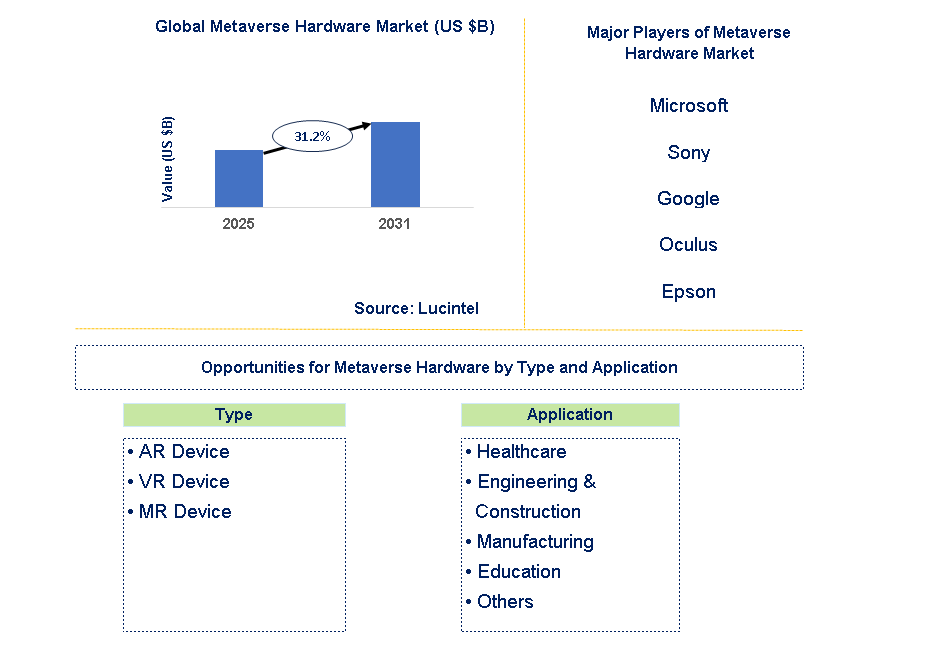
Key data points: The growth forecast = 31.2% annually for the next 7 years. Scroll below to get more insights. This market report covers Trends, opportunity and forecast in metaverse hardware market to 2031 by type (AR device, VR device, and MR device), application (healthcare, engineering & construction, manufacturing, education, and others), and region (North America, Europe, Asia Pacific, and the Rest of the World)
We'll send your sample report shortly.
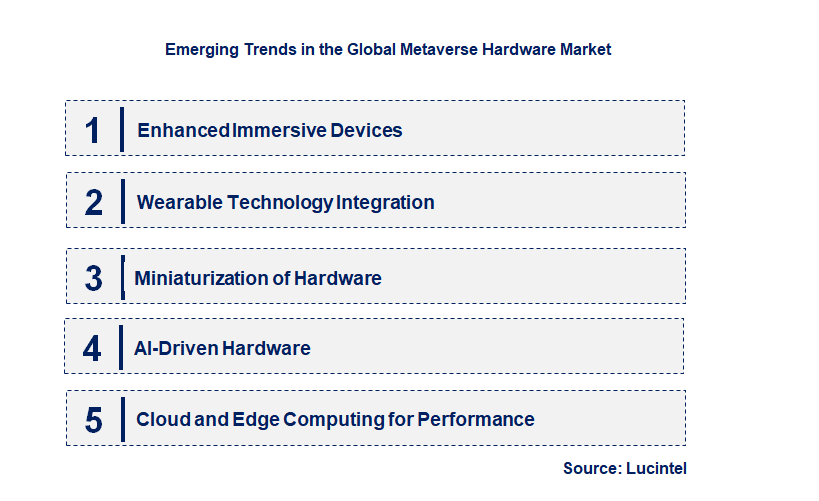
• Enhanced Immersive Devices: Hardware like VR headsets and AR glasses are becoming more immersive with advancements in display technology, field-of-view expansion, and sensory feedback systems. These devices offer more lifelike experiences, making virtual environments more engaging for users. Innovations like eye-tracking, motion sensors, and wireless connectivity are contributing to more seamless, realistic Metaverse interactions.
• Wearable Technology Integration: Wearable technologies, such as haptic suits, gloves, and VR boots, are allowing users to feel tactile sensations in the Metaverse. These technologies have continued to make virtual worlds feel more real by providing feedback for activities undertaken in the virtual world. Haptic technology combined with advanced motion tracking has entered various areas of work to be applied more seriously in games, training, and therapy applications.
• Miniaturization of Hardware: The trend toward smaller, lighter hardware is allowing for more comfortable and convenient Metaverse experiences. Miniaturization of VR and AR devices is making them more accessible to a broader audience, with wearable headsets, smart glasses, and mobile devices now providing immersive experiences without the need for bulky equipment. This development will enable greater mobility and ease of use.
• AI-Driven Hardware: Artificial intelligence is increasingly integrated into metaverse hardware, enhancing interaction, personalization, and content generation. AI-driven systems can adapt to user behavior, providing more customized experiences, while intelligent algorithms optimize performance, latency, and rendering. The use of AI in hardware also facilitates real-time content creation, making the Metaverse more dynamic and responsive to user input.
• Cloud and Edge Computing for Performance: The cloud and edges play a significant part in delivering immersive, real-time, high-fidelity experiences in supporting the data intensive requirements of Metaverse. Both enable seamless rendering, faster computation, and low latency connections as needed for deep immersion. Moreover, offloading computation to the cloud or edge frees devices from focusing exclusively on content reproduction and allows hardware devices to get more directly involved with displaying content that makes for an easier user experience. Emergencies such as advanced devices, wearing technology, shrinking, AI-embedding, and moving to the clouds are changing this hardware market from Metaverse into a new environment. These change variables develop the user experiences, making their virtual environments richer, more sensible, accessible and engaging. Emerging trends will form the future prospects of Metaverse, with increasingly better and diversified implementations across industries as these trends build up.
• Advancements in the Head-Mounted Displays of VR/AR: Improvements in display resolution, wider field of view, and motion tracking enhance the immersive experience of vitalness. More lifelike interactions are offered by devices such as Meta Quest and PlayStation VR2, including wireless connectivity and precise hand tracking. These improvements create a much better Metaverse experience in gaming and professional applications.
• Haptic Feedback Devices: There has been rapid growth in integrating haptic feedback devices into the Metaverse, including gloves, suits, and controllers. These enable users to experience tactile sensations within virtual environments and thus enhance engagement in gaming, training, and simulations. The development of more precise and affordable haptic technology expands the scope of virtual interaction.
• Miniaturized Smart Glasses: With smart glasses being reduced to miniature size, made light and lighter, by firms such as Apple and Microsoft, it opens AR experiences up for people who enjoy entertainment or help in navigating directions. It will encourage further expansion in everyday life due to the effort put into developing wearable, light AR devices that can be applied practically.
• AI-Powered Content Generation: AI-driven hardware is changing the face of the Metaverse with adaptive and personalized virtual environments. Real-time content generation by AI powers dynamic interactions, from NPC behaviors to personalized experiences. Integration of AI also optimizes hardware performance, making virtual worlds smoother and more responsive, enhancing user engagement in gaming and social interactions.
• Cloud and Edge Computing Infrastructure: The computing demands of the Metaverse will be met through cloud and edge computing solutions. It will allow faster data processing, lower latency, and high-quality rendering without powerful local hardware. Companies are investing in edge computing to deliver immersive experiences on lightweight devices, offloading intensive tasks to the cloud. The recent advancements in VR/AR headsets, haptic devices, smart glasses, AI-powered hardware, and cloud computing are fueling the growth of the metaverse hardware market. These developments enhance the quality of virtual experiences and make them more accessible to consumers. As the market evolves, these innovations will continue to shape the future of immersive digital environments.
• Gaming and Entertainment: Gaming is one of the biggest segments driving growth in metaverse hardware. The desire for an immersive VR/AR experience is pushing progress in high-fidelity headsets, motion tracking, and haptic feedback devices. As virtual worlds are created, gaming companies will want new hardware innovations that promote deeper player immersion, creating a big growth area for developers of hardware.
• Healthcare and Virtual Therapy: Healthcare is increasingly using VR/AR technologies in therapy, training, and surgery simulations. Virtual environments allow for immersion in medical training, pain management, and rehabilitation. Hardware solutions like haptic feedback suits and medical-specific VR headsets are ready to explode in growth as healthcare systems integrate Metaverse technologies.
• Education and Remote Learning: Hardware for education using VR and AR is growing exponentially from virtual classrooms to interactive learning. The demand for immersive tools in teaching complex concepts, virtual labs, and remote learning drives the need for specialized hardware. The potential for the Metaverse to transform education is a great growth opportunity for developing hardware.
• Social Interactions and Virtual Workspaces: As people continue shifting toward remote work, virtual workspaces and social platforms within the Metaverse are becoming more in demand. Companies are searching for VR/AR hardware that makes it easier to collaborate, have meetings, and have social interactions within virtual environments. This opens up new development avenues for enhancing communication and collaboration hardware in the Metaverse.
• Retail and Virtual Shopping: The use of virtual shopping and e-commerce within the Metaverse is developing fast, as it allows for browsing and purchasing from a 3D environment. More and more retailers are spending on VR/AR hardware for an immersive customer experience. When the Metaverse evolves, the demand for hardware solutions for virtual retail and engaging with customers will grow. Strategic growth opportunities in the metaverse hardware market span gaming, healthcare, education, social interaction, and retail. These applications are driving demand for innovative, immersive devices that enable richer virtual experiences. As industries embrace the Metaverse, hardware solutions will play a critical role in shaping the future of digital interactions and virtual environments.
• Microsoft
• Sony
• Oculus
• Epson
• Lenovo
• DPVR
• AR Device
• VR Device
• MR Device
• Healthcare
• Engineering & Construction
• Manufacturing
• Education
• Others
• North America
• Europe
• Asia Pacific
• The Rest of the World
• United States: In the United States, companies are spearheading the development of metaverse hardware, such as VR headsets, AR glasses, and haptic feedback devices. Major players, like Meta (previously Facebook) and Microsoft, have invested significantly in building immersive experiences. The United States leads the pack in research and development, particularly in neural interfaces, hand tracking, and real-time rendering, all which enhance Metaverse interactions.
• China: China is booming with investments from tech giants like Tencent and ByteDance in its hardware market for the Metaverse. The attention is given to AR glasses and VR headsets, as well as hardware infrastructure which supports online gaming and virtual commerce. Chinese firms are creating budget-friendly, high-quality equipment to meet rising demand for immersive experiences, primarily in gaming and e-commerce applications.
• Germany: Germany is leading the way in metaverse hardware, especially in industrial applications and automotive design. Companies are working on high-fidelity VR and AR systems that can enhance design workflows, simulations, and training. Germany is also focusing on the integration of VR and AR for manufacturing, improving product testing and collaborative design, as well as advancing immersive learning environments.
• India: India's metaverse hardware market is still in its nascent stage, but growth is accelerating, especially in VR and AR for education, entertainment, and gaming. Indian tech companies are investing in affordable VR headsets and AR-enabled smartphones to increase accessibility. India's burgeoning tech ecosystem supports a growing interest in creating localized Metaverse content and applications for the Indian market.
• Japan: There is a balance of gaming culture, robotics, and technological innovation which propels metaverse hardware in Japan. There is a huge focus on the furtherance of VR technologies by the companies like Sony. Robotics firms are incorporating haptic feedback for an immersive experience. Japan is concentrating efforts on the optimization of VR/AR systems for entertainment and industrial applications to increase precision as well as usability.


• Microsoft
• Sony
• Oculus
• Epson
• Lenovo
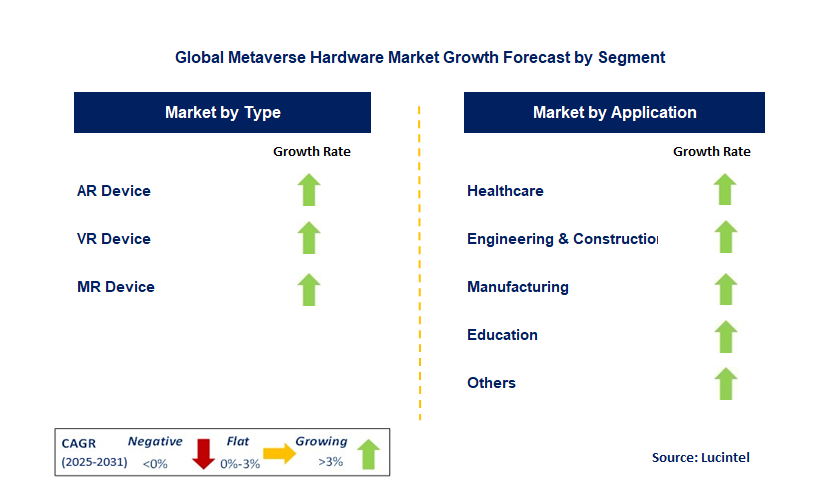
• DPVR Q5. Which metaverse hardware market segment will be the largest in future? Answer: Lucintel forecasts that AR device is expected to witness the highest growth over the forecast period. Q6. In metaverse hardware market, which region is expected to be the largest in next 5 years? Answer: APAC is expected to witness the highest growth over the forecast period. Q7. Do we receive customization in this report? Answer: Yes, Lucintel provides 10% customization without any additional cost.


Choose a license that fits your team. Instant PDF delivery.
Prices exclude taxes. Instant delivery. Custom licensing available on request.
Market Report · July 13, 2026
Market Report · July 13, 2026
Market Report · July 2, 2026
Trusted partner for strategic intelligence and business growth


Receive a complimentary market analysis tailored to your industry. Our analysts will identify key growth opportunities and competitive dynamics specific to your business.

Market size, growth rate, and key trend analysis for your specific sector.

Top competitor positioning and market share analysis.

Strategic recommendations backed by data-driven insights.
Get curated market intelligence and competitive moves straight to your inbox.
By subscribing, you agree to receive our monthly insights. Unsubscribe anytime.
Receive a complimentary market analysis tailored to your industry. Our analysts will identify key growth opportunities and competitive dynamics specific to your business.
Market size, growth rate, and key trend analysis for your specific sector.
Top competitor positioning and market share analysis.
Strategic recommendations backed by data-driven insights.
Get curated market intelligence, emerging trends, and competitive moves straight to your inbox each month.
By subscribing, you agree to receive our monthly insights. Unsubscribe anytime.
We'll send your sample report shortly.