
Market Report · July 22, 2026

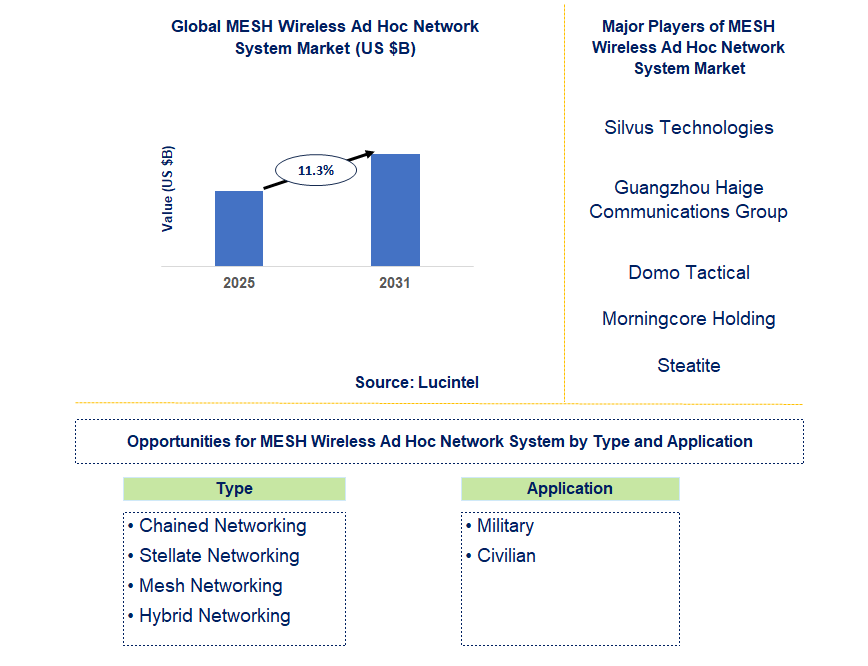
Key data points: The growth forecast = 11.3% annually for the next 7 years. Scroll below to get more insights. This market report covers Trends, opportunities and forecasts in MESH wireless ad hoc network system market to 2031 by type (chained networking, stellate networking, mesh networking, and hybrid networking), application (military and civilian), and region (North America, Europe, Asia Pacific, and the Rest of the World)
We'll send your sample report shortly.
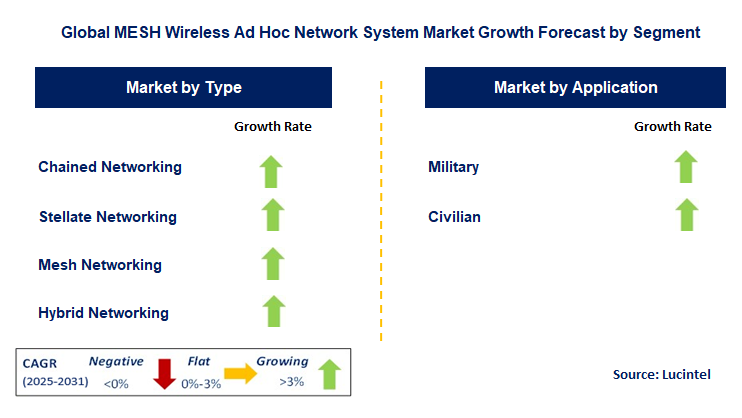
• Lucintel forecasts that, within the type category, mesh networking is expected to witness the highest growth over the forecast period due to the rising need for scalable & decentralized communication.
• Within the application category, military is expected to witness higher growth..
• In terms of region, North America is expected to witness the highest growth over the forecast period.
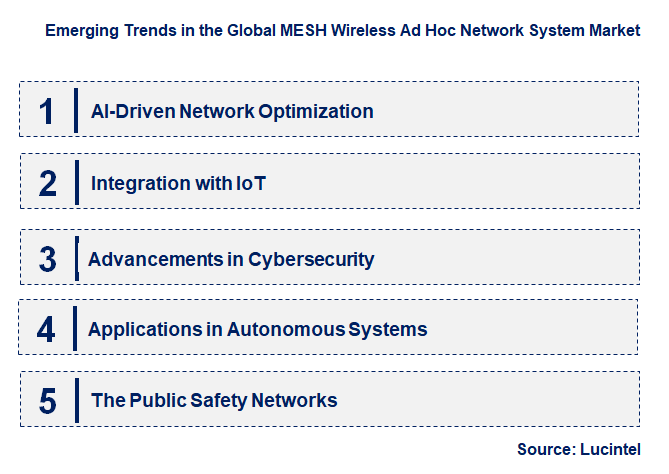
• AI-Driven Network Optimization: MESH networks optimization is an emerging application of artificial intelligence, especially in real-time traffic management. AI enhances efficiency by requiring fewer resources to accomplish tasks, such as dynamically adjusting routing (which lowers latency and increases bandwidth). This is very useful in industrial automation and in the military where the reliability of communication needs to be adaptable.
• Integration with IoT: MESH networks play a huge role in smart cities, smart agriculture, industrial automation, and overall IoT ecosystems. The self-configuring, self-healing, and energy-efficient structures of mesh networks can sustain the uninterrupted flow of communication among IoT devices. This allows for ideal large-scale deployment and drives the demand for agile and cost-efficient MESH solutions.
• Advancements in Cybersecurity: The use of MESH networks in sensitive areas increases the importance of cybersecurity which needs to be addressed. To protect MESH networks from diverse cyberattacks, companies are developing sophisticated encryption methods, decentralized security models, and AI-based threat detection systems. These developments are important for defense, finance, and smart infrastructure applications.
• Applications in Autonomous Systems: MESH networking is being influenced by the development of autonomous cars, drones, and robotic systems. Real-time data exchange between vehicles (V2V) and drones (D2D) depends on MESH networks, in which numerous research centers and automotive companies are seeking low latency and high-speed MESH solutions. Such advancements will allow for increased safety and efficiency of autonomous mobility.
• The Public Safety Networks: Emergency response and law enforcement communications are being enhanced through the deployment of MESH networks by governments in various parts of the world. MESH networks function without a central infrastructure and can be very useful for crisis situations. Countries are investing in MESH systems for public safety to be able to communicate effectively even in remote and hazardous areas. The MESH wireless ad hoc network system market is transforming at an accelerating pace because of the adoption of AI, the Internet of Things, advancements in cybersecurity, autonomous systems, and public safety initiatives. These trends are improving the efficiency, security, and scalability of networks, creating new prospects for innovation and growth. With further investment into MESH technologies, the industry will continue to expand in defense, smart cities, and automated industrial systems.
• AI Fueled Optimization of Network: MESH wireless ad hoc networks are being transformed through the utilization of Artificial Intelligence (AI) and Machine Learning (ML) as they advance traffic control, and routing algorithms while predicting possible network failures well in advance. The implementation of AI solutions equips the system with adaptive self-healing capabilities which responds to real-time changes to maximize performance in rapidly and highly dynamic environments, such as disaster response and in military applications. Innovations like these improve bandwidth allocation and ensure uninterrupted connectivity regardless of the condition. Permitting organizations to adopt the technology to transmit real time data for instantaneous use, LEAP MESH networks become the ideal solution for low-latency requirements.
• Integration of 5G and Edge Computing: The combination of MESH networks with 5G and edge computing is opening up new frontiers in ultra-low-latency use cases. Smart surveillance systems, industrial automation, and vehicle-to-everything (V2X) communication are some of the applications that can benefit from 5G’s high-speed connectivity and edge computing’s proximity processing capabilities. Responsive reaction times and reduced dependence on centralized cloud computing are additional benefits which improve network efficiency in densely populated areas. Businesses leveraging these integrated technologies are able to scale faster and improve real-time communications.
• Energy-Efficient Networking Protocols: Innovations in energy-efficient MESH networking protocols are improving the lifespan of battery-powered and remote devices. Low-power adaptive networking techniques streamline power utilization while satisfying acceptable standards of performance in the network. These improvements are most useful for low-maintenance, long-duration deployments such as those found in sensor networks used in environmental monitoring and agriculture. Adopting these energy-efficient protocols enhances the practicality of large-scale MESH networks by lowering operational costs and increasing sustainability.
• Enhanced Cybersecurity Measures: Cybersecurity is a concern for the expanding application of MESH networks. New developments in the area include advanced encryption techniques, blockchain-based authentication, and AI anomaly detection systems. These improvements defend against cyber threats such as network access, data breach, and denial-of-service attacks. Defense, healthcare, and financial services are adopting secure MESH network solutions to protect sensitive communications and preserve the integrity of the data transmitted.
• Expansion in Autonomous Systems: MESH networks are becoming standard in autonomous systems like drones, self-driving cars, and robotic swarms. Machine-to-machine interactions become simpler with enhanced communication medium, thus improving coordination and the sharing of information in real-time. Increased adoption of MESH networks in smart transportation, logistics, and defense systems is facilitating these advancements in autonomous networking. These changes will likely come more swiftly as set, unmanned systems become more prevalent and industries look for strong, distributed channels for robust operations. The MESH wireless ad hoc network system market is advancing at a breakneck pace owing to AI optimization, integration of 5G technology, energy-efficient networking, enhanced cybersecurity, and the growth of autonomous systems. MESH networks are becoming increasingly effective, secure, and scalable which will accelerate their adoption across diverse verticals such as defense, healthcare, industrial IoT, and smart infrastructure. With the continuous emergence of new applications and innovations, the market is set to experience sustained growth.
• Defense and Military Communications: MESH networks have found extensive applications in pole military operations because of their reliability and functionality within inhospitable areas. The capability of real time communication for soldiers, drones, and command centers, circumventing the dependency on fixed infrastructure, is enabled with these networks. Investment towards military-grade MESH networks with enhanced security and AI-powered optimization is driven by needs for advanced battlefield communication solutions. Next-generation tactical communication systems have budgetary allocation from governments which enables lucrative opportunities for defense contractors and technology providers.
• Emergency Response and Disaster Recovery: The role of MESH networks in disaster recovery is critical as they provide first responders reliable communication channels in the absence of traditional networks. Wildfires, hurricanes, and earthquakes disrupt conventional networks, making rescue operations difficult without decentralized MESH systems. There is increased use by governments and humanitarian organizations for these MESH network solutions, aiding in rapid deployment of communication devices, which enables a significant opportunity for network and emergency response agencies to enhance their offerings.
• MESH Networks in Smart City: Smart cities use MESH networks for monitoring and traffic management services, as well as safety and environmental issues. Such networks help cities collect and analyze information in real time, improve the city’s service efficiency, and enhance overall operational productivity. The connected infrastructure of smart cities and their components is a primary market for scalable MESH networks that need to be cost-effective. This means that municipal governments can pair with tech companies for large-scale implementation projects.
• Industrial Automation and the IoT: MESH networks are key enablers of industrial automation by providing full connectivity of IoT sensors, robotics, and monitoring systems. Manufacturing plants along with oil refineries and warehouses rely on MESH networks to optimize operations and enhance predictive maintenance in order to reduce downtime. With the growing adoption of Industry 4.0 technologies, there is a significant opportunity for MESH network providers to expand into manufacturing, logistics, and the supply chain with solutions that provide greater operational efficiency and productivity.
• Remote and Rural Connectivity: Providing reliable connectivity for remote and rural areas continues to be a challenge, but MESH networks do offer some solutions. MESH networks are being used to implement community-driven Internet access by linking educational institutions, healthcare services, and businesses in remote areas. Public and private sector operations are starting MESH-based rural broadband initiatives to eliminate digital disparity. There is ample market growth for firms dealing in wireless communication products and services to enhance connectivity for the rural regions. The market for MESH wireless ad hoc network systems is growing rapidly in the fields of defense, emergency response, smart cities, industrial IoT, and remote connectivity. Investing in MESH technology is increasing as industries and governments recognize the need for decentralized and resilient networking solutions. Businesses focused on developing flexible, secure, and affordable MESH systems stand to benefit greatly and will shape the future of wireless networking.
• Silvus Technologies
• Guangzhou Haige Communications Group
• Domo Tactical Communications
• Morningcore Holding
• Steatite
• Changsha Jingjia Microelectronics
• Xinuo Maitian Technology
• Chained Networking
• Stellate Networking
• MESH Networking
• Hybrid Networking
• Military
• Civilian
• North America
• Europe
• Asia Pacific
• The Rest of the World
• United States: In the United States, the market is seeing a surge due to government efforts in improving public safety communications and national security. Tactical MESH networks are being developed by the Department of Defense for communication in the battlefield. MESH is also being adopted in smart grids and industrial automations, as the private sector utilizes more and more MESH based applications. Furthermore, strategic partnerships between MESH and telecom companies are developing technologies to improve efficiency and reliability using AI to automate MESH networking processes.
• China: China is at the forefront of MESH network development, focusing on urban systems and industrial automation. The country deployed MESH networks with 5G to improve coverage for highly populated areas. Both military and civilian sectors have started utilizing military secure MESH networks for command and control applications for different branches of the armed forces. Private enterprises have been developing advanced technologies for AI-powered MESH networks and are looking to expand their business to other countries in Asia and Africa.
• Germany: For Germany, the primary focus is on the deployment of MESH networks towards the 4.0 industrial revolution to improve the level of automation in manufacturing and logistics. The country also allocates resources towards the development of MESH networks for emergency services and disaster management systems. Furthermore, automotive companies are developing systems for vehicle-to-everything V2X communication. MESH networks are vital for the implementation of autonomous driving features. Government policies for the deployment of MESH networks are providing the needed protection with regard to information security.
• India: For India, the expansion of the MESH networks market incurs from the rising need for rural access solutions. Government investment is enhanced with the implementation of the Digital India campaign, which promotes the development of wireless modem infrastructure for MESH-Ade smart cities and public Wi-Fi. For defense purposes, MESH networks are being implemented into border patrol and disaster response systems. Indian telcos are investing in MESH technology to improve the last mile connectivity in remote regions.
• Japan: Japan is leading the deployment of MESH networks in smart city initiatives. The country’s research institutions and private enterprises are developing high-speed, AI-powered MESH networks for IoT and autonomous systems. A primary focus is on the deployment of MESH networks to enhance communication in-disaster prone areas. In addition, the defense sector is incorporating advanced MESH technologies for communication on secure real-time battlefields.


• Silvus Technologies
• Guangzhou Haige Communications Group
• Domo Tactical Communications
• Morningcore Holding
• Steatite
• Changsha Jingjia Microelectronics
• Xinuo Maitian Technology Q5. Which MESH wireless ad hoc network system market segment will be the largest in future? Answer: Lucintel forecasts that, within the type category, mesh networking is expected to witness the highest growth over the forecast period due to the rising need for scalable & decentralized communication. Q6. In MESH wireless ad hoc network system market, which region is expected to be the largest in next 5 years? Answer: In terms of region, North America is expected to witness the highest growth over the forecast period. Q7. Do we receive customization in this report? Answer: Yes, Lucintel provides 10% customization without any additional cost.


Choose a license that fits your team. Instant PDF delivery.
Prices exclude taxes. Instant delivery. Custom licensing available on request.
Market Report · July 22, 2026
Market Report · July 17, 2026
Market Report · July 17, 2026
Trusted partner for strategic intelligence and business growth


Receive a complimentary market analysis tailored to your industry. Our analysts will identify key growth opportunities and competitive dynamics specific to your business.

Market size, growth rate, and key trend analysis for your specific sector.

Top competitor positioning and market share analysis.

Strategic recommendations backed by data-driven insights.
Get curated market intelligence and competitive moves straight to your inbox.
By subscribing, you agree to receive our monthly insights. Unsubscribe anytime.
Receive a complimentary market analysis tailored to your industry. Our analysts will identify key growth opportunities and competitive dynamics specific to your business.
Market size, growth rate, and key trend analysis for your specific sector.
Top competitor positioning and market share analysis.
Strategic recommendations backed by data-driven insights.
Get curated market intelligence, emerging trends, and competitive moves straight to your inbox each month.
By subscribing, you agree to receive our monthly insights. Unsubscribe anytime.
We'll send your sample report shortly.