
Market Report · July 15, 2026

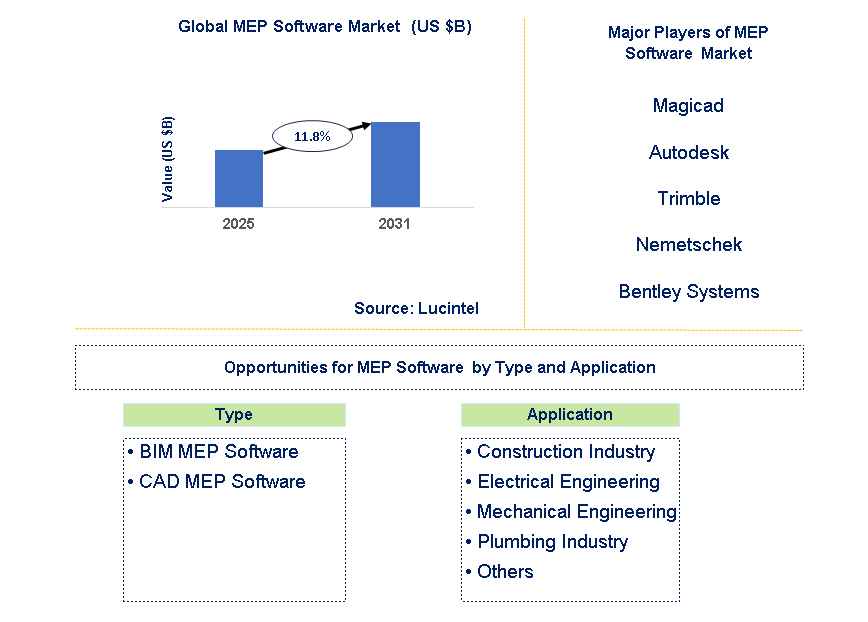
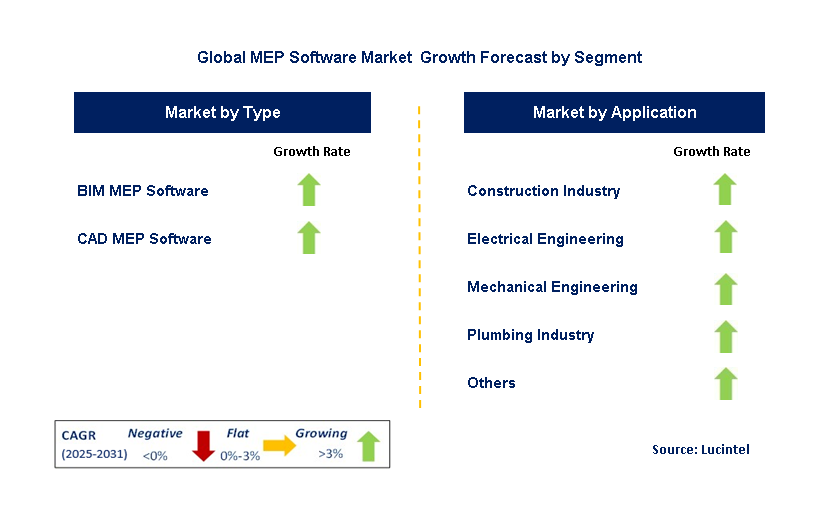
Key data points: The growth forecast = 11.8% annually for the next 7 years. Scroll below to get more insights. This market report covers Trends, opportunity and forecast in MEP software market to 2031 by type (bim MEP software and cad MEP software), application (construction industry, electrical engineering, mechanical engineering, plumbing industry, and others), and region (North America, Europe, Asia Pacific, and the Rest of the World)
We'll send your sample report shortly.
• Adoption of Building Information Modeling (BIM): BIM technology is changing the MEP software market by improving coordination and collaboration between project stakeholders. BIM facilitates engineers, architects, and contractors to work on a virtual site to optimize MEP designs before starting construction. The outcome is reduced errors, low project costs, and shorter periods. With more adoption of BIM, MEP software vendors have been incorporating BIM compatibility in their products to meet the increasing demand in the industry.
• Cloud-Based Solutions: Increasing adoption of cloud technology in the MEP software market can be attributed to the fact that it allows users to collaborate real-time and share data from any location. It makes it seamless for MEP professionals to work cross-team and project-wise, allowing for efficiency and flexibility. Such a shift makes expensive on-premise infrastructure not necessary and renders software tools easily accessible to SMEs.
• Integration of Artificial Intelligence (AI) and Machine Learning (ML): AI and ML are also added to MEP software to automate difficult tasks like energy analysis and optimization of the MEP system. With these technologies, MEP engineers make data-driven decisions, increase efficiency in systems, and minimize the consumption of energy in buildings. AI is integrated into MEP to enable predictive maintenance, whereby software can predict a failure in an MEP system before it occurs so that necessary precautions can be taken.
• Sustainability and Green Building Standards: With sustainability gaining more prominence in the construction industry, there is a growing demand for MEP software supporting the development of building certificates like LEED, BREEAM, and WELL. These software tools guide engineers to optimize their energy usage while reducing carbon emissions and ensure that systems are designed and built efficiently to contribute towards the overall environmental sustainability of buildings.
• IOT Integration for Smart Buildings: IoT with MEP software is another big trend; smart, connected buildings are to be created using IoT. This integration enables MEP systems to be monitored in real-time, detects inefficiencies, and automatically adjusts systems. Such integration is essential for energy management and the optimization of building performance across the entire lifecycle of a building.
Such emerging trends shape the MEP software market to a greater extent for efficiency, sustainability, and innovation. BIM, AI, cloud-based solutions, sustainability initiatives, and integration of IoT ensure that building system design and management is more connected and data-driven. As the trend continues, MEP software would play a big role in shaping the construction and building management industry.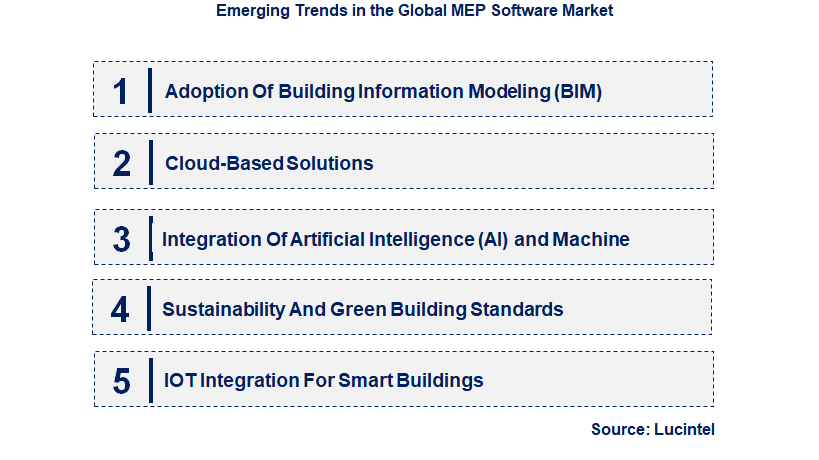
• Integration of Advanced Analytics and AI: Integration of advanced analytics and AI technologies is happening in MEP software, where data-driven decisions are possible. This will help MEP engineers to optimize the system's performance, predict failures, and minimize energy consumption. It helps in making patterns from big data and algorithms using machine learning and provides suggestions for improvement to engineers who wish to achieve higher efficiency.
• Cloud-Based Collaboration Platforms: The move to cloud-based collaboration platforms has greatly enhanced the efficiency of MEP software. These platforms enable real-time collaboration among project stakeholders, reducing errors and ensuring that design modifications are immediately reflected across the system. This has made it easier for teams working in different locations to stay synchronized, enhancing productivity and streamlining project workflows.
• Increased Focus on Energy Efficiency: With increased energy costs and an increased emphasis on sustainability, providers of MEP software are now concentrating on developing tools for energy efficiency. This includes features such as energy modeling, load calculations, and system simulations that enable the design of MEP systems that not only minimize energy consumption but also maximize performance; this becomes increasingly important in meeting global sustainability goals.
• Advancements in integration with Building Information Modeling (BIM): The development of BIM integration in the MEP software market has been quite significant as it allows more accurate modeling of building systems. This has resulted in fewer design errors, better coordination among disciplines, and lower construction costs. In addition, the evolution of BIM tools is leading to the development of specialized MEP solutions that enhance the capabilities of traditional BIM platforms.
• Mobile and Remote Access Features: The access of people to the use of MEP engineers and their software is changing. Users can access designs, project data, and real-time metrics on system performance from smartphones and tablets with new mobile and remote features. This feature becomes crucial in the hectic construction industry; engineers can produce work at job sites and become updated on the progress of each project.
These new developments are transforming the MEP software market by making it more efficient, collaborative, and sustainable. In focus, including energy efficiency, the integration of BIM, using AI and advanced analytics, and cloud-based solutions, these are significantly enhancing the capabilities of MEP professionals to design, optimize, and manage building systems efficiently.• Smart Building Solutions: The growing demand for smart buildings is opening up new opportunities for MEP software providers to integrate IoT technologies and smart systems into their solutions. Such technologies enable real-time monitoring, predictive maintenance, and enhanced energy management, thereby providing immense value to building owners and operators. MEP software that supports smart building features can enhance operational efficiency and reduce costs.
• Energy Efficiency and Sustainability: Building design is becoming more energy-efficient and sustainable. Energy modeling, system simulation, and green building certification are all potential growth areas for MEP software that supports these areas. With its ability to provide engineers with designs that optimize energy use and carbon emissions, MEP software can contribute to meeting the regulatory requirements of sustainability goals.
• Building Information Modeling (BIM) Integration: With BIM holding a great market share over the construction sector, MEP software compatible with the platforms of BIM will give more growth in future. Including the MEP system within a wider framework of BIM helps bring teams together while also minimizing error-prone practices, thereby refining design processes. Many MEP software developers are developing this aspect in detail to achieve an advantage based on this development trend.
• Cloud-Based Software Solutions: Cloud-based MEP software allows for greater flexibility and collaboration, as teams can work across locations and time zones easily. This is an area where the demand will continue to grow, especially as businesses are looking for ways to cut costs and increase productivity. Cloud-capable MEP software solutions will experience significant gains in market share as scalable, accessible, and cost-effective solutions become available.
• Predictive Maintenance and Analytics: The use of predictive maintenance and data analytics in MEP software is expected to grow significantly. With the help of IoT sensors and machine learning algorithms, MEP software can predict failures and optimize system performance before issues arise. This shift towards predictive maintenance opens up opportunities for software providers to offer value-added services that enhance system reliability and reduce operational downtime.
These growth opportunities are reshaping the MEP software market, driving innovation and improving efficiency across the building design and management processes. With a focus on smart building solutions, energy efficiency, BIM integration, cloud-based platforms, and predictive maintenance, the MEP software industry is poised for continued expansion, delivering more advanced and sustainable solutions.• Magicad
• Autodesk
• Trimble
• Nemetschek
• Bentley Systems
• Coins Global
• Evolve MEP
• Witas
• Exactal
• On Center Software
• Bim MEP Software
• Cad MEP Software
• Construction Industry
• Electrical Engineering
• Mechanical Engineering
• Plumbing Industry
• Others
• North America
• Europe
• Asia Pacific
• The Rest of the World
• United States: In the United States, growth of MEP software has had accelerated due to BIM usage, cloud-based computation, as well as implementation of AI systems. There is an increasing emphasis on sustainability and energy efficiency in building designs, which increases the demand for software solutions that can support compliance with green building standards. Furthermore, other drivers of demand include improvement in user experience through intuitive user interfaces and increased interoperability with other design tools. The software solutions developed in the United States continue to focus on developing advanced analytics and machine learning capabilities to optimize MEP system performance.
• China: China's MEP software market is growing rapidly as the country sticks to its focus on urban development and infrastructure development. Initiatives are being taken for smart cities by the government, with a lot of emphasis on sustainability. These are pushing the demand for MEP software integrating IoT, AI, and data analytics. The construction industry is also expanding, and the government is investing more in green technology. Chinese companies are also looking more toward BIM integration with MEP software, which increases design and construction efficiencies in the very rapidly developing building sector of the country.
• Germany: The German MEP market is characterized by emphasizing precision engineering, as well as sustainability and energy efficiency. Environmental regulations and green building standards of the country have stimulated advanced software tools developed for optimizing the MEP system's design and performance. BIM adoption by German companies is more inclined towards better coordination across all parties involved in the building process. It is witnessed that cloud-based solutions enhance the overall flexibility to collaborate real-time on construction projects while supporting stringency of local regulations.
• India: India MEP software is on growth as the construction and infrastructure sectors continue to rise in India rapidly. Increased demands for urbanizing, residential, commercial, and industrial buildings are placing demands on designing efficient MEP systems. Indian firms are increasingly embracing BIM and integrated MEP solutions that enable them to coordinate their projects better and save on construction costs. In the face of increased energy efficiency, demand for software that can support green building certifications such as LEED is also increasing. The adoption, however, lags behind the more developed markets and is influenced by the availability of infrastructure and development of the skilled workforce.
• Japan: In Japan, the country's focus on technological innovation and smart city initiatives has influenced the MEP software market. The increasing adoption of BIM in the construction industry is also driving the demand for advanced MEP design tools. Japanese firms are using automation and AI-driven solutions to improve the accuracy and efficiency of MEP system designs. The push toward disaster-resistant buildings, especially in earthquake-prone regions, has further fueled the need for sophisticated software that aids in the design of resilient MEP systems. Japan still leads the charge in incorporating novel technologies into MEP software solutions.


• Magicad
• Autodesk
• Trimble
• Nemetschek
• Bentley Systems
• Coins Global
• Evolve MEP
• Witas
• Exactal
• On Center Software
Q5. Which MEP software market segment will be the largest in future?

Choose a license that fits your team. Instant PDF delivery.
Prices exclude taxes. Instant delivery. Custom licensing available on request.
Market Report · July 15, 2026
Market Report · June 26, 2026
Market Report · June 24, 2026
Trusted partner for strategic intelligence and business growth


Receive a complimentary market analysis tailored to your industry. Our analysts will identify key growth opportunities and competitive dynamics specific to your business.

Market size, growth rate, and key trend analysis for your specific sector.

Top competitor positioning and market share analysis.

Strategic recommendations backed by data-driven insights.
Get curated market intelligence and competitive moves straight to your inbox.
By subscribing, you agree to receive our monthly insights. Unsubscribe anytime.
Receive a complimentary market analysis tailored to your industry. Our analysts will identify key growth opportunities and competitive dynamics specific to your business.
Market size, growth rate, and key trend analysis for your specific sector.
Top competitor positioning and market share analysis.
Strategic recommendations backed by data-driven insights.
Get curated market intelligence, emerging trends, and competitive moves straight to your inbox each month.
By subscribing, you agree to receive our monthly insights. Unsubscribe anytime.
We'll send your sample report shortly.