
Market Report · May 18, 2026

This market report covers trends, opportunities, and forecasts in the global mems singlemode optical switch market to 2031 by technology (1x1 switches, 1x2 switches, and others), application (fiber optical communication system, test equipment, and others), and region (North America, Europe, Asia Pacific, and the Rest of the World)
We'll send your sample report shortly.
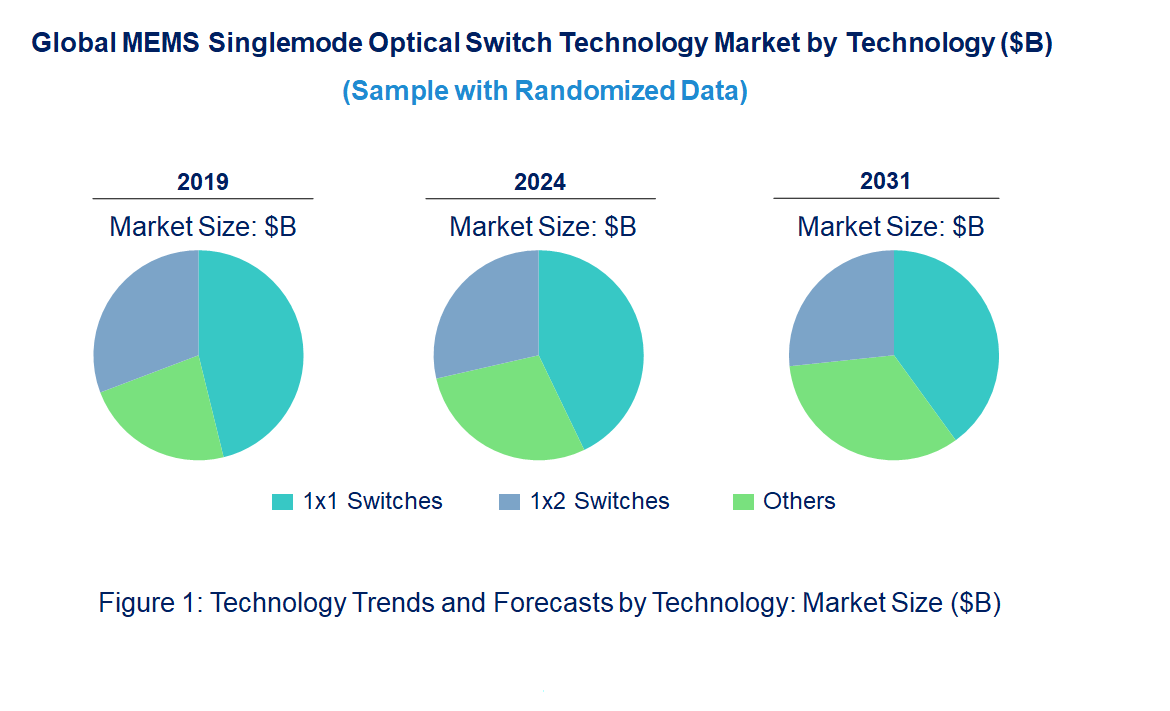
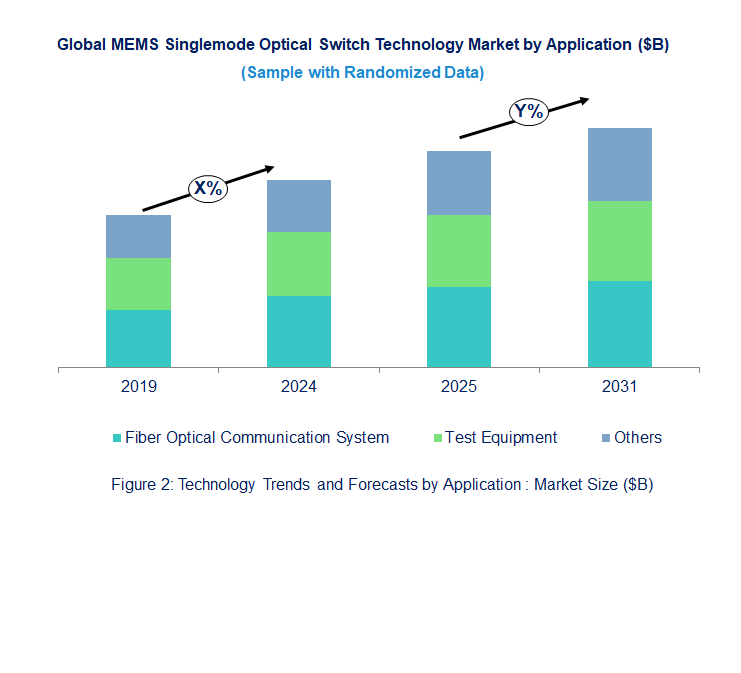
• MEMS switches-1x2 over 1x1 switches. The main trend in the MEMS singlemode optical switch market is the transition from 1x1 switches to 1x2 switches. As two paths are supported in 1x2 MEMS switches, it can offer much richer capability of routing capabilities, the reason is the switching of optical signals between the paths. This transition is mainly caused due to the multi-path routing requirement of fiber optic communications.
• Miniaturization of MEMS Devices: MEMS switches are now miniaturized to decrease the size and weight of optical switching systems. The necessity of density in the network and data center operations will create the need for small, compact MEMS switches. These miniaturized devices help optimize real estate and decrease the costs of optical network installations.
• Integration with Optical Add/Drop Multiplexers (OADMs): MEMS-based optical switches are increasingly integrated with Optical Add/Drop Multiplexers (OADMs) to provide more flexible and scalable networks. The integration enhances the reconfigurability and dynamic routing of optical signals, hence improving resource management in telecommunication and data center networks.
• Low-Loss MEMS Switching Advancement: This is a growing trend in the market because low-loss MEMS switches reduce signal degradation from the switching process. Such advancements are critical for applications in which signal integrity and quality are of utmost importance, such as in fiber-optic communications and high-performance test equipment.
• MEMS Switches in Test Equipment MEMS switches are gaining use in optical test equipment for validating performance and optimizing systems. These switches provide high precision, fast response times, and other critical requirements for testing in optical networks and fiber-optic devices. Their ability to do high-speed switching with minimal loss of signal is driving adoption in the sector. The MEMS singlemode optical switch market has been rapidly changing, where 1x2 switches have been used instead of traditional 1x1 switches, miniaturizing the MEMS devices, integrating with OADMs, low-loss switching advancement, and increased usage in test equipment. These trends are enhancing flexibility, efficiency, and better performance in optical networks.
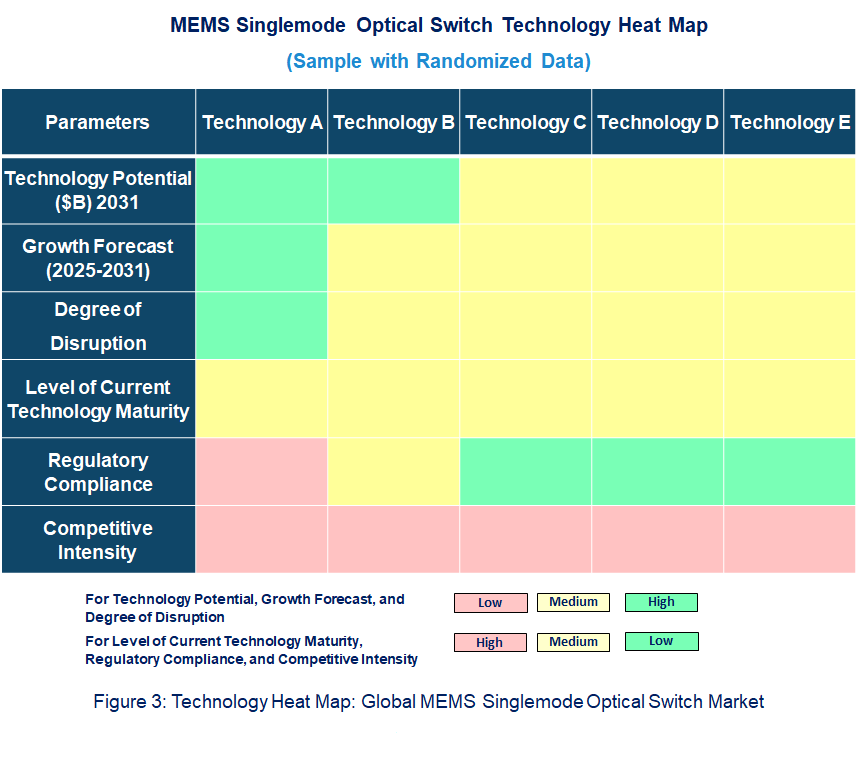
• Technology Potential: The need for scale-efficient optical networks drives high MEMS technology potential for single-mode optical switches. MEMS is of high advantage in its power consumption, miniaturization, and faster switching than any conventional optical switch. Ongoing progress includes increasing the range of switching, reducing the signal loss, and higher integration of photonic devices to form next-generation communication systems, including 5G, fiber optic networks, and cloud computing infrastructure.
• Degree of Disruption: It is moderate to high because MEMS-based switches offer a tremendous improvement over traditional mechanical and electro-optic switches in terms of speed, size, and reliability. This can eventually lead to widespread adoption in telecommunications, especially in optical networks, and eventually replace older, less efficient technologies in high-performance systems.
• Current Technology Maturity: MEMS single-mode optical switches are at a relatively mature stage, with some commercial products already in use for fiber-optic communications and data centers. However, continued innovation is necessary to enhance scalability and reliability.
• Regulatory Compliance: In this market, regulatory compliance is related to safety standards and electromagnetic compatibility (EMC) regulations. Since optical switching technology is critical in infrastructure, compliance with telecom standards such as ITU-T and IEEE is necessary.
• Thorlabs: Thorlabs has introduced MEMS-based optical switches that have ultra-low insertion loss and very fast switching times. The products are being applied in several applications of fiber-optic testing and network routing, and enhance the overall efficiency and reliability of telecommunication systems. They address solutions to research labs, test equipment manufacturers, and network operators.
• Sercalo Microtechnology: Sercalo Microtechnology has recently developed MEMS optical switches that feature low power consumption and high switching reliability. These switches are designed for integration into high-density fiber networks and are being used to improve the performance of data centers and telecommunications networks.
• DiCon Fiberoptics: DiCon Fiberoptics has developed several MEMS-based optical switch modules that are applied in optical monitoring systems and dynamic network provisioning. These products are vital for real-time optical signal routing, as they ensure the scalability and dynamic reconfigurability of fiber-optic networks.
• Agiltron: With the latest advancements in low-loss and high-speed switching technologies, Agiltron has taken significant strides toward MEMS optical switch design. Its MEMS switches are being used widely in fiber-optic communications and in test equipment to ensure optimal performance in mission-critical applications.
• Adamant: Adamant’s latest MEMS optical switches offer higher switching precision and greater reliability in applications such as telecommunications and data center management. The company’s switches are also being integrated with automated optical testing systems to improve performance evaluation in high-speed optical networks.
• HUBER + SUHNER: HUBER + SUHNER has rolled out a range of MEMS-based optical switch solutions to help network operators and telecommunication providers provide scalable optical switching systems. HUBER + SUHNER’s products feature advanced signal routing and support high-throughput optical networks.
• Accelink: MEMS optical switches with very high-speed switching and very low insertion loss for use in fiber-optic communications and data center networks. These are assisting customers in implementing adaptive network reconfiguration and real-time service provisioning.
• HYC: HYC has launched MEMS-based switches that are more durable and perform better than the others. These switches are used in optical communication systems and high-performance test equipment. Their switches are designed to meet the demanding requirements of modern fiber-optic infrastructure.
• HYGJ Communication: The MEMS optical switches designed by HYGJ contain an extended lifespan and strong performance. Their switches are applied in optical network management and network protection systems, enhancing the flexibility and scalability of optical networks.
• Exfo: Exfo is using MEMS technology in their optical test equipment, providing high-precision switches that are ideal for network diagnostics and signal routing. Their latest switches are key in optimizing network performance and reducing downtime in fiber-optic systems. The major players in the MEMS Singlemode Optical Switch Market, such as Thorlabs, Sercalo Microtechnology, and Agiltron, are constantly innovating to provide high-performance, low-loss switches that can meet the ever-growing demand for scalable, dynamic optical networks in such fields as telecommunications, data centers, and test equipment.
• Increasing Demand for High-Speed Optical Networks: As telecommunication and fiber-optic communication systems advance, there is a need for fast, reliable switches. MEMS switches are critical for dynamic routing, low-loss performance, and scalability in fiber-optic networks.
• Increase in Data Center Capacity and Cloud Computing: High demand for capacity of data centers as well as cloud computing drives the MEMS optical switches. MEMS optical switches have been offering fast and high-capacity signal routing that handles complex traffic flows within large data centers. Technological developments in optical networking such as miniaturization and power conservation in MEMS technologies, make it more adaptable for MEMS switches in high-performance networks; hence, the above advancement makes optical communication systems even more flexible and efficient.
• Demand for Network Reconfigurability: The growing need for flexible, reconfigurable networks in telecommunication systems is driving the adoption of MEMS-based switches. MEMS switches enable real-time adjustments to signal routing, improving the resilience and efficiency of networks. Challenges in the MEMS singlemode optical switch market are:
• High Cost of MEMS Switches: Although MEMS-based switches offer high performance, their initial production cost can be higher than traditional switching technologies, limiting their widespread adoption in cost-sensitive markets.
• Integration Complexity: The integration of MEMS switches into an existing network infrastructure is relatively complex, especially in large networks. The design and engineering complexities in integration slow down market adoption.
• Limited availability of MEMS switch technology: Even though MEMS-based switches provide much-needed benefits, there is a limited supply of these advanced components; therefore, the technology is not widely available for commercial use by industries around the world. The MEMS single mode optical switch market is growing under the impact of high-demand applications of high-speed and flexible optical networks, along with ongoing advancements in data center technology and the development of communications-related technology. However, further potential uses will depend on such applications and industries overcoming issues regarding MEMS technology’s very high price and integration complexity while enhancing their access.
• Thorlabs
• Sercalo Microtechnology
• DiCon Fiberoptics
• Agiltron
• Adamant
• HUBER + SUHNER
• Technology Readiness and Competitive Level Across Technologies: 1x1 MEMS switches are mature and widely used, whereas 1x2 switches are developing to meet the increased demand for flexibility and speed. Advanced configurations (2x2, 4x4) are being developed for high-performance applications. Competition is intense for 1x1 and 1x2 switches, while there are fewer players in the advanced switch segment. Multi-port switches have stricter regulatory compliance, especially in the telecom and data center markets. Key applications include optical networking and high-performance computing.
• Competitive Intensity and Regulatory Compliance Across Technologies: The MEMS Singlemode Optical Switch market is highly competitive, especially for 1x1 and 1x2 switches. Companies are focused on speed, reliability, and integration. Advanced switches like multi-port configurations face less competition but are targeted at high-density applications. Regulatory compliance is very critical, especially in terms of performance standards, EMI, and safety certifications in telecom and data center networks.
• Disruption Potential of Various Technologies in the MEMS Singlemode Optical Switch Market: 1x1 switches are widely deployed in entry-level telecom and data center applications. 1x2 switches provide more flexibility to accommodate scalable optical networks, but are still gaining popularity. Advanced multi-port switches are coming into view in high-density networks and next-generation computing. These technologies will continue to mature and disrupt the market in complex network infrastructures with more efficient routing for 1x2 and multi-port switches.
• 1x1 Switches
• 1x2 Switches
• Others
• Fiber Optical Communication System
• Test Equipment
• Others
• North America
• Europe
• Asia Pacific
• The Rest of the World
• Latest Developments and Innovations in the MEMS Singlemode Optical Switch Technologies
• Companies / Ecosystems
• Strategic Opportunities by Technology Type


Choose a license that fits your team. Instant PDF delivery.
Prices exclude taxes. Instant delivery. Custom licensing available on request.
Market Report · May 18, 2026
Market Report · May 18, 2026
Market Report · May 18, 2026
Trusted partner for strategic intelligence and business growth


Receive a complimentary market analysis tailored to your industry. Our analysts will identify key growth opportunities and competitive dynamics specific to your business.

Market size, growth rate, and key trend analysis for your specific sector.

Top competitor positioning and market share analysis.

Strategic recommendations backed by data-driven insights.
Get curated market intelligence and competitive moves straight to your inbox.
By subscribing, you agree to receive our monthly insights. Unsubscribe anytime.
Receive a complimentary market analysis tailored to your industry. Our analysts will identify key growth opportunities and competitive dynamics specific to your business.
Market size, growth rate, and key trend analysis for your specific sector.
Top competitor positioning and market share analysis.
Strategic recommendations backed by data-driven insights.
Get curated market intelligence, emerging trends, and competitive moves straight to your inbox each month.
By subscribing, you agree to receive our monthly insights. Unsubscribe anytime.
We'll send your sample report shortly.