
Market Report · May 18, 2026

This market report covers trends, opportunities, and forecasts in the global material moisture meter market to 2031 by technology (capacitance, resistance (conductivity), microwave, near-infrared (nir), and gravimetric (drying oven)), end use industry (agriculture, construction, food processing, pharmaceuticals, and others), and region (North America, Europe, Asia Pacific, and the Rest of the World)
We'll send your sample report shortly.
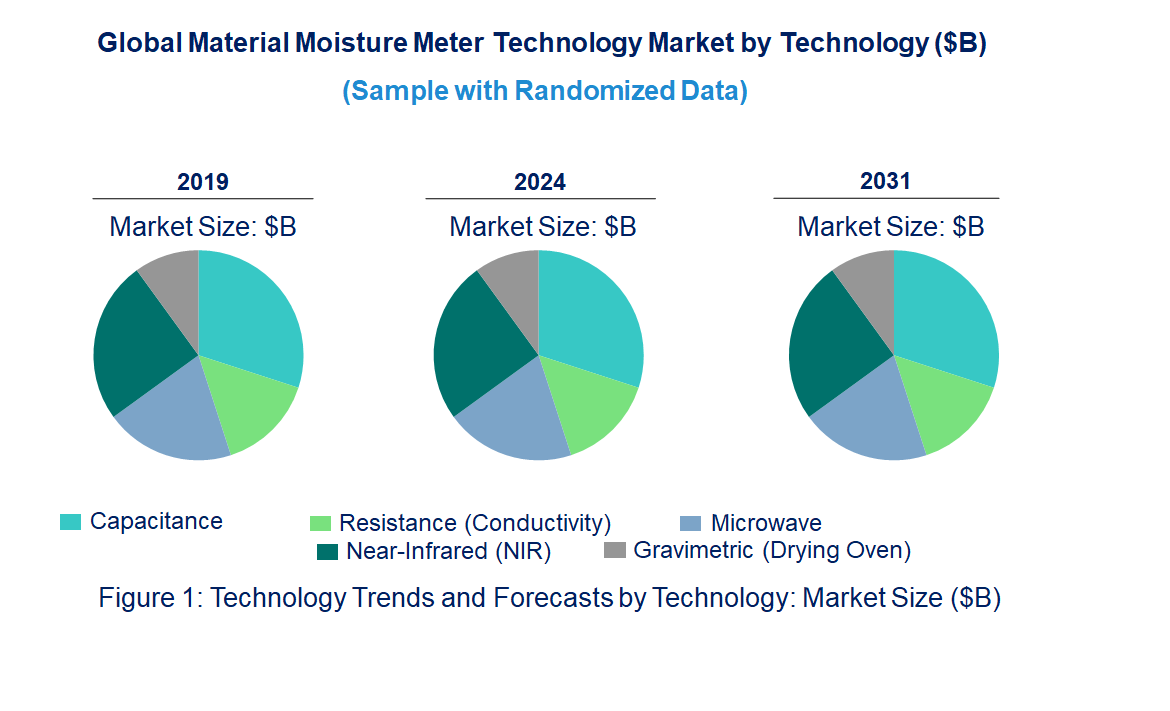
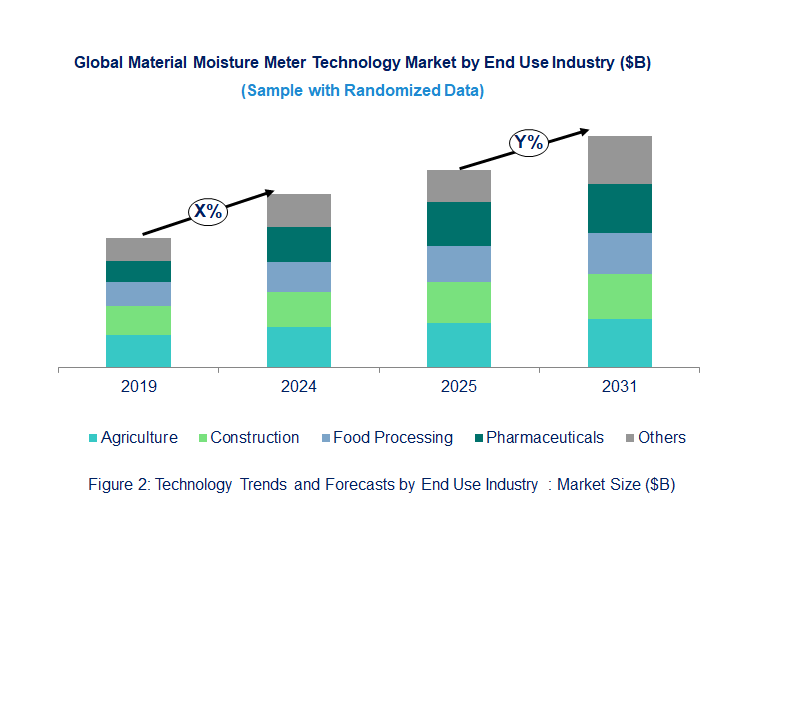
• Increasing adoption of non-destructive measurement techniques such as Near-Infrared (NIR) and Microwave technologies that provide real-time moisture data without damaging samples.
• Integration of IoT and smart sensor technologies for remote monitoring and automated moisture control in agriculture and food processing industries.
• Growing emphasis on energy-efficient and eco-friendly solutions leading to reduced reliance on traditional gravimetric methods that are time-consuming and energy-intensive.
• Expansion of portable and handheld moisture meters for on-site testing, improving operational efficiency in construction and pharmaceuticals.
• Enhanced data analytics and AI integration with moisture meters to predict material quality and optimize processing parameters, driving better decision-making. These trends are collectively reshaping the material moisture meter market by enhancing accuracy, reducing operational costs, and improving user experience across multiple sectors.
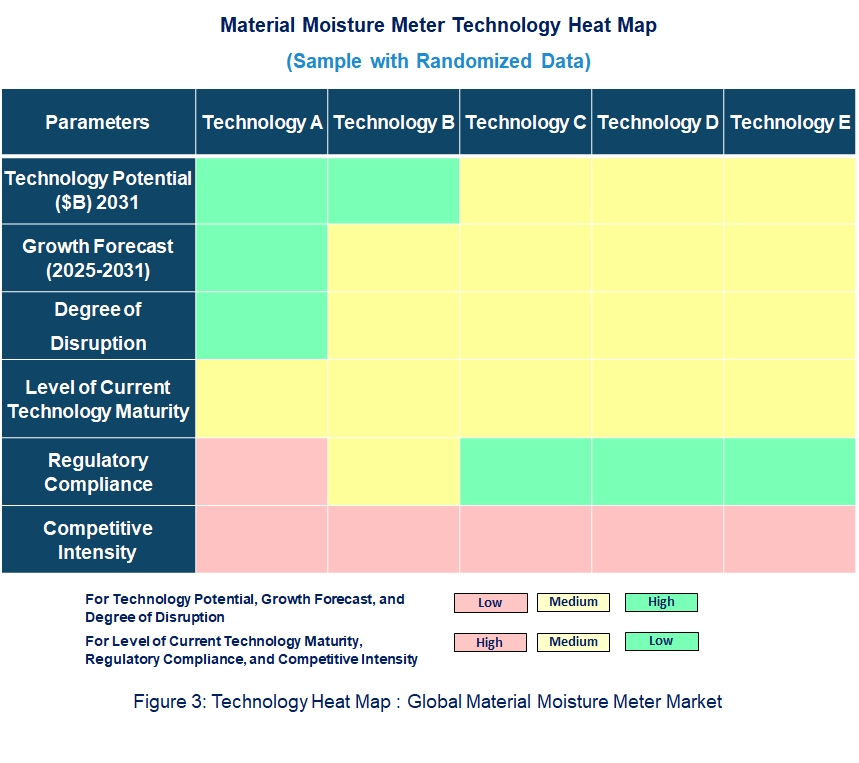
• Technology Potential: Material moisture meter technologies exhibit varying degrees of potential and disruption. Traditional Gravimetric methods, while accurate, have limited scalability due to their destructive nature and long processing times, rendering them less suitable for real-time applications. In contrast, advanced technologies such as near-infrared (NIR) and microwave offer non-destructive, rapid, and highly sensitive moisture detection, thus holding significant disruptive potential. Capacitance and resistance (Conductivity) sensors strike a balance by providing cost-effective, moderately accurate solutions suitable for many industries.
• Current Technology Maturity Level: The maturity level of these technologies varies; gravimetric and resistance technologies are well-established, while microwave and NIR are in growth phases with increasing adoption. Regulatory compliance across these technologies depends on industry standards, especially in food, pharmaceuticals, and agriculture, where precise moisture levels impact safety and quality. Emerging regulations push for environmentally friendly, energy-efficient devices, further favoring the adoption of non-destructive and automated moisture meters. Overall, the material moisture meter market is poised for growth driven by technological innovation, evolving regulations, and expanding industrial needs for rapid, accurate moisture measurement.
• Degree of Disruption: Capacitance and resistance (Conductivity) technologies offer moderate to low disruption due to affordability and maturity but have accuracy limitations. Microwave and near-infrared (NIR) technologies show high disruption potential with fast, non-destructive, and precise moisture measurement ideal for industrial use. Gravimetric methods remain accurate but are labor-intensive and less scalable.
• Regulatory Compliance: Capacitance and Resistance sensors face high competition due to many cost-effective suppliers, while Microwave and Near-Infrared technologies see moderate to high competition driven by innovation. Gravimetric methods have low competition but strict regulatory acceptance. IoT-enabled meters add compliance challenges with data security and connectivity regulations.
• Metravi Instruments introduced advanced NIR moisture meters with enhanced data integration features, improving real-time monitoring in food processing.
• KYMA developed portable microwave moisture meters with IoT connectivity, enabling remote and continuous moisture tracking for agriculture and construction.
• MEXTECH launched capacitance-based handheld moisture meters focusing on user-friendly interfaces and rugged design for field applications.
• Bosch Sensortec expanded its sensor portfolio by integrating multi-technology sensors, combining capacitance and infrared for more comprehensive moisture profiling. Challenges These advancements are driving market competitiveness and enabling broader adoption across diverse industrial applications.
• Growing industrial need for rapid, accurate moisture measurement enhances product quality and process efficiency.
• Rising adoption of IoT and smart sensors fuels demand for connected moisture meters enabling real-time data analytics.
• Regulatory pressure for consistent quality in food and pharmaceuticals drives investment in advanced moisture measurement technologies.
• High initial costs of Microwave and NIR technologies limit adoption among small and medium enterprises.
• Integration challenges with existing industrial systems hinder seamless deployment of advanced moisture meters. Challenges
• Accuracy Variability: Different materials and environmental conditions (temperature, density) can affect sensor accuracy, requiring frequent calibration.
• Material Heterogeneity: Non-uniform moisture distribution within a sample can cause inconsistent readings, especially in bulk materials.
• Calibration Complexity: Many technologies need material-specific calibration, increasing setup time and limiting versatility across diverse applications. Overall, these drivers and challenges are shaping market strategies, with opportunities focusing on affordable innovation and regulatory alignment to accelerate adoption.
• Metravi Instruments
• Kyma
• Mextech
• Bosch Sensortec
• Wagner Meters
• Technology Readiness by Technology Type: Capacitance and resistance technologies are mature, widely adopted, and cost-effective for basic moisture measurement needs. Microwave technology is at a moderate readiness level, with growing use in industrial inline applications. NIR sensors show high readiness in food and pharmaceutical sectors due to their speed and accuracy. Gravimetric drying ovens are fully mature but limited by slow throughput. Competitive levels are highest for capacitance and resistance due to commoditization, while microwave and NIR face innovation-driven competition. Regulatory compliance is well-established for gravimetric methods, evolving for NIR and microwave as use expands. Key applications range from agriculture and construction to pharmaceuticals and food processing. Technological advancements focus on miniaturization, integration with control systems, and real-time analytics. Overall, the market is progressing toward faster, more accurate, and automated moisture measurement solutions.
• Competitive Intensity and Regulatory Compliance: Capacitance and resistance-based moisture meters face moderate competition due to their established use and low cost. Microwave and NIR technologies see increasing competitive intensity as newer entrants introduce advanced sensing solutions. Gravimetric methods have lower competition but remain essential for compliance verification. Regulatory compliance involves accuracy standards and calibration protocols specific to industries like food, pharmaceuticals, and construction. Certifications such as ISO and ASTM standards govern testing methods and reporting. Microwave and NIR sensors must also comply with electromagnetic emission regulations. Data security and integrity are emerging concerns for connected moisture meters. The competitive landscape is influenced by technological innovation, price sensitivity, and application specificity. Vendors are investing in regulatory alignment to ease adoption. Partnerships with industry bodies enhance compliance credibility.
• Disruption Potential of Material Moisture Meter Technologies: Capacitance technology offers high disruption potential with its non-destructive, rapid moisture measurement suitable for various materials. Resistance (Conductivity) methods are widely used but face disruption from faster, more versatile techniques. Microwave technology provides deep penetration and accuracy, disrupting traditional surface-level sensing. Near-Infrared (NIR) sensors bring speed and precision, enabling real-time monitoring in industrial settings. Gravimetric (Drying Oven) methods remain the gold standard for accuracy but are slow and labor-intensive, limiting their disruption. These technologies collectively push moisture measurement toward greater automation, efficiency, and integration into process control. Microwave and NIR, in particular, enable inline and continuous moisture monitoring, transforming quality assurance. The trend is moving from manual, sample-based testing to real-time, non-destructive sensing. Integration with IoT and data analytics enhances their disruptive impact. The shift improves product quality, reduces waste, and lowers operational costs. Overall, these technologies drive a modernization wave in moisture measurement.
• Capacitance
• Resistance (Conductivity)
• Microwave
• Near-Infrared (NIR)
• Gravimetric (Drying Oven)
• Agriculture
• Construction
• Food Processing
• Pharmaceuticals
• Others
• North America
• Europe
• Asia Pacific
• The Rest of the World
• Latest Developments and Innovations in the Material Moisture Meter Technologies
• Companies / Ecosystems
• Strategic Opportunities by Technology Type


Choose a license that fits your team. Instant PDF delivery.
Prices exclude taxes. Instant delivery. Custom licensing available on request.
Market Report · May 18, 2026
Market Report · May 18, 2026
Market Report · May 18, 2026
Trusted partner for strategic intelligence and business growth


Receive a complimentary market analysis tailored to your industry. Our analysts will identify key growth opportunities and competitive dynamics specific to your business.

Market size, growth rate, and key trend analysis for your specific sector.

Top competitor positioning and market share analysis.

Strategic recommendations backed by data-driven insights.
Get curated market intelligence and competitive moves straight to your inbox.
By subscribing, you agree to receive our monthly insights. Unsubscribe anytime.
Receive a complimentary market analysis tailored to your industry. Our analysts will identify key growth opportunities and competitive dynamics specific to your business.
Market size, growth rate, and key trend analysis for your specific sector.
Top competitor positioning and market share analysis.
Strategic recommendations backed by data-driven insights.
Get curated market intelligence, emerging trends, and competitive moves straight to your inbox each month.
By subscribing, you agree to receive our monthly insights. Unsubscribe anytime.
We'll send your sample report shortly.