
Market Report · May 18, 2026

This market report covers trends, opportunities, and forecasts in the global mass flow controllers for gases market to 2031 by technology (direct and indirect), application (industrial, medical, and others), and region (North America, Europe, Asia Pacific, and the Rest of the World)
We'll send your sample report shortly.
• Increased IoT and Digital Connectivity: The internet of things (IoT) has enabled real-time monitoring and remote control of mass flow controllers. IoT integration enhances data collection, analysis, and predictive maintenance, resulting in improved operational efficiency.
• Shift to Micro/Compact Mass Flow Controllers: Companies are increasingly seeking downscaled, compact mass flow controllers, particularly in semiconductor-based companies and medical instrumentation. These controllers offer high resolution in restricted areas while reducing the equipment footprint and overall costs.
• MEMS Technology Adoption: MEMS-based mass flow controllers are being adopted because they are smaller, more reliable, and consume much less power than traditional models. MEMS-based controllers provide faster response times and greater accuracy for applications requiring high precision.
• Increased Demand for Biocompatible Materials in Medical Applications: There is a growing demand for mass flow controllers made from biocompatible materials to ensure the safe and effective regulation of gas flow in medical applications, such as anesthesia and respiratory support.
• Analog to Digital Mass Flow Controllers: As industries embrace greater automation and digital control systems, there is a widespread shift from analog to digital mass flow controllers. Digital controllers offer better accuracy, remote access, and improved integration into automated systems.
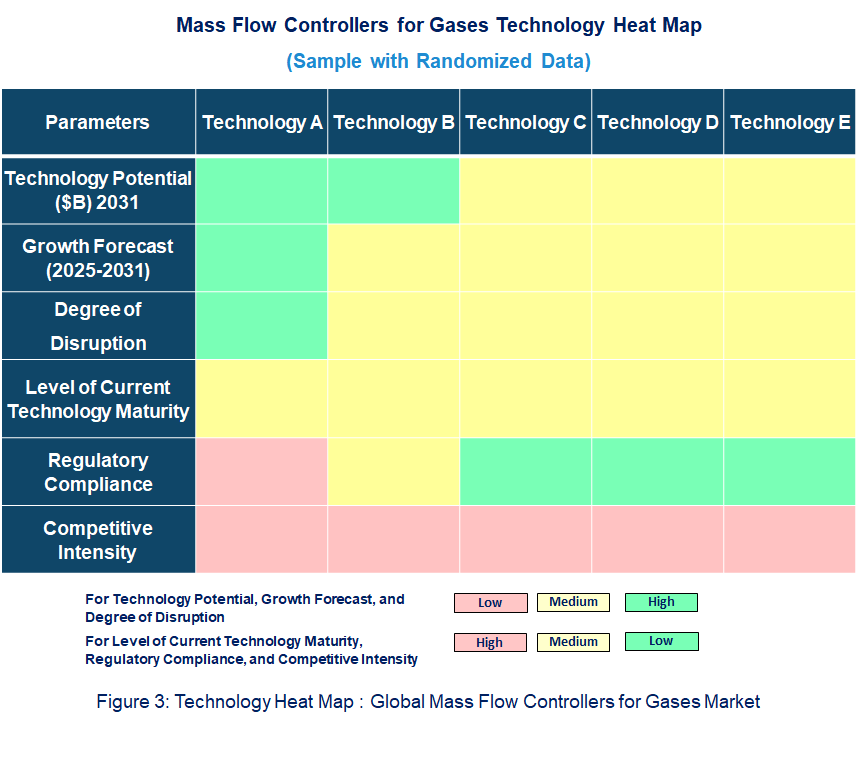
• Technology Potential: MFCs offer high accuracy and reliability, with growing potential for integration into automated and smart systems. The technology is crucial in industries requiring tight control over gas flow rates. With IoT and AI integration, MFCs can provide real-time monitoring and predictive analytics.
• Degree of Disruption: The impact of MFC technology is significant but not overly disruptive, as it enhances existing gas flow control systems rather than replacing them entirely. However, advancements in miniaturization and precision could disrupt conventional approaches in certain sectors.
• Level of Current Technology Maturity: The technology is well-established but continues to evolve with improvements in sensor technology, materials, and digital integration. Innovations such as low power consumption, digital communications, and miniaturization are advancing the field.
• Regulatory Compliance: Compliance with industry standards, such as ISO 9001, safety regulations, and environmental norms, is critical for MFC manufacturers. Ongoing regulatory updates, especially in sectors like pharmaceuticals, influence technology design and production processes. MFC technology is essential for precision applications, with continuous growth driven by advancements in integration and regulation.
• Sensirion: Sensirion has launched digital mass flow controllers, which promise much higher precision and faster response times. These controllers are well-positioned for IoT and wireless connectivity to meet the growing need for smart remote control applications across industries, ranging from automotive to healthcare.
• Alicat Scientific: Alicat Scientific remains at the forefront of the market with its multi-parameter flow controllers, which integrate measurements of pressure, temperature, and flow rate. Its products are used in high-precision applications in industrial automation and research labs, proving their adaptability and high performance.
• Premier Control Technologies: The company has broadened its product line with mass flow controllers that are more accurate, scalable, and cost-effective. Premier Control Technologies’ products have gained a strong reputation in industrial and medical applications, particularly in process control and air-quality monitoring.
• Horiba: Horiba has focused on improving its mass flow controllers by enhancing their integration with advanced sensor technologies to improve the measurement and regulation of gas more efficiently. This technology is particularly relevant to the semiconductor and chemical industries, which require strict control over the flow of gases.
• Sierra Instruments: Sierra Instruments has developed a range of mass flow controllers with built-in diagnostics and remote monitoring features. This positions the company as a leader in precision gas flow measurement, with applications spanning industrial, medical, and research domains.
• Thermo Fisher Scientific: Thermo Fisher Scientific has introduced mass flow controllers designed to meet stringent biocompatibility and regulatory standards for medical devices. Their products ensure safe and accurate flow regulation for critical medical applications, such as respiratory therapy.
• Brooks Instrument: Brooks Instrument has emphasized developing digital mass flow controllers that can accommodate the latest communication protocols, such as Modbus and Ethernet/IP. This innovation responds to the increasing demand for integration into automated systems, which have grown in popularity in pharmaceuticals and biotechnology.
• Surge in the Requirement for Automation and High-Accuracy Control: More industrial applications are migrating toward fully automated production lines, demanding highly controlled gas flows. Improved and more precise control for higher accuracy and reliability in automatic systems, particularly in semiconductor manufacturing and the pharmaceutical sectors, is increasing the demand for mass flow controllers in the global market.
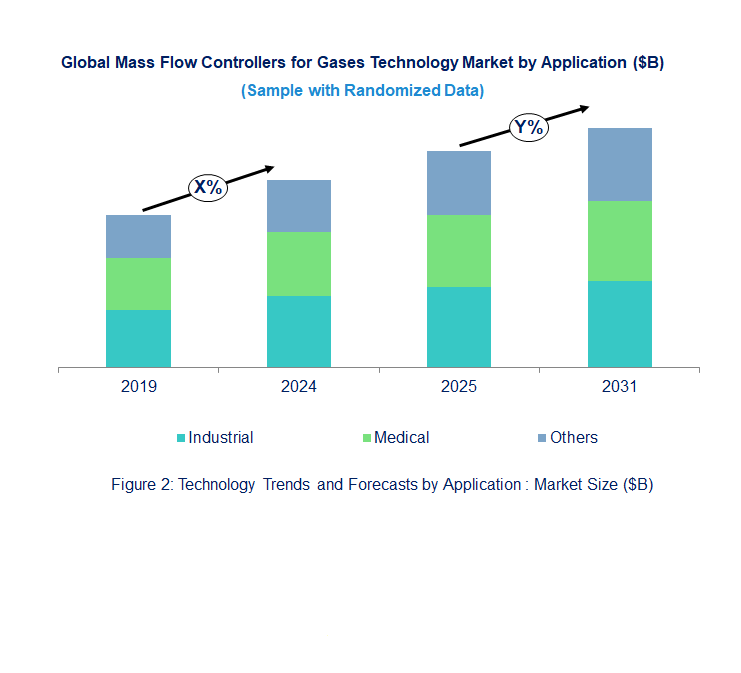
• Growth in the Pharmaceutical and Healthcare Industries: The increased utilization of high-precision equipment in medical devices and pharmaceutical applications is driving the growth of the market for mass flow controllers. Applications include anesthesia delivery, respiratory support, and sterilization processes, all of which require precise control of gas flows.
• Technological Advancements in Sensor Integration: Advanced sensors integrated into mass flow controllers improve the accuracy and reliability of gas flow measurements. These controllers are used in industrial automation and clean rooms in the semiconductor industry, which boosts their adoption.
• Stricter Environmental Regulations for Air Quality and Emissions Control: Stronger environmental regulations regarding air quality and emissions control force industries to implement better flow measurement systems. Mass flow controllers are crucial for precisely regulating gases, reducing waste, and meeting environmental norms. Challenges in the mass flow controllers for gases market include:
• Expensive High-End Technologies: While digital and MEMS-based mass flow controllers offer clear advantages, these technologies come with high initial investments, making them challenging to introduce for small and medium-sized enterprises (SMEs) due to their cost.
• Complex Integration with Existing Systems: Integrating new mass flow controllers with legacy systems in industries like manufacturing or chemical processing can be complex. This integration often requires significant investments in time and resources, which can deter some companies from adopting newer technologies.
• Supply Chain Constraints for Key Components: The global supply chain disruptions, particularly after the COVID-19 pandemic, have led to a shortage of key components for mass flow controllers. This has delayed production and delivery times, impacting short-term market growth. The mass flow controllers for gases market is rapidly evolving due to the influence of digitalization, IoT integration, and the trend toward smaller and more efficient designs. Leading companies in this market, such as Sensirion, Alicat Scientific, and Thermo Fisher Scientific, are driving innovation across various sectors. While factors like automation, healthcare growth, and regulatory pressures are creating new opportunities, challenges such as high initial costs, complex integrations, and supply chain issues still need to be addressed. Overall, these technological trends and developments are poised to reshape the mass flow controller market, leading to increased efficiency, precision, and functionality across industries.
• Sensirion
• Alicat Scientific
• Premier Control Technologies
• Horiba
• Sierra Instruments
• Thermo Fisher Scientific
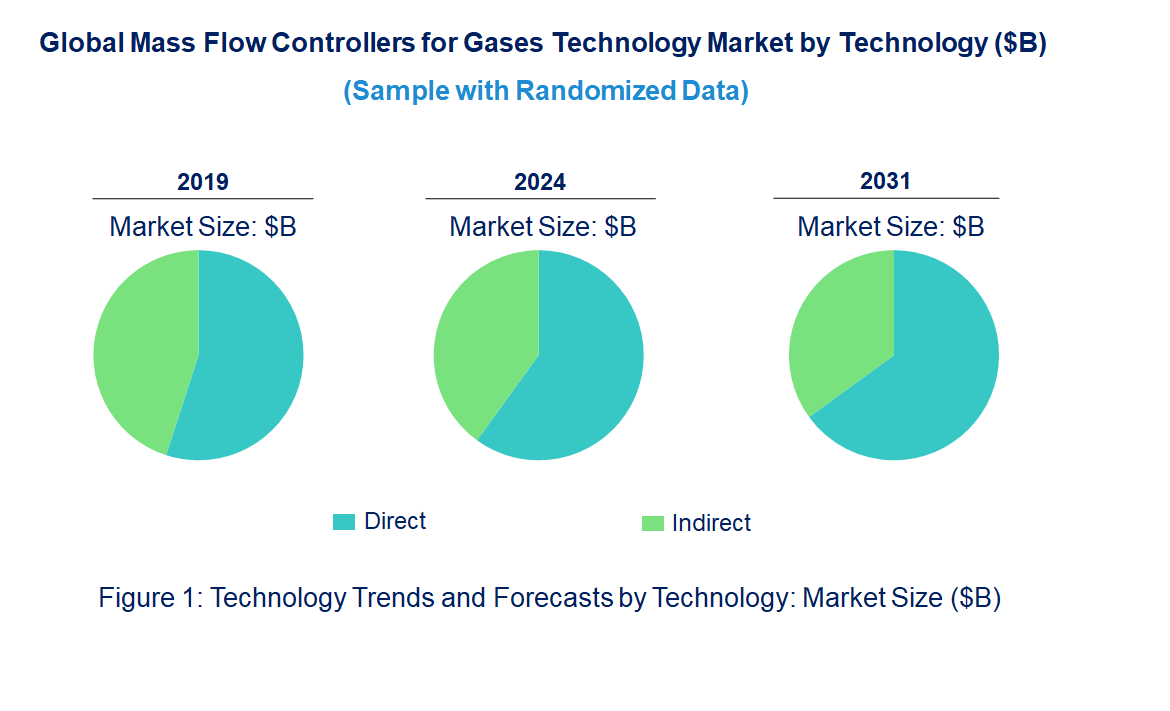
• Technology Readiness by Technology Type: Direct mass flow controllers for gases are well-established, widely used, and moderately innovative, with relatively lower prices. Indirect mass flow controllers for gases, such as Coriolis and ultrasonic meters, are less mature but gaining traction in industries with demanding precision requirements. Although indirect mass flow controllers for gases are relatively more costly and less competitive compared to their direct counterparts, they offer innovative solutions tailored to specific applications, especially where stricter regulatory compliance is required due to their advanced technologies.
• Disruption Potential: Direct MFC technologies, such as thermal mass flow controllers, are mature and widely applied but have limited innovation. Indirect mass flow controllers for gases, such as Coriolis and ultrasonic technologies, are more disruptive due to their superior accuracy and efficiency compared to direct MFC technologies, particularly in high-performance sectors like semiconductors and aerospace. In contrast, direct technologies dominate because of their cost-effectiveness. However, indirect technologies are expected to disrupt traditional models, particularly in industries requiring higher precision.
• Competitive Intensity and Regulatory Compliance: The market is very competitive, with direct mass flow controllers for gases competing on cost and reliability, and indirect mass flow controllers for gases competing through added features for high-end applications. Regulatory compliance is a challenge, especially in industries such as pharmaceuticals and semiconductors. Compliance is more complex for indirect technologies, while direct mass flow controllers for gases must contend with constantly evolving industry standards, maintaining competitive pressure across both technology types.
• Direct
• Indirect
• Industrial
• Medical
• Others
• North America
• Europe
• Asia Pacific
• The Rest of the World
• Latest Developments and Innovations in the Mass Flow Controllers for Gases Technologies
• Companies / Ecosystems
• Strategic Opportunities by Technology Type


Choose a license that fits your team. Instant PDF delivery.
Prices exclude taxes. Instant delivery. Custom licensing available on request.
Market Report · May 18, 2026
Market Report · May 18, 2026
Market Report · May 18, 2026
Trusted partner for strategic intelligence and business growth


Receive a complimentary market analysis tailored to your industry. Our analysts will identify key growth opportunities and competitive dynamics specific to your business.

Market size, growth rate, and key trend analysis for your specific sector.

Top competitor positioning and market share analysis.

Strategic recommendations backed by data-driven insights.
Get curated market intelligence and competitive moves straight to your inbox.
By subscribing, you agree to receive our monthly insights. Unsubscribe anytime.
Receive a complimentary market analysis tailored to your industry. Our analysts will identify key growth opportunities and competitive dynamics specific to your business.
Market size, growth rate, and key trend analysis for your specific sector.
Top competitor positioning and market share analysis.
Strategic recommendations backed by data-driven insights.
Get curated market intelligence, emerging trends, and competitive moves straight to your inbox each month.
By subscribing, you agree to receive our monthly insights. Unsubscribe anytime.
We'll send your sample report shortly.