
Market Report · July 16, 2026

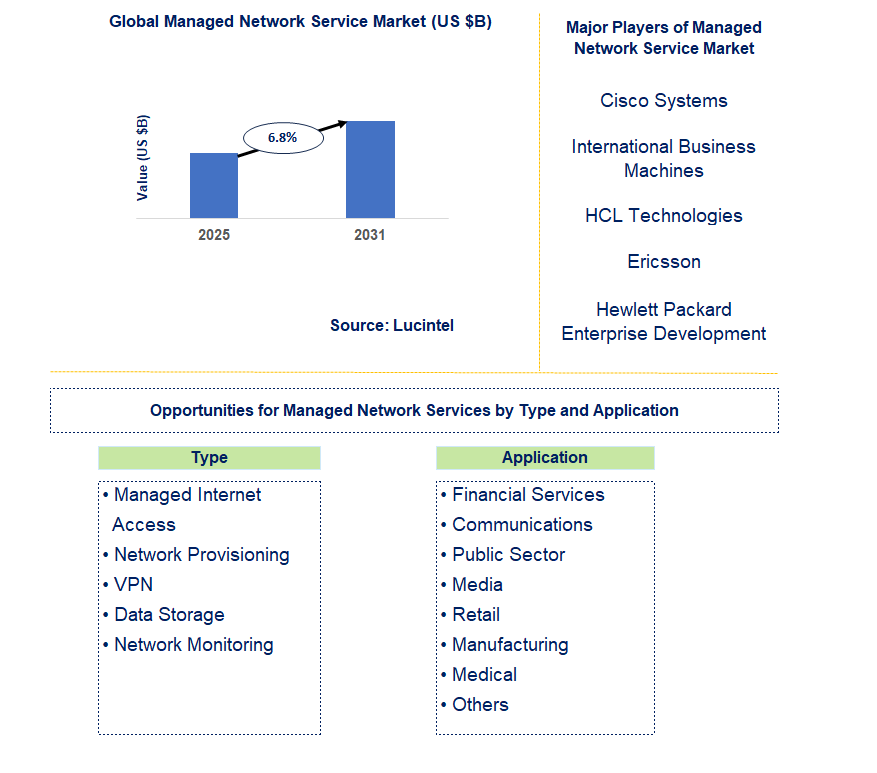
Key data points: The growth forecast = 6.8% annually for the next 7 years. Scroll below to get more insights. This market report covers trends, opportunities and forecasts in managed network service market to 2031 by type (managed internet access, network provisioning, VPN, data storage, and network monitoring), application (financial services, communications, public sector, media, retail, manufacturing, medical, and others), and region (North America, Europe, Asia Pacific, and the Rest of the World)
We'll send your sample report shortly.
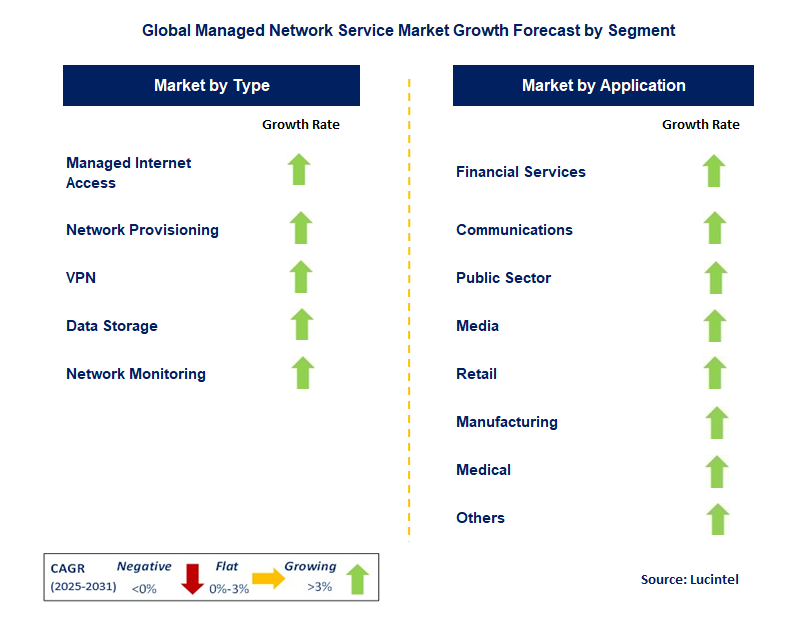
• Lucintel forecasts that, within the type category, VPN is expected to witness the highest growth over the forecast period.
• Within the application category, medical is expected to witness the highest growth.
• In terms of region, APAC is expected to witness the highest growth over the forecast period. Gain valuable insights for your business decisions with our comprehensive 150+ page report. Sample figures with some insights are shown below.
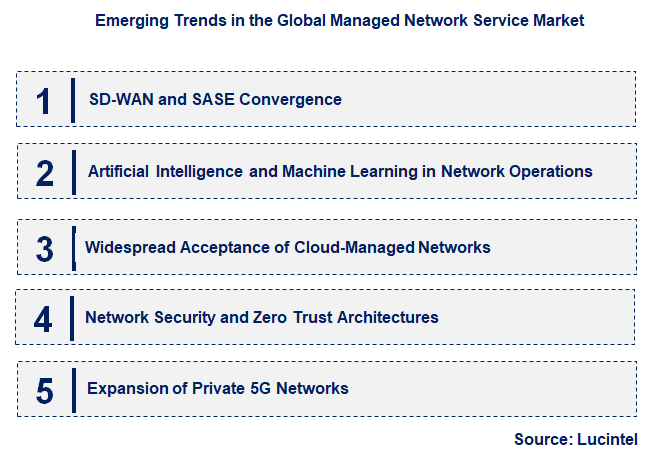
• SD-WAN and SASE Convergence: This is the convergence of Software-Defined Wide Area Networking (SD-WAN) and Secure Access Service Edge (SASE architectures). SD-WAN streamlines network traffic and connectivity, whereas SASE unifies networking and security capabilities into one cloud-native service. The effect is a more efficient, secure, and agile network infrastructure in support of distributed workforces and cloud-first applications. It streamlines network management, strengthens security posture, and enhances application performance by routing traffic smartly and enforcing consistent security policies from the cloud edge.
• Artificial Intelligence and Machine Learning in Network Operations: AIOps utilizes artificial intelligence and machine learning to monitor, analyze, and manage networks automatically and improve them. This trend allows predictive maintenance, quicker anomaly detection, and automatic resolution of network problems. The effect is a dramatic decrease in manual intervention, better network uptime, and improved performance. AIOps solutions can sift through large volumes of network data to find patterns, predict issues, and provide recommendations for solutions, resulting in more proactive and optimized network operations.
• Widespread Acceptance of Cloud-Managed Networks: Cloud-managed networks are based on the deployment and management of network infrastructure using a cloud-enabled platform. This trend is providing centralized management, ease of deployment, and expanded scalability. The effect is lower operational complexity and lower total cost of ownership for organizations. Cloud management offers a one pane of glass to monitor and configure network devices, supporting remote management and fast provisioning of services. It brings advanced network functions to a broader set of organizations through democratization.
• Network Security and Zero Trust Architectures: With the increasing threat environment, network security takes center stage. A major trend is the adoption of Zero Trust architectures, where no user or device is ever trusted by default. The effect is a more resilient security posture that reduces the attack surface and blocks unauthorized access. This means rigorous identity validation, micro-segmentation, and ongoing monitoring so that all access requests are validated and approved, irrespective of whether they are coming from inside or outside the network perimeter.
• Expansion of Private 5G Networks: Private 5G networks provide specific, secure, and high-performance wireless connectivity for businesses, especially within industrial and campus settings. The drivers for this trend are low-latency, high-bandwidth communication requirements for use cases such as IoT, automation, and real-time data processing. The effect is increased operational efficiency, enhanced security for data, and new innovation opportunities within defined organizational boundaries. Private 5G networks mean enhanced control of network resources and data, and allow tailored solutions to meet distinctive business requirements. The new trends are redefining the managed network service market in a fundamental manner by changing the paradigm from simple reactive management to proactive, smart, and secure network environments. Service providers are transforming their product portfolios to encompass higher-level analytics, automation, and built-in security capabilities. This evolution equips companies with enhanced agility, resilience, and cost savings in their network activities, ultimately aiding their overall digital transformation goals and helping them succeed in a world that is ever more connected. The industry is shifting towards extremely personalized, scalable, and smart network services.
• Secure Access Service Edge Rise: One of the significant developments is the convergence of security and network functions into a single, cloud-native service, SASE. It is immensely impactful, providing an integrated solution for network security and connectivity for cloud apps and distributed workforces. SASE streamlines network administration by minimizing the number of point solutions, increasing security through end-to-end policy enforcement from the cloud edge, and enhancing performance by optimizing traffic flow. SASE is emerging as the architectural norm for secure access in hybrid environments.
• Growing Adoption of AI-based Network Operations: Artificial Intelligence and Machine Learning-based network management, which is referred to as AIOps, is picking up lots of steam. This trend affects the market in a positive way by facilitating more predictive and proactive network management. AIOps platforms automate many repetitive tasks, detect anomalies quicker, and deliver insights into optimizing network performance, reducing operational expenses, and increasing network uptime. It turns reactive troubleshooting into proactive problem prevention, improving the overall network reliability.
• Growth of Edge Computing and Private 5G Networks: The increasing demand for low-latency processing and local data management is fueling the growth of edge computing, supplemented with private 5G networks. This trend affects the MNS market by adding new demands for distributed network infrastructure management and very localized connectivity. MNS service providers now provide services to deploy and host edge data centers and private 5G networks, and businesses can use these technologies for real-time use and source-side data security.
• Hybrid and Multi-Cloud Network Connectivity Focus: With companies embracing hybrid and multi-cloud models, the demand for secure and seamless connectivity between on-premises data centers and multiple clouds has become imperative. This evolution affects the MNS market by requiring advanced solutions for cloud networking, direct cloud connect, and inter-cloud routing. MNS providers are becoming experts at ensuring best-in-class network performance and security across the advanced hybrid and multi-cloud environments, guaranteeing smooth data flow and application access.
• Greater Emphasis on Cybersecurity as a Managed Service: With the growing cyber threat environment, cybersecurity is no longer an afterthought but a fundamental aspect of network management. Building on delivering cutting-edge cybersecurity solutions as a managed service is important. This affects the market in that it offers companies access to specialist security skills, threat knowledge, and advanced security technologies without requiring considerable in-house resources. MNS providers are providing holistic security portfolios, such as threat detection, incident response, and compliance management. These latest advancements are significantly influencing the managed network service market by tilting the trend in favor of more integrated, intelligent, and secure networking solutions. The market is abandoning hardware-centric, fragmented solutions in favor of end-to-end, software-defined, and cloud-native services. MNS service providers are emerging as strategic partners for enterprises, providing not only operational productivity but also the underlying infrastructure for digital transformation, allowing organizations to maneuver complex technology environments with increased agility and responsiveness.
• Hybrid Cloud Management and Cloud Connectivity: Widespread cloud computing adoption, spanning hybrid and multi-cloud strategies, is a key opportunity for growth. Enterprises need strong and secure connectivity from their on-premises setup to different cloud environments. MNS vendors can provide customized services for direct cloud connect, optimized routing, and end-to-end management of network performance and security among these distributed environments. This meets the increasing demand for smooth data flow and application access within complex cloud environments.
• SASE and Zero Trust Deployments: The need for consolidated network security and access solutions, especially for distributed workers and cloud applications, represents a strong growth area in SASE and Zero Trust architectures. MNS providers can provide end-to-end SASE solutions by integrating networking and security capabilities into one cloud-native service. This offers companies greater security, ease of management, and better performance, resonating with the new imperative of secure access everywhere, on any device.
• Industry 4.0 and IoT Network Management: The growth of Internet of Things (IoT) devices and the development of Industry 4.0 applications in manufacturing, logistics, and smart cities provide enormous growth potential. These use cases need very reliable, low-latency, and secure networks to enable real-time data processing and automation. MNS providers can specialize in the planning, deployment, and management of networks that are optimized for IoT ecosystems, such as private 5G networks, edge computing infrastructure, and secure data ingestion and processing.
• Managed SD-WAN for Branch Transformation: When businesses grow and transform their branch offices, the requirement for scalable, cost-saving, and high-performance network connectivity becomes unavoidable. Managed Software-Defined Wide Area Networking (SD-WAN) fulfills this requirement by streamlining traffic routing, enhancing application performance, and providing better network visibility between far-flung locations. MNS providers can provide end-to-end managed SD-WAN services, covering deployment, monitoring, and continuous optimization, allowing companies to simplify their branch network management and lower operating expenses.
• AI/ML-based Network Automation and Optimization: The convergence of Artificial Intelligence and Machine Learning (AI/ML) into network management (AIOps) is one of the principal areas of growth. MNS providers can use AI/ML to provide sophisticated services for predictive maintenance, automated fault detection, performance enhancement, and security intelligence. This gives companies more proactive, efficient, and agile network infrastructures with minimal downtime and optimal resource utilization. Providing intelligence-based network management differentiates providers in a competitive scenario. These growth strategies are fundamentally shaping the managed network service market by broadening its scope from mere network maintenance to encompass intelligent, sophisticated, and integrated solutions. MNS providers are transforming themselves into strategic partners that facilitate digital transformation, improve cybersecurity stances, and foster operational efficiencies in many industry verticals. The market is increasingly becoming specialized, with providers concentrating on selected application domains to offer customized and value-added services that solve complex business issues.
• Cisco Systems
• International Business Machines
• HCL Technologies
• Ericsson
• Hewlett Packard Enterprise Development
• Accenture
• Alcatel-Lucent Enterprise
• At&T
• Wipro
• LG Networks
• Managed Internet Access
• Network Provisioning
• VPN
• Data Storage
• Network Monitoring
• Financial Services
• Communications
• Public Sector
• Media
• Retail
• Manufacturing
• Medical
• Others
• North America
• Europe
• Asia Pacific
• The Rest of the World
• United States: The US managed network service market is marked by accelerated uptake of Software-Defined Wide Area Networking (SD-WAN) and Secure Access Service Edge (SASE) technology. Enterprises are giving top priority to agile and secure connectivity for cloud applications and distributed workforces. Marked investments are being directed toward AI-driven network operations (AIOps) and automation to improve network visibility, predictive maintenance, and overall operational efficiency. Priority is given to scalable, resilient, and extremely secure network architectures.
• China: The managed network service market in China is growing robustly driven by the country’s fast-expanding digital economy and large 5G deployments. Domestic players are fiercely competitive and emphasize offering end-to-end solutions that encompass cloud, AI, and IoT capabilities. Encouragement from the government toward building digital infrastructure and smart city development further drives demand. Highly localized support and high-end security services are showing high growth trends.
• Germany: Germany’s managed network service market is fueled by its strong industrial economy and widening use of Industry 4.0 technologies. Organizations are looking for highly secure and reliable network solutions to drive business-critical operations and data compliance. Hybrid cloud connectivity, private 5G networks, and advanced security services are the focus. The market has a strong need for providers providing technical depth expertise and strong compliance with strict data privacy regulations.
• India: The Indian managed network service market is seeing tremendous growth based on widespread digitalization across industries, growing internet penetration, and the emergence of work-from-home or remote work. Small and Medium-sized Enterprises (SMEs) are especially interested in outsourcing network management in order to minimize IT overheads. The emphasis is on cost-saving solutions, cloud-managed services, and robust connectivity, particularly in tier-2 and tier-3 cities. Cybersecurity and network optimization are becoming top priorities.
• Japan: The Japanese managed network service market is characterized by high demand for stable, secure, and quality network services, especially from multinational companies and large enterprises. There is increasing demand for using AI and machine learning for automated and predictive network management. Hybrid cloud and multi-cloud strategies adoption is leading to the requirement for integrated network solutions. Providers are focusing on superior service level agreements and sophisticated disaster recovery options.


• Cisco Systems
• International Business Machines
• HCL Technologies
• Ericsson
• Hewlett Packard Enterprise Development
• Accenture
• Alcatel-Lucent Enterprise
• At&T
• Wipro
• LG Networks Q5. Which managed network service market segment will be the largest in future? Answer: Lucintel forecasts that, within the type category, VPN is expected to witness the highest growth over the forecast period. Q6. In managed network service market, which region is expected to be the largest in next 5 years? Answer: In terms of region, APAC is expected to witness the highest growth over the forecast period. Q7. Do we receive customization in this report? Answer: Yes, Lucintel provides 10% customization without any additional cost.


Choose a license that fits your team. Instant PDF delivery.
Prices exclude taxes. Instant delivery. Custom licensing available on request.
Market Report · July 16, 2026
Market Report · May 18, 2026
Market Report · May 18, 2026
Trusted partner for strategic intelligence and business growth


Receive a complimentary market analysis tailored to your industry. Our analysts will identify key growth opportunities and competitive dynamics specific to your business.

Market size, growth rate, and key trend analysis for your specific sector.

Top competitor positioning and market share analysis.

Strategic recommendations backed by data-driven insights.
Get curated market intelligence and competitive moves straight to your inbox.
By subscribing, you agree to receive our monthly insights. Unsubscribe anytime.
Receive a complimentary market analysis tailored to your industry. Our analysts will identify key growth opportunities and competitive dynamics specific to your business.
Market size, growth rate, and key trend analysis for your specific sector.
Top competitor positioning and market share analysis.
Strategic recommendations backed by data-driven insights.
Get curated market intelligence, emerging trends, and competitive moves straight to your inbox each month.
By subscribing, you agree to receive our monthly insights. Unsubscribe anytime.
We'll send your sample report shortly.