
Market Report · July 20, 2026

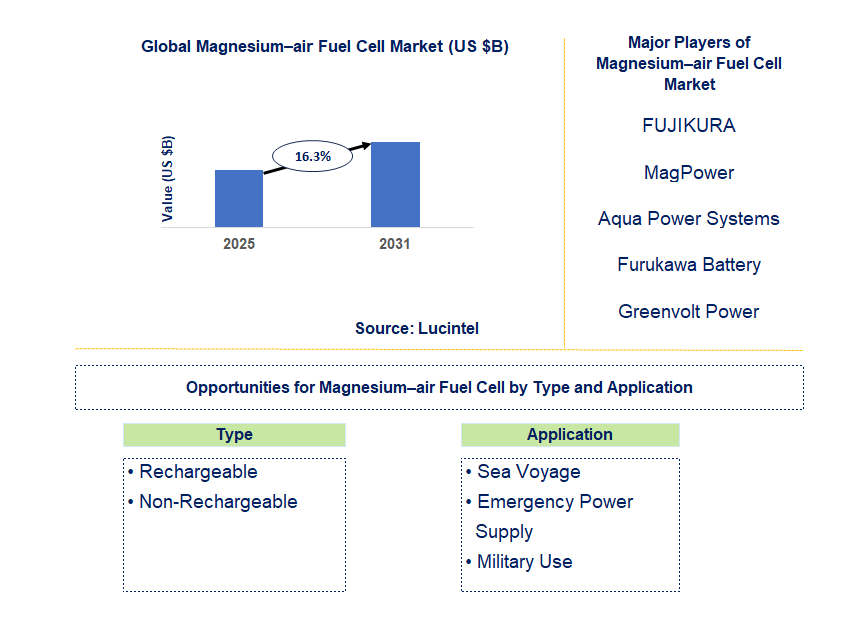
Key data points: The growth forecast = 16.3% annually for the next 7 years. Scroll below to get more insights. This market report covers Trends, opportunities and forecasts in magnesium–air fuel cell market to 2031 by type (rechargeable and non-rechargeable), application (sea voyage, emergency power supply, and military use), and region (North America, Europe, Asia Pacific, and the Rest of the World)
We'll send your sample report shortly.
• Lucintel forecasts that, within the type category, rechargeable is expected to witness higher growth over the forecast period due to growing demand of sustainable energy storage.
• Within the application category, emergency power supply is expected to witness the highest growth due to the increasing demand for reliable backup solutions.
• In terms of region, APAC is expected to witness the highest growth over the forecast period.

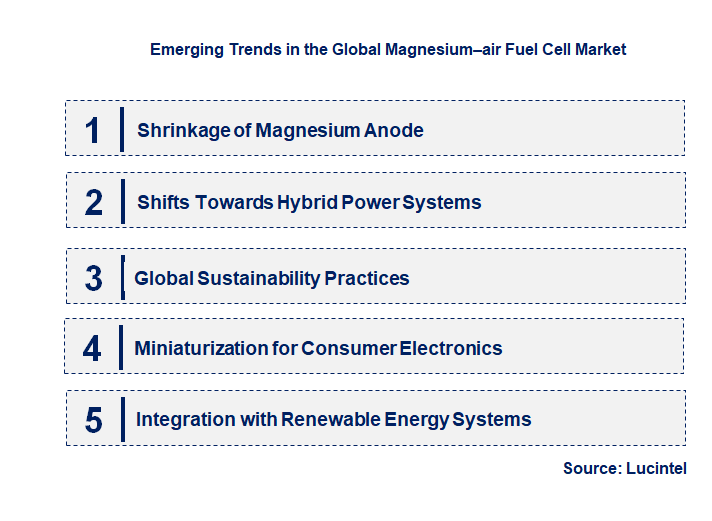
• Shrinkage of Magnesium Anode: Many scientists are currently focusing on enhancing the re-charge capability of magnesium–air fuel cells, which has been challenging in the past. If the magnesium anode can be efficiently recharged, its applicability will greatly increase in long-term areas such as electric vehicles and grid storage, hence increasing its commercial appeal.
• Shifts Towards Hybrid Power Systems: Magnesium–air fuel cells are increasingly being used in combination with other energy storage devices, such as lithium-ion batteries. The combination of two or more energy sources increase performance and offer an effective compromise for electric vehicles, portable devices, and increasing operational life.
• Global Sustainability Practices: Magnesium–air fuel cells are built using recyclable materials, thereby making them less harmful to the environment. With the recent government and industrial pushes to adopt eco-friendly technologies worldwide, magnesium–air fuel cells provide a better alternative due to their higher energy density and ability to support global efforts towards reducing dependency on fossil fuels.
• Miniaturization for Consumer Electronics: The most popular trend is the creation of compact magnesium–air fuel cells driven by the need to portable, high energy-density power sources. These fuel cells are expected to cater to a variety of consumer electronics, including mobile phones and laptops, that require longer battery life and faster charging times than traditional lithium-ion batteries offer.
• Integration with Renewable Energy Systems: Magnesium–air fuel cells are being integrated into renewable energy systems to increase energy storage capabilities. Solar and wind power systems integrated with magnesium–air technology can use these fuel cells as long-duration energy storage systems, which balance intermittent energy production with greater grid stability. These trends are redefining the future of the magnesium–air fuel cell market and are establishing the technology as a competitive and sustainable solution for a diversity of energy needs. With further innovations, magnesium–air fuel cells are projected to be an important factor in the transition to cleaner energy systems in varying industries.
• Improved Anode Materials: One of the key advancements in the magnesium–air fuel cell market is the development of more durable and efficient anode materials. New alloys and coatings are being designed to reduce corrosion and improve the overall longevity and efficiency of the cells, making them more suitable for practical applications such as electric vehicles and backup power systems.
• Increased Investment in Hybrid Systems: There has been a significant push toward developing hybrid systems that combine magnesium–air fuel cells with other energy storage solutions like lithium-ion batteries. This development improves the overall performance and energy output, allowing for longer operational lifespans and greater efficiency in various applications, including transportation and residential energy storage.
• Electric Vehicles Commercialization: Ev’s have turned their eyes towards the magnesium-air fuel cells due to the need of alternative energy resource in the transportation section. Manufacturers are trying to resolve the key issues associated with the feasibility of using magnesium-air fuel cells in EV powertrains such as rechargeability and overall performance in different environmental conditions.
• Cost Efficient Production Focused: To meet the increasing demand for magnesium-air fueled cells, there has been a change in focus towards more efficient manufacturing processes and material sourcing. Such efforts increase the cost-effectiveness of production which is necessary for more broad adoption in developed and emerging economies that are sensitive to price elasticity.
• Industry and Government Collaboration: China, Japan and the US are some of the prominent countries investing into magnesium air fuel cell research. Along with industry investments, these governments are investing to promote the development of clean energy technologies which seek to speed up the commercialization of the processes and technologies for grid energy storage, backup power, and as well as clean transportation means. To sum up, these emerging trends clearly point to the increasing possibility of magnesium–air fuel cells being adopted as a suitable replacement for conventional energy storage devices. Further work and funding, along with advancements in magnesium–air technology, will define the pace at which industries aiming at carbon footprint reduction will embrace and incorporate magnesium–air fuel cells into their operations.
• Electric Vehicle (EV) Power Systems: The magnesium–air fuel cell industry has a significant opportunity in the EV market. Due to its high energy density and light weight, magnesium–air fuel cells can offer a competitive substitute for lithium-ion batteries, with longer ranges and quicker charging times for electric vehicles.
• Portable Electronics: Magnesium–air fuel cells offer a growth potential in the consumer electronics space. Their compact size and high energy density make them suitable for powering gadgets such as smartphones, laptops, and wearables, providing longer battery life and minimizing the environmental footprint related to conventional battery technologies.
• Off-Grid and Backup Power: Magnesium–air fuel cells are increasingly being looked at for off-grid power solutions and backup power systems. Their long-term energy storage capabilities make them well-suited for remote locations and applications where reliability and sustainability are essential, including rural electrification and disaster relief.
• Renewable Energy Storage: Magnesium–air fuel cells can be part of renewable energy systems as an energy storage means with long duration. Through storing excess energy that is produced by solar and wind power, magnesium–air fuel cells have the potential to levelized intermittent power generation, hence providing grid stability and making the renewable energy systems more efficient.
• Military and Aerospace Uses: The energy density of magnesium–air fuel cells, which is very high, presents expansion opportunities in the military and aerospace markets. The fields need smaller, lighter power sources for remote deployments, and magnesium–air fuel cells can deliver safe power for devices in harsh environments. The magnesium–air fuel cell industry has significant growth prospects in multiple industries. As technology advances and production becomes more economical, the applications are set to drive broad usage, mainly in transportation, energy storage, and consumer devices, leading towards a cleaner energy future.
• FUJIKURA COMPOSITES
• MagPower
• Aqua Power Systems
• Furukawa Battery
• Greenvolt Power
• Rechargeable
• Non-Rechargeable
• Sea Voyage
• Emergency Power Supply
• Military Use
• North America
• Europe
• Asia Pacific
• The Rest of the World
• United States: Researchers in the United States have turned their focus towards extending the operational life of the magnesium-air fuel cells and improving the reaction mechanism's efficiency. New strategies are being devised to enhance magnesium anodes’ stability, improving power output. Additionally, projects funded by the US Department of Energy are trying to scale up magnesium-air fuel cell technology for vehicle and emergency power system applications.
• China: China is aggressively investing in magnesium-air fuel cells, focusing on mass production and integration with electric vehicles. The country’s existing manufacturing base is being utilized to expand magnesium production and improve the fuel cell's rechargeability. China seeks to lower the dependency on lithium-ion batteries and are also testing magnesium-air cells for use in portable consumer electronics and energy storage devices.
• Germany: Germany has been focusing on perfecting the performance and durability of magnesium–air fuel cells, especially for industrial and automotive uses. Magnesium anode material optimization as well as corrosion and energy efficiency problems are some of the primary focuses of businesses. The government of Germany is financing green energy expenditures, which in turn is creating research towards magnesium–air fuel cells as a component of the hydrogen economy.
• India: The need for cost-effective and environmentally friendly solutions is motivating the development of magnesium air fuel cells in India. The off-grid areas as well as rural regions of India are particularly enthusiastic about these fuel cells. The ongoing research is focusing on making the production more cost effective while simultaneously making the cells more stable and effective under various conditions.
• Japan: Japan remains one of the leading countries in fuel cell technology development and has invested in magnesium air fuel cell inventions. Japanese firms are working with hybrid systems that use magnesium air fuel cells together with lithium-ion batteries for electric vehicles. Japan is also trying to find ways to promote the use of these fuel cells in the increasing demand for clean and efficient energy systems in all forms of transportation and even at home.


• FUJIKURA COMPOSITES
• MagPower
• Aqua Power Systems
• Furukawa Battery
• Greenvolt Power Q5. Which magnesium–air fuel cell market segment will be the largest in future? Answer: Lucintel forecasts that, within the type category, rechargeable is expected to witness higher growth over the forecast period due to growing demand of sustainable energy storage. Q6. In magnesium–air fuel cell market, which region is expected to be the largest in next 5 years? Answer: In terms of region, APAC is expected to witness the highest growth over the forecast period. Q7. Do we receive customization in this report? Answer: Yes, Lucintel provides 10% customization without any additional cost.


Choose a license that fits your team. Instant PDF delivery.
Prices exclude taxes. Instant delivery. Custom licensing available on request.
Market Report · July 20, 2026
Market Report · July 20, 2026
Market Report · July 20, 2026
Trusted partner for strategic intelligence and business growth


Receive a complimentary market analysis tailored to your industry. Our analysts will identify key growth opportunities and competitive dynamics specific to your business.

Market size, growth rate, and key trend analysis for your specific sector.

Top competitor positioning and market share analysis.

Strategic recommendations backed by data-driven insights.
Get curated market intelligence and competitive moves straight to your inbox.
By subscribing, you agree to receive our monthly insights. Unsubscribe anytime.
Receive a complimentary market analysis tailored to your industry. Our analysts will identify key growth opportunities and competitive dynamics specific to your business.
Market size, growth rate, and key trend analysis for your specific sector.
Top competitor positioning and market share analysis.
Strategic recommendations backed by data-driven insights.
Get curated market intelligence, emerging trends, and competitive moves straight to your inbox each month.
By subscribing, you agree to receive our monthly insights. Unsubscribe anytime.
We'll send your sample report shortly.