
Market Report · July 15, 2026

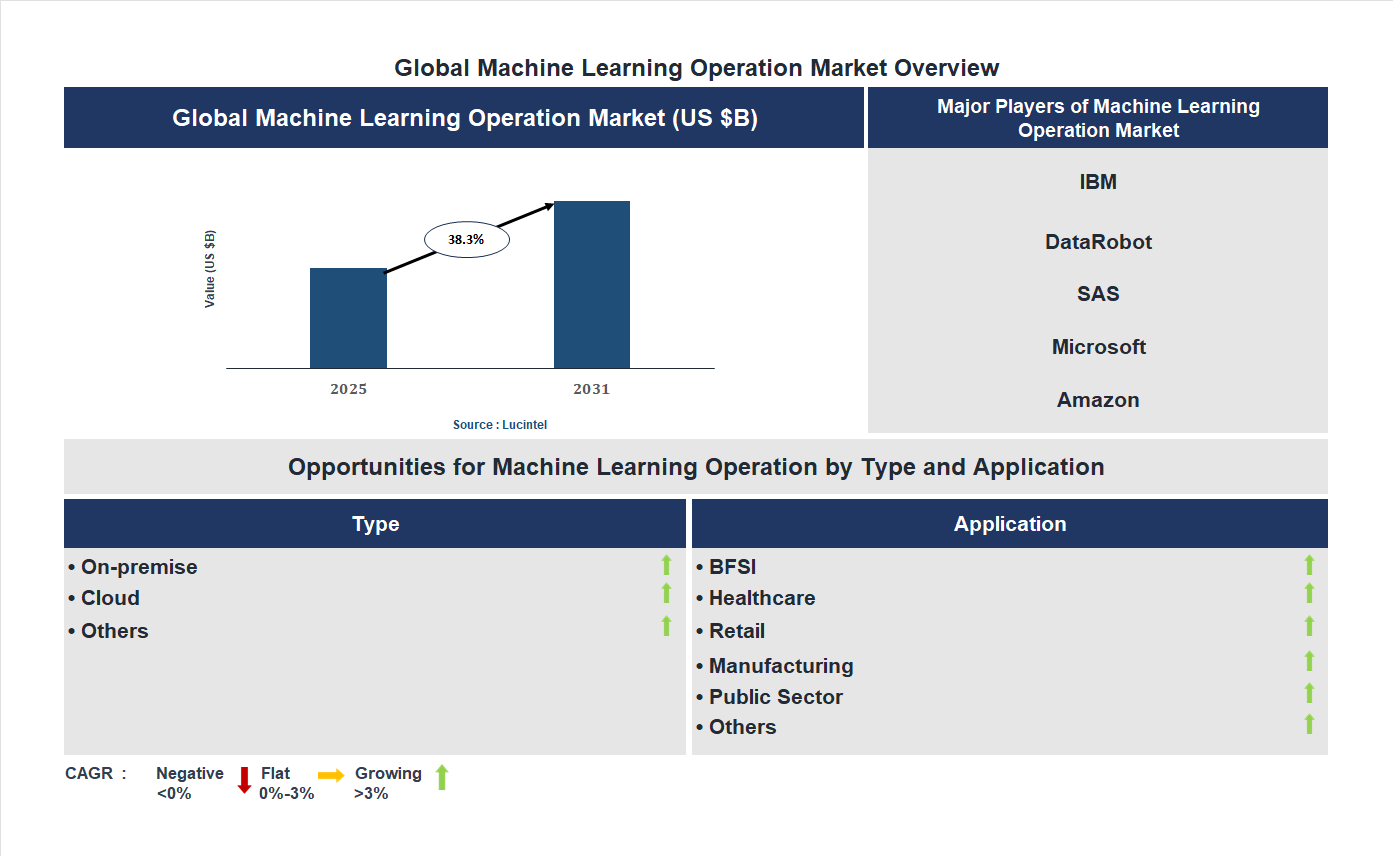
Key data points: The growth forecast = 38.3% annually for the next 7 years. Scroll below to get more insights. This market report covers trends, opportunities and forecasts in machine learning operation market to 2031 by type (on-premise, cloud, and others), application (BFSI, healthcare, retail, manufacturing, public sector, and others), and region (North America, Europe, Asia Pacific, and the Rest of the World)
We'll send your sample report shortly.
• Lucintel forecasts that, within the type category, cloud is expected to witness higher growth over the forecast period.
• Within the application category, healthcare is expected to witness the highest growth.
• In terms of region, APAC is expected to witness the highest growth over the forecast period. Gain valuable insights for your business decisions with our comprehensive 150+ page report. Sample figures with some insights are shown below.
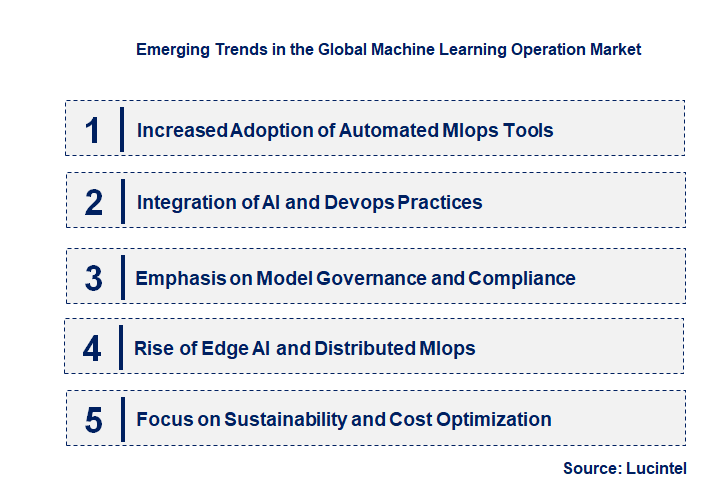
• Increased Adoption of Automated MLOps Tools: The market is witnessing a surge in automated tools that simplify model deployment, monitoring, and management. These tools reduce manual intervention, accelerate deployment cycles, and improve accuracy by automating tasks such as data validation, model testing, and version control. As organizations seek faster, more reliable AI deployment, automated MLOps solutions are becoming essential, enabling teams to focus on innovation rather than operational overhead.
• Integration of AI and DevOps Practices: MLOps is increasingly blending with DevOps methodologies to create a unified approach for software and AI development. This integration promotes continuous integration and continuous delivery (CI/CD) for machine learning models, ensuring rapid updates and consistent performance. It enhances collaboration between data scientists and IT teams, reduces deployment risks, and accelerates time-to-market for AI-driven products, ultimately leading to more agile and resilient AI ecosystems.
• Emphasis on Model Governance and Compliance: With growing concerns over data privacy, security, and ethical AI, the market is prioritizing model governance and regulatory compliance. Features such as audit trails, access controls, and explainability are becoming standard. This trend ensures that AI models adhere to legal standards and ethical guidelines, reducing risks of bias and misuse. It also builds trust among users and stakeholders, facilitating broader adoption of AI solutions in regulated industries like healthcare, finance, and government.
• Rise of Edge AI and Distributed MLOps: As IoT devices and edge computing become more prevalent, MLOps is expanding beyond centralized data centers to support edge deployment. Distributed MLOps solutions enable models to run efficiently on edge devices, providing real-time insights and reducing latency. This trend is crucial for applications requiring immediate decision-making, such as autonomous vehicles and smart cities, and is driving the development of lightweight, scalable MLOps frameworks tailored for decentralized environments.
• Focus on Sustainability and Cost Optimization: The market is increasingly emphasizing sustainable AI practices and cost-effective operations. This includes optimizing resource usage, reducing energy consumption, and implementing efficient model training and inference techniques. Cost management tools integrated into MLOps platforms help organizations control expenses while maintaining high performance. This trend aligns with global sustainability goals and ensures that AI deployment remains economically viable, especially for small and medium-sized enterprises. In summary, these emerging trends are transforming the machine learning operation market by making AI deployment more automated, integrated, compliant, scalable, and sustainable. They are enabling organizations to deploy AI solutions more rapidly, securely, and responsibly, thereby reshaping how AI is integrated into business operations and driving innovation across industries.
• Integration of Automated Machine Learning (AutoML): This development simplifies model development by automating tasks like feature engineering, model selection, and hyperparameter tuning. AutoML integration reduces time-to-market, democratizes AI adoption, and enables non-experts to deploy effective models, thereby expanding the market reach and accelerating innovation.
• Enhanced Model Deployment and Monitoring Tools: New tools now offer seamless deployment options across cloud, edge, and on-premises environments, along with real-time monitoring and management. These capabilities improve model reliability, reduce downtime, and ensure compliance, which is critical for industries like healthcare and finance, boosting confidence in AI solutions.
• Adoption of Containerization and Orchestration Technologies: The use of Docker, Kubernetes, and similar technologies has become prevalent for deploying scalable, portable ML models. This development enhances flexibility, simplifies environment management, and accelerates deployment cycles, leading to more robust and efficient MLOps pipelines.
• Focus on Data Privacy and Security: With increasing data regulations, MLOps platforms are integrating advanced security features such as encryption, access controls, and audit trails. This focus ensures compliance with GDPR, HIPAA, and other standards, fostering trust and enabling deployment in sensitive sectors, thus broadening market opportunities.
• Expansion of MLOps Platforms with AI-Powered Automation: Platforms are incorporating AI-driven automation for tasks like model tuning, anomaly detection, and workflow optimization. This evolution reduces manual intervention, increases operational efficiency, and lowers costs, making MLOps solutions more attractive to enterprises seeking scalable AI deployment. In summary, these developments are significantly transforming the machine learning operation market by enhancing automation, deployment flexibility, security, and scalability. They are enabling organizations to deploy AI more efficiently and securely, fostering broader adoption across industries. As a result, the market is poised for sustained growth, innovation, and increased competitiveness in the AI ecosystem.
• Healthcare: Improved patient outcomes and operational efficiency : MLOps enables healthcare providers to deploy and manage AI models for diagnostics, personalized treatment, and predictive analytics, leading to faster decision-making and better patient care.
• Finance: Enhanced risk management and fraud detection : In finance, MLOps facilitates real-time model deployment for credit scoring, fraud detection, and algorithmic trading, increasing accuracy and reducing operational risks.
• Retail: Personalized customer experiences : Retailers utilize MLOps to deploy recommendation engines and customer analytics models efficiently, resulting in targeted marketing, increased sales, and improved customer satisfaction.
• Manufacturing: Predictive maintenance and quality control : MLOps supports the deployment of predictive models for equipment maintenance and quality assurance, minimizing downtime and reducing costs.
• Autonomous Vehicles: Real-time decision-making and safety : MLOps is critical for deploying and managing models in autonomous vehicles, ensuring safety, reliability, and compliance in real-time operations. These growth opportunities are significantly impacting the market by driving innovation, improving operational efficiencies, and enabling industries to harness AIs full potential. As applications become more sophisticated and scalable, the market is poised for sustained expansion, attracting investments and fostering technological advancements.
• Technological Innovation: The continuous evolution of AI and machine learning algorithms fuels the demand for sophisticated MLOps solutions. As organizations seek to automate and streamline their ML workflows, innovative tools enable faster deployment, monitoring, and management of models. This technological progress reduces time-to-market and enhances model accuracy, thereby accelerating adoption across sectors such as healthcare, finance, and retail. The integration of cloud computing and containerization further supports scalable and flexible MLOps environments, making advanced ML capabilities accessible to a broader range of enterprises.
• Increasing Data Volumes: The exponential growth of data generated by digital platforms, IoT devices, and enterprise systems necessitates robust MLOps frameworks. Managing, processing, and analyzing vast datasets require automated pipelines and efficient model deployment strategies. This surge in data volume enhances the potential for insights and predictive analytics, prompting organizations to invest heavily in MLOps tools that facilitate data management, version control, and reproducibility. Consequently, the market experiences heightened demand for solutions capable of handling big data efficiently.
• Rising Adoption of Cloud Platforms: Cloud service providers offer scalable, cost-effective infrastructure that supports MLOps workflows. The shift towards cloud-based solutions enables organizations to deploy, monitor, and update machine learning models remotely, reducing infrastructure costs and increasing agility. Cloud platforms also provide integrated tools for data storage, model training, and deployment, simplifying complex ML operations. This trend accelerates market growth by making MLOps accessible to small and medium-sized enterprises, fostering innovation and collaboration across industries.
• Growing Focus on Model Governance and Compliance: As AI models become integral to critical decision-making processes, regulatory bodies emphasize transparency, fairness, and accountability. Organizations are adopting MLOps solutions that incorporate model governance, audit trails, and compliance checks to meet legal standards such as GDPR and CCPA. This focus on responsible AI practices drives demand for specialized tools that ensure models are interpretable, unbiased, and secure, thereby shaping the development of the MLOps market towards more ethical and compliant solutions.
• Strategic Collaborations and Partnerships: Collaborations between technology providers, cloud vendors, and industry players facilitate the development of comprehensive MLOps ecosystems. These partnerships enable the integration of diverse tools and platforms, enhancing functionality and user experience. Joint ventures also promote knowledge sharing and innovation, accelerating product development and market penetration. Such strategic alliances are crucial for addressing complex deployment challenges and expanding the reach of MLOps solutions globally. The challenges facing this machine learning operation market include:
• Data Privacy and Security Concerns: The increasing reliance on large datasets raises significant privacy and security issues. Organizations must comply with stringent data protection regulations, which can complicate data collection, storage, and processing. Breaches or misuse of sensitive information can lead to legal penalties and reputational damage. Implementing robust security measures and ensuring compliance adds complexity and cost to MLOps initiatives, potentially hindering rapid deployment and innovation within the market.
• Complexity of MLOps Integration: Integrating MLOps tools into existing IT infrastructure can be complex and resource-intensive. Organizations often face challenges related to compatibility, scalability, and skill gaps among personnel. The diverse range of platforms and frameworks requires extensive customization and expertise, which can delay deployment and increase costs. Overcoming these integration hurdles is essential for realizing the full benefits of MLOps but remains a significant obstacle for many enterprises.
• Rapid Technological Changes: The fast-paced evolution of AI and machine learning technologies creates a constantly shifting landscape. Keeping up with new tools, frameworks, and best practices demands continuous learning and adaptation. Companies risk investing in solutions that quickly become outdated, leading to increased costs and strategic uncertainty. Navigating this rapid technological change requires agility and foresight, which can be challenging for organizations with limited resources or expertise. In summary, the machine learning operation market is driven by technological advancements, data growth, cloud adoption, regulatory focus, and strategic collaborations. However, challenges such as data security, integration complexity, and rapid technological change pose significant hurdles. These factors collectively influence the market’s growth trajectory, requiring stakeholders to innovate and adapt continuously. Successfully addressing these drivers and challenges will determine the market’s future landscape, impacting innovation, competitiveness, and the responsible deployment of AI solutions globally.
• IBM
• DataRobot
• SAS
• Microsoft
• Amazon
• Dataiku
• Databricks
• HPE
• Lguazio
• On-premise
• Cloud
• Others
• BFSI
• Healthcare
• Retail
• Manufacturing
• Public Sector
• Others
• North America
• Europe
• Asia Pacific
• The Rest of the World
• United States: The US market for MLOps has seen significant growth with major tech giants like Google, Microsoft, and Amazon expanding their platforms. Increased investment in AI startups and cloud-based solutions has driven innovation, with a focus on automation, model monitoring, and deployment efficiency. Regulatory frameworks around data privacy and security are also influencing market strategies. Additionally, the rise of AI-as-a-Service offerings has made MLOps more accessible to enterprises of all sizes, fostering widespread adoption across sectors such as finance, healthcare, and retail.
• China: China is rapidly advancing in the MLOps space, supported by government initiatives like the New Generation Artificial Intelligence Development Plan. Major Chinese tech firms such as Baidu, Alibaba, and Tencent are investing heavily in AI infrastructure and tools to enhance model deployment and management. The focus is on integrating AI into smart city projects, manufacturing, and e-commerce. Local cloud providers are developing tailored MLOps solutions to meet domestic data sovereignty requirements. The market is also characterized by a strong emphasis on cost-effective, scalable solutions to support the countrys large-scale AI deployment ambitions.
• Germany: Germanys MLOps market is strongly linked to its industrial sector, emphasizing automation and Industry 4.0 initiatives. Leading automotive and manufacturing companies are adopting MLOps to optimize production lines, predictive maintenance, and supply chain management. The focus is on integrating AI with existing industrial systems, ensuring compliance with strict EU data privacy regulations. Several startups and established firms are developing specialized tools for industrial AI deployment, fostering collaboration between technology providers and traditional industries. The market is also supported by government funding aimed at digital transformation and innovation.
• India: The Indian MLOps market is characterized by rapid growth driven by increasing digital adoption and a large, young workforce. Startups and enterprises are leveraging affordable cloud solutions to deploy and manage AI models efficiently. Key sectors include banking, healthcare, and agriculture, where AI-driven insights are transforming operations. The government’s Digital India initiative and policies promoting AI research are further fueling market expansion. Local providers are developing cost-effective MLOps platforms tailored to regional needs, focusing on scalability, ease of use, and integration with existing systems to democratize AI adoption across small and medium enterprises.
• Japan: Japans MLOps market is advancing through its focus on robotics, automation, and smart manufacturing. Major corporations like Sony, Toyota, and Hitachi are integrating MLOps to enhance product development, predictive maintenance, and autonomous systems. The emphasis is on high-quality, reliable AI deployment, with a strong focus on safety and compliance standards. Japan is also investing in AI research collaborations and startups to foster innovation. The market benefits from government initiatives supporting Industry 4.0 and digital transformation, with a growing ecosystem of tools and platforms designed to support complex, large-scale AI applications in manufacturing and service industries.


• IBM
• DataRobot
• SAS
• Microsoft
• Amazon
• Dataiku
• Databricks
• HPE
• Lguazio Q5. Which machine learning operation market segment will be the largest in future? Answer: Lucintel forecasts that, within the type category, cloud is expected to witness higher growth over the forecast period. Q6. In machine learning operation market, which region is expected to be the largest in next 5 years? Answer: In terms of region, APAC is expected to witness the highest growth over the forecast period. Q7. Do we receive customization in this report? Answer: Yes, Lucintel provides 10% customization without any additional cost.


Choose a license that fits your team. Instant PDF delivery.
Prices exclude taxes. Instant delivery. Custom licensing available on request.
Market Report · July 15, 2026
Market Report · June 26, 2026
Market Report · June 24, 2026
Trusted partner for strategic intelligence and business growth


Receive a complimentary market analysis tailored to your industry. Our analysts will identify key growth opportunities and competitive dynamics specific to your business.

Market size, growth rate, and key trend analysis for your specific sector.

Top competitor positioning and market share analysis.

Strategic recommendations backed by data-driven insights.
Get curated market intelligence and competitive moves straight to your inbox.
By subscribing, you agree to receive our monthly insights. Unsubscribe anytime.
Receive a complimentary market analysis tailored to your industry. Our analysts will identify key growth opportunities and competitive dynamics specific to your business.
Market size, growth rate, and key trend analysis for your specific sector.
Top competitor positioning and market share analysis.
Strategic recommendations backed by data-driven insights.
Get curated market intelligence, emerging trends, and competitive moves straight to your inbox each month.
By subscribing, you agree to receive our monthly insights. Unsubscribe anytime.
We'll send your sample report shortly.