
Market Report · July 16, 2026

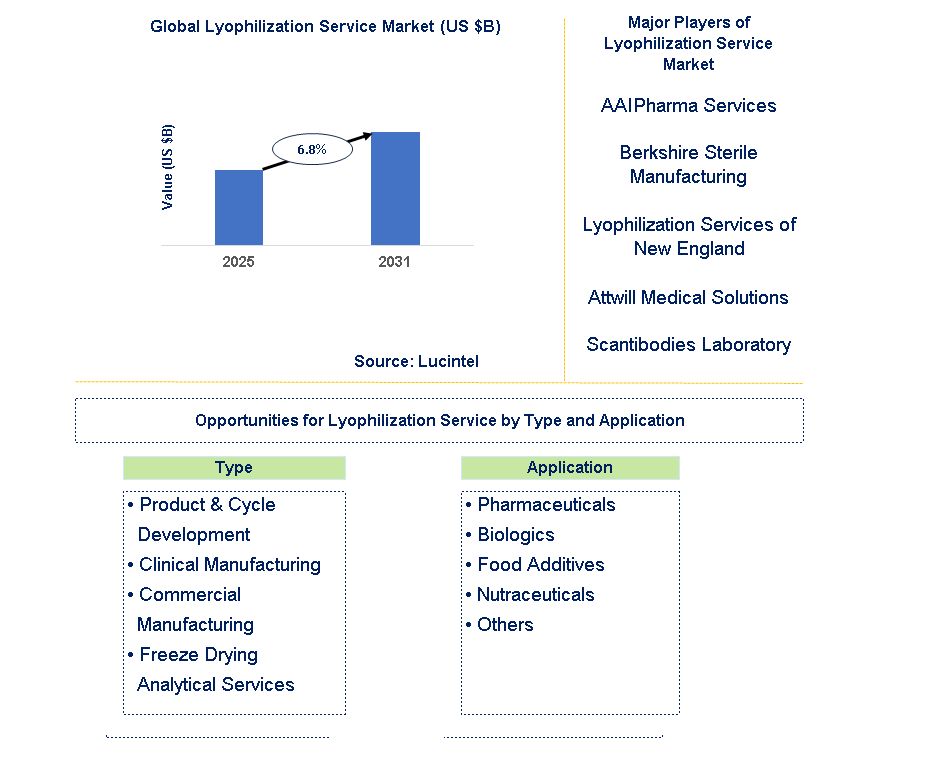
Key data points: The growth forecast = 6.8% annually for the next 7 years. Scroll below to get more insights. This market report covers trends, opportunities and forecasts in lyophilization service market to 2031 by type (product & cycle development, clinical manufacturing, commercial manufacturing, and freeze drying analytical services), application (pharmaceuticals, biologics, food additives, nutraceuticals, and others), and region (North America, Europe, Asia Pacific, and the Rest of the World)
We'll send your sample report shortly.
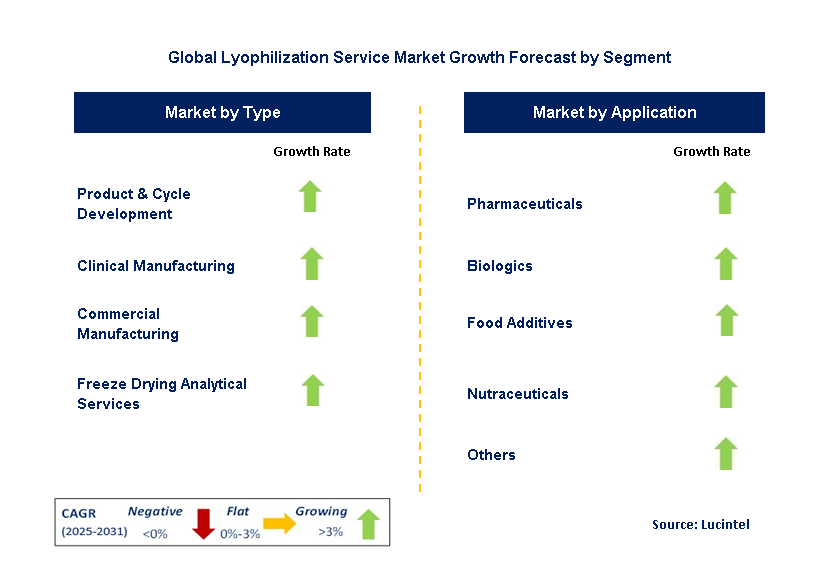
• Lucintel forecasts that, within the type category, commercial manufacturing is expected to witness the highest growth over the forecast period.
• Within the application category, pharmaceutical is expected to witness the highest growth.
• In terms of region, APAC is expected to witness the highest growth over the forecast period. Gain valuable insights for your business decisions with our comprehensive 150+ page report. Sample figures with some insights are shown below.
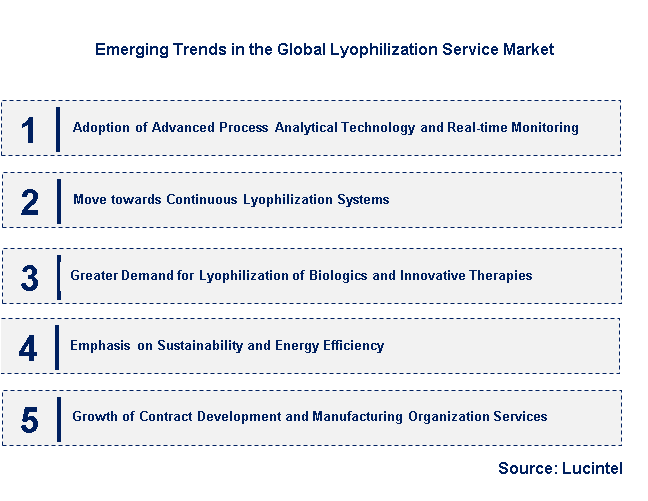
• Adoption of Advanced Process Analytical Technology and Real-time Monitoring: This trend entails the growing incorporation of advanced sensors and analytical equipment in lyophilization processes. PAT allows critical parameters such as product temperature, residual moisture, and chamber pressure to be monitored in real-time during the course of the freeze-drying process. This enables accurate control, optimization, and early deviation detection, resulting in better product quality, shorter cycle times, and better process understanding. The effect is dramatic, since it reduces batch failure, guarantees product consistency, and facilitates regulatory compliance, enhancing efficiency and reliability in lyophilization services.
• Move towards Continuous Lyophilization Systems: Historically, lyophilization has been a batch process. But there is a movement towards continuous lyophilization systems, especially at the large-scale production level. These systems provide benefits like greater throughput, smaller footprint of equipment, less manual intervention, and better consistency of process. They facilitate a more integrated manufacturing flow, which tend to be aligned with Pharma 4.0 initiatives. The trend affects the market by creating demand for experts in specialized service providers who can operate and optimize such sophisticated continuous systems, providing higher efficiency and cost savings for high-volume products.
• Greater Demand for Lyophilization of Biologics and Innovative Therapies: The growing biopharmaceutical sector, especially the production of complex biologics, vaccines, cell and gene therapies, and mRNA-based medicines, is driving a significant trend in lyophilization services. Several of these new medicines are very sensitive to temperature and moisture, so lyophilization is critical to ensuring their stability, long shelf life, and convenience of distribution. The effect is a high demand for specialized lyophilization services and equipment that can deal with these high-value, sensitive compounds, creating pressure for cycle development innovation and aseptic processing.
• Emphasis on Sustainability and Energy Efficiency: Environmental issues are focusing attention on making lyophilization processes more sustainable and energy-efficient. This involves the creation of freeze-dryers with improved refrigeration systems, minimizing energy consumption during drying, and the search for alternative environmentally friendly refrigerants. Service providers are committing to green technologies to reduce their carbon footprint as well as operational costs. This trend affects the industry by promoting R&D in new drying technologies and green practices’ adoption, targeting environmentally sensitive pharmaceutical firms.
• Growth of Contract Development and Manufacturing Organization Services: Lyophilization service outsourcing to CDMOs is a fast-growing trend. Biotech and pharmaceutical firms, especially small and mid-tier companies, are increasingly outsourcing to CDMOs for their specialized knowledge, cutting-edge equipment, and regulatory expertise. This enables them to eschew large capital outlay and concentrate on their fundamental R&D work. The consequence is a more dispersed but highly specialized service marketplace, where CDMOs provide end-to-end services, from cycle optimization and formulation development to commercial-scale lyophilization and aseptic filling. These nascent trends are jointly transforming the lyophilization service market by pushing it towards increased precision, scalability, and specialization. The use of sophisticated PAT and real-time systems increases efficiency and product quality. The increasing pipeline of biologics and advanced therapies places a pressing need on specialized services. The emphasis on sustainability mirrors a wider industry goal of environmental stewardship, and the growth of CDMO services offers agile and cost-saving solutions. These developments reflect an increasingly sophisticated, technology-oriented, and responsive market to the advanced needs of the pharmaceutical and biopharmaceutical sectors, guaranteeing the stability and availability of essential medicines.
• Integration of Automation and Robotics in Lyophilizes: One of the notable recent advancements has been the greater integration of robotics and automation into lyophilization operations, especially loading, unloading, and vial and tray handling. It reduces the need for manual intervention, thus minimizing the risk of contamination and ensuring process consistency. Automated systems provide higher throughput, lower labor costs, and 24/7 operation in certain plants. The effect is increased efficiency, improved aseptic conditions, and larger scalability of lyophilization operations, making service more predictable and economical for bulk production.
• Improvements in Lyophilization Cycle Development and Optimization: The past few years have witnessed tremendous growth in scientific knowledge and technological equipment for lyophilization cycle design. This encompasses the application of computational modeling, powerful software to simulate the process, and elaborate analytical methods to establish product behavior in freeze-drying. These enable more efficient and reliable cycle design, eliminate trial-and-error work, decrease development schedules, and minimize product degradation. The result is enhanced product stability, lower manufacturing costs, and accelerated time-to-market for new pharmaceuticals.
• Increase in Capacity and International Reach by CDMOs: One of the key developments is the strategic increase in capacity and international reach by top Contract Development and Manufacturing Organizations (CDMOs) providing lyophilization services. This includes the construction of new state-of-the-art facilities, purchase of smaller specialized service providers, and expansion of existing sites. This growth is being fueled by the growing trend of outsourcing by pharmaceutical and biotech firms. The benefit is increased availability of high-quality lyophilization capacity, decreased clients’ lead times, and improved resilience of the global supply chain for sensitive drugs.
• Lyophilization Development for Emerging Drug Delivery Systems: Current advances involve the use of lyophilization in new and advanced drug delivery systems, including lipid nanoparticles (LNPs) for use in mRNA vaccines, polymeric nanoparticles, and micro-suspensions. These formulations tend to be subject to strict control upon freeze-drying so that their structure and therapeutic activity are preserved. Innovation in lyophilization protocols for such future-proof formulations is imperative. The effect is the facilitation of reproducible and scalable production for innovative drugs, increasing the reach and worth of lyophilization services in the pharmaceutical pipeline.
• Increased Emphasis on Regulatory Compliance and Data Integrity: With growing regulatory attention from organizations such as the FDA and EMA, there is greater emphasis on ensuring effective regulatory compliance and data integrity for lyophilization services. This includes adopting holistic Quality by Design (Qods) practices, stringent validation protocols, and secure data management systems. Service providers are making investments in compliant infrastructure and employee training. The effect is improved product safety and performance, greater confidence from pharmaceutical customers, and a more accountable and transparent service market, essential for international drug approvals. These advancements are significantly altering the lyophilization service market by revolutionizing the limits of efficiency, accuracy, and worldwide reach. The coupling of automation and cycle development advancements is yielding more harmonious and affordable processes. Increasing industry outsourcing demands are met by the growth of CDMO capabilities, and this use of lyophilization to new drug delivery systems is an example of its increasing significance in advanced medicine. Lastly, the increased emphasis on regulatory compliance guarantees safety and quality at the highest level. Together, these advances are cementing lyophilization’s essential position in the contemporary pharmaceutical and biopharmaceutical industries.
• Biopharmaceuticals (Monoclonal Antibodies, Recombinant Proteins, Vaccines): This segment provides the highest growth opportunity. The biopharmaceutical sector continues its strong growth with a rich pipeline of high-complexity biologics such as monoclonal antibodies, recombinant proteins, and new vaccines. Such products tend to be highly degradable and need lyophilization for long-term stability and longer shelf life. Growth lies in investing in specialized plants, state-of-the-art cold chain management, and knowledge of handling large-molecule biologics, providing end-to-end services from development to commercial manufacturing for such high-value products.
• Cell and Gene Therapies: A new and rapidly expanding opportunity is found in the lyophilization of cell and gene therapies (CGTs). These advanced therapies, frequently living cells or viral vectors, need ultra-low temperature preservation in order to be viable and potent. Although conventionally cryopreserved, lyophilization presents the possibility of room temperature storage and streamlined logistics, minimizing cold chain requirements. Strategic growth involves developing specialized lyophilization protocols and technologies tailored for CGTs, requiring significant R&D investment and a deep understanding of these delicate biological entities.
• Diagnostic Kits and Reagents: The growth market for diagnostic kits, such as infectious disease, personalized medicine, and point-of-care testing, is a strong growth opportunity. Most of the reagents used for diagnostics are unstable in a liquid state and need to be lyophilized in order to preserve their activity and increase shelf life, making them suitable for distribution globally. Strategic expansion includes providing high-throughput lyophilization of bulk reagents, accurate filling capabilities, and packaging solutions that preserve product integrity, serving diagnostic companies requiring efficient and reliable preservation means.
• Injectable Pharmaceuticals (Small Molecules and Generics): Though biologics are leading the way, the stable and expanding market for lyophilized injectable small molecule drugs and generics is a large opportunity. Lyophilization is usually done to improve the stability, solubility, or reconstitution characteristics of these drugs. Strategic expansion includes offering cost-effective, high-volume lyophilization services for such products by emphasizing process efficiency, regulatory compliance, and sound quality control. Targeting generic drug makers and those with volatile active pharmaceutical ingredients (APIs) can lock in a steady stream of demand.
• Contract Development and Manufacturing Organizations Services: The general trend for pharmaceutical and biotech firms outsourcing their production and development activities provides a clear growth opportunity for CDMOs with expertise in lyophilization. CDMOs are able to provide end-to-end services, from form development and clinical trial material supply to commercial production. Strategic expansion is about having the latest equipment updated all the time, increasing capacity, establishing an impeccable regulatory compliance track record, and providing integrated services (e.g., aseptic filling, analytical testing) to be a one-stop-shop for customers across several different therapeutic categories. These growth opportunities of strategic nature are deeply influencing the lyophilization service market by expanding its base of applications and solidifying its role as a pharmaceutical and biotechnology industry’s indispensable element. Strong market volumes are assured through focus on biopharmaceuticals, while specialized, high-value growth is promised through the growing domain of cell and gene therapies. Stable revenue streams are afforded through the consistent demand from injectable pharmaceutical and diagnostic industries. In addition, growth in the CDMO services acts as the foundation for the industry move toward outsourced capabilities. Through deliberate aim at these multifarious applications, the lyophilization service market can realize continuous growth and stabilize its pivotal role in global healthcare.
• AAIPharma Services
• Berkshire Sterile Manufacturing
• Lyophilization Services of New England
• Attwill Medical Solutions
• Scantibodies Laboratory
• Biolyph
• Alcami Corporation
• Goodwin Biotechnology
• MME group
• Celsus Laboratories
• Product & Cycle Development
• Clinical Manufacturing
• Commercial Manufacturing
• Freeze Drying Analytical Services
• Pharmaceuticals
• Biologics
• Food Additives
• Nutraceuticals
• Others
• North America
• Europe
• Asia Pacific
• The Rest of the World
• United States: The lyophilization service market in the United States is strong, fueled to a large extent by a robust biopharmaceutical industry as well as widespread research and development efforts. There is increased focus on the development of contract development and manufacturing organizations (CDMOs) that provide complete lyophilization services, ranging from cycle development to commercial production. Some of the advancements in the past few years include the use of automated and continuous lyophilization systems for improved efficiency and scalability. Demand for injectable drugs, biologics, and vaccines drives the market with a focus on product quality and stability.
• China: China’s lyophilization service market is growing aggressively, driven by a developing pharmaceutical and food processing sector, along with higher investments in biotechnology. The market is marked by the burgeoning presence of domestic service providers, usually competing on prices. Recent trends involve higher usage of advanced freeze-drying technologies to respond to growing domestic demand for high-quality, shelf-stable goods. China is becoming an important destination for contract manufacturing of freeze-dried products, also supported by foreign investment because of reduced raw material and labor costs.
• Germany: Germany’s lyophilization service market is a leading market in Europe, famous for its advanced technological level and high-quality standards. The market is dominated by a strong pharmaceutical and biotechnology industry with emphasis on advanced therapies such as biologics, vaccines, and gene therapies. There is evident outsourcing of lyophilization services by pharmaceutical companies to specialist CDMOs, taking advantage of their technical skills and high-end capabilities. Recent trends involve the combination of automated and continuous lyophilization systems for increased productivity and better product quality.
• India: India’s lyophilization service market is growing considerably driven by its burgeoning pharmaceutical industry, especially in vaccine storage and preservation, and a growing freeze-dried food sector. Expanded demand for convenient, long-shelf-life, and nutrient-preserving food products is the major driving factor. Latest trends involve increasing investments in freeze-drying machinery and technology for improving production efficiencies and preservation techniques for products. Enhanced concern for food safety and quality, coupled with the move towards natural and minimally processed foods, is also fueling market growth.
• Japan: Japan’s lyophilization service market is propelled by the emphasis on innovation in the pharmaceutical and biotechnology industries, along with an aging population who need advanced medical care. The demand for biologics, vaccines, and personalized medicines, all of which require advanced preservation, is a key driving force. Recent trends include high investment in R&D and manufacturing plants to meet stringent quality standards for drug development. The food processing industry also experiences increasing demands for quality, convenient, and shelf-stable foods, which drive the use of freeze-drying technology.


• AAIPharma Services
• Berkshire Sterile Manufacturing
• Lyophilization Services of New England
• Attwill Medical Solutions
• Scantibodies Laboratory
• Biolyph
• Alcami Corporation
• Goodwin Biotechnology
• MME group
• Celsus Laboratories Q5. Which lyophilization service market segment will be the largest in future? Answer: Lucintel forecasts that, within the type category, commercial manufacturing is expected to witness the highest growth over the forecast period. Q6. In lyophilization service market, which region is expected to be the largest in next 5 years? Answer: In terms of region, APAC is expected to witness the highest growth over the forecast period. Q7. Do we receive customization in this report? Answer: Yes, Lucintel provides 10% customization without any additional cost.


Choose a license that fits your team. Instant PDF delivery.
Prices exclude taxes. Instant delivery. Custom licensing available on request.
Market Report · July 16, 2026
Market Report · July 15, 2026
Market Report · July 15, 2026
Trusted partner for strategic intelligence and business growth


Receive a complimentary market analysis tailored to your industry. Our analysts will identify key growth opportunities and competitive dynamics specific to your business.

Market size, growth rate, and key trend analysis for your specific sector.

Top competitor positioning and market share analysis.

Strategic recommendations backed by data-driven insights.
Get curated market intelligence and competitive moves straight to your inbox.
By subscribing, you agree to receive our monthly insights. Unsubscribe anytime.
Receive a complimentary market analysis tailored to your industry. Our analysts will identify key growth opportunities and competitive dynamics specific to your business.
Market size, growth rate, and key trend analysis for your specific sector.
Top competitor positioning and market share analysis.
Strategic recommendations backed by data-driven insights.
Get curated market intelligence, emerging trends, and competitive moves straight to your inbox each month.
By subscribing, you agree to receive our monthly insights. Unsubscribe anytime.
We'll send your sample report shortly.