
Market Report · May 18, 2026

This market report covers trends, opportunities, and forecasts in the global lte-m module market to 2031 by technology (lte cat m1 and lte cat m2), application (automotive industry, intelligent buildings, medical equipment, and others), and region (North America, Europe, Asia Pacific, and the Rest of the World)
We'll send your sample report shortly.
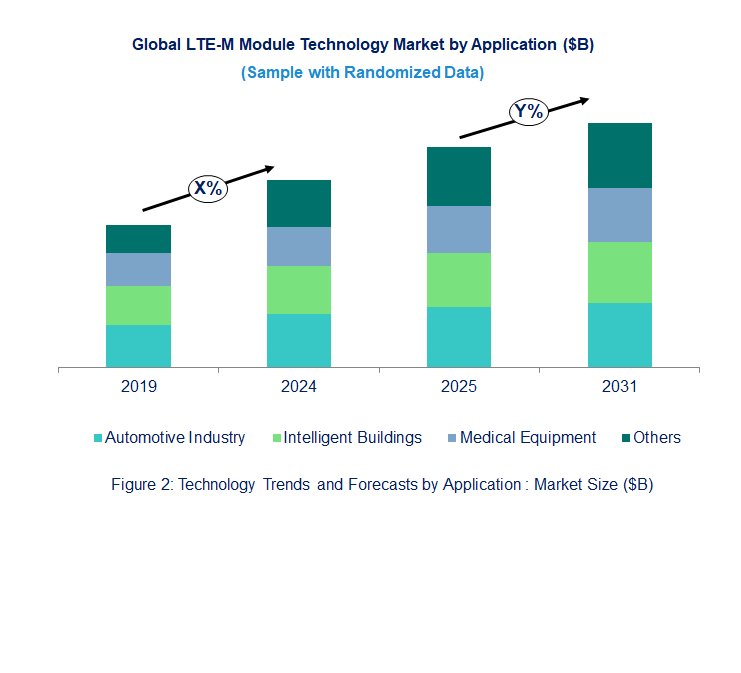
• Adoption of IoT applications is increasing with the use of LTE-M modules in IoT devices. Sectors like smart cities, healthcare, and automotive have been increasingly adopting it. LTE-M provides improved connectivity for applications such as asset tracking, smart meters, and connected vehicles, which offer a secure and low-power solution for long-range communication.
• Shift Towards Low Power Wide Area Networks (LPWAN): LTE-M modules are a key enabler of LPWAN technologies, which are designed for low power consumption and wide coverage areas. This shift is particularly relevant in applications requiring long battery life and extended coverage, such as remote healthcare devices, utility meters, and tracking systems in agriculture and logistics.
• Increasing Importance in Automotive Industry: LTE-M modules are becoming increasingly crucial in the automotive industry with the support of vehicle-to-everything (V2X) communication, autonomous driving, and tracking systems for vehicles. The automobile industry is being transformed by the ability to support low power, wide coverage, and real-time data transmission, and enable smarter, more connected vehicles.
• Enhanced Security Features: As IoT devices become more widespread, there is an increasing focus on security. LTE-M modules are incorporating stronger security features, such as end-to-end encryption and secure authentication, to protect sensitive data in industries like healthcare and automotive, where data privacy and integrity are critical.
• Global Expansion of 5G Networks: As 5G networks expand globally, LTE-M modules are being positioned as a complementary technology to provide seamless connectivity for low-power IoT applications. LTE-M’s ability to support 5G networks will unlock new use cases, particularly in remote healthcare and smart city infrastructure, where reliable, high-bandwidth communication is needed. These emerging trends in the LTE-M module market are propelling the proliferation of IoT devices across various industries. With these trends enhancing connectivity, improving security, and allowing low-power, wide-area communication, they are transforming industries such as automotive, healthcare, and intelligent buildings, and LTE-M is at the center of this transformation.
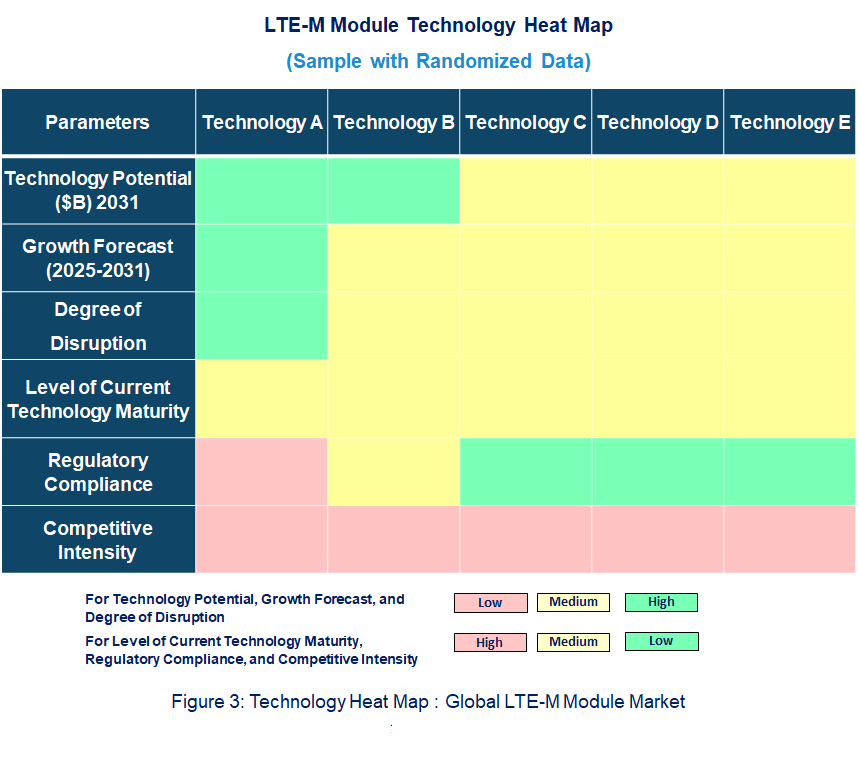
• Technology Potential: The technology of LTE-M has very good potential as it represents a robust solution for low data rate, long range, and extended battery life IoT applications. As smart devices become more popular and 5G networks continue to grow, modules of LTE-M will be called upon to play a critical role in the next generation of connected devices, from smart meters and wearables to autonomous vehicles.
• Degree of Disruption: The degree of disruption is moderate, especially for industries requiring low power, low bandwidth, and cost-effective connectivity. It is competing with other LPWA technologies, such as NB-IoT and LoRa, but it does provide superior integration with existing cellular networks, making it a great competitor for large-scale IoT deployments.
• Level of Current Technology Maturity: LTE-M technology is relatively mature, with a wide penetration across various industries. Ongoing improvements are being made in module design, signal coverage, and power efficiency.
• Regulatory Compliance: LTE-M modules have to adhere to global standards such as 3GPP and regional certifications such as CE, FCC, and RoHS for interoperability, safety, and environmental sustainability in IoT applications.
• Digi: Digi International has launched high-spec LTE-M modules suited particularly for low-power wide-area applications, such as distant monitoring and asset tracking, but the Digi XBee 3 LTE-M provides long battery life and secure connectivity that integrates seamlessly in almost all industrial IoT, automobile, and smart city types of applications.
• Telit: Telit continues to be a key player in the LTE-M module space, offering solutions that provide high-speed connectivity and low power consumption for a range of applications. Their LE910C1-AP module, for example, is designed for automotive, healthcare, and industrial IoT applications, offering enhanced data speeds and reliable connectivity, especially in rural and remote areas.
• u-blox: This company has launched the SARA-R5 LTE-M module, which is designed with a wide range of possibilities for IoT applications. The modules are optimized for low-power usage and can be used in smart metering, asset tracking, and industrial monitoring. u-blox’s solution offers much better security and scalability, enabling secure IoT communication in a complex environment.
• Laird: Laird Connectivity launched its Sentrius™ MG100 module to bring together LTE-M and NB-IoT technologies to offer seamless connectivity, ideal for IoT applications to operate remotely with low power. It was specifically targeted toward the automotive, agriculture, and healthcare industries through its capability to track or monitor, reliably collecting real-time data.
• Asiatelco: Asiatelco has introduced the ATEL-M2101, a module with LTE-M. It can be used in various IoT applications with low power consumption and extended battery life. It is ideal for industries like healthcare, logistics, and smart buildings, requiring real-time monitoring and long-range connectivity. These developments from key players demonstrate the importance that is growing for the module with LTE-M support and allowing a wide spectrum of applications in IoT. Therefore, these companies with attention towards power efficiency and better security, along with enhanced connectivity, put them in a position to capitalize on the growing need for IoT solutions across multiple domains.
• Growing Demand for IoT Connectivity: The increasing demand for IoT devices and applications creates a need for reliable, low-power connectivity. This is where LTE-M modules come in, crucially enabling IoT solutions across health care, automotive, and smart buildings, among others.
• Cost-Effective and Scalable Solutions: LTE-M modules provide cost-effective and scalable connectivity for any application. Their capability of offering low power consumption, long-range connectivity, and high reliability makes them an attractive choice for industries such as agriculture, logistics, and utilities, where cost efficiency is the prime focus.
• Regulatory Support for IoT Connectivity: Governments and regulatory bodies increasingly support the deployment of LPWAN technologies such as LTE-M to enable the growth of IoT. Global rollouts of 5G and LTE networks are, therefore, creating a conducive environment for the expansion of LTE-M modules in various sectors.
• Increasing Adoption in Automotive and Healthcare Sectors: The automotive and healthcare sectors are increasingly adopting LTE-M for vehicle tracking, remote monitoring, and connected medical devices. LTE-M is ideal for these applications because of its low power consumption and extended range, thus growing both sectors. Challenges in the LTE-M module market are:
• Narrow coverage of the networks in rural and distant places; the LTE-M module can achieve a wide range of coverage but faces significant challenges with a network in remote or rural areas with few infrastructural network bases, such as application fields including agriculture and health care.
• Integration and Compatibility Issues: LTE-M module integration into existing systems will prove to be a huge challenge, especially in legacy technology-based industries. LTE-M solutions will be implemented only at a slower pace, as their compatibility with older communication protocols and equipment is a constraint for them.
• Concern for Data Security and Privacy: As the IoT device penetration increases, the data exchanged through LTE-M networks needs to be secure and private. There are risks of cyberattacks within the IoT system that can affect the healthcare and automotive sectors because such industries have sensitive information. The LTE-M module market is expected to grow on the back of increasing demand for IoT and cost-effective solutions, alongside regulatory support. However, network coverage, integration issues, and data security concerns are bound to be the challenges that need to be addressed to let LTE-M technology grow and spread over various industries.
• Digi
• Telit
• u-blox
• Laird
• Asiatelco
• AT&T
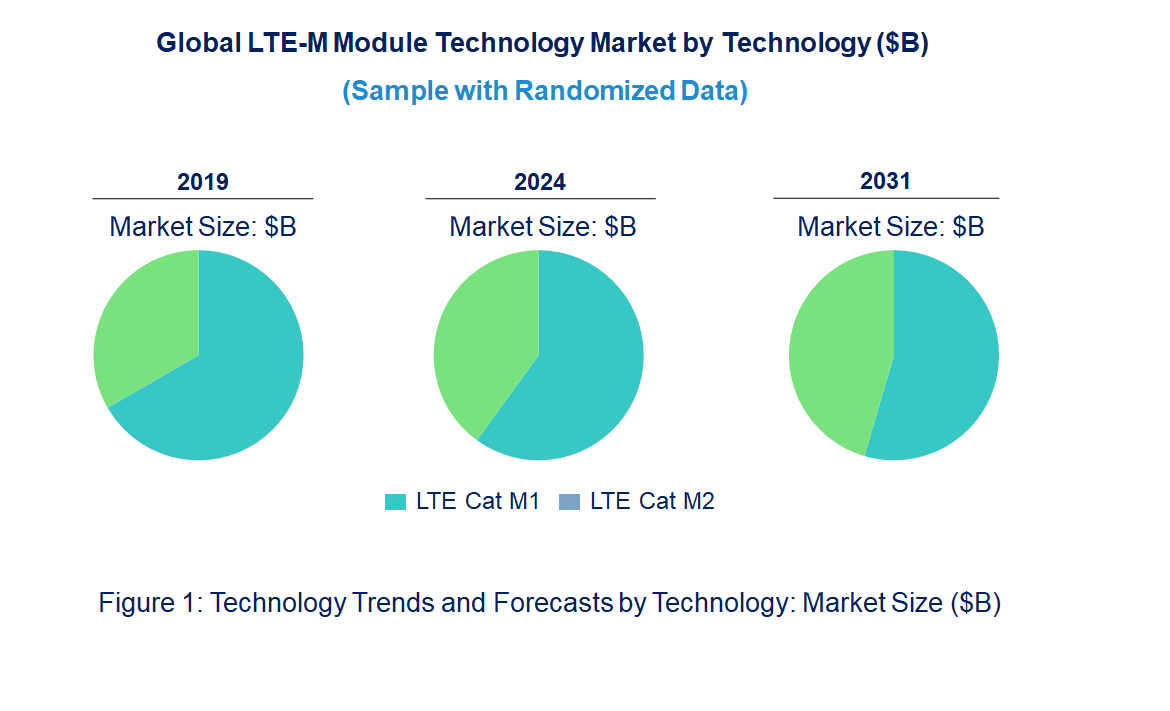
• Technology Readiness and Competitive Level for LTE Cat M1 and LTE Cat M2 in LTE-M Module Market: LTE Cat M1 is popular and mature, which best suits real-time IoT uses such as smart cities, while LTE Cat M2 is picking up pace on low-power, long-range requirements in logistics and agriculture usage. The market is highly competitive. Many players are integrating these technologies; however, regulatory compliance with both technologies is strong and follows global 4G standards. The key applications for LTE Cat M1 are wearables and asset tracking, whereas Cat M2 is suited for remote sensors and long-range use cases. Both of these complement each other in various industries.
• Competitive Intensity and Regulatory Compliance of LTE Cat M1 and LTE Cat M2 for LTE-M Module Market: The LTE-M module market is competitive, with LTE Cat M1 competing against NB-IoT and 5G for high-performance applications, and LTE Cat M2 competing with LPWA solutions such as LoRa and Sigfox. For both, regulatory compliance is critical, as both align with global LTE standards and ensure compatibility across regions. Challenges persist in spectrum allocation and cross-border regulations, particularly in developing markets. Standardization for both is a double-edged sword: it simplifies deployment but requires navigating region-specific security and privacy regulations.
• Disruption Potential of LTE Cat M1 and LTE Cat M2 for LTE-M Module Market: LTE Cat M1 and Cat M2 are breaking the LTE-M module market by allowing low-power, wide-area connectivity for IoT. LTE Cat M1 provides higher data rates and lower latency, making it more suitable for real-time applications like smart cities and healthcare. LTE Cat M2 is best for asset tracking and sensor networks because of ultra-low power and long-range capabilities. Both these technologies support IoT growth by improving connectivity in remote areas. While Cat M1 targets higher bandwidth applications, Cat M2 focuses on low-data-rate, power-efficient use cases, offering complementary strengths in different sectors.
• LTE Cat M1
• LTE Cat M2
• Automotive Industry
• Intelligent Buildings
• Medical Equipment
• Others
• North America
• Europe
• Asia Pacific
• The Rest of the World
• Latest Developments and Innovations in the LTE-M Module Technologies
• Companies / Ecosystems
• Strategic Opportunities by Technology Type


Choose a license that fits your team. Instant PDF delivery.
Prices exclude taxes. Instant delivery. Custom licensing available on request.
Market Report · May 18, 2026
Market Report · May 18, 2026
Market Report · May 18, 2026
Trusted partner for strategic intelligence and business growth


Receive a complimentary market analysis tailored to your industry. Our analysts will identify key growth opportunities and competitive dynamics specific to your business.

Market size, growth rate, and key trend analysis for your specific sector.

Top competitor positioning and market share analysis.

Strategic recommendations backed by data-driven insights.
Get curated market intelligence and competitive moves straight to your inbox.
By subscribing, you agree to receive our monthly insights. Unsubscribe anytime.
Receive a complimentary market analysis tailored to your industry. Our analysts will identify key growth opportunities and competitive dynamics specific to your business.
Market size, growth rate, and key trend analysis for your specific sector.
Top competitor positioning and market share analysis.
Strategic recommendations backed by data-driven insights.
Get curated market intelligence, emerging trends, and competitive moves straight to your inbox each month.
By subscribing, you agree to receive our monthly insights. Unsubscribe anytime.
We'll send your sample report shortly.