
Market Report · July 22, 2026

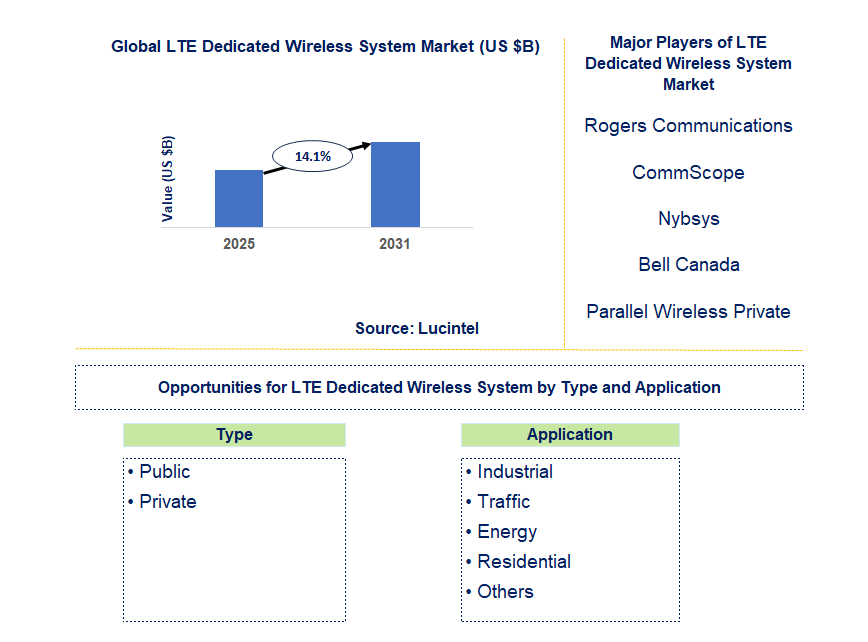
Key data points: The growth forecast = 14.1% annually for the next 7 years. Scroll below to get more insights. This market report covers Trends, opportunities and forecasts in LTE dedicated wireless system market to 2031 by type (public and private), application (industrial, traffic, energy, residential, and others), and region (North America, Europe, Asia Pacific, and the Rest of the World)
We'll send your sample report shortly.
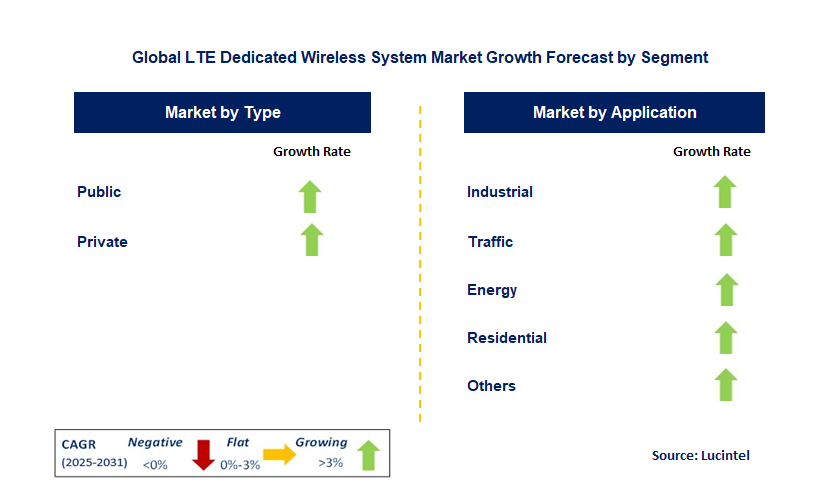
• Lucintel forecasts that, within the type category, private is expected to witness higher growth over the forecast period due to the increasing demand for secure networks.
• Within the application category, industrial is expected to witness the highest growth due to the growing demand for automation and connectivity.
• In terms of region, APAC is expected to witness the highest growth over the forecast period.
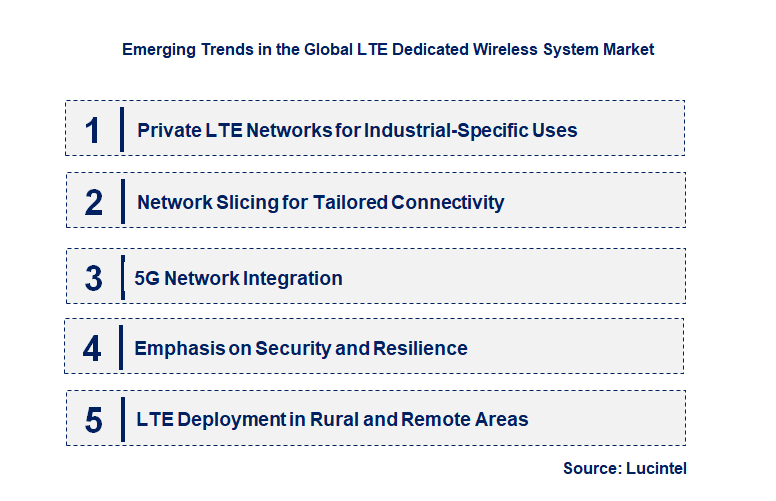
• Private LTE Networks for Industrial-Specific Uses: Increasingly, industries are using private LTE networks that are specifically designed for their particular communications requirements, e.g., manufacturing, healthcare, and public safety. These offer higher control, security, and reliability, which ensures smooth communication for mission-critical operations and lowers latency.
• Network Slicing for Tailored Connectivity: Network slicing enables operators to develop bespoke virtual networks on top of a shared physical infrastructure, facilitating the customization of service levels for particular applications. This development is especially crucial for sectors needing unique communication channels, including emergency services, requiring assured bandwidth and low latency.
• 5G Network Integration: LTE dedicated wireless systems are increasingly being integrated with 5G technology, which improves bandwidth and lowers latency. The integration of LTE and 5G networks provides smooth communication across various use cases, catering to both high-speed mobile applications and mission-critical services in industries such as healthcare and manufacturing.
• Emphasis on Security and Resilience: Since LTE dedicated wireless systems are being rolled out in mission-critical industries, maintaining data security and network resilience is now a prime concern. Encryption, authentication, and sophisticated access control systems are being used to safeguard sensitive data and provide continuous availability of critical services.
• LTE Deployment in Rural and Remote Areas: Most countries are employing LTE dedicated wireless systems to close the rural and remote area connectivity gap. These systems are best suited to extend broadband coverage and deliver secure communication for agriculture, healthcare, and rural infrastructure, fueling economic growth in underserved areas. These trends are redefining LTE dedicated wireless systems from simple communications tools to indispensable infrastructure for industries that need high performance, security, and scalability.
• Greater Investment in Private LTE Networks: Enterprises and governments are making significant investments in private LTE networks, which allow industries to gain more control over their communication infrastructure. These networks are being implemented in manufacturing, logistics, and healthcare industries to improve operational efficiency and security of communications.
• Regulatory Assistance for Spectrum Allocation: The world is seeing the implementation of policies to allocate spectrum for private LTE networks, and industries are being encouraged to create their own exclusive communication systems. These regulatory reforms are providing easier access for businesses operating in mission-critical sectors such as public safety, healthcare, and transport to utilize LTE networks for enhanced communication.
• Collaboration Between Enterprises and Telecom Operators: Enterprises are collaborating with telecom operators to deploy LTE dedicated wireless systems. These partnerships allow industries such as oil and gas, utilities, and transportation to implement private LTE networks that offer secure, low-latency communication for mission-critical operations.
• Deployment in Smart Cities: LTE dedicated wireless systems are being incorporated into smart city infrastructure to enable applications like traffic management, smart grids, and public safety. The deployment of these systems provides the reliable communication required for city operations, enabling the increasing demand for smart technologies.
• Innovation in Network Optimization: LTE networks are getting optimized for individual applications, such as high-density use cases. Carriers are leveraging advanced technology like carrier aggregation and advanced antenna systems to improve bandwidth, mitigate interference, and optimize overall network performance. Such advancements are leading LTE dedicated wireless systems to emerge as a crucial element of new communication infrastructure, especially in mission-critical segments.
• Smart City Development: The increasing trend of smart cities offers a major opportunity for LTE dedicated wireless systems. These systems are critical to link smart devices, control traffic, enable IoT applications, and ensure secure communication for city operations, optimizing urban infrastructure.
• Industrial Automation: When industries implement automation technologies, they require efficient, low-latency communication networks. LTE dedicated wireless systems provide wireless communication between machines, sensors, and devices in real time and with maximum operational efficiency for manufacturing, logistics, and other industries.
• Healthcare and Remote Monitoring: LTE dedicated wireless systems offer healthcare centers dependable communication for telemedicine, patient monitoring, and emergency response. These networks allow critical medical information to be sent securely and without delay, improving patient care and operational efficiency.
• Rural Connectivity: Growth in LTE dedicated wireless systems for rural and under-served communities is a substantial growth opportunity. With enhanced connectivity in these communities, companies can provide improved services in industries such as agriculture, healthcare, and education, as well as support economic development with increased access to information and services.
• Public Safety Networks: There is an increasing requirement for LTE dedicated wireless systems for public safety networks. These networks assist first responders and law enforcement agencies with safe, dependable communication during emergencies, providing uninterrupted service in emergency situations and enhancing the coordination of operations. These prospects illustrate how LTE dedicated wireless systems are contributing towards infrastructure modernization and facilitating industries to address changing communication requirements.
• Rogers Communications
• CommScope
• Nybsys
• Bell Canada
• Parallel Wireless Private
• Telit Cinterion
• Nokia
• Samsung Electronics
• Redline Communications
• ZTE
• Public
• Private
• Industrial
• Traffic
• Energy
• Residential
• Others
• North America
• Europe
• Asia Pacific
• The Rest of the World
• United States: The U.S. is experiencing growing deployment of LTE dedicated wireless systems in industries, especially public safety, healthcare, and smart manufacturing. The Federal Communications Commission (FCC) is also authorizing spectrum for private LTE networks to create a more secure communication infrastructure. Other states are also deploying these systems to assist first responders and critical industries.
• China: China's dedicated wireless system market for LTE is growing as the government emphasizes digital infrastructure for sectors such as manufacturing and logistics. Private LTE networks are being promoted to enhance connectivity and offer secure, high-speed communication, particularly in rural regions and for companies that need high-performance networks.
• Germany: Germany is leading LTE dedicated wireless systems in both private and industrial contexts. The state is aiding the deployment of private LTE networks for increased connectivity within manufacturing, smart cities, and healthcare. Numerous major businesses are rolling out the systems to make their operations as efficient as possible and provide greater communication within core industries.
• India: India is progressing in the deployment of LTE dedicated wireless systems for industries like agriculture, healthcare, and education. The government is making spectrum allocation for private LTE networks easier to enhance connectivity, particularly in rural and remote locations, fueling the growth of internet access and providing improved communication in under-served areas.
• Japan: Japan is investing in LTE dedicated wireless systems in its smart city and industrial IoT projects. Private LTE networks are being encouraged through investments by the government to enhance network security and maximize communication in industries such as transportation, manufacturing, and public safety, ensuring that critical services can function with ease.


• Rogers Communications
• CommScope
• Nybsys
• Bell Canada
• Parallel Wireless Private
• Telit Cinterion
• Nokia
• Samsung Electronics
• Redline Communications
• ZTE Q5. Which LTE dedicated wireless system market segment will be the largest in future? Answer: Lucintel forecasts that, within the type category, private is expected to witness higher growth over the forecast period due to the increasing demand for secure networks. Q6. In LTE dedicated wireless system market, which region is expected to be the largest in next 5 years? Answer: In terms of region, APAC is expected to witness the highest growth over the forecast period. Q7. Do we receive customization in this report? Answer: Yes, Lucintel provides 10% customization without any additional cost.


Choose a license that fits your team. Instant PDF delivery.
Prices exclude taxes. Instant delivery. Custom licensing available on request.
Market Report · July 22, 2026
Market Report · July 17, 2026
Market Report · July 17, 2026
Trusted partner for strategic intelligence and business growth


Receive a complimentary market analysis tailored to your industry. Our analysts will identify key growth opportunities and competitive dynamics specific to your business.

Market size, growth rate, and key trend analysis for your specific sector.

Top competitor positioning and market share analysis.

Strategic recommendations backed by data-driven insights.
Get curated market intelligence and competitive moves straight to your inbox.
By subscribing, you agree to receive our monthly insights. Unsubscribe anytime.
Receive a complimentary market analysis tailored to your industry. Our analysts will identify key growth opportunities and competitive dynamics specific to your business.
Market size, growth rate, and key trend analysis for your specific sector.
Top competitor positioning and market share analysis.
Strategic recommendations backed by data-driven insights.
Get curated market intelligence, emerging trends, and competitive moves straight to your inbox each month.
By subscribing, you agree to receive our monthly insights. Unsubscribe anytime.
We'll send your sample report shortly.