
Market Report · July 24, 2026

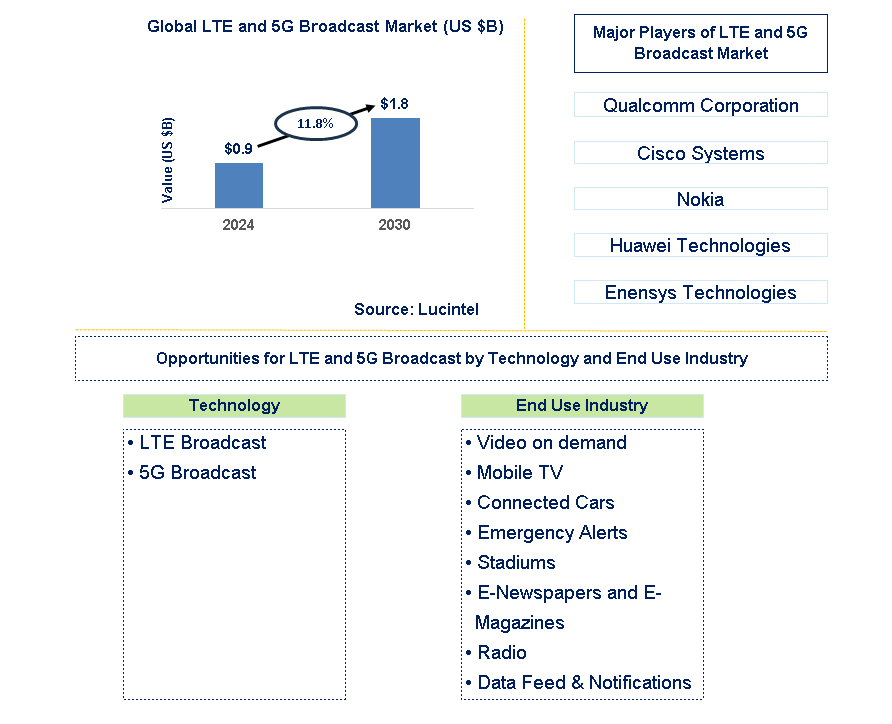
Key data points: The market size in 2030 = $1.8 billion, growth forecast = 11.8% annually for the next 6 years. Scroll below to get more insights. This market report covers trends, opportunities, and forecasts in the global lte and 5G broadcast market to 2030 by technology (LTE broadcast and 5G broadcast), end use industry (video on demand (VOD), mobile TV, connected cars, emergency alerts, stadiums, e-newspapers and e- magazines, radio, and data feed & notifications), and region (North America, Europe, Asia Pacific, and the Rest of the World)
We'll send your sample report shortly.
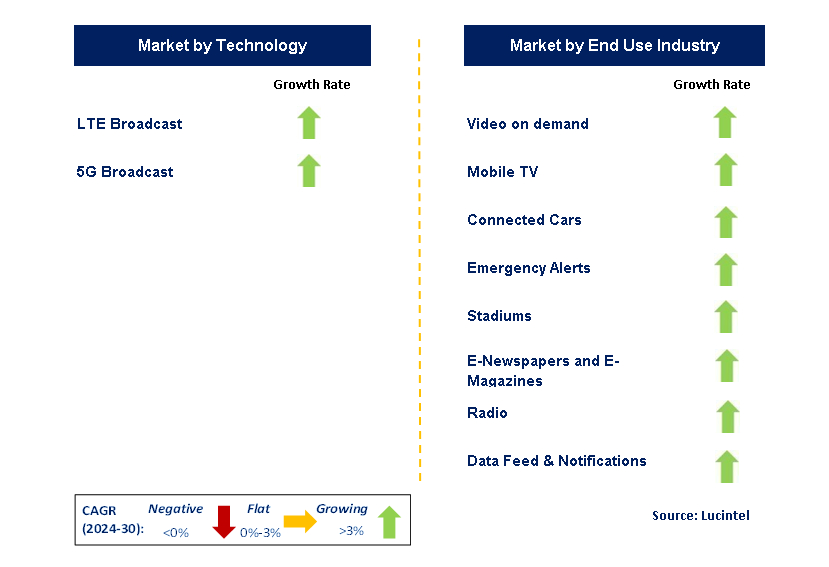
• Lucintel forecasts that, within the technology category, 5G broadcast is expected to witness the higher growth over the forecast period because of home customers' growing desire to watch live broadcasts of all sporting events, including football tournaments, chess competitions, cricket world cups, and other competitions.
• In terms of regions, North America will remain the largest region over the forecast period due to growing advancements in hardware-driven connected internet-of-things (iot) devices and the increasing need for incredibly low latency data connectivity. Gain valuable insights for your business decisions with our comprehensive 150+ page report.
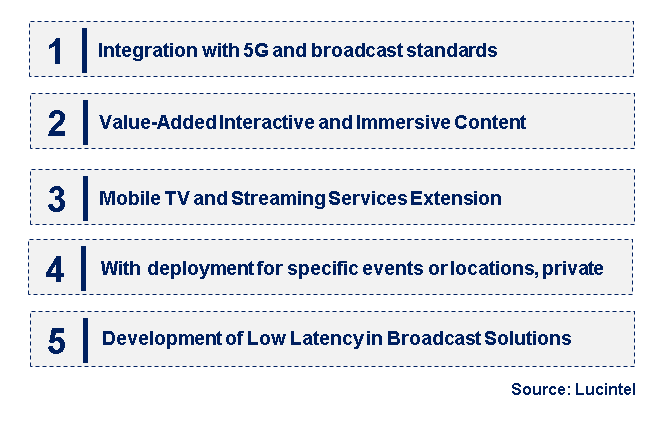
• Integration with 5G and Broadcast Standards: The integration of 5G with existing broadcast standards such as DVB-I and ATSC 3.0 is reinforcing the delivery of content. This trend supports HD video streaming, interactive services, and better coverage. The convergence of 5G and broadcast standards will offer more versatile and robust broadcasting solutions.
• Value-Added Interactive and Immersive Content: 5G's high speed enables the delivery of augmented and virtual reality content. This increases user engagement by enriching live broadcasts and multimedia with interactive and immersive experiences.
• Mobile TV and Streaming Services Extension: The adoption of 5G has helped mobile TV and streaming services gain prominence. High bandwidth and low latency in 5G support high-quality video streaming on mobile devices, improving usability and access to live and on-demand content.
• Private 5G Networks for Specific Events and Locations: Private 5G networks are becoming a new wave in broadcasting. These networks provide customized and high-performance broadcasting solutions, catering to specific needs and configurations defined by broadcasters and content providers.
• Development of Low Latency in Broadcast Solutions: The growing demand for low-latency broadcast solutions is particularly evident in live sports and real-time news. 5G's low latency will play an important role in seamless content delivery, enhancing viewer satisfaction and engagement. These emerging trends are breaking the mold in the LTE and 5G broadcast market by amplifying content delivery, interactivity, and user experiences. This includes the integration of 5G into broadcast standards, the development of mobile TV, and immersive content. Innovation and quality remain key drivers for pushing broadcast services to newer heights.
• 5G Broadcast Pilot Projects: Various pilot projects are underway to test 5G broadcast technology, offering high-definition content in an interactive manner. These projects aim to demonstrate how 5G can enhance the quality and effectiveness of broadcasting services.
• Adoption of ATSC 3.0 Standards: In regions such as the U.S. and Germany, the adoption of ATSC 3.0 standards, integrated with 5G technology, is improving broadcast services. This adoption will improve features for viewers, including interactive TV and better content delivery.
• Increased Mobile Streaming: The expansion of 5G technology has significantly increased mobile streaming, allowing users to view high-quality video content on their devices. This increases access to and consumption of broadcast services.
• Development of Low-Latency Solutions: The advancement of low-latency broadcast solutions is responding to the demand for real-time content delivery. This development is critical in application areas such as live sports and news, where instantaneous content delivery is essential.
• Private 5G Networks for Broadcasting: Private 5G networks have been deployed to offer customized broadcasting solutions for specific events and locations. These developments enable broadcasters to deliver high-performance content tailored to their needs. These developments are advancing the LTE and 5G broadcast market by improving content delivery, quality, and service portfolio expansion. With a focus on pilot projects, standards adoption, and low latency, innovation is shaping the future of broadcasting.
• Smart Cities and Public Safety: 5G broadcast technology offers opportunities for smart city applications and public safety services. Enhanced broadcasting capabilities support real-time data transmission for traffic management, emergency alerts, and public information services.
• Improved Mobile Streaming: The growth of mobile streaming services presents significant opportunities in the 5G broadcast market. The high-speed, low-latency 5G networks will enable seamless streaming of high-definition video content on mobile devices, meeting increasing customer demand.
• Integration of 5G with Interactive TV and Multimedia Services: The integration of 5G technology with interactive TV and multimedia services opens up new opportunities to enhance user experiences. Broadcasting services can now offer more interactive features, such as content personalization and real-time viewer involvement.
• Event Broadcasting and Sports: 5G networks enable a new level of event broadcasting, particularly for sports. Low-latency and high-quality video streaming enhance viewer experiences for live sports events or concerts.
• Private Networks for Enterprises: Private 5G networks provide enterprises with specialized broadcasting solutions. These networks allow businesses to deliver high-performance content tailored to their needs. The strong growth opportunities in the LTE and 5G broadcast market are driving innovation and expansion. The market is evolving in various directions, including smart cities, mobile streaming, interactive services, event broadcasting, and private networks, driven by technological advancements.
• Technological Advancements: Developments in LTE and 5G technology, such as enhanced data rates, low latency, and higher bandwidth, enable high-definition video streaming, immersive content delivery, and interactive services. These advancements improve user experiences and expand the service offerings for broadcasters, fueling market growth.
• Increasing Consumer Demand for HD and UHD Content: Growing demand for HD and UHD content is a key driver for the adoption of LTE and 5G broadcast technologies. These technologies enable the delivery of high-order video and interactive services, meeting consumer expectations and helping broadcasters remain competitive.
• Expansion of Mobile Streaming Services: The proliferation of mobile devices and streaming platforms is driving the expansion of mobile streaming services. 5G technology improves mobile streaming by offering better and faster connectivity, enabling seamless delivery of live and on-demand content. This trend supports the growth of the LTE and 5G broadcast market. Challenges in the LTE and 5G broadcast market are:
• Expensive Cost of Deployment: Deploying 5G infrastructure to provide ultra-wideband and ultra-low latency, along with advanced broadcasting technologies, is costly. High equipment, installation, and maintenance costs can make market expansion expensive and may limit entry for smaller players.
• Regulatory and Standardization Issues: Regulatory inconsistencies and a lack of standardization across regions pose challenges. These issues hinder the interoperability of LTE and 5G broadcast systems, affecting deployment timelines and market efficiency.
• Security and Privacy Concerns: The increased connectivity provided by LTE and 5G broadcasting opens the door to security and privacy concerns. Protecting against cyber threats and safeguarding user data are significant challenges that must be addressed to build consumer trust in broadcast services. The drivers for the LTE and 5G broadcast market include technological advancements, growing consumer demand for content, the expansion of mobile streaming, supportive regulations, and infrastructure investments. Challenges involve regulatory issues, high deployment costs, and security concerns. Balancing these drivers and challenges is key to the successful growth and implementation of LTE and 5G broadcast technologies.
• Qualcomm Corporation
• Cisco Systems
• Nokia
• Huawei Technologies
• Enensys Technologies
• Telstra Corporation
• Ericsson
• Reliance Jio
• Samsung Electronics
• ZTE Corporation
• LTE Broadcast
• 5G Broadcast
• Video on demand (VOD)
• Mobile TV
• Connected Cars
• Emergency Alerts
• Stadiums
• E-Newspapers and E- Magazines
• Radio
• Data Feed & Notifications
• North America
• Europe
• Asia Pacific
• The Rest of the World
• United States: Key innovations in the U.S. include the incorporation of 5G broadcast technology to improve the quality of live streams and mobile TV. Broadcasters like Sinclair Broadcast Group are studying ATSC 3.0 standards to enhance content delivery. The focus is on how 5G will enable high-definition video streaming and interactive services, providing users with better content accessibility.
• China: China is making significant strides in 5G broadcasting, with companies such as Huawei and ZTE leading the way. Deployments of 5G networks are underway to enhance content delivery for live events and mobile services. Notable projects include trials of 5G broadcast technology to deliver high-quality video streaming and interactive broadcasting across urban and rural areas.
• Germany: In Germany, 5G is integrated into the DVB-I standard, advancing LTE and 5G broadcast development. Deutsche Telekom is leading the use of 5G for advanced live TV and multimedia services, focusing on building robust and versatile broadcasting for mobile and smart devices.
• India: India is in the early stages of adopting 5G broadcast technologies, with significant interest from telecom operators and broadcasters. Pilot projects are testing 5G broadcast for high-definition video streaming and mobile content delivery. The government and industry players are working to leverage 5G to improve broadcast quality and access across the country.
• Japan: Japan is at the forefront of 5G broadcasting, with companies like NTT Docomo and SoftBank leading the charge. Recent developments focus on deploying 5G networks to enable high-definition and immersive content delivery. Japan is also prioritizing the integration of 5G and broadcasting services to elevate user experiences in live sports and interactive media.


• Qualcomm Corporation
• Cisco Systems
• Nokia
• Huawei Technologies
• Enensys Technologies
• Telstra Corporation
• Ericsson
• Reliance Jio
• Samsung Electronics
• ZTE Corporation Q6. Which LTE and 5G broadcast market segment will be the largest in future? Answer: Lucintel forecasts that 5G broadcast is expected to witness the higher growth over the forecast period because of home customers' growing desire to watch live broadcasts of all sporting events, including football tournaments, chess competitions, cricket world cups, and other competitions. Q7. In LTE and 5G broadcast market, which region is expected to be the largest in next 5 years? Answer: North America will remain the largest region over the forecast period due to growing advancements in hardware-driven connected internet-of-things (iot) devices and the increasing need for incredibly low latency data connectivity. Q.8 Do we receive customization in this report? Answer: Yes, Lucintel provides 10% customization without any additional cost.


Choose a license that fits your team. Instant PDF delivery.
Prices exclude taxes. Instant delivery. Custom licensing available on request.
Market Report · July 24, 2026
Market Report · July 20, 2026
Market Report · July 20, 2026
Trusted partner for strategic intelligence and business growth


Receive a complimentary market analysis tailored to your industry. Our analysts will identify key growth opportunities and competitive dynamics specific to your business.

Market size, growth rate, and key trend analysis for your specific sector.

Top competitor positioning and market share analysis.

Strategic recommendations backed by data-driven insights.
Get curated market intelligence and competitive moves straight to your inbox.
By subscribing, you agree to receive our monthly insights. Unsubscribe anytime.
Receive a complimentary market analysis tailored to your industry. Our analysts will identify key growth opportunities and competitive dynamics specific to your business.
Market size, growth rate, and key trend analysis for your specific sector.
Top competitor positioning and market share analysis.
Strategic recommendations backed by data-driven insights.
Get curated market intelligence, emerging trends, and competitive moves straight to your inbox each month.
By subscribing, you agree to receive our monthly insights. Unsubscribe anytime.
We'll send your sample report shortly.