
Market Report · July 15, 2026

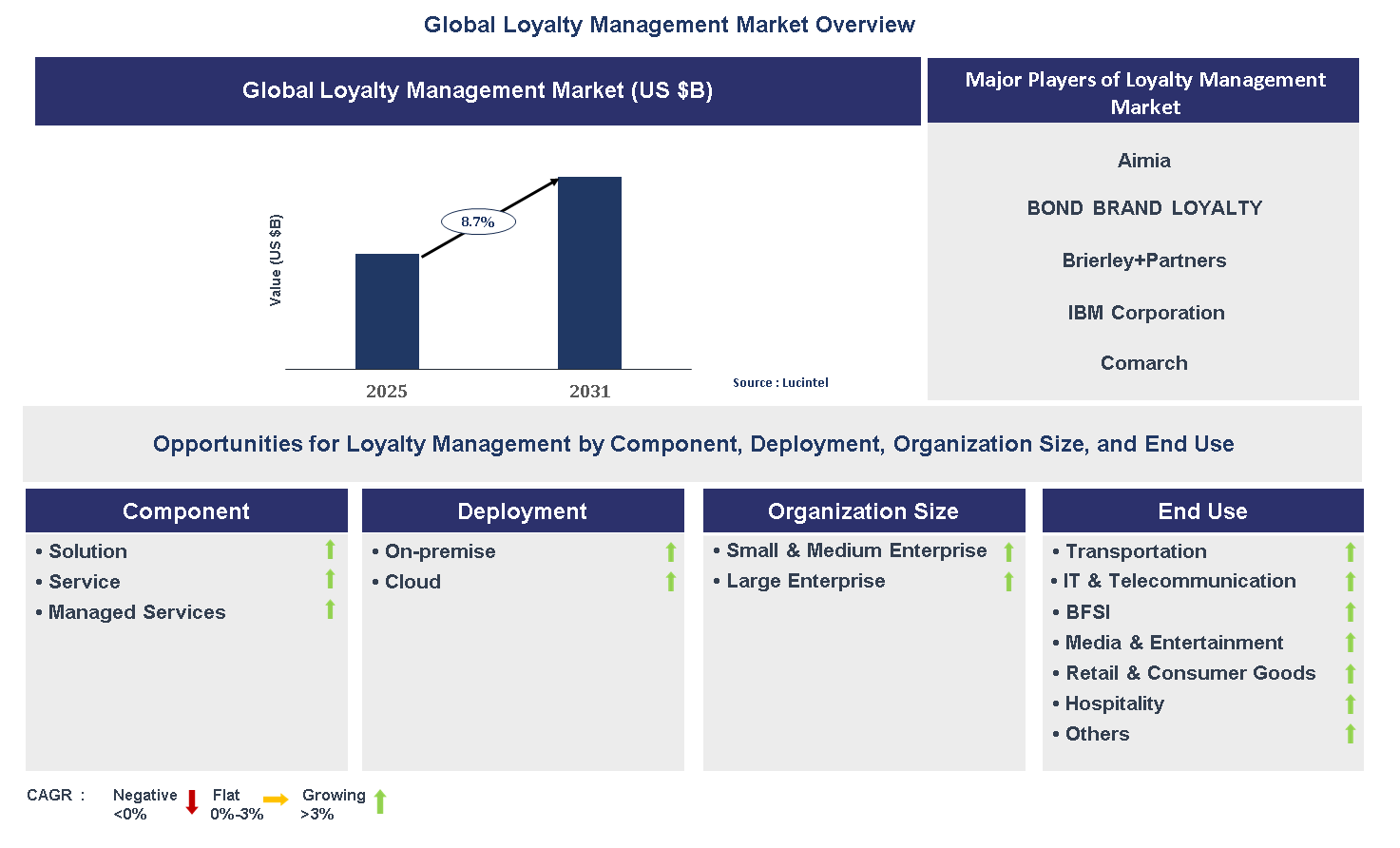
Key data points: The growth forecast = 8.7% annually for the next 7 years. Scroll below to get more insights. This market report covers trends, opportunities and forecasts in loyalty management market to 2031 by component (solution, service, and managed services), deployment (on-premise and cloud), organization size (small & medium enterprise and large enterprise), end use (transportation, IT & telecommunication, BFSI, media & entertainment, retail & consumer goods, hospitality, and others), and region (North America, Europe, Asia Pacific, and the Rest of the World)
We'll send your sample report shortly.
• Lucintel forecasts that, within the component category, solution will remain the largest segment over the forecast period.
• Within the end use category, retail & consumer good will remain the largest segment.
• In terms of region, North America is expected to witness the highest growth over the forecast period. Gain valuable insights for your business decisions with our comprehensive 150+ page report. Sample figures with some insights are shown below.
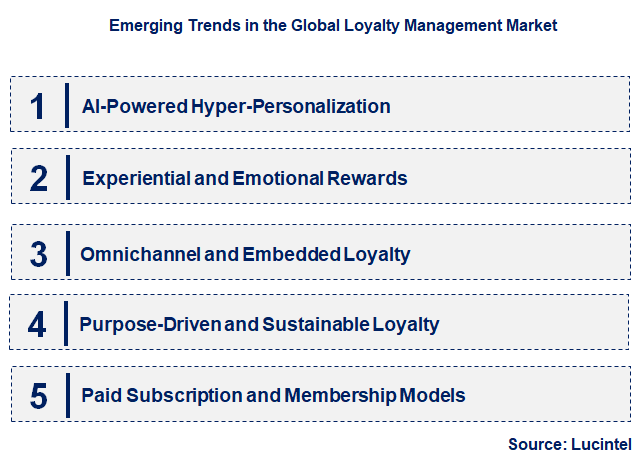
• AI-Powered Hyper-Personalization: AI and Machine Learning are being used to parse enormous amounts of customer information—from shopping history and behavioral patterns to real-time interactions—to provide offers, communications, and rewards specific to an individual customers requirements and interests. This ability goes beyond fundamental segmentation, making one-to-one marketing at scale possible.
• Experiential and Emotional Rewards: Loyalty programs are turning away from strictly transactional rewards (such as points and discounts) towards non-monetary, emotional, and experiential rewards. These include reserved access to events, personalized brand experiences, preview product releases, and customized acknowledgments. This movement is a reaction to customers placing greater importance on memorable experiences rather than straightforward savings, especially among younger, wealthier generations.
• Omnichannel and Embedded Loyalty: This trend is about building a single, unified loyalty experience across every customer interaction channel, from physical stores to e-commerce sites, mobile apps, social media, and customer service channels. Embedded loyalty goes one step further by embedding reward mechanisms in the usage of the product or service itself, making it almost invisible and passive. The key impact is enhanced customer convenience and a reduction in friction points, as members can earn and redeem benefits effortlessly regardless of how they choose to interact with the brand.
• Purpose-Driven and Sustainable Loyalty: Contemporary consumers, especially Millennials and Gen Z, increasingly opt for brands that share their values, including social responsibility and environmental sustainability. This phenomenon includes loyalty programs that reward customers for environmentally friendly activities like recycling, lowering carbon footprints, or buying sustainable goods, or that enable members to donate their points to non-profit organizations. The effect is the establishment of a shared-value proposition, which builds a deeper, ethical relationship between the consumer and the brand.
• Paid Subscription and Membership Models: Companies are launching paid membership levels or subscription models where consumers pay a recurring fee in return for greater and instantaneous benefits, including free shipping, priority service, deeper discounts, or early access to sales. This is differentiated from standard free, points-based programs. The main effect of this strategy is a major boost in customer commitment and frequency of spending, since paid members are psychologically inclined to get the most out of their subscription. These five trends are all combined to reshape the loyalty management market, driving it away from a transactional cost center and into a strategic profit driver and source of competitive differentiation. AI and embedded technology are facilitating unprecedented degrees of personalization and seamlessness (Hyper-Personalization, Omnichannel). At the same time, an emphasis on emotional drivers (Experiential Rewards, Purpose-Driven Loyalty, Paid Models) is building more robust, high-value customer relationships.
• Generation of Generative AI for Loyalty Content Creation : A new innovation is the real-world utilization of Generative AI (GenAI) models in loyalty programs. GenAI is employed to quickly generate hyper-personalized marketing copy, one-of-a-kind reward descriptions, and customized communication flows at scale. For example, it can generate a custom offer email for thousands of distinct customer audiences in a flash, far beyond the reach of legacy marketing automation. The effect is a major increase in the value and timely nature of loyalty messages, which translates directly into increased open, click through, and redemption rates.
• Development of Non-Fungible Token and Blockchain Loyalty : Large brands and loyalty platform providers have introduced pilot programs with the use of Non-Fungible Tokens (NFTs) and blockchain technology to store loyalty assets. This is a new step from the old points to provide members with digital collectibles, documentation of unique membership, or tokenized rewards that can actually be exchanged. The central effect is increased transparency, security, and added layer of perceived value for loyalty members.
• Strategic Alliance Growth for Coalition Loyalty Programs : One of the most important developments is the growth of strategic alliances between brands that are not competitors to create coalition loyalty programs or even just cross brand reward pacts. For instance, an airline may have an alliance with a credit card company, a large retailer, and a chain of petrol stations. Customers can earn and redeem one loyalty currency in a wide range of services. The effect is a huge boost in the perceived value and usefulness of the loyalty currency since it becomes more convenient and practical to use on a daily basis.
• API First and Headless Loyalty Architectures : More and more loyalty management solutions are being developed based on Application Programming Interface (API) first and headless architectures. This entails the core loyalty logic (points, tiers, rules) being decoupled from the customer facing interface (website, app, POS system). This innovation enables brands to bring loyalty capabilities into any touchpoint—a new mobile app, a third party website, an in-store kiosk—without sophisticated, monolithic integrations.
• B2B Loyalty and Channel Partner Programs Focus : One of the key developments outside of consumer retail is the accelerating investment in B2B loyalty and channel partner programs across manufacturing, technology, and the automotive sector. These initiatives emphasize rewarding distributors, resellers, and sales agents with customized incentives, training, and recognition, as opposed to end consumers. The result is a stabilization and optimization of the sales channel, resulting in higher retention of top performing partners and increased wallet share. These above-mentioned developments are essentially transforming the loyalty management market by making its digitalization faster, its customer value perceived, and embedding it more within business core processes. The emphasis is on technology responsiveness (API-First, GenAI), innovation in new value propositions (NFT/Blockchain, Coalition), and penetration into high growth segments (B2B). This combined advancement is turning loyalty management into a mission critical, information rich platform that generates revenue, reinforces brand differentiation, and lays the foundation for long term customer relationships.
• Optimizing Customer Lifetime Value through Predictive Analytics Growth Opportunity: The greatest strategic growth opportunity is in applying sophisticated predictive analytics (a key use case) to simulate and optimize Customer Lifetime Value (CLV). This requires applying ML algorithms to forecast future customer behavior—such as churn risk or the next best product to present—and then automatically triggering highly specific, preventative loyalty initiatives in real time. The effect is the power to move loyalty programs from reactive (rewarding current behavior) to proactive (influencing future behavior), resulting in a material lift in the average revenue per customer.
• Deeper Integration into the Mobile-First Customer Engagement Channel: With customers interacting more through mobile, a primary growth application is deeper, integrated integration of loyalty programs into mobile apps and mobile payment systems (Apple Pay, Google Wallet, WeChat Pay). This extends beyond a basic loyalty app to integrate rewards, point accrual, and redemption into the mobile transaction path itself. The effect is a huge boost to convenience and utility, since the loyalty program is accessible anywhere, all the time, and seamlessly combined with the act of purchase.
• Coalition and Ecosystem Loyalty Applications: One of the key strategic growth areas is the growth of loyalty as an ecosystem, commonly called coalition loyalty or cross-brand partnerships. This application is the development of platforms and arrangements where consumers can accumulate and redeem a common currency across several, non-competing companies (e.g., a bank, an airline, a grocery chain). The effect is a sudden surge in the scope and appeal of the loyalty program by increasing its usefulness in various areas of a customer life.
• Omnichannel Unification for Frictionless Customer Experience: Implementing loyalty management to combine all customer touchpoints—in store Point of Sale (POS), e-commerce, mobile, and social media—into one uniform, seamless experience is a strategic imperative. The system needs to identify the customer, their status, and their redeemable rewards regardless of the usage channel. The effect is the elimination of friction in the customer experience, which removes typical annoyances such as not being able to redeem points on the website that were accumulated in store. This integrated application fuels customer satisfaction, promotes cross channel buying, and ensures all data gathered is centralized into one source of truth, offering a 360 degree view of the customer.
• Dedicated B2B Channel Partner and Loyalty Management Applications: There is a high value, under-exploited application in the form of dedicated software and service for managing B2B channel partners and loyalty, independent of consumer-oriented programs. This includes applications customized to monitor sales performance, training completion, and relationship longevity of distributors, resellers, or agents, rewarding them with cash equivalent rewards, tiered recognition, or priority support. These opportunities for strategic growth are shaping the loyalty management market by directing investment into high-return, data focused, and integrated applications. The market is expanding with sophistication, evolving from broad-based discounts to accurate, high utility value delivery. With a concentration on predictive CLV, mobile supremacy, ecosystem growth, omnichannel cohesion, and B2B maturity, the loyalty management market is becoming an essential driver for sustained growth, competitive success, and comprehensive customer value creation.
• Aimia
• BOND BRAND LOYALTY
• Brierley+Partners
• IBM Corporation
• Comarch
• Five Stars Loyalty
• ICF International
• Kobie Marketing
• The Lacek Group
• Martiz Holdings
• Solution
• Service
• Managed Services
• On-premise
• Cloud
• Small & Medium Enterprise
• Large Enterprise
• Transportation
• IT & Telecommunication
• BFSI
• Media & Entertainment
• Retail & Consumer Goods
• Hospitality
• Others
• North America
• Europe
• Asia Pacific
• The Rest of the World
• United States: The US market is dominated by a heavy focus on subscription loyalty programs and paid membership, with premium benefits and greater engagement, particularly in retail and travel. There is accelerated investment in utilizing Generative Artificial Intelligence (GenAI) and Machine Learning (ML) capabilities for hyper-personalization and real-time reward optimization. Companies are increasingly connecting loyalty platforms to existing CRM systems to attain a unified omnichannel customer view.
• China: The Chinese loyalty management market is strongly influenced by the countrys highly advanced digital infrastructure and super-apps and mobile payment platform dominance. Loyalty schemes are strongly embedded in WeChat and Alipay-type platforms, with an emphasis on frictionless, mobile-led experiences. A major trend is the leveraging of social loyalty and gamification to stimulate engagement, especially among young consumers, riding on the social aspect of e-commerce. Coalition loyalty initiatives with cross-brand collaborations are emerging as dominant to broaden the rewards system.
• Germany: The German marketplace, which is characterized by a strong focus on data privacy and consumer protection, is witnessing developments aimed at creating transparent and reliable loyalty relationships. Loyalty programs tend to be more value-based and utility-based in their rewards instead of having extensive data exchanges. There is a gradual shift toward digitalizing card-based schemes, using mobile wallets and cloud platforms for efficiency and greater customer convenience.
• India: India is amongst the fastest-growing loyalty markets, driven by growing smartphone penetration and the mass adoption of digital payment systems. The growth is defined by the proliferation of mobile-based and personalized loyalty programs within retail, BFSI, and e-commerce. A striking trend is Indian consumers, particularly millennials, being very willing to join high-end or fee-paying loyalty tiers for superior service. Firms are also using local and vernacular data to personalize loyalty messages and propositions, emphasizing ease of use and immediate reward to drive adoption in different geographic and demographic groups.
• Japan: The Japanese market for loyalty is mature with strong consumer engagement in many programs, often built on coalition programs and multi-brand point currencies. The notable trend is the convergence of e-commerce and physical stores using sophisticated omnichannel solutions to close the gap between online and offline shopping. Technology adoption emphasizes efficiency, with AI use in customer segmentation and predictive analysis to optimize rewards and offers. The market also exhibits an increasing, although cautious, interest in "Green Loyalty" programs that reward environmentally friendly buying habits.


• Aimia
• BOND BRAND LOYALTY
• Brierley+Partners
• IBM Corporation
• Comarch
• Five Stars Loyalty
• ICF International
• Kobie Marketing
• The Lacek Group
• Martiz Holdings Q5. Which loyalty management market segment will be the largest in future? Answer: Lucintel forecasts that, within the component category, solution will remain the largest segment over the forecast period. Q6. In loyalty management market, which region is expected to be the largest in next 5 years? Answer: In terms of region, North America is expected to witness the highest growth over the forecast period. Q7. Do we receive customization in this report? Answer: Yes, Lucintel provides 10% customization without any additional cost.


Choose a license that fits your team. Instant PDF delivery.
Prices exclude taxes. Instant delivery. Custom licensing available on request.
Market Report · July 15, 2026
Market Report · June 26, 2026
Market Report · June 24, 2026
Trusted partner for strategic intelligence and business growth


Receive a complimentary market analysis tailored to your industry. Our analysts will identify key growth opportunities and competitive dynamics specific to your business.

Market size, growth rate, and key trend analysis for your specific sector.

Top competitor positioning and market share analysis.

Strategic recommendations backed by data-driven insights.
Get curated market intelligence and competitive moves straight to your inbox.
By subscribing, you agree to receive our monthly insights. Unsubscribe anytime.
Receive a complimentary market analysis tailored to your industry. Our analysts will identify key growth opportunities and competitive dynamics specific to your business.
Market size, growth rate, and key trend analysis for your specific sector.
Top competitor positioning and market share analysis.
Strategic recommendations backed by data-driven insights.
Get curated market intelligence, emerging trends, and competitive moves straight to your inbox each month.
By subscribing, you agree to receive our monthly insights. Unsubscribe anytime.
We'll send your sample report shortly.