
Market Report · July 22, 2026

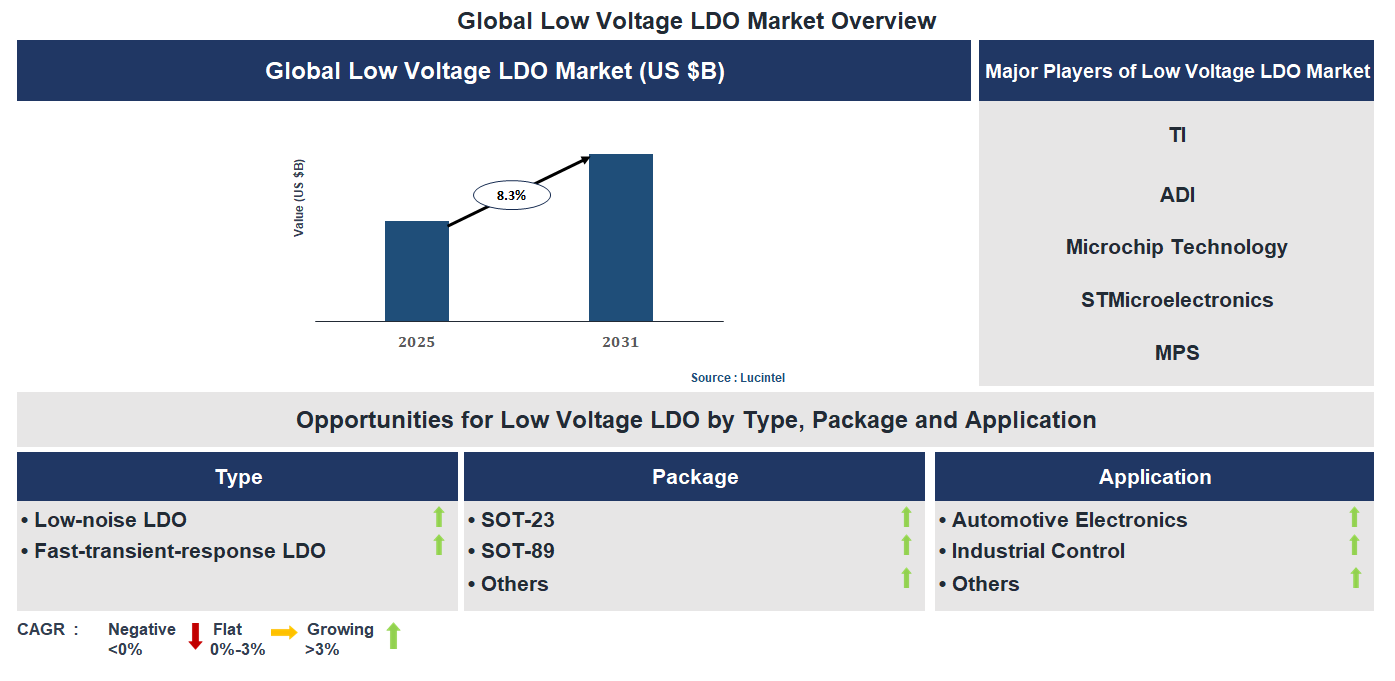
Key data points: The growth forecast = 8.3% annually for the next 6 years. Scroll below to get more insights. This market report covers trends, opportunities and forecasts in low voltage LDO market to 2031 by type (low-noise LDO and fast-transient-response LDO), package (SOT-23, SOT-89, and others), application (automotive electronics, industrial control, and others), and region (North America, Europe, Asia Pacific, and the Rest of the World)
We'll send your sample report shortly.
• Lucintel forecasts that, within the type category, fast-transient-response LDO is expected to witness higher growth over the forecast period.
• Within the application category, automotive electronics is expected to witness higher growth.
• In terms of region, APAC is expected to witness the highest growth over the forecast period. Gain valuable insights for your business decisions with our comprehensive 150+ page report. Sample figures with some insights are shown below.
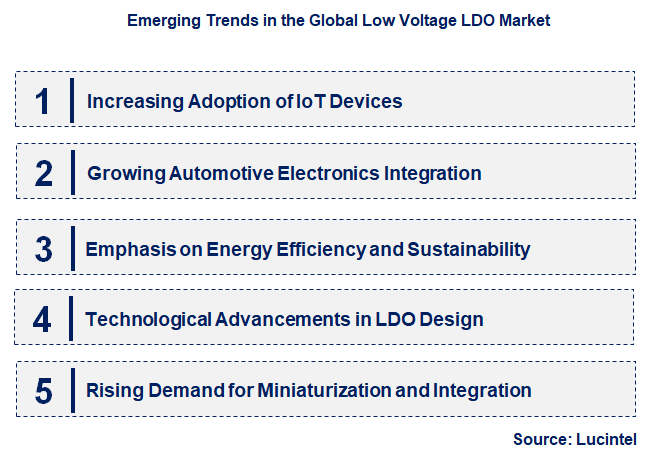
• Increasing Adoption of IoT Devices: The proliferation of IoT devices demands compact, energy-efficient power solutions. Low Voltage LDOs are favored for their ability to provide stable voltage regulation in small form factors, supporting the miniaturization of smart sensors, wearables, and connected home devices. This trend drives innovation in low-power, high-performance LDOs, expanding market opportunities and encouraging manufacturers to develop specialized solutions tailored for IoT applications.
• Growing Automotive Electronics Integration: The automotive industry is integrating more electronic systems, including ADAS, infotainment, and electric vehicle components. Low Voltage LDOs are essential for powering sensitive electronics with minimal noise and high efficiency. The trend toward electric and autonomous vehicles boosts demand for robust, reliable LDOs capable of operating under harsh conditions, prompting manufacturers to focus on enhanced thermal stability, durability, and compliance with automotive standards.
• Emphasis on Energy Efficiency and Sustainability: As energy conservation becomes a priority, the market is shifting toward ultra-low power LDOs that reduce energy consumption in portable and battery-powered devices. Innovations focus on reducing quiescent current and improving dropout voltage, which enhances overall system efficiency. This trend aligns with global sustainability goals, encouraging the development of eco-friendly, energy-efficient power management solutions that appeal to environmentally conscious consumers and industries.
• Technological Advancements in LDO Design: New materials, fabrication techniques, and circuit architectures are enabling the creation of LDOs with better performance metrics such as lower noise, higher accuracy, and faster transient response. These technological innovations improve the reliability and versatility of Low Voltage LDOs, allowing them to meet the stringent requirements of advanced applications like 5G infrastructure, medical devices, and high-speed data processing systems.
• Rising Demand for Miniaturization and Integration: The trend toward smaller, integrated electronic systems necessitates compact power management solutions. Low Voltage LDOs are being designed with smaller footprints and integrated features such as enable/disable functions and adjustable output voltages. This miniaturization trend supports the development of multi-functional, space-saving devices, fostering innovation in packaging and integration techniques, and expanding the market for portable and wearable electronics. In summary, these trends are collectively transforming the Low Voltage LDO market by enhancing device performance, enabling new applications, and promoting sustainability. They are fostering innovation, increasing competition, and expanding the market scope, ultimately leading to more efficient, reliable, and versatile power management solutions across various industries.
• Growing Demand for Portable Devices: The proliferation of smartphones, wearables, and IoT gadgets is boosting the need for low voltage, high-efficiency LDOs. These devices require compact power management solutions that conserve energy and extend battery life. As consumer preference shifts toward portable, wireless technology, manufacturers are innovating to produce smaller, more efficient LDOs. This trend enhances device performance, reduces heat dissipation, and supports the miniaturization of electronic products, thereby expanding the market significantly.
• Advancements in Semiconductor Technology: Innovations in semiconductor materials and fabrication processes are enabling the development of more efficient low voltage LDOs. These technological improvements result in lower dropout voltages, reduced quiescent current, and enhanced load regulation. As a consequence, power management ICs become more reliable and energy-efficient, meeting the stringent requirements of modern electronics. This progress is attracting investments and fostering competitive product development, which accelerates overall market growth.
• Increasing Adoption in Automotive Electronics: The automotive industry’s shift toward electric vehicles (EVs) and advanced driver-assistance systems (ADAS) is driving demand for low voltage LDOs. These components are crucial for powering sensors, control units, and infotainment systems with high efficiency. The need for compact, robust, and reliable power solutions in automotive applications is prompting manufacturers to innovate. This trend not only expands the market but also emphasizes the importance of durable, high-performance LDOs in safety-critical systems.
• Rising Focus on Energy Efficiency and Sustainability: Environmental concerns and energy regulations are pushing industries to adopt more sustainable power management solutions. Low voltage LDOs, with their high efficiency and low quiescent current, are central to this shift. They help reduce overall energy consumption in electronic devices, supporting green initiatives. As sustainability becomes a key market driver, companies are investing in eco-friendly, energy-efficient LDO designs, which further propels market growth and aligns with global environmental goals.
• Expansion in Industrial Automation and IoT: The increasing deployment of industrial automation systems and IoT devices requires reliable, low-power power management solutions. Low voltage LDOs are essential for powering sensors, controllers, and communication modules in these applications. The demand for miniaturized, energy-efficient components is rising as industries seek to improve operational efficiency and reduce energy costs. This expansion is creating new opportunities for market players to develop specialized LDOs tailored for industrial and IoT environments, fueling overall market development. These recent developments are significantly impacting the low voltage LDO market by driving innovation, enhancing product efficiency, and expanding application areas. The focus on portable devices, automotive electronics, sustainability, and industrial automation is creating a dynamic environment for growth. As manufacturers continue to innovate and meet evolving technological demands, the market is poised for sustained expansion, offering new opportunities for stakeholders and shaping the future of power management solutions globally.
• Growing Demand for Energy-Efficient Power Management Solutions: The increasing need for low power consumption in portable devices and IoT applications is driving the adoption of low voltage LDOs. These regulators offer efficient voltage regulation with minimal power loss, making them ideal for battery-powered devices. As consumer electronics become more sophisticated and energy-conscious, manufacturers are prioritizing low voltage LDOs to enhance device performance and battery life, thereby expanding market opportunities.
• Expansion of IoT and Wearable Devices Creating New Market Opportunities: The proliferation of IoT devices and wearable technology necessitates compact, reliable, and low-power voltage regulators. Low voltage LDOs are essential for powering sensors, microcontrollers, and wireless modules in these devices. The trend toward miniaturization and energy efficiency in IoT and wearables is expected to significantly boost demand, encouraging innovation and new product development in this segment.
• Automotive Electronics Integration Boosts Market Growth: The automotive industry’s shift toward electric and autonomous vehicles requires advanced power management solutions. Low voltage LDOs are increasingly used in automotive electronics for sensors, infotainment systems, and ADAS applications. Their ability to operate efficiently at low voltages and withstand harsh conditions makes them vital. Growing automotive electronics integration is expected to propel market growth, with manufacturers focusing on rugged, high-performance, low voltage LDOs.
• Technological Advancements in Semiconductor Materials and Design: Innovations in semiconductor materials, such as silicon carbide and gallium nitride, are enhancing the performance of low voltage LDOs. Improved design techniques, including integrated passives and advanced packaging, reduce size and improve thermal management. These technological advancements enable higher efficiency, lower noise, and better stability, opening new avenues for applications in sensitive electronics and high-performance systems, thereby expanding the market scope.
• Increasing Adoption in Consumer Electronics and Industrial Automation: Consumer electronics like smartphones, tablets, and smart home devices require compact, efficient power regulators. Similarly, industrial automation systems demand reliable voltage regulation for sensors and controllers. The rising adoption of low voltage LDOs in these sectors is driven by their ability to deliver stable power in space-constrained environments. This trend is expected to continue, fostering innovation and increasing market penetration across diverse application areas. The overall impact of these opportunities is set to significantly accelerate the growth trajectory of the low voltage LDO market, fostering innovation, expanding application scope, and enhancing competitiveness among industry players.
• Technological Innovation: The continuous development of advanced low voltage LDOs with higher efficiency, lower noise, and better thermal performance is a key driver. As electronic devices become more compact and power-sensitive, the demand for sophisticated voltage regulators increases. Innovations such as integrated power management solutions and improved fabrication techniques enable manufacturers to meet the rising performance standards. These technological advancements not only enhance device performance but also open new application avenues, thereby expanding the market.
• Growing Adoption in Consumer Electronics: The surge in demand for smartphones, tablets, wearables, and IoT devices significantly propels the low voltage LDO market. Consumers expect longer battery life and reliable performance, which necessitates efficient power management solutions. Manufacturers are integrating low voltage LDOs to ensure a stable power supply while minimizing energy consumption. The proliferation of connected devices and smart gadgets continues to drive the need for compact, efficient voltage regulators, fueling market growth.
• Increasing Focus on Energy Efficiency and Sustainability: Regulatory pressures and consumer preferences are pushing manufacturers to develop energy-efficient components. Low voltage LDOs contribute to reducing overall power consumption in electronic devices, aligning with global sustainability goals. Governments and industry standards promote the adoption of energy-efficient solutions, encouraging innovation and deployment of low voltage regulators. This focus on sustainability not only enhances brand reputation but also ensures compliance with evolving regulations, thereby supporting market expansion.
• Expansion of Automotive and Industrial Applications: The integration of low voltage LDOs in automotive electronics, such as ADAS and infotainment systems, and industrial automation equipment is a significant growth driver. These sectors demand reliable, compact, and efficient power management solutions to operate safely and efficiently. The increasing complexity of automotive electronics and the rise of Industry 4.0 initiatives necessitate advanced voltage regulation, boosting demand for low voltage LDOs across these industries.
• Rising Demand for Miniaturization and Integration: The trend toward miniaturized electronic devices requires smaller, integrated power management solutions. Low voltage LDOs are favored for their compact size and ease of integration into complex circuits. This miniaturization trend is evident in wearable technology, medical devices, and portable gadgets, where space constraints are critical. The ability to deliver high performance in a small form factor makes low voltage LDOs indispensable, driving their adoption in new and existing markets. The challenges facing this low voltage LDO market include:
• Technological Limitations: Despite ongoing innovations, low voltage LDOs face inherent limitations such as dropout voltage, efficiency constraints, and thermal management issues. As devices operate at lower voltages, maintaining a stable output without excessive heat generation becomes challenging. These technical hurdles can restrict performance improvements and increase design complexity, potentially limiting market growth and forcing manufacturers to invest heavily in R&D to overcome these barriers.
• Intense Market Competition: The low voltage LDO market is highly competitive, with numerous established players and new entrants vying for market share. Price wars, rapid technological advancements, and product differentiation are constant challenges. Companies must continuously innovate and optimize costs to stay competitive, which can strain resources and impact profit margins. This competitive landscape also makes it difficult for smaller players to gain footholds, potentially stifling innovation and market diversity.
• Regulatory and Environmental Challenges: Evolving regulatory standards related to energy efficiency, safety, and environmental impact pose compliance challenges for manufacturers. Meeting diverse regional regulations requires significant adaptation in product design and testing, increasing time-to-market and costs. Additionally, stricter environmental regulations on electronic waste and hazardous materials necessitate sustainable manufacturing practices, which can be costly and complex to implement, potentially hindering market growth. In summary, the low voltage LDO market is driven by technological advancements, increasing adoption in consumer electronics, a focus on energy efficiency, expanding automotive and industrial applications, and miniaturization trends. However, it faces challenges such as technological limitations, intense competition, and regulatory hurdles. These factors collectively influence the market's growth potential, requiring stakeholders to innovate continuously and adapt to evolving standards. Overall, the market's future will depend on how effectively these drivers are leveraged and challenges managed, shaping a landscape of opportunities and obstacles for industry participants.
• TI
• ADI
• Microchip Technology
• STMicroelectronics
• MPS
• Suzhou Novosense
• 3PEAK
• Awinic
• SGMICRO
• Silicon Content Technology
• Low-noise LDO
• Fast-transient-response LDO
• SOT-23
• SOT-89
• Others
• Automotive Electronics
• Industrial Control
• Others
• North America
• Europe
• Asia Pacific
• The Rest of the World
• United States: The US market has seen substantial innovation in low voltage LDOs, focusing on high efficiency and low noise performance. Major players are investing in R&D to develop integrated solutions for consumer electronics, medical devices, and aerospace applications. The adoption of advanced manufacturing techniques has enhanced product reliability and miniaturization, supporting the growth of the IoT and wearable technology sectors.
• China: China remains a dominant force in the low voltage LDO market, driven by rapid industrialization and a booming electronics manufacturing industry. Recent developments include the integration of smart power management solutions and the expansion of local manufacturing capabilities. Chinese companies are also focusing on cost-effective, high-performance LDOs to serve the growing domestic and export markets, especially in mobile devices and automotive electronics.
• Germany: Germany's market is characterized by a focus on high-quality, precision components for industrial automation, automotive, and aerospace sectors. Recent advancements include the development of ultra-low noise LDOs and enhanced thermal management solutions. German firms are also investing in sustainable manufacturing practices and innovative designs to meet stringent European standards and environmental regulations.
• India: The Indian market has experienced rapid growth due to increased demand for consumer electronics, renewable energy systems, and IoT applications. Recent developments include the localization of manufacturing and R&D activities, with a focus on developing low-cost, energy-efficient LDOs. The government’s initiatives to promote electronics manufacturing have further accelerated market expansion and technological innovation.
• Japan: Japan continues to lead in high-performance, reliable low voltage LDOs, especially for automotive, robotics, and industrial applications. Recent advancements involve the integration of smart features such as overcurrent protection and thermal shutdown. Japanese companies are also emphasizing miniaturization and energy efficiency, aligning with global trends toward sustainable and compact electronic solutions.


• TI
• ADI
• Microchip Technology
• STMicroelectronics
• MPS
• Suzhou Novosense
• 3PEAK
• Awinic
• SGMICRO
• Silicon Content Technology Q5. Which low voltage LDO market segment will be the largest in future? Answer: Lucintel forecasts that, within the type category, fast-transient-response LDO is expected to witness higher growth over the forecast period. Q6. In low voltage LDO market, which region is expected to be the largest in next 5 years? Answer: In terms of region, APAC is expected to witness the highest growth over the forecast period. Q7. Do we receive customization in this report? Answer: Yes, Lucintel provides 10% customization without any additional cost.


Choose a license that fits your team. Instant PDF delivery.
Prices exclude taxes. Instant delivery. Custom licensing available on request.
Market Report · July 22, 2026
Market Report · July 22, 2026
Market Report · July 17, 2026
Trusted partner for strategic intelligence and business growth


Receive a complimentary market analysis tailored to your industry. Our analysts will identify key growth opportunities and competitive dynamics specific to your business.

Market size, growth rate, and key trend analysis for your specific sector.

Top competitor positioning and market share analysis.

Strategic recommendations backed by data-driven insights.
Get curated market intelligence and competitive moves straight to your inbox.
By subscribing, you agree to receive our monthly insights. Unsubscribe anytime.
Receive a complimentary market analysis tailored to your industry. Our analysts will identify key growth opportunities and competitive dynamics specific to your business.
Market size, growth rate, and key trend analysis for your specific sector.
Top competitor positioning and market share analysis.
Strategic recommendations backed by data-driven insights.
Get curated market intelligence, emerging trends, and competitive moves straight to your inbox each month.
By subscribing, you agree to receive our monthly insights. Unsubscribe anytime.
We'll send your sample report shortly.