
Market Report · July 20, 2026

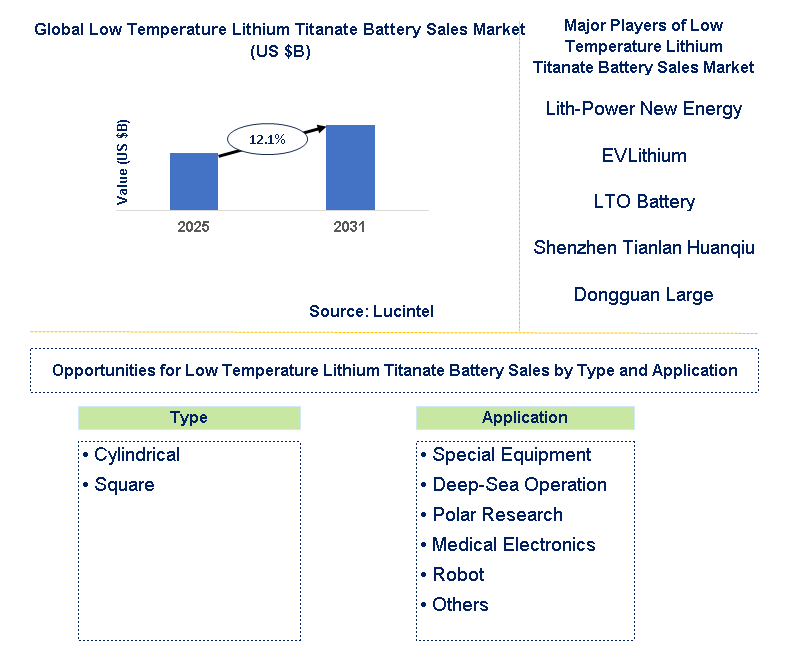
Key data points: The growth forecast = 12.1% annually for the next 7 years. Scroll below to get more insights. This market report covers Trends, opportunities and forecasts in low temperature lithium titanate battery sales market to 2031 by type (cylindrical and square), application (special equipment, deep-sea operation, polar research, medical electronics, robot, and others), and region (North America, Europe, Asia Pacific, and the Rest of the World)
We'll send your sample report shortly.
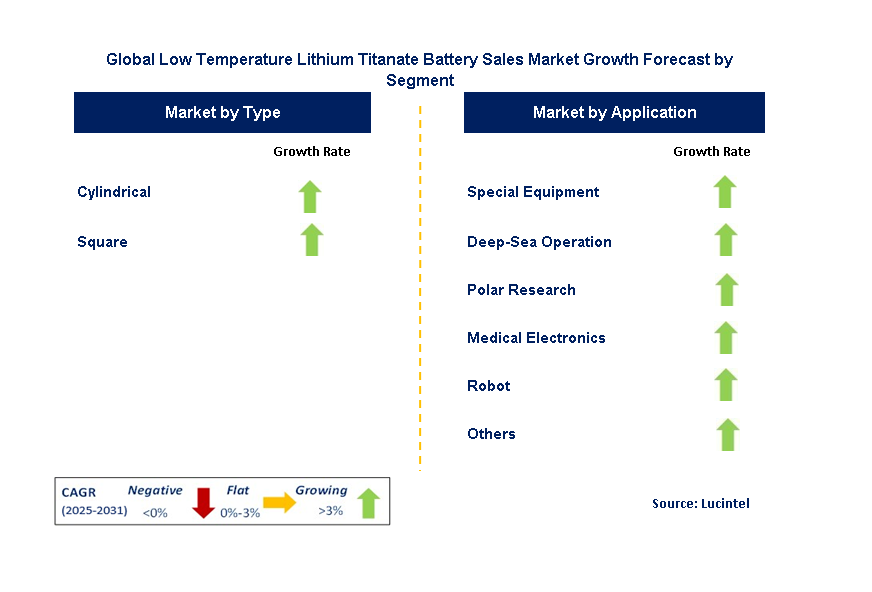
• Lucintel forecasts that, within the type category, cylindrical is expected to witness higher growth over the forecast period due to the increasing use in electric vehicles.
• Within the application category, medical electronics is expected to witness the highest growth due to the growing healthcare needs.
• In terms of region, APAC is expected to witness the highest growth over the forecast period due to the rising adoption of renewable energy storage systems.
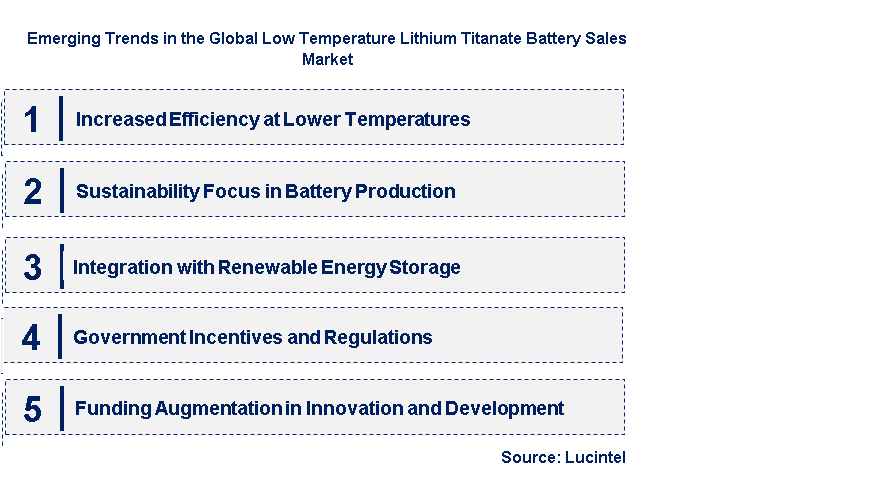
• Increased Efficiency at Lower Temperatures: One of the major developments is the engineering of batteries that are cold tolerant, which can operate optimally even in sub-zero environments. With global temperatures shifting, especially in Europe and North America, these batteries are highly sought after. Progressions of this sort improve the practicality of electric vehicle and energy storage systems in colder regions where, for the most part, lithium ion batteries do not perform efficiently.
• Sustainability Focus in Battery Production: It is noted that, as companies and governments strive towards sustainability, the production of low temperature lithium titanate batteries at eco-friendly standards is being put into more consideration. Manufacturers are looking for ways to enhance the use of eco-friendly materials, lessen the production waste, and improve battery recyclability. It is therefore unsurprising that the demand for such products is on the rise as consumers and industries switch towards cleaner technologies.
• Integration with Renewable Energy Storage: Batteries with low temperature lithium titanate batteries are being used more and more in the energy storage market, in particular for solar and wind energy. These batteries affordably control the storage of energy produced during peak hours, allowing for distribution during periods of high consumption. This is important to ensure energy equilibrium in areas where there is a high uptake of renewables and energy storage systems have to work effectively in different climatic regions even in the cold season.\
• Government Incentives and Regulations: The low temperature lithium titanate battery market is being driven considerably because of policies and government incentives. For example, governments in colder regions provide incentives to adopt energy-efficient technologies, such as low-temperature electric batteries. These policies encourage the adoption of cleaner technologies with the hope that innovation will make energies system more efficient. There is also a growing regulation to moderate carbon emissions which is leading companies to invest in sustainable battery technologies.
• Funding Augmentation in Innovation and Development: There is a growing funding augmentation dedicated to innovation and development for the low temperature lithium titanate battery sales market. More brands are attempting to expend significant funds on developing battery technologies that perform well with high energy density, longer life cycles, and faster charging in extreme conditions. Funding in this area is paramount for advancing the next generation of low temperature batteries to satisfy the growing need of energy solutions in electric vehicles and renewable energy storing devices. These changes are transforming the low temperature lithium titanate battery sales market by improving efficiency, sustainability, and penetration in emerging markets. With strong growth expected in the demand for low-temperature batteries, more technological development, in combination with stronger government funding will continue to bolster market growth and new developments.
• Enhanced Battery Performance at Low Temperature: The marketing Low Temperature Lithium Titanate Battery has progressed remarkably in efficiency on low-temperature ranges. With new technologies developed, these batteries can now operate on -30°C or lower without a hitch. This is very crucial for Electric Vehicle and energy storage systems implemented in areas with colder temperatures. This development is bettering their appeal in northern parts of Europe and North America that are prone to harsh winters.
• Erection Of New Manufacturing Plants: Low-temperature lithium titanate batteries are in high stride. To correlate these changes, companies are working to make changes on the production side too. New plants are being built with modern technologies for the production of lithium titanate batteries to meet the market supply and demand balance. Not only is this expansion fulfilling the increasing market need, but it is also providing an increased affordable supply, targeting a higher number of industries.
• Developments in Charge Time and Power Speed: With the efforts toward low-temperature lithium titanate batteries, charging speed and battery life are two key pillars that are continuously improving. The development of batteries for electric vehicles and renewable energy storage systems is easier now due to quicker charging and prolonged durability. These improvements are vital for modern applications such as electric vehicles and renewable energy systems, where fast recharging capabilities and power longevity are necessary.
• Greater Penetration of the Electric Vehicle Segment : The proliferation of electric vehicles is further fueling growth of the low temperature lithium titanate battery sales market. There has been a noticeable increase in the supply of electric vehicles which is driving battery manufacturing firms to put a greater emphasis on building lithium titanate batteries with low temperature capabilities. These batteries are designed for use in electric vehicles to allow for adequate performance in relatively cold winter conditions, especially in northern climates. This tendency is forecasted to grow further with the increased adoption of electric vehicles in regions with severe weather.
• The Role of Government for Assistance with Low-Temperature Technologies: Development is being sponsored by governments around the world through financial incentives and favorable regulations for the production of low temperature lithium titanate batteries. Subsidies are being offered for businesses that research and employ energy efficient technology like low temperature batteries in the US, China, and Europe. These funding policies are critical for the enhanced adoption of these batteries and for the clean energy technology advance. These changes are tremendously benefiting the low temperature lithium titanate battery sales market as they bring in an increase affordable, effective, and durable batteries. With advancing technology, these batteries are poised to serve a myriad of applications from electric vehicles to renewable energy storage systems, and this is propelling the market growth at a global scale.
• Electric Vehicles: Unlike traditional Electric Vehicles (EVs) powered by conventional Lithium Ion batteries, low-temperature Lithium Titanate batteries are the most suitable for cold climate regions that are learnt to rapidly accept EV mobility like Canada and Scandinavian regions. Shifting to an electric mobility does enhance the need for reliable batteries, and in cold regions that greatly suffer from winter, such batteries are desperately needed.
• Energy Storage Systems (ESS): Low temperature lithium titanate batteries are ideal for regions that receive high quantities of solar and wind energy. Extremely cold region often experiences peak production during winters, and these batteries will allow for energy to be stored until the summer months, greatly increasing demand for these batteries.:
• Consumer Electronics : As the market for lithium titanate batteries with low-temperature charging deepens, so does the need for batteries in consumer electronics. In particular, smartphones, laptops, and wearable devices have performance specifications that require adaptable batteries. These batteries should function seamlessly at lower temperatures. In colder regions, low temperature batteries enhance the performance of devices, which makes them more useful for consumers. With the progressive growth in the use of portable electronics, this phenomenon is forecasted to grow more in regions with extreme cold winters.
• Military and Aerospace Applications: Another important field of focus for low-temperature lithium titanate batteries is in the military and aerospace sectors. Widespread use of these batteries is possible for industries that need to perform under extreme conditions, especially cold weather. The strength and functionality of low-temperature lithium titanate batteries makes them perfect for military-grade equipment, satellites, and other aerospace technologies. As these industries grow and more sophisticated technologies are built, the need for these specific batteries will grow.
• Telecommunications: The telecommunications sector, which includes cellular towers and data centers, can also benefit from low-temperature lithium titanate batteries. These infrastructures need to be reliable and efficient in varied external temperatures. Particularly in places such as mountain ranges, where extremely low temperatures are commonplace, low-temperature batteries can guarantee the construction of critical communication and infrastructure. In extreme management battery driven applications, there is a need to put considerable effort toward the development of batteries that can function capable of performing in low temperature environment. As more and more industries are striving toward adopting energy efficient technologies, low temperature batteries are becoming increasingly important in many industries and markets which broadens it even more.
• Lith-Power New Energy
• EVLithium
• LTO Battery
• Shenzhen Tianlan Huanqiu
• Dongguan Large Electronics
• Gree Altairnano New Energy
• Toshiba Corporation
• Leclanché
• Proterra
• Seiko Instruments
• Cylindrical
• Square
• Special Equipment
• Deep-Sea Operation
• Polar Research
• Medical Electronics
• Robot
• Others
• North America
• Europe
• Asia Pacific
• The Rest of the World
• United States: As for the United States, the low temperature lithium titanate battery sales market is developing as a result of the increasing use in electric vehicles energy storage systems. US firms are working to improve battery performance in cold weather regions. The introduction of lithium titanate batteries, which allow for improved charge and discharge cycles, has made the batteries more appealing. Additionally, government programs supporting green energy solutions and electric vehicles are propelling growth. These factors imply that the United States market will continue to play a significant role in the opportunity for low temperature battery technology.
• China: China is a frontrunner and will remain so in the Low Temperature Lithium Titanate Batteries market, thanks to their electric vehicle demand and world-leading manufacturing capacity. As the country moves towards environmental sustainability, low-temperature batteries are becoming increasingly important in renewable energy storage and EVs. Chinese firms are trying to increase their battery life cycles and charge efficiency to cater to the cooler regions of the country. The increase in government support for green technology and electric mobility is also driving demand for more sophisticated energy storage, which further positions China into an industry leadership role.
• Germany: The sales of Low Temperature Lithium Titanate Batteries in Germany are increasing owing to the focus the country has on renewable energy and electric vehicles. Germany's automotive prowess is adopting low temperature lithium titanate batteries in EVs for improved performance on colder days. Furthermore, enhanced battery technologies have improved the charge and lifespan of the batteries, which in turn increases adoption in many industries. With Germany's decreasing carbon emission focus, green technology supporting government policies, energy efficient and dependable storage systems for low temperature, are highly favored to complete the country’s sustainability goals.
• India : The sales of Low-Temperature Lithium Titanate Batteries (LTO) in India is on the rise as the country moves towards electric vehicles and clean energy sources. With different climate conditions across the region, there is an increasing need for batteries that can work efficiently during low temperature. Indian government’s clean energy initiatives and sustainable transport solutions have resulted in favorable business conditions for low-temperature batteries. Additionally, as the electric vehicles market continues to mature, there is a growing requirement for batteries capable of sustaining the blistering sub-zero temperatures of the northern regions. This need is fostering investment from both domestic and foreign suppliers into the sub-zero temperature battery technology.
• Japan: Japan is another important market for Low Temperature Lithium Titanate Batteries (LTO) because it prioritizes innovations and sustainability. Japanese manufacturers are spearheading modern advances in battery technology by concentrating on low temperature performance improvement for electric vehicles and energy storages systems. Increased use of these batteries is fueled by cold winters along with the rising need to mitigate greenhouse gasses. Furthermore, improvements in battery life and rapid charge and discharge capabilities are enhancing their use. Lithium titanate battery markets are growing faster in Japan due to the proactive use of policies combined with clean energy and electric mobility.


• Lith-Power New Energy
• EVLithium
• LTO Battery
• Shenzhen Tianlan Huanqiu
• Dongguan Large Electronics
• Gree Altairnano New Energy
• Toshiba Corporation
• Leclanché
• Proterra
• Seiko Instruments Q5. Which low temperature lithium titanate battery sales market segment will be the largest in future? Answer: Lucintel forecasts that, within the type category, cylindrical is expected to witness higher growth over the forecast period due to the increasing use in electric vehicles. Q6. In low temperature lithium titanate battery sales market, which region is expected to be the largest in next 5 years? Answer: In terms of region, APAC is expected to witness the highest growth over the forecast period due to the rising adoption of renewable energy storage systems. Q7. Do we receive customization in this report? Answer: Yes, Lucintel provides 10% customization without any additional cost.


Choose a license that fits your team. Instant PDF delivery.
Prices exclude taxes. Instant delivery. Custom licensing available on request.
Market Report · July 20, 2026
Market Report · July 20, 2026
Market Report · July 20, 2026
Trusted partner for strategic intelligence and business growth


Receive a complimentary market analysis tailored to your industry. Our analysts will identify key growth opportunities and competitive dynamics specific to your business.

Market size, growth rate, and key trend analysis for your specific sector.

Top competitor positioning and market share analysis.

Strategic recommendations backed by data-driven insights.
Get curated market intelligence and competitive moves straight to your inbox.
By subscribing, you agree to receive our monthly insights. Unsubscribe anytime.
Receive a complimentary market analysis tailored to your industry. Our analysts will identify key growth opportunities and competitive dynamics specific to your business.
Market size, growth rate, and key trend analysis for your specific sector.
Top competitor positioning and market share analysis.
Strategic recommendations backed by data-driven insights.
Get curated market intelligence, emerging trends, and competitive moves straight to your inbox each month.
By subscribing, you agree to receive our monthly insights. Unsubscribe anytime.
We'll send your sample report shortly.