
Market Report · July 24, 2026

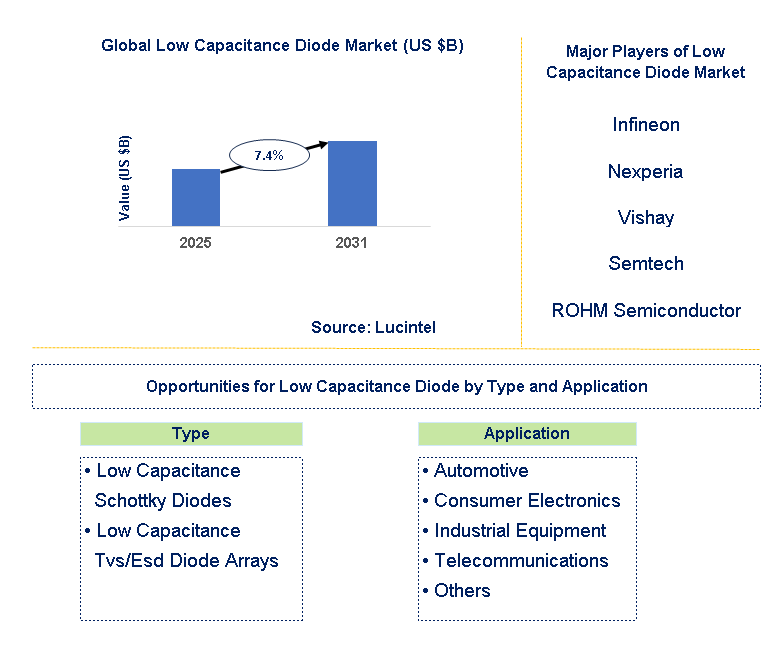
Key data points: The growth forecast = 7.4% annually for the next 7 years. Scroll below to get more insights. This market report covers trends, opportunities and forecasts in low capacitance diode market to 2031 by type (low capacitance schottky diodes and low capacitance TVS/ESD diode arrays), application (automotive, consumer electronics, industrial equipment, telecommunications, and others), and region (North America, Europe, Asia Pacific, and the Rest of the World)
We'll send your sample report shortly.
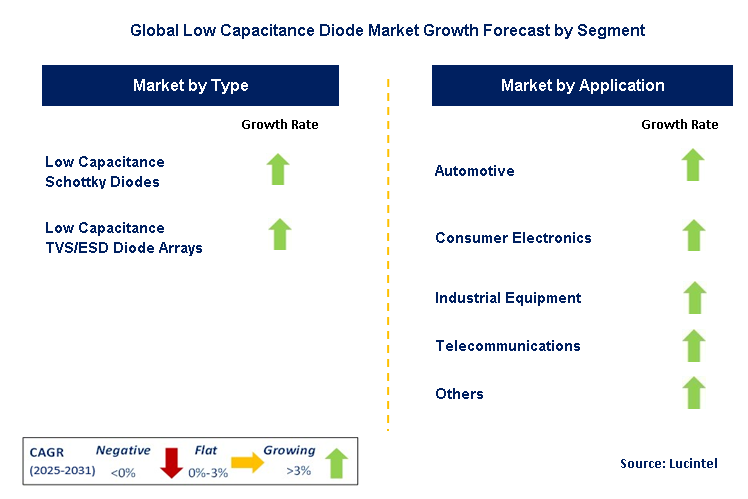
• Lucintel forecasts that, within the type category, low capacitance schottky diode is expected to witness higher growth over the forecast period.
• Within the application category, consumer electronics is expected to witness the highest growth.
• In terms of region, APAC is expected to witness the highest growth over the forecast period. Gain valuable insights for your business decisions with our comprehensive 150+ page report. Sample figures with some insights are shown below.
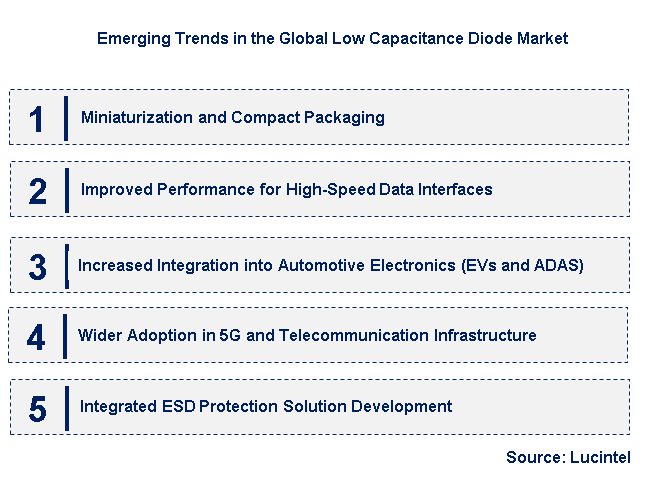
• Miniaturization and Compact Packaging: This includes the creation of low capacitance diodes in progressively smaller sizes and surface mount device (SMD) packages, like 0402 (DFN1006). As electronic products trend towards reduced size and integration, the demand for compact components saving board space and providing increased component density on printed circuit boards is very high. Consumer electronic products, portable equipment, and automotive usage are most affected, permitting reduced electronic product size and weight and improving assembly processing through automation, resulting in cost savings and design flexibility.
• Improved Performance for High-Speed Data Interfaces: This direction addresses enhancing the performance of low capacitance diodes in protecting high-speed data lines, including USB4, Thunderbolt, HDMI, and PCIe, without compromising signal integrity. This entails obtaining very low capacitance values (usually below 0.15pF) and low clamping voltages. The impact is vital for the spread of high-bandwidth communications across devices, guaranteeing data transmission over the air, reducing data loss, and allowing next-generation connectivity standards to operate seamlessly in consumer, telecommunication, and computing markets.
• Increased Integration into Automotive Electronics (EVs and ADAS): This fashion reflects the increased need for low capacitance diodes within the growing automotive electronics market, especially for electric vehicles (EVs) and Advanced Driver-Assistance Systems (ADAS). Such diodes are important in the protection of sensitive high-speed data lines applied in sensors, communication modules, and infotainment systems. The demand is fueled by the automotive industry’s trend towards electrification and smart capabilities, demanding strong, rugged, and AEC-Q101 qualified diodes that can operate in adverse automotive conditions and provide the safety and functionality of contemporary vehicles.
• Wider Adoption in 5G and Telecommunication Infrastructure: This trend reflects the prominence of low capacitance diodes in the world rollout of 5G networks and other sophisticated telecommunication infrastructure. Such diodes play a critical role in defending sensitive RF parts, base station equipment, and data transmission lines against ESD and other transients. The effect is essential to providing the high-speed, low-latency performance needed in contemporary telecommunication networks, guaranteeing network reliability, reducing downtime, and accommodating the enormous data traffic surge.
• Integrated ESD Protection Solution Development: This trend combines low capacitance ESD protection diodes with other circuit functionalities, including the filtering or signal conditioning, into a combined integrated circuit or module. This design strategy lowers part count, streamlines board design, and enhances system-level performance. The result is a smaller and less costly solution for designers, increased protection capability through maximized integration, and more streamlined manufacturing processes for electronic products across the board, especially those that require space savings and intricate signal pathways. These new trends are all together transforming the worldwide low capacitance diode market by propelling innovation towards higher specialty, high-performance, and integrated products. The emphasis is on satisfying increasingly stringent demands of various end-use industries, specifically in applications such as signal integrity, miniaturization, and reliability in harsh environments, that will keep low capacitance diodes relevant and expanding in the contemporary electronic environment.
• Ultra-Low Values Reached: The principal advancement is the successful manufacture of low capacitance diodes with very low junction capacitance values, usually in the sub-0.15pF range. This is accomplished by utilizing high-end semiconductor manufacturing processes and engineered device architecture. The effect is essential in shielding very high-speed data interfaces (e.g., USB4, Thunderbolt 5, 5G RF front-ends) from electrostatic discharge (ESD) and transient voltage phenomena without inducing signal degradation or loss of data, thus ensuring faster and more dependable communication.
• Improved ESD and Surge Protection Performance: Advances in recent times have seen major enhancements in the electrostatic discharge (ESD) and surge current protection abilities of low capacitance diodes. This translates to higher voltage spikes and surges of current handling by these diodes while still providing protection. The effect is greater robustness and reliability for electronic devices, especially in hostile operating conditions such as in automotive or industrial applications, ensuring delicate integrated circuits are not damaged and prolonging the end product lifespan.
• Miniaturization and Advanced Packaging Solutions: Another important development is the ongoing miniaturization of low capacitance diodes and packaging them in highly compact surface mount device (SMD) packages (e.g., DFN1006). This is prompted by the need for smaller and thinner electronic devices. The effect is that there is a significant decrease in board space consumption of electronic circuits, leading to increased component density, enabling designs for smaller and more mobile consumer electronics, and simplifying automated assembly processes in production.
• AEC-Q101 Qualification for Automotive Applications: Development is the universal qualification of low capacitance diodes to automotive requirements such as AEC-Q101. This certification guarantees the diodes pass the stringent reliability and environmental tests for use in automotive electronics. The stress is vital for the automotive market growth, allowing the diodes to be safely incorporated into electric vehicles (EVs), advanced driver-assistance systems (ADAS), and in-car infotainment systems, where components endure harsh temperatures and vibrations.
• Specialized RF and Communication System Designs: The latest advances have seen the development of specialized low capacitance diodes designed specifically for use in radio frequency (RF) and high-frequency communication systems. The diodes are such that they have little effect on RF circuit impedance matching and signal integrity. The effect is significant to the evolution of future wireless communication equipment, 5G base stations, and IoT devices to provide efficient transmission of signals, less harmonic distortion, and improved antenna performance in high-frequency technologies. All these advancements are having a deep impact on the low capacitance diode market by accelerating an extensive move towards further advanced, dependable, and application-specific products. The market is shifting to deliver higher performance, higher resilience, and greater integration capabilities, satisfying the ever more stringent requirements of contemporary electronic systems globally.
• High-Speed Data Interfaces (USB, HDMI, Ethernet): The ongoing development of high-speed data communication standards such as USB (Type-C, USB4, Thunderbolt), HDMI, and Gigabit Ethernet is a tremendous growth opportunity. Low capacitance diodes play a critical role in protecting these high-speed data lines against ESD without compromising signal integrity or resulting in data loss. The strategic expansion entails creating ultra-low capacitance TVS diodes that are capable of fulfilling the demanding needs of these emerging standards and providing strong performance in consumer electronics, computing systems, and telecommunications devices.
• 5G and Telecommunications Infrastructure: Global deployment and densification of 5G networks and continued development in the telecommunication infrastructure are a major growth opportunity. Low capacitance diodes are essential for the protection of RF front-end modules, base station elements, and high-speed data transmission lines. Strategic growth means offering rugged, high-frequency tolerant low capacitance diodes with the ability to resist the challenges of telecom environments with guaranteed reliability and performance of future generation communication networks.
• Automotive Electronics (EVs, ADAS, Infotainment): The fast-growing automotive electronics market, especially in electric vehicles (EVs) and Advanced Driver-Assistance Systems (ADAS), presents a large opportunity. Low capacitance diodes play an essential role in protecting high-speed communication buses (e.g., CAN, Ethernet) and sensitive sensor inputs from ESD events in tough automotive environments. Strategic expansion includes creating AEC-Q101 qualified, highly reliable, temperature-resistant low capacitance diodes designed specifically for the specific requirements of vehicle electronic systems.
• Consumer Electronics (Smartphones, Wearables, IoT): The continuously growing consumer electronics sector, marked by growing miniaturization, increased functionality, and connectivity, offers a steady level of demand for low capacitance diodes. They are crucial in safeguarding sensitive inputs and data lines for smartphones, wearables, smart home appliances, and other IoT devices. Strategic expansion is achieved by providing compact, cost-efficient, and highly efficient low capacitance diodes that allow device footprints to be reduced and overall product reliability and life to be enhanced.
• RF and Microwave Applications: The wide variety of RF and microwave applications, such as satellite communications, radar systems, and wireless modules, are dependent on devices having small parasitic capacitance to ensure signal integrity in high-frequency circuits. Low capacitance diodes are utilized in tuning, switching, and protection circuits within these systems. Strategic expansion includes designing special low capacitance PIN diodes, varactor diodes, and TVS diodes that are tailored for high-frequency performance and strong operation in harsh RF environments. These strategic growth opportunities are having a profound effect on the low capacitance diode market by propelling innovation to highly specialized, application-specific, and performance-optimized solutions. The market is diversifying to address the unique reliability, efficiency, and environmental requirements of various high-growth industries to ensure ongoing growth and solidify the position of low capacitance diodes in the global electronic ecosystem.
• Infineon
• Nexperia
• Vishay
• Semtech
• ROHM Semiconductor
• Fuji Electric
• Littelfuse
• Toshiba
• STMicroelectronics
• China Resources Microelectronics
• Low Capacitance Schottky Diodes
• Low Capacitance Tvs/Esd Diode Arrays
• Automotive
• Consumer Electronics
• Industrial Equipment
• Telecommunications
• Others
• North America
• Europe
• Asia Pacific
• The Rest of the World
• United States: In the United States, the market for low capacitance diodes is fueled by the strong growth of telecommunication, especially the installation of 5G infrastructure, and the need for data centers with high speed. Some of the recent trends involve the launch of ultra-low capacitance transient voltage suppressor (TVS) diodes specifically targeted at shielding high-speed data lines, including USB4 v2.0 and Thunderbolt 5. There is also significant emphasis on automotive-grade certifications (AEC-Q101) for the diodes in advanced driver-assistance systems (ADAS) and electric vehicle (EV) electronics, emphasizing reliability and performance under harsh conditions.
• China: The Chinese low capacitance diode industry is witnessing strong growth, driven by its huge consumer electronics manufacturing hub, swift 5G rollout, and fast-growing automotive sector. Recent movements include heavy investments in local production facilities to cater to both domestic demand as well as exports, tending to concentrate on budget-friendly manufacturing processes. Chinese producers are aggressively working on developing low capacitance diodes for high volume usage in smartphones, laptops, and other IoT devices, besides working to improve performance parameters to take on industry leaders.
• Germany: The German low capacitance diode market is distinguished by a high focus on precision engineering, high reliability, and compliance with tight European quality and safety standards. Recent trends have involved the development of low capacitance TVS diodes in industrial automation, renewable energy inverters, and high-frequency communication systems. German companies emphasize thermal optimization and rugged performance in critical applications, evidencing a focus on high-end, long-lasting components in advanced industrial and automotive electronics.
• India: The Indian low capacitance diode market is growing at a fast pace, buoyed by the country’s quick development in telecommunications infrastructure, consumer electronics production, and the automotive industry. Recent trends involve a growing demand for low capacitance ESD protection devices, particularly with the increased rollout of 5G networks. Cost-effective yet efficient solutions are given greater importance to meet a growing domestic market that favors local manufacture and supports the rising use of high-speed data transmission devices.
• Japan: The Japanese low capacitance diode market is characterized by technological advancement, miniaturization, and high standards for precision usage. New developments involve the introduction of ultra-low capacitance TVS diodes designed exclusively for high-frequency antennas in IoT equipment and mobile communication aimed at harmonic distortion suppression. Japanese producers are focusing on maximizing the performance metrics, including very low capacitance and enhanced ESD immunity, to enable the creation of next-generation electronic devices requiring enhanced signal integrity and dependability in small packages.


• Infineon
• Nexperia
• Vishay
• Semtech
• ROHM Semiconductor
• Fuji Electric
• Littelfuse
• Toshiba
• STMicroelectronics
• China Resources Microelectronics Q5. Which low capacitance diode market segment will be the largest in future? Answer: Lucintel forecasts that, within the type category, low capacitance schottky diode is expected to witness higher growth over the forecast period. Q6. In low capacitance diode market, which region is expected to be the largest in next 5 years? Answer: In terms of region, APAC is expected to witness the highest growth over the forecast period. Q7. Do we receive customization in this report? Answer: Yes, Lucintel provides 10% customization without any additional cost.


Choose a license that fits your team. Instant PDF delivery.
Prices exclude taxes. Instant delivery. Custom licensing available on request.
Market Report · July 24, 2026
Market Report · July 20, 2026
Market Report · July 20, 2026
Trusted partner for strategic intelligence and business growth


Receive a complimentary market analysis tailored to your industry. Our analysts will identify key growth opportunities and competitive dynamics specific to your business.

Market size, growth rate, and key trend analysis for your specific sector.

Top competitor positioning and market share analysis.

Strategic recommendations backed by data-driven insights.
Get curated market intelligence and competitive moves straight to your inbox.
By subscribing, you agree to receive our monthly insights. Unsubscribe anytime.
Receive a complimentary market analysis tailored to your industry. Our analysts will identify key growth opportunities and competitive dynamics specific to your business.
Market size, growth rate, and key trend analysis for your specific sector.
Top competitor positioning and market share analysis.
Strategic recommendations backed by data-driven insights.
Get curated market intelligence, emerging trends, and competitive moves straight to your inbox each month.
By subscribing, you agree to receive our monthly insights. Unsubscribe anytime.
We'll send your sample report shortly.