
Market Report · July 15, 2026

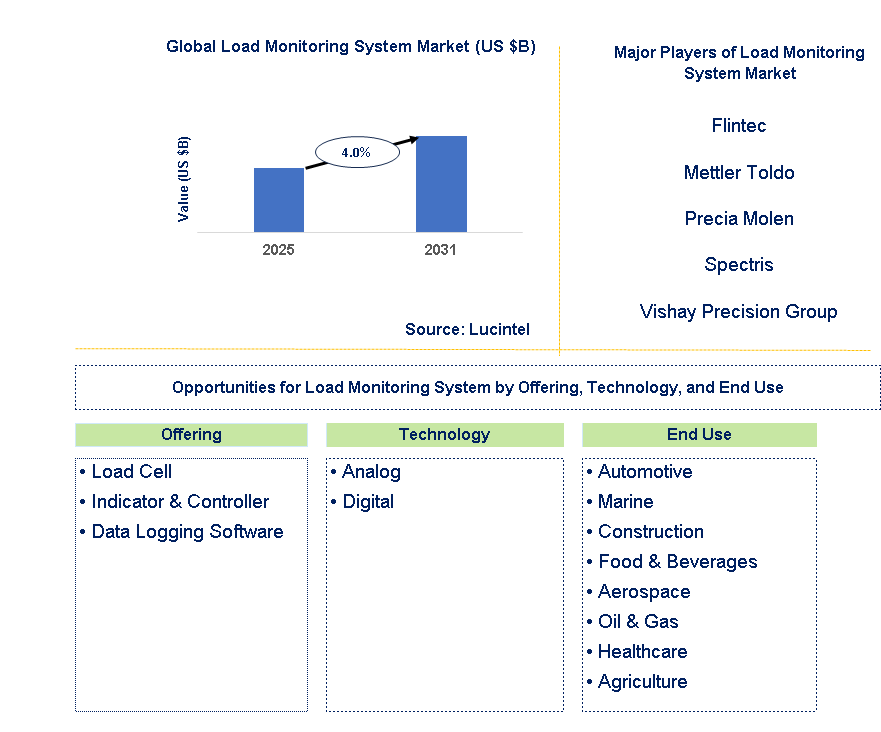
Key data points: The growth forecast = 4% annually for the next 7 years. Scroll below to get more insights. This market report covers trends, opportunities and forecasts in load monitoring system market to 2031 by offering (load cell, indicator & controller, and data logging software), technology (analog and digital), end use (automotive, marine, construction, food & beverages, aerospace, oil & gas, healthcare, and agriculture), and region (North America, Europe, Asia Pacific, and the Rest of the World)
We'll send your sample report shortly.
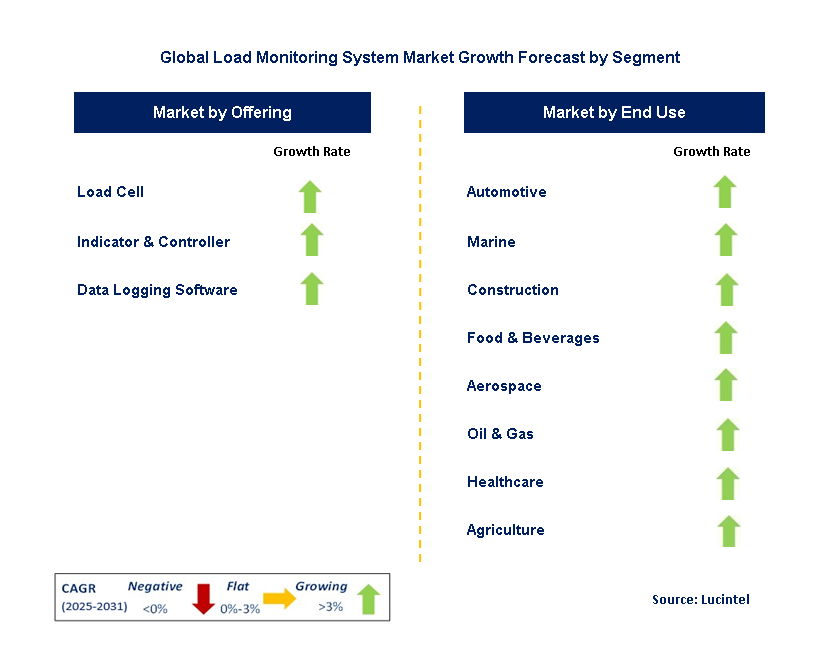
• Lucintel forecasts that, within the offering category, load cell is expected to witness the highest growth over the forecast period.
• Within the industry category, oil & gas is expected to witness the highest growth.
• In terms of region, APAC is expected to witness the highest growth over the forecast period. Gain valuable insights for your business decisions with our comprehensive 150+ page report. Sample figures with some insights are shown below.
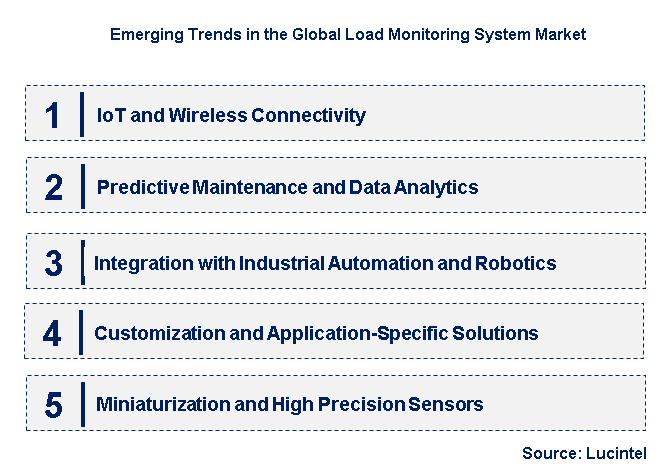
• IoT and Wireless Connectivity: One of the most notable of the emerging trends is the ubiquitous use of IoT and wireless technologies in load monitoring systems. This entails the use of load cells and sensors combined with wireless communication modules (Bluetooth, Wi-Fi, LoRaWAN) and networking to cloud-based platforms. This facilitates real-time remote monitoring of load status, minimizing the need for manual inspections, improving operating flexibility, and instant reporting of possible overloading or deviations.
• Predictive Maintenance and Data Analytics: Strong emerging trend towards utilization of load monitoring data for predictive maintenance and analytics. Through ongoing observation of load patterns and equipment stress, systems can detect anomalies and forecast expected failures ahead of time. This enables industries to plan maintenance in advance, reduce unplanned downtime, maximize equipment life, and decrease operational expenses by transitioning from reactive to proactive maintenance.
• Integration with Industrial Automation and Robotics: A rapidly growing emerging trend is the greater integration of load monitoring systems with automation in industry and robotics. Load sensors are being incorporated into robotic arms, automatic guided vehicles AGV, and assembly lines to provide accurate material handling, avoid overloading, and uphold product quality. This integration makes the automated processes safer and more efficient while allowing real-time load feedback for robots to modify their operations dynamically.
• Customization and Application-Specific Solutions: There is an increasing trend for customization and application-defined load monitoring solutions. Instead of off-the-shelf solutions, industries are looking for customized systems optimized for specific operational conditions, types of loads, and regulatory needs. These comprise specialized load cells for harsh temperatures, hazardous environments, or particular structural monitoring requirements, enabling more precise and consistent data for specific applications.
• Miniaturization and High Precision Sensors: The market is experiencing a developing tendency toward miniaturization and the creation of high-precision load sensors. The evolution of sensor technology provides for compact, inconspicuous load cells that can be built into a greater variety of equipment and structures without drastically changing their form or performance. The miniature sensors also possess greater precision and quicker response, essential for use in applications involving highly accurate load measurement. These new trends are actually transforming the load monitoring system market by making solutions smarter, connected, and more efficient. IoT and wireless connectivity provide remote, real-time monitoring. Predictive maintenance features, based on data analytics, save time and improve asset utilization. Automation integration provides improved safety and accuracy in industrial processes. Customization meets specific industry demands, and miniaturization facilitates wider application and greater accuracy. Together, these trends are propelling innovation, broadening market uses, and placing load monitoring systems at the forefront as essential tools for contemporary industrial processes.
• Improved Wireless and IoT Integration: One of the major recent advances is the significant improvement and widespread use of wireless and IoT integration in load monitoring devices. New devices provide wireless connectivity (e.g., through Bluetooth, Wi-Fi, or LoRaWAN) for seamless connection to load cells and sensors, enabling remote transmission of data to cloud platforms. This allows real-time access to the load, enables remote monitoring of devices, and greatly enhances operational responsiveness and flexibility.
• Advanced Digital Load Cells Development: Advanced digital load cells have recently been in widespread development and use. The digital load cells are more accurate, have greater resolution, and better signal integrity than their traditional analog counterparts. The digital load cells reduce signal interference, can measure very slight load changes, and are vital for high-precision applications like aerospace testing, automotive production, and drug manufacturing.
• Emphasis on Predictive Maintenance and Data Analytics Software: There has been a significant recent trend in the added emphasis on combining advanced data analytics software with load monitoring systems for predictive maintenance. This includes algorithms that make use of real-time load data, historical patterns, and operational trends to forecast possible equipment failures or maintenance requirements. This proactive effort enables industries to lower unplanned downtime, maximize maintenance scheduling, and prolong the life of important equipment.
• Miniaturization and Ruggedization of Sensors: The recent advances are pointing to a miniaturization and ruggedization trend in load monitoring sensors. Companies are making smaller, more compact load cells that are easily installed in restricted areas or particular components without compromising their performance. At the same time, a focus is being placed on developing sensors that are extremely rugged and can withstand harsh industrial conditions, such as high temperatures, humidity, and corrosive environments, to perform consistently in demanding situations.
• Expansion into New Application Areas: The market has witnessed recent growth with load monitoring systems venturing into new application fields away from legacy construction and industrial lifting. These encompass increasing usage in smart manufacturing for robotic load measurement, in agriculture for precision agricultural equipment, and in the healthcare sector for accurate weighing in medical devices. This expansion of applications highlights the versatility and mounting significance of accurate load measurement in a widening segment of industries. These advancements are profoundly contributing to the load monitoring system market by making it a more technologically sophisticated and data-intensive industry. Improved wireless and IoT capabilities support pervasive, real-time monitoring. Advanced digital load cells offer improved accuracy. The emphasis on predictive maintenance and data analytics maximizes operations and minimizes costs. Miniaturization and ruggedization open up application opportunities, and growth into new markets reinforces increasing requirements for accurate load management. Together, these advances are enabling innovation, expanding market penetration, and cementing the critical position of load monitoring systems in contemporary industrial efficiency and safety.
• Construction and Infrastructure Development: This is a fundamental and important strategic growth area. Strategic growth means offering strong and solid load monitoring systems for cranes, hoists, excavators, and other heavy lifting machinery utilized in construction and infrastructure projects. Opportunities exist in creating solutions that improve safety by stopping overloading, optimize material handling, and offer real-time information for project management and compliance with more rigorous safety regulations.
• Aerospace and Defense: The aerospace and defense industry presents a high-value strategic growth opportunity. Strategic growth consists of delivering highly accurate and resilient load monitoring systems for aircraft production, structural testing, flight load monitoring, and military equipment. Opportunities lie in creating high-performance load cells and telemetry systems that can withstand harsh environments, deliver important data for design verification, and provide the structural integrity and safety of advanced aerospace and defense equipment.
• Automotive Manufacturing and Testing: The automotive sector is an emerging strategic growth opportunity. Strategic growth is offering load monitoring systems for all levels of automotive manufacturing, such as assembly lines, material handling, and vehicle testing (e.g., suspension testing, dynamometer applications, pedal force measurement). Opportunities are creating accurate load cells and integrated solutions to help with quality control, research and development, and safety testing of vehicle parts and whole vehicles.
• Logistics, Warehousing, and Material Handling: This industry presents a fast-growing strategic growth opportunity, fueled by increasing e-commerce and supply chain automation. Strategic growth includes delivering load monitoring systems for forklifts, automated guided vehicles AGV, conveyor systems, and industrial scales in logistics centers and warehouses. Opportunities exist in designing solutions that maximize inventory management, avoid overloading of equipment, provide safe material flow, and interface with warehouse management systems.
• Healthcare and Medical Devices: A potential and exciting strategic growth area is the healthcare and medical device industry. Strategic growth encompasses delivering very precise and frequently miniaturized load monitoring systems for healthcare devices like dialysis machines, infusion pumps, patient weighing scales, and surgical robots. Potential areas are in creating specialized load cells that guarantee precise fluid delivery, accurate dosing, and safe operation of vital medical devices, all aimed at promoting patient safety and diagnostic accuracy. These strategic expansion possibilities are having a deep influence on the load monitoring system market by propelling the creation of targeted, high-performance, and technologically combined solutions in vital industrial categories. Construction stresses safety and efficiency in projects. Aerospace and defense require high accuracy for key applications. Automotive production leverages systems for quality checking and testing, whereas logistics focuses on optimization and safety in handling materials. In addition, the medical industry emphasizes accuracy in medical devices. All these opportunities combined are creating a more segregated, innovative, and impactful load monitoring system market.
• Flintec
• Mettler Toldo
• Precia Molen
• Spectris
• Vishay Precision Group
• Dynamic Load Monitoring
• JCM Load Monitoring
• LMC Systems
• Load Monitoring Systems
• Straightpoint
• Load Cell
• Indicator & Controller
• Data Logging Software
• Analog
• Digital
• North America
• Europe
• Asia Pacific
• The Rest of the World
• United States: In the US, recent trends in the load monitoring system industry are being propelled by strict safety regulations in the construction, manufacturing, and aerospace industries. There is a significant focus on the implementation of wireless and IoT-based load sensors to capture real-time data and monitor remotely. Cloud-based platforms and data analytics are being invested in by companies to deliver predictive maintenance intelligence, which is improving operation efficiency and employee safety, especially in heavy lifting operations and critical infrastructure developments.
• China: The market for China’s load monitoring systems is experiencing a quickening pace of developments, driven by its extensive manufacturing, construction, and transportation sectors. A particular emphasis is being put on raising domestic production and the quality of load cells and combined monitoring solutions. Chinese manufacturers are investing in automation and smart factory plans, which results in greater use of digital load monitoring systems that provide higher accuracy and connectivity of data to assist the nation’s large-scale industrial growth.
• Germany: The load monitoring system market in Germany is dominated by a high focus on precision engineering, quality components, and convergence with Industry 4.0 programs. Recent trends involve the development of extremely accurate digital load cells and advanced control systems for special applications in automotive, aerospace, and general manufacturing. German firms are also leaders in creating integrated solutions that offer end-to-end data analytics for predictive maintenance and optimized business workflows.
• India: India’s load monitoring system market is witnessing huge recent growth with fast industrialization, infrastructural growth, and enhanced workplace safety focus. Although analog systems are still common because of economy, the trend is definitely shifting towards embracing digital load cells and consolidated solutions. The "Make in India" program is favoring local production, encouraging the creation of economical yet durable load monitoring systems for various industries such as construction, logistics, and manufacturing.
• Japan: Japan’s load monitoring system market is focused on precision, reliability, and integration with advanced technologies. The latest trends involve a heavy emphasis on intelligent sensing solutions, typically with AI and sophisticated algorithm inclusion, for real-time monitoring and predictive analysis. Japanese companies are producing highly compact and precise load cells for use in robotics, automotive testing, and advanced manufacturing in line with the nation’s dominant position in automation and high-tech industrial processes.


• Flintec
• Mettler Toldo
• Precia Molen
• Spectris
• Vishay Precision Group
• Dynamic Load Monitoring
• JCM Load Monitoring
• LMC Systems
• Load Monitoring Systems
• Straightpoint Q5. Which load monitoring system market segment will be the largest in future? Answer: Lucintel forecasts that, within the offering category, load cell is expected to witness the highest growth over the forecast period. Q6. In load monitoring system market, which region is expected to be the largest in next 5 years? Answer: In terms of region, APAC is expected to witness the highest growth over the forecast period. Q7. Do we receive customization in this report? Answer: Yes, Lucintel provides 10% customization without any additional cost.


Choose a license that fits your team. Instant PDF delivery.
Prices exclude taxes. Instant delivery. Custom licensing available on request.
Market Report · July 15, 2026
Market Report · June 26, 2026
Market Report · June 24, 2026
Trusted partner for strategic intelligence and business growth


Receive a complimentary market analysis tailored to your industry. Our analysts will identify key growth opportunities and competitive dynamics specific to your business.

Market size, growth rate, and key trend analysis for your specific sector.

Top competitor positioning and market share analysis.

Strategic recommendations backed by data-driven insights.
Get curated market intelligence and competitive moves straight to your inbox.
By subscribing, you agree to receive our monthly insights. Unsubscribe anytime.
Receive a complimentary market analysis tailored to your industry. Our analysts will identify key growth opportunities and competitive dynamics specific to your business.
Market size, growth rate, and key trend analysis for your specific sector.
Top competitor positioning and market share analysis.
Strategic recommendations backed by data-driven insights.
Get curated market intelligence, emerging trends, and competitive moves straight to your inbox each month.
By subscribing, you agree to receive our monthly insights. Unsubscribe anytime.
We'll send your sample report shortly.