
Market Report · July 15, 2026

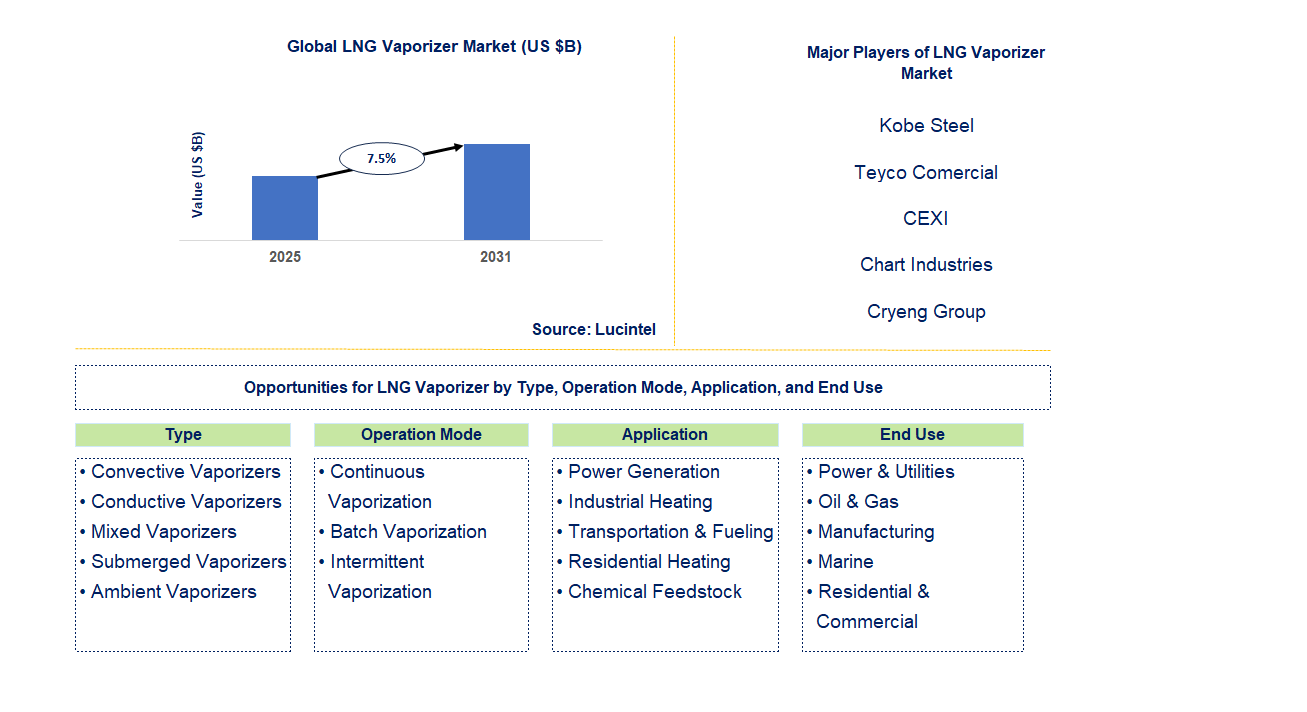
Key data points: The growth forecast = 7.5% annually for the next 7 years. Scroll below to get more insights. This market report covers trends, opportunities and forecasts in LNG vaporizer market to 2031 by type (convective vaporizers, conductive vaporizers, mixed vaporizers, submerged vaporizers, and ambient vaporizers), operation mode (continuous vaporization, batch vaporization, and intermittent vaporization), application (power generation, industrial heating, transportation & fueling, residential heating, and chemical feedstock), end use (power & utilities, oil & gas, manufacturing, marine, and residential & commercial), and region (North America, Europe, Asia Pacific, and the Rest of the World)
We'll send your sample report shortly.
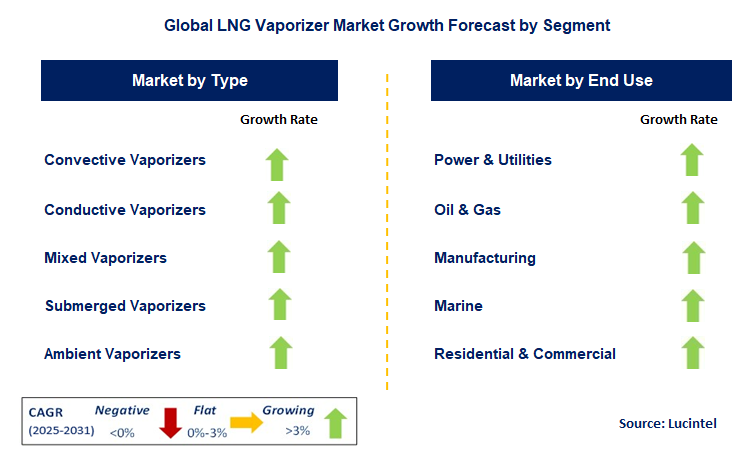
• Lucintel forecasts that, within the type category, the convective vaporizer is expected to witness the highest growth over the forecast period.
• Within the end use category, power & utility is expected to witness the highest growth.
• In terms of region, APAC is expected to witness the highest growth over the forecast period. Gain valuable insights for your business decisions with our comprehensive 150+ page report. Sample figures with some insights are shown below.
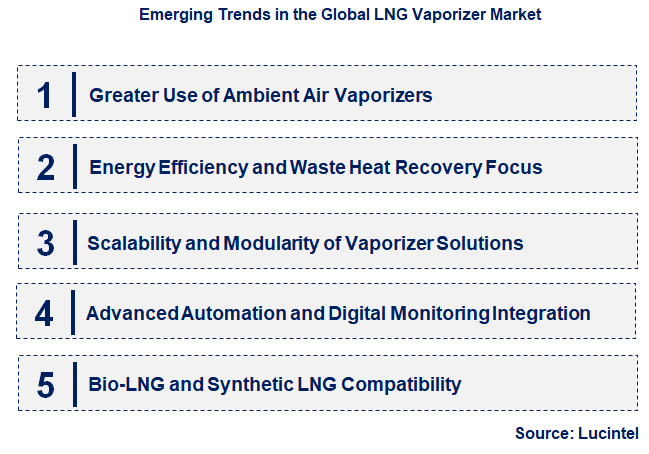
• Greater Use of Ambient Air Vaporizers: The trend here is increased use of ambient air vaporizers, which use surrounding air as a fuel to vaporize LNG directly to gas without consuming external energy. The effect is high savings in energy, low operational expenses, and a smaller carbon footprint compared to conventional-fired or submerged combustion vaporizers. This trend is especially strong in areas where favorable climates exist, favoring sustainable and economically suitable regasification solutions.
• Energy Efficiency and Waste Heat Recovery Focus: There is a keen focus on designing LNG vaporizers that are most energy efficient, usually by incorporating waste heat recovery systems from other industrial operations or power generation. The result is a very low overall energy intensity of LNG regasification, which translates to reduced operating costs and better environmental performance. This is part of a global movement to minimize energy consumption industry-wide.
• Scalability and Modularity of Vaporizer Solutions: There is a trend towards scalable and modular vaporizer solutions, especially for small to medium-sized LNG applications, like satellite stations, industrial customers, and marine bunkering. The effect is enhanced flexibility, quicker deployment times, and lower initial capital expenditures for LNG infrastructure projects. It makes the solutions flexible enough to be easily expanded or modified in response to shifting demand, promoting wider LNG adoption.
• Advanced Automation and Digital Monitoring Integration: New LNG vaporizers increasingly use advanced automation, sensors, and digital monitoring systems. They allow real-time performance monitoring, remote diagnostics, predictive maintenance, and optimized control. The effects include improved operational safety, reliability, minimized manual intervention, and more efficient management of LNG regasification facilities, resulting in more intelligent and robust energy infrastructure.
• Bio-LNG and Synthetic LNG Compatibility: An emerging trend is the design of LNG vaporizers specifically for or easily convertible for use on bio-LNG (liquefied biomethane) and synthetic LNG (e-LNG), which are renewable alternatives to natural gas. The effect is instrumental support for decarbonization in the energy market, enabling current LNG infrastructure to enable the transition towards greener and circular energy economies, encouraging the use of green gas. These emerging trends are radically transforming the LNG vaporizer market by pushing for more sustainable, efficient, and technologically advanced solutions. Increasing focus on ambient vaporization, energy recovery, modular designs, automation, and compatibility with renewable gases is changing how LNG gets repacified and utilized across the globe. This ensures LNG vaporizers play a critical role in a global energy transition, allowing for cleaner energy consumption and a diversified gas supply chain.
• Advanced Shell and Tube Vaporizer Development: Recent innovations in shell and tube vaporizer technology are targeted at increasing heat transfer efficiency and minimizing the overall footprint. Advances encompass improved tube design, optimized flow patterns, and the use of advanced materials to resist cryogenic temperatures and corrosion. The result is a more efficient and energy-saving vaporization process, reducing the operating cost of LNG regasification terminals and improving reliability in continuous operation, especially in large-scale operations.
• Emergence of Submerged Combustion Vaporizers SCVs with Enhanced Efficiency: Submerged combustion vaporizers have experienced remarkable advances in their thermal efficiency and environmental performance. Companies are equipping them with sophisticated burner technologies and heat recovery systems to reduce fuel consumption and emissions of nitrogen oxides and carbon dioxide. The effect is a greener and cost-efficient solution for regasification, particularly where there are tight emission controls or waste heat recovery is desirable, towards creating a cleaner energy infrastructure.
• Growing use of Electric and Ambient Air Vaporizers: There is a tendency towards increased use of electric and ambient air vaporizers due to a wish to cut the use of fossil fuels for heating and to save on operating costs. Electric vaporizers provide accurate temperature control and no local emissions, whereas ambient air vaporizers make use of atmospheric heat, providing an extremely sustainable solution. Its effect is a diversification of vaporization technologies, providing cleaner options for small-scale LNG applications, peak-shaving stations, and distributed power generation, encouraging energy self-sufficiency and lowering carbon footprint.
• Digitalization and Automation Integration for Remote Monitoring and Operation: New advancements involve integrating state-of-the-art sensor technology, data analytics, and automation systems into LNG vaporizers. This enables real-time monitoring of performance, predictive maintenance, and remote control of operations. The effect is improved operational safety, optimized performance, minimized downtime, and lower labor costs through effective process management of vaporization. It also enhances overall system reliability and responsiveness to changes in demand.
• Emphasis on Floating Storage and Regasification Units FSRU Dedicated Vaporizer Solutions: As the popularity of FSRUs for agile and easy installation of LNG import facilities grows, innovations in vaporizer design are taking shape that are compact, heavy-duty, and marine environment-optimized. These solutions tend to emphasize space efficiency and motion resistance. The effect is speeded-up installation of LNG facilities in varied geographical conditions, enhancing energy security and flexibility to areas that might otherwise lack access to conventional onshore terminals, enabling global LNG trade and delivery. These new advances are playing an important role in the LNG vaporizer industry by promoting greater efficiency, environmental sustainability, and operating flexibility. Shifting to sophisticated and diversified vaporization technologies, accompanied by digitalization, is making regasification of LNG more cost-effective and dependable. This transformation is very much essential for addressing the increasing world demand for natural gas, supporting the energy transition, and enabling the widespread use of LNG as a flexible and cleaner fuel source in multiple applications.
• Large-Scale LNG Import Terminals: With increasing world energy demand and nations looking to diversify their sources of energy, the building and development of large-scale LNG import terminals continue to be a major opportunity. These terminals have high-capacity, dependable vaporizers used to convert massive amounts of LNG into natural gas, which is then delivered to national grids. The increase is fueled by domestic energy security policies and requirements for a reliable and cleaner power supply to underpin industrial and domestic consumption.
• Peak Shaving and Energy Storage Uses: LNG peak shaving plants, where LNG is stored during off-peak demand and vaporized during peak demand, are an emerging opportunity. Likewise, LNG finds more use as an energy storage in renewable-based grids. Both of these uses demand flexible and quick-response vaporizers that can readily respond to changing demand in order to provide energy supply stability and make grid operation optimal.
• Marine Bunkering and Fueling Operations: The change in the maritime business to use LNG as a marine fuel to meet tightened emission regulations is a very big growth opportunity for dedicated LNG vaporizers. These vaporizers are needed to liquefy gas to gaseous fuel for ship engines at bunkering terminals and onboard LNG-fueled ships. This usage requires compact, heavy-duty, and very efficient vaporizers that are appropriate for marine conditions.
• Industrial and Commercial Distributed Power Generation: Where coal or oil is to be minimized or where pipeline natural gas is not present, LNG is increasingly employed for industrial power generation and commercial heat. This opens opportunities for small to medium-sized LNG vaporizers that can economically supply natural gas for captive power plants, industrial uses, and district heating schemes, encouraging cleaner on-site energy solutions.
• LNG-Powered Transport Fueling Stations: Increasing use of LNG as a fuel for heavy-duty trucks, buses, and other commercial vehicles is creating demand for LNG vaporizers at fueling stations. Vaporizers play an important role in converting LNG stored at the fueling stations into compressed natural gas or direct injection LNG for vehicle engines. The potential lies in designing compact, safe, and economical vaporizers that are appropriate for universal deployment at vehicle refueling facilities. These growth opportunities of strategy are having a profound impact on the LNG vaporizer market by increasing its scope and spurring innovation in various industries. Expansion into marine, industrial, and automobile fueling applications, and ongoing development of large-scale terminals and peak shaving, requires more specialized, efficient, and adaptive vaporizer solutions. This diversification is strengthening the LNG vaporizer market as an essential enabler of the natural gas world economy and the shift toward cleaner energy.
• Kobe Steel
• Teyco Comercial
• CEXI
• Chart Industries
• Cryeng Group
• Cryonorm
• Linde
• Nikkiso
• Incryo Systems
• Kwangsan
• Convective Vaporizers
• Conductive Vaporizers
• Mixed Vaporizers
• Submerged Vaporizers
• Ambient Vaporizers
• Continuous Vaporization
• Batch Vaporization
• Intermittent Vaporization
• Power Generation
• Industrial Heating
• Transportation & Fueling
• Residential Heating
• Chemical Feedstock
• Power & Utilities
• Oil & Gas
• Manufacturing
• Marine
• Residential & Commercial
• North America
• Europe
• Asia Pacific
• The Rest of the World
• United States: The US market for LNG vaporizers is greatly driven by its strong natural gas production and growing export capacity. Recent trends have involved strong emphasis on next-generation ambient air vaporizers that are energy-efficient with the use of atmospheric heat, hence lowering operating costs. Large-scale vaporizers have also seen investment in new and growing LNG export terminals as a result of worldwide demand for US natural gas and the requirement for assured regasification assets.
• China: The Chinese LNG vaporizer market is growing very fast, driven by its energetic drive to natural gas consumption in order to reduce air pollution and help drive industrial development. Recent trends include massive investment in new LNG import terminals and satellite stations, resulting in strong demand for large-scale and smaller, modular vaporizers. Chinese companies are quickly innovating, producing efficient and economical ambient and submerged combustion vaporizers to service domestic and overseas projects.
• Germany: The German LNG vaporizer market is propelled by its energy transition ambitions and requirements for diversified gas supply, especially in the wake of geopolitical changes. Some of the recent trends include growing investment in floating storage and regasification units (FSRUs) and related vaporizers to ensure quick deployment and flexibility. There is also a focus on energy-efficient and low-emission vaporizer technologies to reflect Germany’s ambition to reduce carbon footprints and implement sustainable energy solutions, such as bio-LNG.
• India: The Indian market for LNG vaporizers is witnessing strong growth, driven by the increasing energy demand in the country, the growing gas pipeline network, and an adoption push for cleaner fuels. Recent happenings involve high investments in new LNG import terminals and city gas distribution networks, which are driving the demand for different types of vaporizers, particularly ambient air and submerged combustion units. The "LNG at Doorstep" program, with LNG supply through cryogenic tankers and the use of ambient vaporizers at the site, identifies a major development for off-grid industrial consumers.
• Japan: The market for LNG vaporizers is marked by high standards of quality and long-term energy security, focused on a country lacking indigenous energy resources. Recent trends involve continuous modernization of current LNG import facilities as well as new studies into vaporization technologies in order to maximize efficiency and reliability. There is also a focus on highly reliable and compact vaporizers for industrial and satellite station use, with a view to providing a stable gas supply to different sectors and keeping pace with changing energy policies.


• Kobe Steel
• Teyco Comercial
• CEXI
• Chart Industries
• Cryeng Group
• Cryonorm
• Linde
• Nikkiso
• Incryo Systems
• Kwangsan Q5. Which LNG vaporizer market segment will be the largest in future? Answer: Lucintel forecasts that, within the type category, the convective vaporizer is expected to witness the highest growth over the forecast period. Q6. In LNG vaporizer market, which region is expected to be the largest in next 5 years? Answer: In terms of region, APAC is expected to witness the highest growth over the forecast period. Q7. Do we receive customization in this report? Answer: Yes, Lucintel provides 10% customization without any additional cost.


Choose a license that fits your team. Instant PDF delivery.
Prices exclude taxes. Instant delivery. Custom licensing available on request.
Market Report · July 15, 2026
Market Report · May 18, 2026
Market Report · May 18, 2026
Trusted partner for strategic intelligence and business growth


Receive a complimentary market analysis tailored to your industry. Our analysts will identify key growth opportunities and competitive dynamics specific to your business.

Market size, growth rate, and key trend analysis for your specific sector.

Top competitor positioning and market share analysis.

Strategic recommendations backed by data-driven insights.
Get curated market intelligence and competitive moves straight to your inbox.
By subscribing, you agree to receive our monthly insights. Unsubscribe anytime.
Receive a complimentary market analysis tailored to your industry. Our analysts will identify key growth opportunities and competitive dynamics specific to your business.
Market size, growth rate, and key trend analysis for your specific sector.
Top competitor positioning and market share analysis.
Strategic recommendations backed by data-driven insights.
Get curated market intelligence, emerging trends, and competitive moves straight to your inbox each month.
By subscribing, you agree to receive our monthly insights. Unsubscribe anytime.
We'll send your sample report shortly.