
Market Report · July 20, 2026

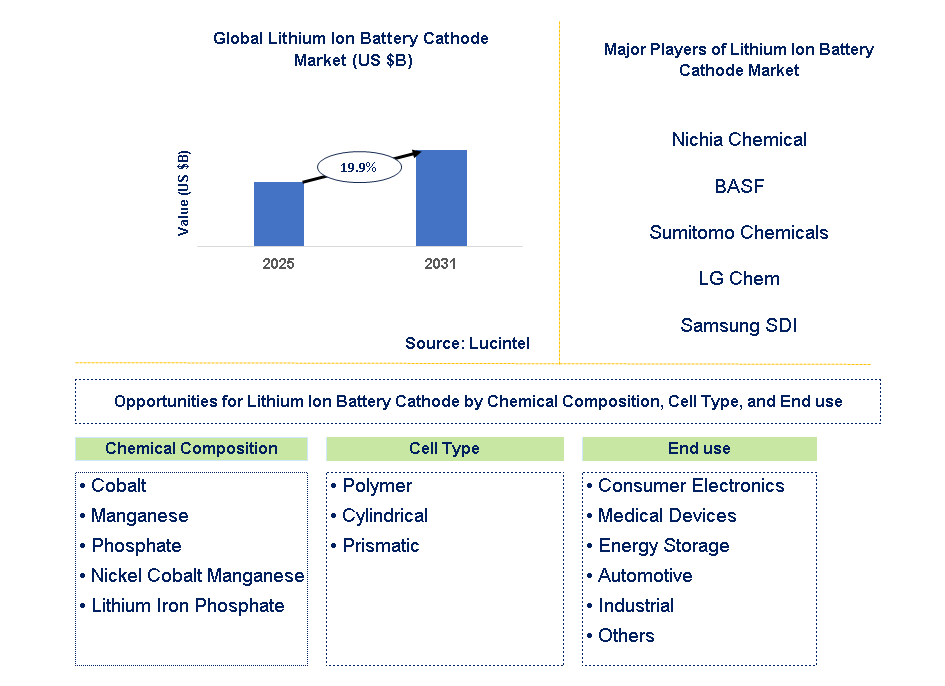
Key data points: The growth forecast = 19.9% annually for the next 7 years. Scroll below to get more insights. This market report covers trends, opportunities and forecasts in lithium ion battery cathode market to 2031 by chemical composition (cobalt, manganese, phosphate, nickel cobalt manganese, and lithium iron phosphate), cell type (polymer, cylindrical, and prismatic), end use (consumer electronics, medical devices, energy storage, automotive, industrial, and others), and region (North America, Europe, Asia Pacific, and the Rest of the World)
We'll send your sample report shortly.
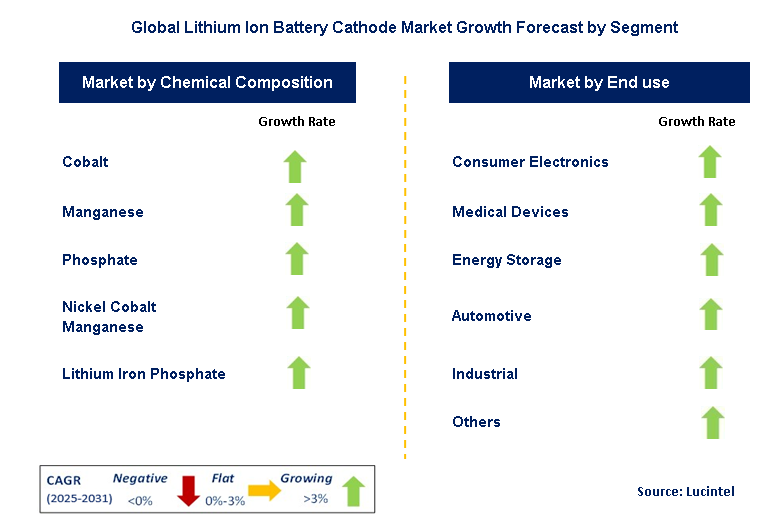
• Lucintel forecasts that, within the chemical composition category, nickel cobalt manganese is expected to witness the highest growth over the forecast period.
• Within the end use category, automotive is expected to witness the highest growth.
• In terms of region, APAC is expected to witness the highest growth over the forecast period. Gain valuable insights for your business decisions with our comprehensive 150+ page report. Sample figures with some insights are shown below.
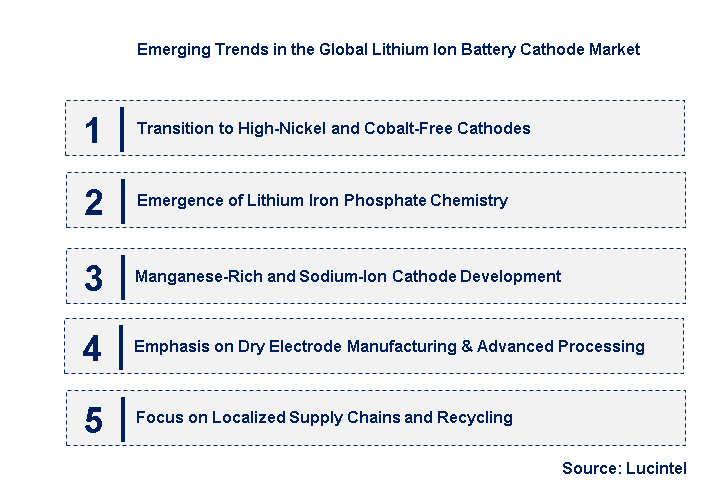
• Transition to High-Nickel and Cobalt-Free Cathodes: There is a clear industry push to raise the nickel content in NMC cathodes (e.g., from NMC532 to NMC811 and higher) in order to enhance energy density, and in parallel to reduce or remove cobalt because it is expensive, poses supply chain ethical issues, and creates geopolitical risks. The effect is profound: increased energy density allows for longer range electric vehicles and more efficient energy storage solutions. Decreasing cobalt reduces material prices and resolves sustainability issues, making Lithium-ion batteries economically more attractive and ethically sourced, driving their use in multiple applications faster.
• Emergence of Lithium Iron Phosphate Chemistry: LFP cathodes are gaining traction again, particularly in low-end and mid-range electric cars, and more and more in stationary energy storage systems. The trend is spurred by LFPs improved safety profile, higher cycle life, and lower price relative to nickel-rich chemistries, as it relies on abundant and cheaper iron. The effect is a more diversified battery market providing economical and highly long-lasting options. LFPs increasing popularity offers a durable solution for applications where energy density matters less than cost, safety, and longevity, making Lithium-ion technology widely accessible.
• Manganese-Rich and Sodium-Ion Cathode Development: Investigations and development are focusing on manganese-rich cathode chemicals, e.g., Lithium Manganese Oxide (LMO) analogs and Lithium Manganese Iron Phosphate (LMFP), toward a cost-effectiveness, safety, and median energy density balance. At the same time, cathode development for sodium-ion batteries is emerging as a cost-effective candidate to replace Lithium-ion with readily available sodium. The effect is diversification of raw material dependency and demand for sustainable and scalable battery technologies. These new chemistries hold promise for applications where lithium availability or price is a key limitation, expanding the vision for future batteries.
• Emphasis on Dry Electrode Manufacturing & Advanced Processing: Dry electrode manufacturing processes and advanced processing methods are emerging as key areas of innovation. Dry electrode procedures seek to replace the use of toxic and energy-some solvents with less environmental and cost burdens. Novel processing methods such as single-crystal cathode materials enhance cycle life and stability. The effect is an environmentally and cost-effective production of cathode materials, contributing to cleaner and cheaper batteries. These are vital for battery mass production while reducing ecological imprints and enhancing product quality.
• Focus on Localized Supply Chains and Recycling: Geopolitical tensions and supply chain risks have promoted a strong direction towards the development of localized and regional supply chains for cathode materials, from raw material mining to the manufacturing of cathode active material. At the same time, there is great focus on building effective battery recycling technologies for the recovery of valuable cathode materials such as lithium, nickel, and cobalt. The effect is increased supply chain resilience, decreased dependence on individual regions for key minerals, and transition to a circular economy for batteries. The trend guarantees long-term material supply security and sustainability for the fast-growing Lithium-ion battery industry. These new trends are inherently changing the lithium ion battery cathode market by promoting innovation in material science, manufacturing, and supply chain management. They are compelling the production of safer, less costly, higher-performing, and more eco-friendly battery solutions. This transformation is pivotal to enabling the international energy transformation, powering the mass adoption of electric vehicles and renewable energy storage, and changing the way energy is generated, stored, and consumed.
• LFP Cathode Dominance and Diversification: One notable recent trend is the rising dominance and diversification of Lithium Iron Phosphate (LFP) cathodes. Originally popular in stationary applications and commercial fleets because of their safety and longevity, LFP cathodes have spread to mainstream electric vehicles. The effect is a less expensive battery solution for a wider variety of applications, diminishing dependence upon more pricey and supply-restricted nickel and cobalt. The trend is reducing overall battery pack expense and increasing the availability of electric mobility and energy storage solutions worldwide.
• High-Nickel NMC Chemistry Advances: Recent technology advances further stretch the high-nickel Nickel Manganese Cobalt (NMC) cathode chemistries, with emphasis on higher nickel content (e.g., NMC811, NMC900) with decreasing cobalt. This is intended to maximize energy density for extended-range electric vehicles and applications requiring high performance. The effect is batteries with longer range and enhanced charging speeds, essential for resolving consumers’ concerns regarding EV performance. These innovations need advanced material engineering to provide thermal stability and cycle life, progressively enhancing the whole efficiency and appeal of electric mobility.
• Cobalt-Free and Manganese-Rich Cathodes: One of the developments is accelerated research and market commercialization of cobalt-free and manganese-rich cathode materials. These involve diverse Manganese-rich layered oxides as well as Spinel structures. This innovation is motivated by the intention to remove cobalt from the supply chain due to ethical sourcing concerns and price variability, and to take advantage of the availability of manganese. The result is a sustainable and less expensive substitute for conventional NMC/NCA cathodes, lowering geopolitical supply risks and providing a route to greener battery production for a broad range of applications.
• Investments in Localized Production and Supply Chains: Recent geopolitical incidents and supply chain disruptions have been prompting massive investments in the creation of localized production units for cathode materials and robust regional supply chains. The United States and Germany are strongly incentivizing local mining, refining, and cathode manufacturing. The effect is maximized national energy security and lowered reliance on single-source regions for core battery materials. This is to construct strong, regional battery ecosystems with a reliable and secure supply of vital materials for the growing electric vehicle and energy storage industries.
• Advanced Recycling Technologies for Cathode Materials: Substantial advancements are taking place in recycling technologies designed specifically to recover valuable cathode materials. Sophisticated hydrometallurgical and pyrometallurgical techniques are being developed to recover lithium, nickel, cobalt, and manganese from spent Lithium-ion batteries efficiently. The effect is a shift towards a circular economy of battery materials, minimizing virgin mining and limiting environmental waste. Besides tackling sustainability issues, it also represents a secondary source of essential raw materials, promoting long-term supply security and resource efficiency in the battery sector. These new breakthroughs are making a deep impact on the lithium ion battery cathode market by driving innovation in material science, expanding product lines, enhancing supply chain resilience, and advancing environmental sustainability. They are essential to fulfill the fast-rising demand for sophisticated battery technologies, drive the global evolution towards electric vehicles and renewable energy, and ultimately define the future of energy storage.
• High-Performance Electric Vehicle Cathodes: One of the growth opportunities is creating and providing high-performance cathode materials for high-end and long-range electric vehicles. This involves high-nickel advanced NMC (such as NMC811 and above) and possibly NCA chemistries, with an emphasis on increasing energy density, power, and cycle life while optimizing safety. The effect is to grab a profitable share of the automotive market that requires higher performance, allowing electric vehicles to better compete with conventional internal combustion engine vehicles. This also spurs battery pack design and thermal management system innovation, fostering symbiotic growth.
• Affordable Cathodes for Mass Market EVs and ESS: Another major opportunity is to be a leader in the manufacture of affordable cathode materials for mass-market electric vehicles and scale-up energy storage systems (ESS). This entails primarily advancing Lithium Iron Phosphate (LFP) chemistry and new low-cost, high-manganese variants. The effect is to facilitate wider electrification of mobility and grid storage through lowering overall battery prices. This unlocks enormous market volumes in price-sensitive segments, fostering economies of scale and hastening the world’s energy transition by making sustainable solutions more widely available and affordable.
• Advanced Cathodes for Consumer Devices and Portable Electronics: There is still a crucial growth window in offering niche cathode materials for consumer electronics and portables. This encompasses custom LCO variants and certain NMC formulations that are optimized to achieve high energy density in tight form factors, rapid charging, and smartphone, laptop, and wearable safety. The effect is servicing a persistently significant and innovation-led market segment. Although smaller in size compared to EV batteries, these uses require special performance attributes enabling premium prices and continuous demand.
• Grid-Scale Energy Storage System Cathodes: The developing market for grid-scale energy storage systems is a huge growth opportunity for cathode producers. For this use, long cycle life, safety, and cost are more important than ultra-high energy density, and therefore LFP and perhaps next-generation sodium-ion cathodes are very well-suited. The effect is to facilitate wider integration of intermittent renewable energy sources such as solar and wind power into national networks, making grids more stable and reliable. This application segment will witness rapid growth as nations shift towards cleaner energy infrastructure.
• Cathodes for Niche and Emerging Applications Investigating growth prospects in niche and emerging applications is equally important. This ranges from supplying advanced cathode materials for electric aviation, marine, heavy-duty industrial trucks, and even medical equipment. The applications themselves typically require special performance specifications like maximum power, special temperatures, or ultralong life. The effect is to diversify revenue bases and place companies at the leading edge of new technology frontiers. This approach encourages innovation in highly specialized materials and processing, generating high-value market niches. These growth opportunities through strategic growth are likely to have a major influence on the lithium ion battery cathode market by driving innovation, supporting market diversification, and ensuring future revenue streams. Through investments in high-performance solutions for EVs, cost-optimal solutions for mass markets and ESS, and engineered materials for special applications, businesses can propel the overall battery industry growth, accelerating the shift towards sustainable energy and electrification globally.
• Nichia Chemical
• BASF
• Sumitomo Chemicals
• LG Chem
• Samsung SDI
• Targray Technology international
• NEI Corporation
• POSCO Chemicals
• Umicore
• Hitachi
• Cobalt
• Manganese
• Phosphate
• Nickel Cobalt Manganese
• Lithium Iron Phosphate
• Polymer
• Cylindrical
• Prismatic
• North America
• Europe
• Asia Pacific
• The Rest of the World
• United States: In the United States, current trends in the Lithium-ion battery cathode industry are also strongly driven by the Inflation Reduction Act (IRA), which encourages local production and supply of battery materials. Localized supply chains for key minerals and cathode active materials are a key emphasis in order to minimize dependence on overseas suppliers. Investments are flowing in new NMC and LFP cathode manufacturing units, focusing on sustainable mining and processing. This is intended to support the country’s EV and energy storage sectors while promoting energy self-sufficiency.
• China: China still leads the global Lithium-ion battery cathode market, which is typified by huge production capacities and quick technical progress, especially in Lithium Iron Phosphate (LFP) cathodes. Recent advancements involve major investments in scaling up LFP production for electric vehicles and grid energy storage because of its affordability and safety. China is also pushing high-nickel NMC chemistries and developing sodium-ion battery cathode materials as a substitute for lithium, further expanding its offerings and continuing to be at the forefront of battery technology.
• Germany: Germany’s cathode market for Lithium-ion batteries is fueled by Europe’s aggressive decarbonization targets and the strong growth of its automotive sector. Recent action includes heavy investments in local cathode manufacturing capacities, frequently with emphasis on high-nickel NMC and cobalt-free versions to enable sustainable and morally sound materials. Collaborative research efforts seek to develop fail-safe new cathode chemistries and enhance recycling processes to create a circular economy for batteries in the European Union. This strategic move minimizes dependence on foreign supply chains and enhances regional battery manufacturing capacity.
• India: India’s Lithium-ion battery cathode industry is growing at an aggressive pace, driven by the nation’s electric vehicle adoption drive and renewable energy incorporation. Recent advancements comprise major government inducements, including the Production Linked Incentive (PLI) scheme, to enhance domestic production of advanced chemistry cell batteries and their components. There is an increasing interest in both LFP and NMC chemistries to serve varied application purposes. The emphasis lies in the development of a localized battery ecosystem to facilitate India’s ambitious electrification plans and lower import dependence.
• Japan: Japan, the leader in Lithium-ion battery technology, continues to lead the cathode market with a focus on high-energy-density and high-performance materials. Recent trends have involved research on next-generation electric vehicle cathode materials using advanced NMC and NCA, driving the limits of range and charging speed. Japanese business is also targeting enhanced battery safety and development of solid-state battery technologies, which will necessitate new cathode formulations. Strategic alliances and R&D investments seek to keep Japan’s technological forefront in the international battery market.


• Nichia Chemical
• BASF
• Sumitomo Chemicals
• LG Chem
• Samsung SDI
• Targray Technology international
• NEI Corporation
• POSCO Chemicals
• Umicore
• Hitachi Q5. Which lithium ion battery cathode market segment will be the largest in future? Answer: Lucintel forecasts that, within the chemical composition category, nickel cobalt manganese is expected to witness the highest growth over the forecast period. Q6. In lithium ion battery cathode market, which region is expected to be the largest in next 5 years? Answer: In terms of region, APAC is expected to witness the highest growth over the forecast period. Q7. Do we receive customization in this report? Answer: Yes, Lucintel provides 10% customization without any additional cost.


Choose a license that fits your team. Instant PDF delivery.
Prices exclude taxes. Instant delivery. Custom licensing available on request.
Market Report · July 20, 2026
Market Report · July 20, 2026
Market Report · July 20, 2026
Trusted partner for strategic intelligence and business growth


Receive a complimentary market analysis tailored to your industry. Our analysts will identify key growth opportunities and competitive dynamics specific to your business.

Market size, growth rate, and key trend analysis for your specific sector.

Top competitor positioning and market share analysis.

Strategic recommendations backed by data-driven insights.
Get curated market intelligence and competitive moves straight to your inbox.
By subscribing, you agree to receive our monthly insights. Unsubscribe anytime.
Receive a complimentary market analysis tailored to your industry. Our analysts will identify key growth opportunities and competitive dynamics specific to your business.
Market size, growth rate, and key trend analysis for your specific sector.
Top competitor positioning and market share analysis.
Strategic recommendations backed by data-driven insights.
Get curated market intelligence, emerging trends, and competitive moves straight to your inbox each month.
By subscribing, you agree to receive our monthly insights. Unsubscribe anytime.
We'll send your sample report shortly.