
Market Report · July 17, 2026

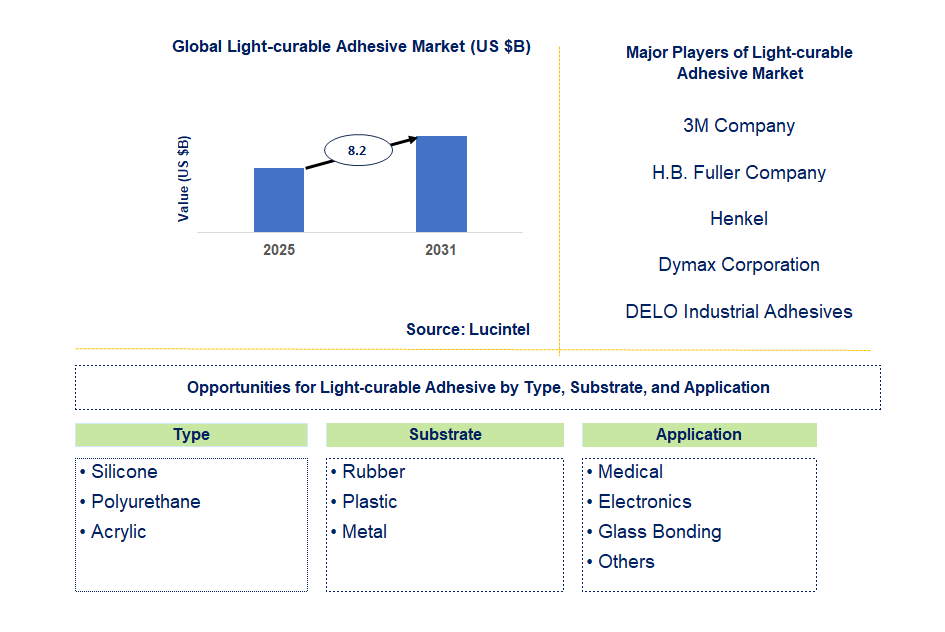
Key data points: The growth forecast = 8.2% annually for the next 7 years. Scroll below to get more insights. This market report covers trends, opportunities and forecasts in light-curable adhesive market to 2031 by type (silicone, polyurethane, and acrylic), substrate (rubber, plastic, and metal), application (medical, electronics, glass bonding, and others), and region (North America, Europe, Asia Pacific, and the Rest of the World)
We'll send your sample report shortly.
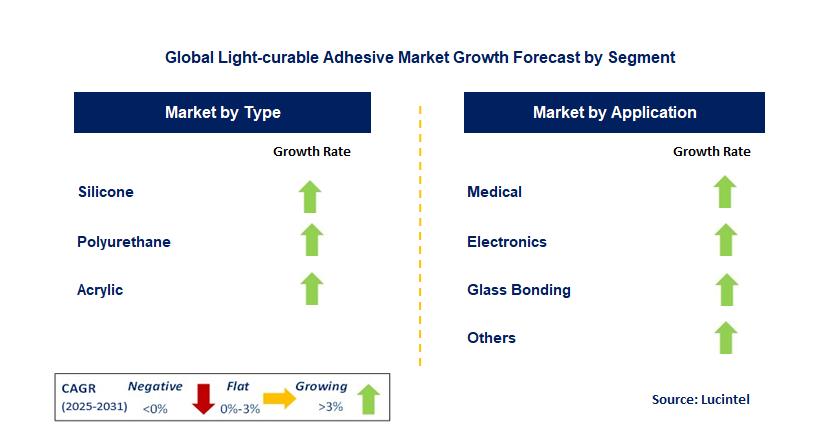
• Lucintel forecasts that, within the type category, acrylic is expected to witness the highest growth over the forecast period.
• Within the application category, electronics is expected to witness the highest growth.
• In terms of region, APAC is expected to witness the highest growth over the forecast period. Gain valuable insights for your business decisions with our comprehensive 150+ page report. Sample figures with some insights are shown below.
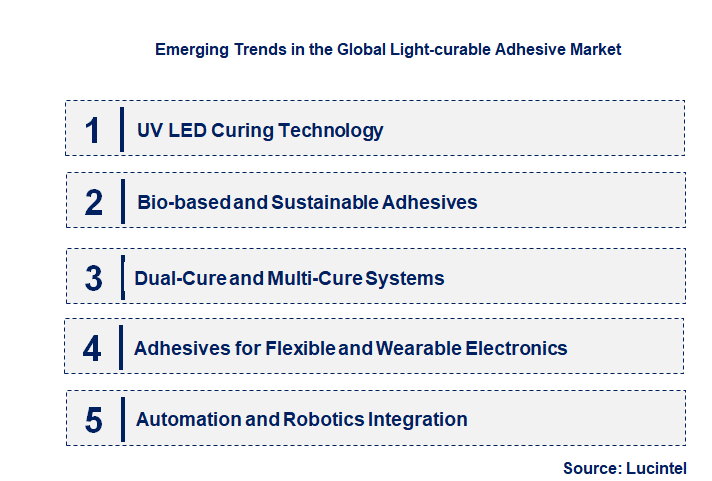
• UV LED Curing Technology: A significant trend is the widespread adoption of UV LED curing technology. This shift is driven by the advantages of LEDs, including lower energy consumption, longer lifespan, reduced heat generation, and instantaneous on/off capabilities compared to traditional mercury lamps. This impacts efficiency, cost savings, and the ability to bond heat-sensitive substrates.
• Bio-based and Sustainable Adhesives: There is a growing trend towards developing bio-based and sustainable light-curable adhesives. This is fueled by increasing environmental awareness and regulatory pressures to reduce reliance on petrochemicals and minimize volatile organic compound (VOC) emissions. Manufacturers are exploring renewable raw materials to create more eco-friendly products.
• Dual-Cure and Multi-Cure Systems: The emergence of dual-cure and multi-cure adhesive systems is a key trend. These adhesives offer secondary curing mechanisms (e.g., heat, moisture, or anaerobic) in addition to UV light, ensuring complete curing in shadowed areas or complex geometries. This expands their applicability and enhances reliability in critical bonding applications.
• Adhesives for Flexible and Wearable Electronics: The miniaturization and increasing complexity of electronics, especially in flexible and wearable devices, are driving a trend for specialized light-curable adhesives. These formulations offer flexibility, high bond strength, and resistance to environmental factors, crucial for durable and high-performing electronic assemblies.
• Automation and Robotics Integration: The integration of light-curable adhesives with automated dispensing and curing systems is an emerging trend. This allows for high-speed, high-precision bonding in manufacturing processes, reducing human error, increasing production throughput, and minimizing material waste, vital for industries like automotive and medical device assembly. These trends are significantly reshaping the light-curable adhesive market by fostering energy efficiency and environmental sustainability through LED curing and bio-based formulations, enhancing application versatility with dual-cure systems, addressing the demands of advanced electronics, and improving manufacturing efficiency through automation. This evolution solidifies light-curable adhesives as a cornerstone of modern bonding.
• Advancements in LED-Curable Formulations: A major development is the continued advancement of LED-curable adhesive formulations. Manufacturers are developing adhesives optimized for specific LED wavelengths, offering faster cure times, lower energy consumption, and reduced heat output, making them ideal for bonding heat-sensitive materials and improving overall production efficiency.
• Development of Dual-Cure Adhesives: Recent developments include the widespread introduction and refinement of dual-cure adhesives. These systems combine light curing with a secondary curing mechanism (e.g., moisture, heat) to ensure complete curing in shadowed areas or complex geometries, expanding their application scope and enhancing bond reliability in critical assemblies.
• Focus on Medical Device Bonding: There’s a significant recent development in tailored light-curable adhesives for the medical device industry. Innovations focus on biocompatibility, sterilization resistance, and precision bonding for intricate components in catheters, syringes, and wearable sensors, meeting stringent regulatory and performance requirements for patient safety.
• Integration with Automation and Robotics: A key development is the seamless integration of light-curable adhesives with automated dispensing and robotic assembly systems. This allows for high-speed, precise, and repeatable bonding operations in high-volume manufacturing environments, improving throughput and reducing labor costs in electronics and automotive industries.
• Increased Use in Displays and Optics: Recent developments highlight the growing application of light-curable adhesives in displays, optics, and optoelectronics. Formulations with excellent optical clarity, low yellowing, and precise refractive indices are being developed for bonding lenses, touchscreens, and fiber optics, driven by the demand for high-performance visual devices. These developments are impacting the light-curable adhesive market by enhancing curing efficiency, expanding application versatility into complex designs, bolstering their use in critical medical and optical fields, and improving manufacturing productivity through automation. This continuous innovation makes light-curable adhesives indispensable for advanced bonding solutions.
• Medical Device Assembly: The rapidly expanding medical device sector, particularly in minimally invasive instruments, diagnostics, and wearables, offers a significant growth opportunity. Light-curable adhesives provide biocompatibility, precision, and fast curing, ideal for bonding sensitive components and enabling high-volume production of intricate medical devices.
• Electronics and Optoelectronics: The ongoing miniaturization of electronic components, increasing demand for high-performance displays, and growth in optoelectronics (e.g., fiber optics, LEDs) present a prime opportunity. Light-curable adhesives offer precise bonding, optical clarity, and low stress, essential for assembling smartphones, cameras, and display panels.
• Automotive and Transportation: The shift towards lightweight materials, electric vehicles, and autonomous driving systems in the automotive sector creates a robust growth avenue. Light-curable adhesives are used for bonding sensors, displays, and structural components, contributing to vehicle weight reduction, improved fuel efficiency, and enhanced passenger safety.
• Glass Bonding and Architectural Applications: The increasing use of glass in modern architecture, furniture, and consumer goods provides a consistent growth opportunity. Light-curable adhesives offer optically clear bonds, fast curing, and high strength for glass-to-glass or glass-to-metal applications, enabling aesthetically pleasing and durable designs.
• 3D Printing and Additive Manufacturing: The emerging field of 3D printing and additive manufacturing offers a novel growth pathway. Light-curable resins are fundamental to many 3D printing processes (e.g., SLA, DLP), providing precise and rapid layer-by-layer curing to create complex prototypes and functional parts across various industries. These strategic growth opportunities are poised to significantly impact the light-curable adhesive market by expanding its critical role in high-growth, high-tech sectors like medical devices and electronics, capitalizing on advancements in automotive and architectural design, and pioneering new applications in additive manufacturing. This ensures its continued market expansion and technological relevance.
• 3M Company
• H.B. Fuller Company
• Henkel
• Dymax Corporation
• DELO Industrial Adhesives
• Permabond Engineering Adhesives
• Dow Chemical Company
• Sika
• Ashland Global Holdings
• Epoxy Technology
• Silicone
• Polyurethane
• Acrylic
• Rubber
• Plastic
• Metal
• North America
• Europe
• Asia Pacific
• The Rest of the World
• United States: The U.S. light-curable adhesive market is driven by increasing adoption in medical devices, electronics, and automotive industries. Recent developments focus on high-performance formulations for wearables and minimally invasive surgeries, alongside a strong push for bio-based and environmentally friendly solutions to meet stringent regulatory requirements.
• China: China’s light-curable adhesive market is experiencing robust growth, propelled by its massive electronics manufacturing and automotive sectors. UV-cured adhesives are gaining traction due to their fast curing times and low VOC emissions. Recent developments include increased investment in R&D to develop advanced formulations and expand applications in flexible packaging and consumer electronics.
• Germany: Germany’s light-curable adhesive market is characterized by innovation, especially in the automotive and electronics sectors. Recent advancements include the development of process technologies that combine adhesive dispensing and pre-activation for enhanced efficiency. There’s also a strong emphasis on meeting stringent quality and environmental standards for high-performance applications.
• India: India’s light-curable adhesive market is witnessing significant growth, driven by the expanding automotive and electronics manufacturing industries. Recent developments include increased demand for high-performance adhesives for electric vehicles and miniaturized electronic devices. There’s a growing trend towards eco-friendly and sustainable adhesive solutions to align with environmental regulations.
• Japan: Japan’s light-curable adhesive market shows consistent growth, particularly in consumer electronics and medical devices. Recent developments focus on advanced formulations like LED UV curing adhesives for improved energy efficiency and reduced environmental impact. The market is also driven by the demand for compact electronic devices requiring precise and durable bonding solutions.


• 3M Company
• H.B. Fuller Company
• Henkel
• Dymax Corporation
• DELO Industrial Adhesives
• Permabond Engineering Adhesives
• Dow Chemical Company
• Sika
• Ashland Global Holdings
• Epoxy Technology Q5. Which light-curable adhesive market segment will be the largest in future? Answer: Lucintel forecasts that, within the type category, acrylic is expected to witness the highest growth over the forecast period. Q6. In light-curable adhesive market, which region is expected to be the largest in next 5 years? Answer: In terms of region, APAC is expected to witness the highest growth over the forecast period. Q7. Do we receive customization in this report? Answer: Yes, Lucintel provides 10% customization without any additional cost.


Choose a license that fits your team. Instant PDF delivery.
Prices exclude taxes. Instant delivery. Custom licensing available on request.
Market Report · July 17, 2026
Market Report · July 17, 2026
Market Report · May 18, 2026
Trusted partner for strategic intelligence and business growth


Receive a complimentary market analysis tailored to your industry. Our analysts will identify key growth opportunities and competitive dynamics specific to your business.

Market size, growth rate, and key trend analysis for your specific sector.

Top competitor positioning and market share analysis.

Strategic recommendations backed by data-driven insights.
Get curated market intelligence and competitive moves straight to your inbox.
By subscribing, you agree to receive our monthly insights. Unsubscribe anytime.
Receive a complimentary market analysis tailored to your industry. Our analysts will identify key growth opportunities and competitive dynamics specific to your business.
Market size, growth rate, and key trend analysis for your specific sector.
Top competitor positioning and market share analysis.
Strategic recommendations backed by data-driven insights.
Get curated market intelligence, emerging trends, and competitive moves straight to your inbox each month.
By subscribing, you agree to receive our monthly insights. Unsubscribe anytime.
We'll send your sample report shortly.