
Market Report · July 15, 2026

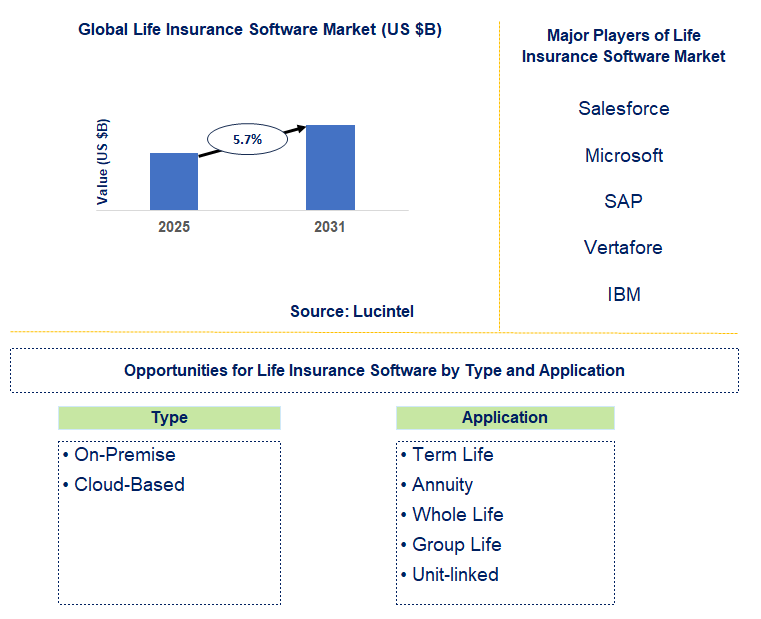
Key data points: The growth forecast = 5.7% annually for the next 7 years. Scroll below to get more insights. This market report covers Trends, opportunities and forecasts in life insurance software market to 2031 by type (on-premise and cloud-based), application (term life, annuity, whole life, group life, and unit-linked), and region (North America, Europe, Asia Pacific, and the Rest of the World)
We'll send your sample report shortly.
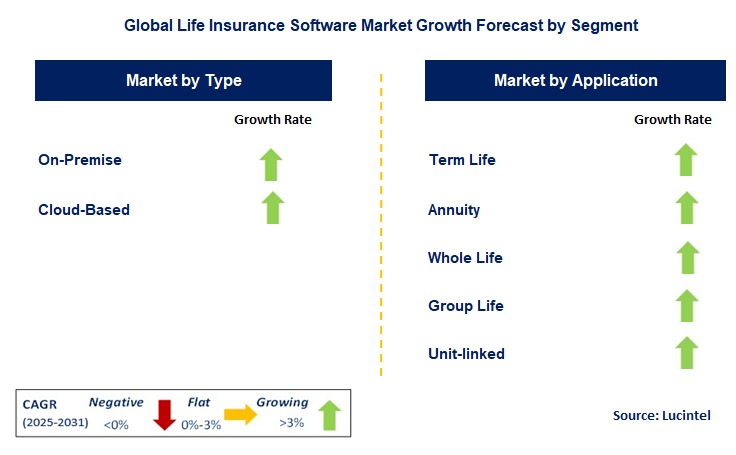
• Lucintel forecasts that, within the type category, cloud-based is expected to witness higher growth over the forecast period.
• Within the application category, Unit-linked is expected to witness the highest growth.
• In terms of region, APAC is expected to witness the highest growth over the forecast period.
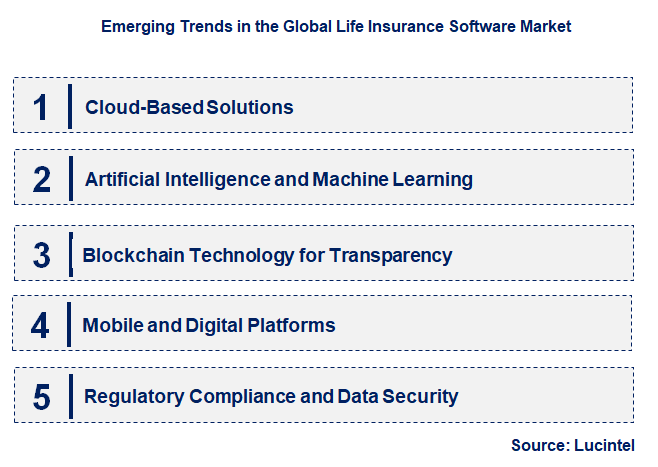
• Cloud-Based Solutions: Cloud-based life insurance software is becoming increasingly popular because of its scalability, affordability, and flexibility. These solutions enable insurers to efficiently manage customer information, policy administration, and claims processing. The cloud facilitates access to systems from anywhere, promoting remote work and enhancing operational agility. Cloud-based platforms also enable insurance companies to remain compliant with data security regulations, which makes it a popular choice for infrastructure modernization.
• Artificial Intelligence and Machine Learning: Artificial intelligence are revolutionizing the manner in which life insurers underwrite policies, determine risk, and settle claims. These innovations allow insurers to anticipate trends, customize policies, and enhance the detection of fraudulent activity. With the ability to review huge pools of data, AI and ML enable insurers to make quicker and more accurate choices. As technologies advance, automation is anticipated in customer service and claim handling, producing a less painful experience for policyholders.
• Blockchain Technology for Transparency: Blockchain is becoming a vital technology in life insurance, promoting transparency and security in transactions. Insurers are able to safely keep and exchange information about policies and claims using blockchain, minimizing fraud and building trust with consumers. Blockchain's decentralized structure makes it possible for all stakeholders in the insurance industry to view accurate and real-time information, resulting in streamlined operations and improved customer experience.
• Mobile and Digital Platforms: The rapidly growing usage of mobile phones is fueling the need for mobile-first life insurance software solutions. Insurers are embracing mobile applications and digital platforms through which policyholders can access, modify, and place their policies, submit claims, and access customer service directly from their mobile phones. Mobile platforms are also enhancing customer engagement, providing convenience, and allowing insurers to provide personalized services through data insights from mobile behavior.
• Regulatory Compliance and Data Security: As data protection regulations are getting stricter across the world, life insurers are increasingly emphasizing compliance through their software solutions. Life insurance software is more and more incorporating functionalities that enable insurers to monitor compliance with regional regulations and laws. Data security features are being strengthened, ensuring that sensitive customer information is stored and processed securely. Insurers are also implementing technologies like encryption and multi-factor authentication to ensure data security. Such trends are redefining the life insurance software industry by enhancing operational effectiveness, customer satisfaction, and compliance with regulations. Cloud computing solutions, artificial intelligence, blockchain technology, mobile technology, and emphasis on data protection are helping insurers introduce innovative products and services and optimize their back-end operations.
• Growing Use of Artificial Intelligence: AI is being widely used in life insurance software for improving risk estimation, underwriting, and client servicing. Automation through AI is enhancing the ease of claims and customer handling. Insurers are using AI for creating predictive algorithms that customize policy and premium decisions according to individuals' risk patterns. This phenomenon is enabling insurers to deliver more effective services and improve operational effectiveness.
• Move to Cloud-Based Infrastructure: The shift to cloud-based infrastructure is gaining momentum in the life insurance sector. Cloud-based solutions provide insurers with more flexibility, scalability, and cost-effectiveness. These platforms facilitate smooth data sharing and collaboration between departments and third-party service providers. Insurers can also enhance disaster recovery features and lower maintenance expenses by abandoning conventional on-premise infrastructure.
• Blockchain Integration for Claim Transparency: Blockchain technology is also being implemented within life insurance software to advance transparency and security. Insurers use blockchain to develop unalterable transaction records, where both policyholders and insurers can see accurate and transparent information. This innovation proves valuable in fighting fraud and enhancing the confidence between the insurers and customers.
• Improved Customer Self-Service Features: Life insurance organizations are now more focused on giving digital platforms and mobile applications to facilitate customers to administer their policies on their own. Through these platforms, the policyholders can check their coverage, lodge claims, and even change their personal data. Through this offering of self-service features, the insurers are improving the satisfaction of their customers while lessening the administrative workload on their staff.
• Regulatory Compliance Enhancements: With changing regulatory environments around the world, life insurance software is being enhanced to keep up with new standards. Software solutions now include automated tracking of regulatory changes and adapting processes to them. This assists insurers in minimizing the risk of non-compliance and incurring penalties. Stronger data protection and privacy capabilities are also being implemented to meet stricter regulations such as GDPR. The developments are assisting the life insurance software market in addressing the growing need for innovation, efficiency, and compliance. Ongoing integration of AI, cloud solutions, blockchain, and customer-centric platforms is revolutionizing how insurers interact and do business with customers.
• E-commerce and Online Insurance Platforms: As online insurance selling increases, there is an increased potential for life insurance software solutions that are e-commerce platform-friendly. The solutions allow insurers to give online quotes, purchase policies, and process instant claims. Digital-first platform adoption is widening as customers increasingly seek higher convenience and accessibility, presenting growth opportunities for insurers that can leverage digital technology.
• Data-Driven Personalization: Personalizing life insurance policies with data analytics presents a prime growth opportunity. Life insurance software is getting infused with artificial intelligence and machine learning to give offer personalized suggestions based on customer information. This development enables insurers to provide customized premiums, coverage, and benefits to suit specific needs, enhancing customer retention and satisfaction.
• Integration of Wellness Programs: Integrating wellness programs with life insurance software provides a strategic growth opportunity. Using health data and inducing healthy behavior, insurers can provide incentives or discounts to policyholders. This trend is especially applicable in health-conscious markets where well-being is an integral part of the insurance service.
• Mobile Apps and Customer Engagement: Mobile apps are becoming more in demand, with consumers wanting to handle their life insurance policies while on the move. Creating mobile apps that enable consumers to monitor policies, submit claims, and interact with agents presents huge growth prospects. Insurers can promote customer engagement by using seamless mobile experiences, which, in turn, supports driving customer loyalty.
• Partnerships with Insurtech Startups: Working with insurrect startups that focus on emerging technologies gives life insurance companies access to innovative software solutions. These collaborations enable insurers to remain at the forefront of technology trends, ranging from blockchain to AI, and offer opportunities for fast product development and service innovation. Strategic growth opportunities in the life insurance software market include digital transformation, customer-centric services, and innovative technology integration. These opportunities are assisting insurers in addressing the needs of a fast-changing market, enhancing customer experience, and fueling overall market growth.
• Salesforce
• Microsoft
• SAP
• Vertafore
• IBM
• Applied Systems
• Oracle
• Sapiens International Corporation
• Adobe
• Accenture
• On-Premise
• Cloud-Based
• Term Life
• Annuity
• Whole Life
• Group Life
• Unit-linked
• North America
• Europe
• Asia Pacific
• The Rest of the World
• United States: The United States has emphasized customer experience enhancement and process optimization in the case of underwriting in its life insurance software market. Several insurance firms are embracing artificial intelligence (AI) and machine learning to offer more customized policies and streamline claims settlement. Insurtech firms have also come into play with cloud-based applications that interface with legacy systems. The application of big data analytics is also growing, allowing the insurers to better analyze the risk and offer improved pricing models. Besides, compliance with regulations has seen enhanced use of software solutions in order to stay compliant with changing legislation.
• China: China is fast embracing life insurance software due to the nation's strong move towards digitalization. The market is experiencing greater use of artificial intelligence and blockchain technology in a bid to enhance the efficiency of operations and the detection of fraud. Life insurance companies are embracing automation and cloud computing in order to provide smooth, online-based services. There is also increased demand for mobile apps to manage life insurance policies with a view to making the customer experience easier. There is also a changing regulatory environment in China, which has seen insurers forced to modernize their systems to meet new regulations.
• Germany: The market for life insurance software in Germany is witnessing a move towards efficient, customer-friendly solutions. Insurers are employing automation tools to enhance underwriting procedures and claims handling. The emphasis is on streamlining sophisticated policy management platforms and enhancing digital customer interaction channels. With tightening regulatory environments for data security, German insurers are spending on solutions that help safeguard consumer information and maintain compliance. AI and big data are also being integrated more and more to improve decision-making and risk management solutions.
• India: India's life insurance software industry is undergoing a leapfrog digital drive with insurers seeking to leap into the modern age. Insurers are implementing solutions that allow them to process claims more quickly and deliver more customized products. The focus is high on mobile-first platforms because of the growing usage of smartphones in India. Software solutions that offer end-to-end management of policies, starting from underwriting to claims settlement, are picking up pace. The Indian market is also witnessing growth in insurrect startups providing cutting-edge software solutions specific to local requirements and regulatory norms.
• Japan: In Japan, the market for life insurance software is geared toward enhancing efficiency of operations with automation and artificial intelligence. Japanese insurers are more adopting digital technologies to automate policy issuance, underwriting, and claims processes. The market is also witnessing an upsurge in customer-facing platforms that provide enhanced transparency and convenience to policyholders. Regulatory compliance and data protection are top priorities, which has driven the implementation of software solutions to ensure insurers adhere to high standards. Insurers are also testing the waters of blockchain to achieve secure and transparent contract management.


• Salesforce
• Microsoft
• SAP
• Vertafore
• IBM
• Applied Systems
• Oracle
• Sapiens International Corporation
• Adobe
• Accenture Q5. Which life insurance software market segment will be the largest in future? Answer: Lucintel forecasts that, within the type category, cloud-based is expected to witness higher growth over the forecast period. Q6. In life insurance software market, which region is expected to be the largest in next 5 years? Answer: In terms of region, APAC is expected to witness the highest growth over the forecast period. Q7. Do we receive customization in this report? Answer: Yes, Lucintel provides 10% customization without any additional cost.


Choose a license that fits your team. Instant PDF delivery.
Prices exclude taxes. Instant delivery. Custom licensing available on request.
Market Report · July 15, 2026
Market Report · June 26, 2026
Market Report · June 24, 2026
Trusted partner for strategic intelligence and business growth


Receive a complimentary market analysis tailored to your industry. Our analysts will identify key growth opportunities and competitive dynamics specific to your business.

Market size, growth rate, and key trend analysis for your specific sector.

Top competitor positioning and market share analysis.

Strategic recommendations backed by data-driven insights.
Get curated market intelligence and competitive moves straight to your inbox.
By subscribing, you agree to receive our monthly insights. Unsubscribe anytime.
Receive a complimentary market analysis tailored to your industry. Our analysts will identify key growth opportunities and competitive dynamics specific to your business.
Market size, growth rate, and key trend analysis for your specific sector.
Top competitor positioning and market share analysis.
Strategic recommendations backed by data-driven insights.
Get curated market intelligence, emerging trends, and competitive moves straight to your inbox each month.
By subscribing, you agree to receive our monthly insights. Unsubscribe anytime.
We'll send your sample report shortly.