Leather Goods Market Report: Trends, Forecast and Competitive Analysis to 2035

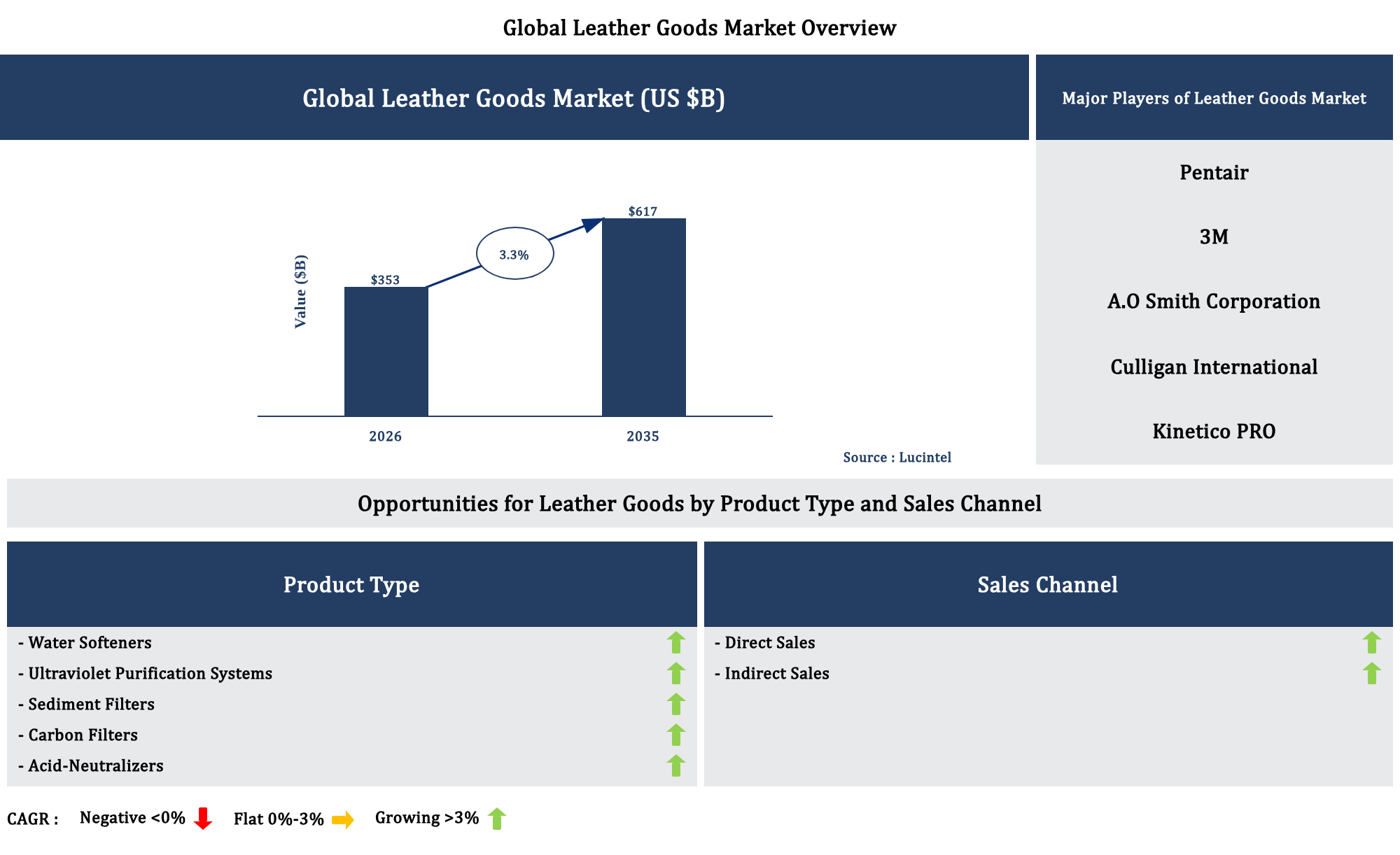
Key data points: The market size in 2035 = $617 billion, growth forecast = 3.3% annually for the next 9 years. Scroll below to get more insights. This market report covers trends, opportunities, and forecasts in the global leather goods market to 2035 by product type (water softeners, ultraviolet purification systems, sediment filters, carbon filters and acid-neutralizers), sales channel (direct sales and indirect sales), and region (North America, Europe, Asia Pacific, and the Rest of the World)

Publisher: Lucintel Last Updated: June 2026
See Pricing

Download Sample Report

| ✨ New Download Sample report — Get instant insights! | ✨ New Download Sample report — Get instant insights!

Leather Goods Market Report: Trends, Forecast and Competitive Analysis to 2035

Leather Goods Market


The future of the global leather goods market looks promising with opportunities in the direct sales and indirect sales markets. The global leather goods market is expected to reach an estimated $617 billion by 2035 with a CAGR of 3.3% from 2026 to 2035. The major drivers for this market are the increasing luxury fashion demand, the rising disposable income spending and the growing e-commerce leather sales.

• Lucintel forecasts that, within the product type category, carbon filters will remain the largest segment over the forecast period as the rising urban water treatment adoption.

• Within the sales channel category, indirect sales will remain the largest segment due to the the increasing distribution channel expansion.

• In terms of regions, APAC will remain the largest region over the forecast period due to the the increasing demand for luxury fashion consumption.

Gain valuable insights for your business decisions with our comprehensive 150+ page report.
Leather Goods Market

Emerging Trends in the Leather Goods Market

The leather goods market is undergoing a period of dynamic transformation driven by shifting consumer values, technological advances, and changing retail models. Premiumization and personalization are redefining what buyers expect from bags, footwear, and small leather accessories, while sustainability pressures are reshaping sourcing and materials innovation. Digital channels, from social commerce to virtual try-ons, are becoming central to discovery and purchase journeys. At the same time, new business models such as resale and rental are extending product lifecycles and altering brand strategies. These emerging trends are collectively redefining competitiveness and long-term growth trajectories in the leather goods market.
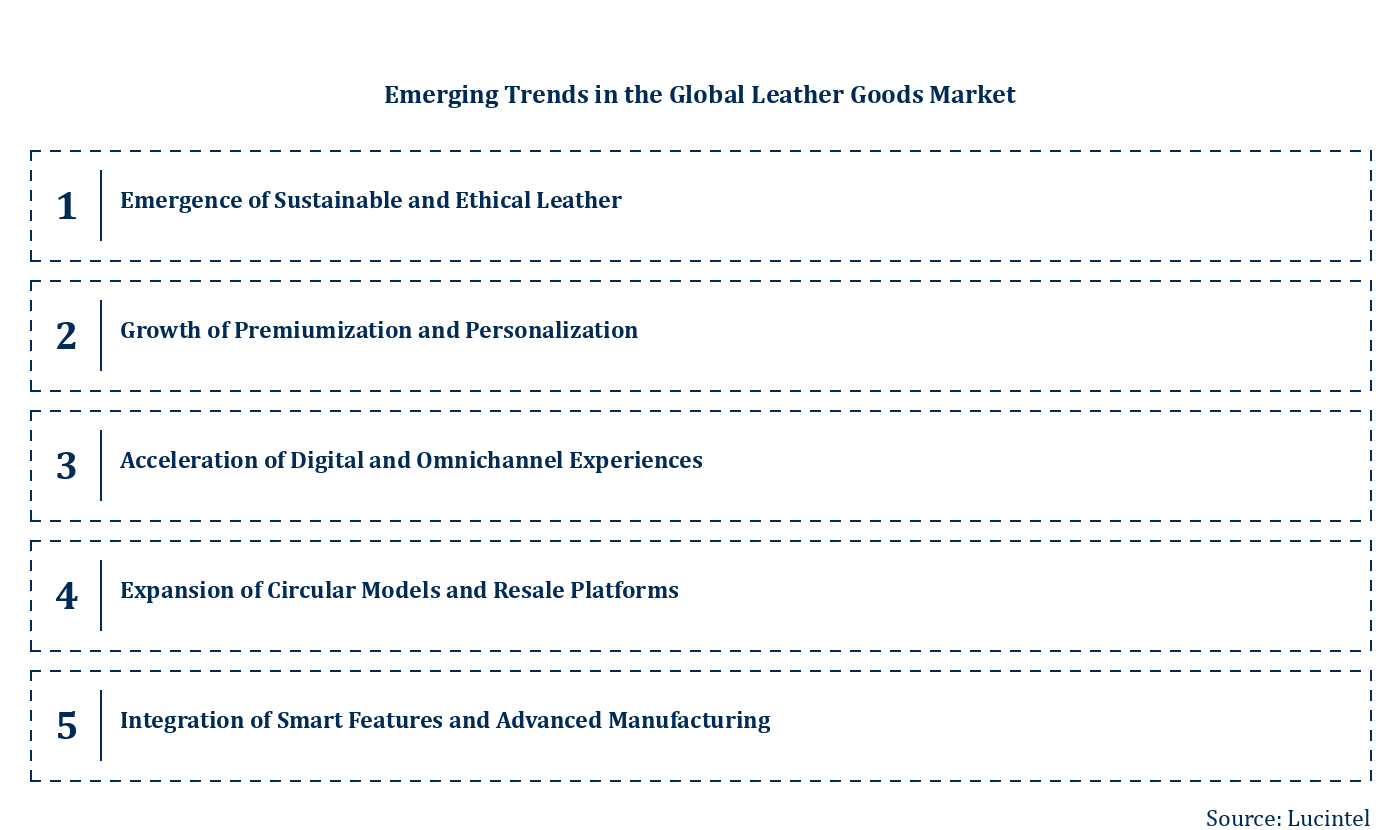
  • Emergence of Sustainable and Ethical Leather: The leather goods market is rapidly moving toward more sustainable practices, with brands investing in certified tanneries, chrome-free tanning, and transparent supply chains. Consumers increasingly demand proof of animal welfare and lower environmental impact, pushing companies to adopt traceability systems and cleaner chemicals. Alternative leathers made from plants or recycled materials are also gaining traction, giving brands new storytelling angles and risk mitigation against regulatory changes. This trend is reshaping sourcing strategies, influencing pricing, and differentiating brands that can credibly demonstrate measurable improvements in sustainability performance.
  • Growth of Premiumization and Personalization: Rising disposable incomes and aspirational lifestyles are driving demand for high-end, differentiated leather goods that signal status and individuality. Brands are expanding customization services, from monogramming and made-to-measure fits to configurable hardware and color combinations. Digital tools enable consumers to co-design products online, strengthening emotional attachment and willingness to pay premiums. This trend elevates the role of craftsmanship and heritage narratives while encouraging limited editions and capsule collections. As a result, the leather goods market is shifting from mass production toward more curated, higher-margin offerings targeted at niche and affluent segments.
  • Acceleration of Digital and Omnichannel Experiences: The leather goods market is witnessing intense digitalization across the value chain, with e-commerce, social media, and virtual showrooms becoming critical touchpoints. Brands are leveraging augmented reality to enable virtual try-ons of handbags and footwear, reducing return rates and enhancing engagement. Influencer marketing and live-stream shopping are emerging as powerful tools for storytelling and product launches. Seamless omnichannel capabilities, such as click-and-collect and unified inventories, are now baseline expectations. This trend is forcing brands to invest heavily in data analytics, user experience design, and digital content to nurture loyalty and capture younger, mobile-first consumers.
  • Expansion of Circular Models and Resale Platforms: Circular economy principles are reshaping the leather goods market as consumers embrace resale, refurbishment, and rental services for premium products. Dedicated resale platforms and brand-operated buy-back programs are extending product lifespans and creating new revenue streams. Authentication technologies and repair services bolster trust and preserve product value, particularly for luxury handbags and accessories. This trend responds to sustainability concerns while enabling entry-level access to prestigious brands. It also changes how brands manage inventory, warranties, and after-sales engagement, encouraging design for durability and easier repair to maximize long-term residual value.
  • Integration of Smart Features and Advanced Manufacturing: The leather goods market is beginning to incorporate smart functionalities and advanced production technologies to enhance performance and efficiency. Embedded sensors, RFID tags, and tracking chips in bags and luggage enable anti-theft features, inventory management, and personalized services. On the manufacturing side, innovations such as 3D patterning, laser cutting, and digital prototyping optimize material usage and reduce lead times. These technologies allow rapid iteration of designs and better fit, while maintaining traditional aesthetics. The fusion of heritage craftsmanship with smart and precise manufacturing is creating new product categories and competitive advantages for forward-looking brands.

Leather Goods Market by country

Recent Developments in the Leather Goods Market

The leather goods market is undergoing a period of rapid transformation driven by shifting consumer expectations, technological innovation, and rising sustainability pressures. Brands are rethinking materials, supply chains, and retail strategies to remain competitive while aligning with ethical and environmental standards. Digital commerce and direct-to-consumer models are reshaping how products are discovered and purchased, while new manufacturing technologies are improving efficiency and customization. At the same time, heightened regulatory scrutiny and evolving fashion trends are influencing product design and sourcing decisions. These recent developments collectively define the current trajectory and future outlook of the global leather goods market.

  • Rising Adoption of Sustainable and Ethical Materials: The leather goods market is witnessing strong momentum toward responsibly sourced hides, bio-based coatings, and chrome-free tanning, reducing environmental and social impacts across the value chain. Major brands are publishing traceability reports, investing in deforestation-free supply chains, and partnering with certified tanneries to meet stricter regulations and consumer expectations. This development is reshaping procurement strategies, driving certification demand, and boosting the appeal of eco-labeled leather goods among environmentally conscious shoppers.
  • Growth of Alternative and Lab-grown Leather Technologies: Material innovation is accelerating, with plant-based, mycelium, and lab-grown leather alternatives gaining commercial traction in footwear, handbags, and accessories. These next-generation materials promise lower carbon footprints and more predictable quality, attracting investment from fashion houses and technology start-ups alike. As performance characteristics improve and costs gradually decline, alternative leathers are expanding design possibilities, enabling new product lines, and intensifying competition with conventional leather goods in premium and mid-market segments.
  • Digitization of Design, Manufacturing, and Retail Channels: The leather goods market is embracing digital tools such as 3D design, virtual sampling, and automated cutting systems to shorten development cycles and minimize waste. Brands are enhancing online product visualization and virtual try-on experiences to boost conversion rates in e-commerce channels. Simultaneously, data-driven inventory and demand forecasting are reducing overproduction and markdowns. This digital shift is improving operational efficiency, supporting agile product launches, and strengthening the integration between online and offline retail environments.
  • Premiumization and Personalization of Product Offerings: Consumer demand is tilting toward high-quality, long-lasting leather goods that offer differentiated design and customization options, from monogramming to made-to-measure services. Brands are using craftsmanship stories, limited editions, and bespoke features to justify higher price points and deepen emotional engagement. This development is expanding the share of luxury and affordable-luxury segments within the leather goods market, while encouraging manufacturers to upgrade materials, finishes, and after-sales services to retain loyal, high-value customers.
  • Expansion in Emerging Markets and Omni-channel Strategies: The leather goods market is experiencing strong growth in emerging economies driven by rising disposable incomes, urbanization, and aspirational consumption. International and local brands are accelerating store openings, marketplace partnerships, and localized e-commerce platforms to capture demand. At the same time, omni-channel models—such as click-and-collect, social commerce, and live shopping—are becoming critical for reaching diverse customer segments. This expansion is increasing competitive intensity, shaping regional product assortments, and prompting investments in localized marketing and logistics capabilities.

Strategic Growth Opportunities in the Leather Goods Market

The leather goods market is evolving as consumer preferences shift toward premium quality, sustainability, and personalization across multiple applications. Rising incomes, urbanization, and digital commerce are boosting demand for bags, footwear, small leather accessories, and luxury items worldwide. At the same time, brands are innovating in materials, design, and manufacturing, integrating circular-economy principles and traceable supply chains. Strategic growth opportunities are emerging in segments that combine fashion, functionality, and ethical sourcing. Companies that align portfolios with these high-potential applications, supported by omnichannel distribution and strong branding, can enhance margins, deepen customer loyalty, and capture share in the leather goods market.

  • Luxury Handbags and Accessories: Premium handbags, wallets, and small leather goods offer strong growth potential as consumers trade up to aspirational brands and limited-edition collections. Strategic focus on craftsmanship, heritage storytelling, and collaboration with designers or influencers can justify higher price points and strengthen brand equity, while personalization services and exclusive online drops create scarcity value and recurring engagement.
  • Footwear and Sneakers: Leather footwear, including fashion sneakers and comfort shoes, presents a scalable opportunity driven by casualization trends and athleisure. Brands can grow by blending performance features with premium leather aesthetics, using eco-certified tanneries and recycled components to address sustainability concerns, and leveraging direct-to-consumer channels and frequent style refreshes to accelerate sell-through.
  • Business, Travel, and Work Essentials: Briefcases, laptop sleeves, backpacks, and travel luggage made from leather are benefiting from hybrid work and increased mobility. Growth is driven by functional designs with device protection, smart compartments, and RFID security, combined with durable, lightweight leathers. Corporate gifting programs and customization for enterprises create additional B2B revenue streams and deepen institutional relationships.
  • Fashion Apparel and Outerwear: Leather jackets, skirts, and tailored garments remain iconic fashion statements, offering high-margin opportunities for both luxury and premium mass brands. Innovation in softer, lighter leathers and versatile silhouettes broadens seasonality and target demographics. Capsule collections, made-to-measure services, and integration of bio-based or chrome-free tanning appeal to ethically minded consumers seeking statement pieces with a lower environmental footprint.
  • Sports, Outdoor, and Performance Gear: Leather-based equipment such as gloves, belts, saddlery, and motorcycle gear supports niche yet resilient growth in sports and outdoor applications. High-performance leathers with enhanced grip, abrasion resistance, and weather protection can differentiate brands. Partnerships with sporting leagues, outdoor influencers, and motorsport communities, combined with safety certifications and sustainable sourcing claims, build trust and justify premium pricing.

Leather Goods Market Drivers and Challenges

The global leather goods market is shaped by a complex mix of technological, economic, and regulatory influences that affect both demand and supply. Advancements in materials science, shifts in consumer income and lifestyle, and evolving environmental and animal welfare regulations all play central roles. Brands must balance heritage craftsmanship with digital retail, sustainability demands, and volatile raw material costs. At the same time, competitive pressures and changing fashion cycles require rapid innovation and agile supply chains. Understanding these interlinked drivers and challenges helps companies identify profitable segments, optimize sourcing, and build resilient strategies in the leather goods market.

The factors responsible for driving the leather goods market include:

  • Premiumization and Rising Disposable Incomes: Increasing disposable incomes, particularly among middle-class consumers in emerging economies, are driving demand for premium and luxury leather goods such as handbags, footwear, wallets, and accessories. As consumers trade up from basic to aspirational products, branded leather goods become status symbols that signal taste and social standing. This premiumization trend allows companies to command higher margins through craftsmanship, brand heritage, and design differentiation. It also encourages global luxury brands to expand retail footprints and invest in localized marketing, further reinforcing demand and supporting sustained value growth in the leather goods market.
  • Fashion Trends and Brand-Driven Consumer Culture: Rapidly evolving fashion trends and the growing influence of global brands and influencers are major catalysts for leather goods consumption. Seasonally changing collections, collaborations with designers and celebrities, and social media exposure stimulate frequent wardrobe updates, especially for leather handbags, footwear, and small accessories. Brand storytelling around heritage, exclusivity, and craftsmanship deepens emotional connections and encourages repeat purchases. This brand-driven culture also supports the growth of premium and limited-edition lines, enabling companies to segment customers and price points more effectively, which ultimately fuels both volume and value growth in the leather goods market.
  • Expansion of E-Commerce and Omnichannel Retail: The proliferation of e-commerce platforms and omnichannel retail strategies significantly expands the reach of leather goods brands to global consumers. Online marketplaces, brand-owned webshops, and social commerce channels allow customers to compare styles, prices, and reviews quickly, boosting purchase confidence and conversion rates. For leather goods, high-quality visuals, virtual try-on tools, and flexible return policies help overcome the tactile barrier. Omnichannel approaches, including click-and-collect and seamless inventory integration, improve convenience and inventory turnover. These digital capabilities lower geographic barriers, widen customer bases, and provide rich data for personalization, thereby accelerating market penetration and revenue growth.
  • Innovation in Materials and Manufacturing Technologies: Technological advancements in tanning, finishing, and cutting processes, alongside the emergence of recycled and alternative leather materials, are transforming product design and production efficiency. Modern machinery and digital design tools enable precise pattern cutting, reducing waste and improving yield from hides and skins. At the same time, innovations such as bio-based or lab-grown leather and high-quality synthetics allow brands to appeal to environmentally and ethically conscious consumers without sacrificing aesthetics or durability. These innovations open new product segments, support compliance with tightening environmental regulations, and can reduce long-term costs, collectively driving sustainable growth in the leather goods market.
  • Growth in Travel, Urbanization, and Lifestyle Shifts: Rising global travel, urban living, and changing work and leisure habits increase the need for functional yet stylish leather products such as luggage, business bags, backpacks, and everyday footwear. Frequent travelers seek durable, lightweight, and organized luggage, while urban professionals demand versatile leather accessories that transition from work to leisure settings. Casualization of dress codes also encourages demand for comfortable yet premium leather sneakers and accessories. These lifestyle shifts expand the addressable market beyond traditional luxury segments into performance and hybrid categories, allowing brands to diversify portfolios and capture demand across multiple occasions and consumer profiles.

The challenges in the leather goods market are:

  • Environmental Impact and Animal Welfare Concerns: Growing awareness of environmental impacts from livestock farming, tanning chemicals, and waste generation, along with heightened animal welfare concerns, is creating reputational and regulatory risks for the leather goods market. Consumers increasingly question traditional leather sourcing practices and seek transparency about traceability, deforestation links, and chemical usage. Stricter environmental regulations around effluents, emissions, and hazardous substances raise compliance costs for tanneries and manufacturers. Brands that fail to adapt face potential boycotts, loss of younger eco-conscious consumers, and greater scrutiny from NGOs and regulators, making sustainability transformation a complex but unavoidable challenge.
  • Volatility in Raw Material Prices and Supply Chain Disruptions: Fluctuations in the availability and prices of hides, skins, and chemical inputs, combined with logistics disruptions and geopolitical tensions, create instability in cost structures for leather goods producers. Disease outbreaks in livestock, trade restrictions, and currency movements can quickly affect hide supply and pricing. Long and fragmented global supply chains heighten vulnerability to delays, quality inconsistencies, and compliance gaps. These factors complicate inventory planning and margin management, especially for mid-market brands with limited pricing power. Managing this volatility requires robust supplier diversification, risk mitigation strategies, and greater flexibility in sourcing and production.
  • Intense Competition and Proliferation of Alternatives: The market faces strong competition both from within the leather segment and from high-quality synthetic and alternative materials that offer lower prices, easier maintenance, or stronger sustainability narratives. Fast-fashion players and private labels compress prices, while digital-native brands disrupt traditional wholesale models with direct-to-consumer strategies. At the same time, advanced non-leather materials, including vegan and bio-based options, attract consumers who are price sensitive or ethically motivated. This competitive intensity pressures traditional leather brands to invest heavily in design, branding, and innovation, while defending market share and margins in an environment of rapidly shifting consumer preferences.

The global leather goods market is propelled by rising incomes, aspirational branding, digital commerce, material innovation, and shifting lifestyles that broaden usage occasions and support premium pricing. However, environmental and ethical scrutiny, raw material volatility, and intensifying competition from alternative materials and new entrants pose significant obstacles. Together, these drivers and challenges are reshaping how leather goods are designed, sourced, produced, and marketed. Companies that transparently address sustainability, build resilient supply chains, and leverage technology and brand equity are best positioned to capture long-term growth while navigating mounting regulatory and consumer pressures.

List of Leather Goods Market Companies

Companies in the market compete on the basis of product quality offered. Major players in this market focus on expanding their manufacturing facilities, R&D investments, infrastructural development, and leverage integration opportunities across the value chain. Through these strategies leather goods market companies cater increasing demand, ensure competitive effectiveness, develop innovative products & technologies, reduce production costs, and expand their customer base. Some of the leather goods market companies profiled in this report include-

  • Pentair
  • 3M
  • A.O Smith Corporation
  • Culligan International
  • Kinetico PRO

Leather Goods Market by Segment

The study includes a forecast for the global leather goods market by product type, sales channel, and region.

  • Leather Goods Market by Product Type [Value ($B) from 2019 to 2035]:
    • Water Softeners
    • Ultraviolet Purification Systems
    • Sediment Filters
    • Carbon Filters
    • Acid-Neutralizers
  • Leather Goods Market by Sales Channel [Value ($B) from 2019 to 2035]:
    • Direct Sales
    • Indirect Sales
  • Leather Goods Market by Region [Value ($B) from 2019 to 2035]:
    • North America
    • Europe
    • Asia Pacific
    • The Rest of the World

Country Wise Outlook for the Leather Goods Market

The global leather goods market is undergoing significant transformation as consumer preferences, sustainability pressures, and digital commerce reshape competitive dynamics. Brands are rethinking sourcing models, investing in traceability, and experimenting with alternative materials to reduce environmental impact while preserving the appeal of premium leather. Luxury and mass-market segments alike are leveraging e‑commerce, direct‑to‑consumer channels, and personalization to capture younger, urban buyers. At the same time, regulatory scrutiny on animal welfare and chemical use is intensifying, prompting innovation in tanning technologies and circular business models. The market developments in the United States, China, Germany, India, and Japan reflect these shifting priorities.

  • United States: In the United States, the leather goods market is seeing robust demand for premium handbags, footwear, and accessories, fueled by luxury spending and resilient online sales. Brands are investing in ethically sourced hides, chrome-free tanning, and transparent supply chains to address sustainability expectations. Direct-to-consumer labels and digitally native brands are expanding with customized, made-to-order leather products, while established players leverage resale and refurbishment programs to extend product life. Technological integration, such as RFID-enabled tracking and advanced inventory analytics, is also improving omnichannel experiences and operational efficiency.
  • China: In China, the leather goods market is benefiting from rising disposable incomes and a strong appetite for status-driven luxury purchases, particularly among younger consumers in tier-one and emerging cities. International and domestic brands are expanding physical boutiques while deepening engagement on social commerce platforms and livestream channels. There is a growing push toward higher-quality domestic leather manufacturing, supported by investments in modern tanneries and stricter environmental standards. At the same time, consumers are increasingly receptive to innovative finishes, bold designs, and collaborations, which is encouraging brands to accelerate product refresh cycles and limited-edition launches.
  • Germany: In Germany, the leather goods market is characterized by a strong emphasis on craftsmanship, durability, and sustainability, especially in footwear, automotive interiors, and premium accessories. Manufacturers are upgrading to low-impact tanning processes, investing in water and energy efficiency, and obtaining certifications that validate eco-friendly operations. German brands are also exploring recycled leather fibers and bio-based coatings to reduce reliance on conventional chemicals. E-commerce adoption has accelerated, but specialty retailers and high-quality leather workshops remain important channels, with consumers favoring timeless designs and repairable products that align with circular economy principles.
  • India: In India, the leather goods market is expanding on the back of export growth and rising domestic consumption of fashion footwear, bags, and small accessories. The country is upgrading its manufacturing base through cluster development, modern tanning units, and skill-building initiatives aimed at improving product quality and compliance with global norms. Policy support is encouraging value-added exports rather than raw hide shipments, while brands increasingly target urban consumers with branded, affordable leather products. There is also early-stage experimentation with eco-friendly tanning, waste management solutions, and alternative materials to respond to environmental and social governance expectations from international buyers.
  • Japan: In Japan, the leather goods market focuses on high-precision craftsmanship, minimalist aesthetics, and long-lasting quality, with strong niches in small leather goods, premium footwear, and specialty bags. Japanese brands and workshops are emphasizing traceability of hides and traditional tanning methods alongside modern, low-impact technologies. Consumers value repair services and meticulous after-sales care, supporting a culture of longevity in leather products. The market is also seeing growth in collaborations between local artisans and global luxury houses, as well as increased online distribution that maintains a curated, boutique-like experience for discerning Japanese shoppers.

Features of the Leather Goods Market

  • Market Size Estimates: Leather goods market size estimation in terms of value ($B).
  • Trend and Forecast Analysis: Market trends (2019 to 2025) and forecast (2026 to 2035) by various segments and regions.
  • Segmentation Analysis: Leather goods market size by various segments, such as by product type, sales channel and region in terms of value ($B).
  • Regional Analysis: Leather goods market breakdown by North America, Europe, Asia Pacific, and the Rest of the World.
  • Growth Opportunities: Analysis of growth opportunities in different product type, sales channel and regions for the leather goods market.
  • Strategic Analysis: This includes M&A, new product development, and competitive landscape of the leather goods market.
  • Analysis of competitive intensity of the industry based on Porter's Five Forces model.

Article

Leather Goods Market: Which Strategic Shifts Are Redefining a Classic Category?

Dallas, June 29, 2026 – The leather goods market is undergoing one of the most consequential transformations in its history, as brands, manufacturers, and technology players converge around sustainability, digitization, and new consumer behaviors. From premium handbags and footwear to automotive interiors and connected device accessories, leather products are being redesigned not only in how they look and feel, but in how they are sourced, manufactured, tracked, and experienced. These shifts are reshaping value pools across fashion, automotive, travel, and the technology industry, while exposing structural challenges around supply chains, regulation, and consumer trust.

What New Material and Sustainability Moves Are Reshaping Leather Goods?

One of the most powerful dynamics in the leather goods market is the rapid diversification of materials, driven by sustainability regulations, activist pressure, and changing consumer expectations. Traditional bovine leather retains a strong share in premium and luxury segments, yet the growth story is increasingly about innovative alternatives and radically more transparent sourcing models.

  • Bio-based and alternative materials such as mushroom-based leather, cactus-based leather, pineapple fiber composites, and lab-grown collagen materials are moving from pilot runs into scaled collaborations with major fashion and automotive brands.
  • Luxury and premium fashion, automotive interiors, and high-end consumer electronics accessories will see pronounced impact as leading brands experiment with hybrid collections that mix conventional and next-generation leathers.
  • Regulatory pressure in the European Union and other markets around deforestation, traceability of hides, and chemical usage in tanning is accelerating adoption of digital product passports and verified sustainable supply chains.
  • Brands that can credibly prove ethical sourcing, reduced carbon footprint, and circular practices are commanding price premiums and strengthening loyalty among younger, sustainability-driven consumers.

These shifts are deeply disruptive for traditional tanneries and upstream processors, many of which must invest in cleaner chemistry, waste treatment, and digital traceability or risk being excluded from international buyers. At the same time, biotechnology and materials science start-ups see a significant opportunity to become strategic suppliers to global fashion houses, automotive OEMs, and technology brands.

How Is Digital Commerce and Personalization Rewriting the Leather Goods Playbook?

Digitization is no longer limited to marketing and e-commerce; it is altering product design, inventory management, and the very nature of consumer engagement with leather goods. Direct-to-consumer brands and established luxury houses alike are rethinking how they launch, personalize, and replenish product lines.

  • Advanced analytics and artificial intelligence are being used to forecast demand for specific styles, colors, and sizes of leather products, allowing brands to reduce overproduction and markdowns.
  • On-demand and semi-custom manufacturing models, enabled by CAD-driven pattern design and digitally guided cutting tools, are making personalized leather bags, watch straps, and device sleeves viable at scale.
  • Markets with strong digital adoption in luxury and premium retail, such as North America, Western Europe, and parts of Asia, are seeing the fastest uptake of interactive configurators where consumers can choose leather types, finishes, hardware, and monogramming.
  • Omnichannel strategies that link online browsing behavior with in-store service are increasing conversion rates and enabling higher-margin upsell into premium and bespoke leather products.

The disruption lies in the migration of margin away from wholesale-driven volume models toward agile, consumer-centric propositions powered by data. Brands that master digital personalization will capture greater share of wallet, while those clinging to static seasonal collections and analog forecasting will face eroding profitability.

Where Do Technology and Connectivity Create New Use Cases for Leather Goods?

The leather goods market is increasingly intertwined with the technology industry, as devices become more central to daily life and consumers seek functional yet premium accessories. This convergence is spawning a new wave of tech-enabled and tech-adjacent leather applications.

  • Protective leather accessories such as smartphone cases, tablet covers, laptop sleeves, and smartwatch bands represent a high-growth intersection where device upgrade cycles fuel recurring demand for new leather goods.
  • Embedded electronics in leather products, including NFC chips, Bluetooth trackers, and smart locks, enable features such as anti-theft tracking for bags, digital warranty registration, and one-tap authentication in corporate or travel contexts.
  • Enterprise technology buyers are experimenting with leather-based accessories such as branded laptop sleeves, smart badge holders, and executive travel gear with integrated power banks and tracking capabilities.
  • Automotive and mobility technology, particularly in high-end electric vehicles, is raising the bar for leather seating, steering wheels, and interior trims that integrate haptic feedback, heating, and embedded sensors for safety and comfort monitoring.

These technology-linked use cases are particularly disruptive in mid to premium price bands, where differentiation increasingly comes from functionality and integration rather than branding alone. Consumer electronics, enterprise IT procurement, and automotive technology ecosystems are emerging as influential buyers and co-designers of leather products, driving new standards for durability, precision, and performance.

How Are Supply Chain Reinvention and Traceability Technologies Transforming Market Power?

Traceability, resilience, and compliance are moving from back-office concerns to front-page strategic issues in the leather goods market. Recent disruptions in logistics, higher scrutiny of labor practices, and environmental regulations are forcing a redesign of sourcing footprints and information flows.

  • End-to-end traceability platforms using QR codes, RFID tags, and in some cases blockchain-based ledgers are being rolled out to track hides from farm through slaughterhouse, tannery, manufacturing, and retail.
  • Brands are investing in nearshoring and dual sourcing strategies to reduce lead times and mitigate geopolitical and transportation risks, reshaping trade flows across regions.
  • Retailers and fashion houses increasingly require suppliers to share granular environmental, social, and governance data, shifting bargaining power toward those tanners and manufacturers that can provide reliable digital records.
  • Markets with strong compliance regimes and digital infrastructure, including Europe and parts of North America and East Asia, are likely to see a concentration of high-value, traceable leather production, while low-cost but opaque suppliers face attrition.

The disruption is structural: information-rich, compliant supply chains are becoming a prerequisite for accessing premium brand partnerships and regulated consumer markets. Technology providers specializing in supply chain visibility and compliance analytics are gaining influence in how leather value chains are configured.

Which Challenges Threaten to Slow Momentum in the leather goods market?

Despite the wave of innovation, the leather goods market navigates a complex set of headwinds that can hinder growth or undermine consumer trust if left unaddressed. These challenges play out differently across fashion, automotive, and technology-linked segments, but share common structural roots.

  • Volatility in raw material prices and availability, driven by livestock cycles, climate impacts, and changing meat consumption patterns, creates planning and margin risks for manufacturers and brands.
  • Environmental and ethical concerns around animal welfare, deforestation, water usage, and toxic chemicals in tanning continue to polarize consumers and invite tighter regulation.
  • Fragmented supply chains with limited digitalization make it difficult for smaller and mid-sized players to prove compliance, meet brand requirements, and participate in premium export markets.
  • Competition from synthetic materials, including high-performance polymers and textile composites, pressures traditional leather segments on both cost and perceived sustainability.
  • Cybersecurity and data privacy risks emerge as leather goods become more connected, particularly in smart accessories and digitally traceable products.

Addressing these challenges requires coordinated investment in cleaner technologies, digital infrastructure, and collaborative standards among brands, suppliers, and technology partners.

Where Are the Most Attractive Opportunities Emerging for Innovators and Investors?

Amid disruption, multiple opportunity clusters are forming along the leather value chain. Companies that can align product innovation with sustainability, transparency, and technology integration stand to benefit disproportionately.

  • Premium and luxury brands can capture value by launching capsule collections that combine certified sustainable leathers, alternative materials, and digital storytelling that proves provenance and impact.
  • Technology providers offering supply chain visibility platforms, lifecycle analytics, and digital product passports are poised to become critical enablers across fashion, automotive, and consumer electronics collaborations.
  • Biotech and advanced materials ventures can scale by partnering with established brands seeking differentiated alternatives to conventional leather without sacrificing aesthetics and durability.
  • Manufacturers investing in flexible production systems, robotics-assisted cutting and stitching, and mass customization capabilities can win nearshoring and private-label contracts.
  • Automotive and mobility players have scope to redefine in-cabin experiences with sustainable, intelligent leather interiors that support safety, comfort, and brand identity in electric and connected vehicles.

For investors, these opportunity areas signal a shift from commoditized manufacturing toward IP-rich materials science, digital infrastructure, and design-driven ecosystems where margin pools are deeper and more defensible.

What Specific Use Cases Are Emerging at the Intersection of Leather Goods and Technology?

The technology industry is not just a buyer of leather accessories; it is actively shaping new categories built around connectivity, data, and experience. Several concrete use cases are gaining traction in both consumer and enterprise segments.

  • Smart wallets and bags incorporating Bluetooth trackers and GPS modules help consumers locate lost items and enable services such as insurance-linked recovery and automated loss reporting.
  • Access control solutions using leather badge holders and wristbands with embedded NFC or RFID enable secure access to offices, campuses, and events while maintaining a premium aesthetic.
  • Device ecosystem accessories, including leather charging pads, cable organizers, and modular desk organizers, support the work-from-anywhere trend while raising the perceived value of technology setups.
  • Corporate gifting and branding programs increasingly specify tech-integrated leather goods, such as power-bank-enabled portfolios, smart luggage tags, and custom-engraved sleeves that interface with mobile apps.
  • Automotive human-machine interface design is experimenting with leather surfaces that include touch-sensitive zones, haptic feedback strips, and integrated lighting to guide driver and passenger interactions.

These use cases demonstrate how leather goods have evolved from static fashion items into platforms for digital services and experiences, blurring the boundaries between accessories, devices, and software.

Which Recent Developments Signal the Next Phase in Leather Goods Innovation?

Recent moves across brands, suppliers, and technology partners underscore that transformation in the leather goods market is accelerating and widening in scope. Several patterns stand out as indicators of the next phase.

  • Strategic partnerships between luxury fashion houses and biotech startups to co-develop lab-grown and mycelium-based leather alternatives are moving from experimental capsules toward more mainstream product lines.
  • Automotive OEMs and interior suppliers are announcing timelines to shift portions of their portfolios to sustainably certified or alternative leathers, often tied to broader climate and ESG commitments.
  • Large retail platforms and marketplaces are piloting digital product passport initiatives that allow consumers to scan leather items and access information on origin, materials, care, and resale value.
  • Technology firms and payment providers are collaborating with leather goods brands to integrate embedded authentication, contactless payment features, and tokenized ownership into wallets and accessories.
  • Resale and refurbishment platforms specializing in leather goods are scaling, supported by AI-powered authentication tools and repair networks that extend the life of high-quality products.

Collectively, these developments indicate that the leather goods market is moving toward a more circular, digital, and collaborative model, where brand equity is intertwined with material innovation, data transparency, and technology integration. Companies that adapt quickly to this new reality will not only defend their relevance but also shape the standards and expectations that define the next generation of leather products worldwide.

Top 5 Companies

1. Pentair

  • Headquarters: London, United Kingdom
  • Website: https.www.pentair.com
  • Total Revenue (2024): $4.25 Billion
  • Establishment Year: 1966

Pentair is a global water treatment and fluid management company that serves residential, commercial, industrial, and infrastructure customers. Headquartered in London and established in 1966, the company employs several thousand people across North America, Europe, Asia-Pacific, and other regions. While Pentair is not a traditional leather goods manufacturer, it plays an enabling role in the Leather Goods Market through water filtration, pumping, and process treatment solutions used in tanneries and leather processing facilities. Its portfolio includes advanced filtration systems, pumps, and wastewater treatment technologies that help leather manufacturers manage water quality, reduce contaminants, and comply with environmental regulations during tanning and finishing stages. Pentair’s geographic presence extends through manufacturing sites, service centers, and distribution networks that support leather clusters in Europe, India, China, and Latin America. The company has focused on expanding its reach into emerging markets where leather production is significant, often through new sales offices, channel partnerships, and technical support centers that address the specific requirements of leather processing customers. In the context of the Leather Goods Market, Pentair’s solutions support process efficiency, water reuse, and sustainability initiatives, which are increasingly important to global brands and suppliers. Publicly reported mergers and acquisitions have primarily strengthened its water treatment and filtration capabilities rather than being explicitly tied to leather goods; however, these moves indirectly enhance its relevance to leather processing by broadening its portfolio of membrane technologies, ultraviolet disinfection, and digitally enabled water management platforms used by industrial customers.

2. 3M

  • Headquarters: Saint Paul, Minnesota, USA
  • Website: https.www.3m.com
  • Total Revenue (2024): $32.68 Billion
  • Establishment Year: 1902

3M is a diversified technology and manufacturing company known for its broad portfolio across safety, industrial, consumer, healthcare, and electronics markets. Founded in 1902 and headquartered in Saint Paul, Minnesota, 3M employs tens of thousands of people and operates in over 70 countries, with sales in nearly every region worldwide. In relation to the Leather Goods Market, 3M supplies a range of materials, adhesives, abrasives, nonwovens, and specialty tapes used in the production and finishing of footwear, bags, belts, automotive leather interiors, and premium accessories. Its industrial abrasives support leather surface preparation and finishing, while adhesive technologies are used in bonding leather to textiles, foams, and structural components in fashion and automotive applications. 3M’s global presence in North America, Europe, Asia-Pacific, and Latin America provides close-to-customer technical support and application engineering for leather processors, footwear manufacturers, and automotive OEMs. The company continuously introduces new performance materials, such as lightweight composites, protective films, and comfort-enhancing products that can be integrated with leather or synthetic alternatives. Recent geographic expansion initiatives have strengthened 3M’s manufacturing and R&D footprint in Asia and other growth markets, enabling collaboration with regional leather clusters and tier suppliers. Mergers and acquisitions have largely focused on advanced materials, safety, and healthcare segments, which indirectly enhance 3M’s material science capabilities used in leather-related applications, rather than being targeted specifically at leather goods brands or tanneries.

3. A.O Smith Corporation

  • Headquarters: Milwaukee, Wisconsin, USA
  • Website: https.www.aosmith.com
  • Total Revenue (2024): $3.88 Billion
  • Establishment Year: 1874

A.O Smith Corporation is a leading manufacturer of water heaters, boilers, and water treatment solutions serving residential, commercial, and industrial customers. Established in 1874 and headquartered in Milwaukee, Wisconsin, the company has thousands of employees across North America, Europe, and Asia, with a particularly strong presence in the United States, China, and India. While A.O Smith is not a direct producer of leather goods, its water heating and treatment technologies are used by industrial customers, including tanneries and leather processing plants, that require reliable hot water and controlled thermal processes. In the Leather Goods Market context, A.O Smith’s industrial water heaters and boilers support critical stages such as cleaning, dyeing, and finishing, where temperature management and energy efficiency are essential. Additionally, the company’s water purification and treatment solutions help leather manufacturers manage input water quality and support sustainability initiatives aimed at reducing environmental impact. A.O Smith’s geographic expansion in Asia, especially in China and India, positions it close to important leather manufacturing hubs, enabling collaboration with local process engineers and plant operators. The company has pursued acquisitions to strengthen its water treatment and filtration portfolio, which can be applied in industrial segments that include leather processing, though these transactions are not exclusively focused on leather goods. Its product development emphasizes energy-efficient, low-emission systems and advanced controls, which align with the leather industry’s shift toward more sustainable and regulated production processes.

4. Culligan International

  • Headquarters: Rosemont, Illinois, USA
  • Website: https.www.culligan.com
  • Total Revenue (2024): -
  • Establishment Year: 1936

Culligan International is a prominent water treatment company specializing in filtration, softening, and purification solutions for residential, commercial, and industrial customers. Founded in 1936 and headquartered in Rosemont, Illinois, Culligan operates through a broad network of franchise dealers, service centers, and manufacturing sites across North America, Europe, the Middle East, Asia-Pacific, and Latin America. In relation to the Leather Goods Market, Culligan supplies water treatment systems that help tanneries, finishing plants, and accessory manufacturers manage water hardness, remove impurities, and improve overall process water quality. These capabilities support key leather processing stages such as soaking, tanning, dyeing, and finishing, where water consistency directly influences product quality, color fastness, and defect rates. Culligan’s portfolio for industrial clients includes softeners, reverse osmosis systems, filtration units, and tailored service programs that help leather manufacturers improve efficiency and meet local environmental and discharge standards. The company’s geographic presence in markets with significant leather activity, such as parts of Europe, India, and Latin America, allows it to offer customized treatment systems aligned with local water conditions. Culligan has expanded its footprint through organic growth and strategic acquisitions within the water treatment sector, consolidating local dealers and specialized treatment providers to strengthen its service capability for industrial customers, including leather-related facilities. While its M&A and expansion activities are not specifically labeled as leather-focused, they enhance Culligan’s ability to provide integrated solutions to process industries that are critical upstream suppliers to global Leather Goods Market brands.

5. Kinetico PRO

  • Headquarters: Newbury, Ohio, USA
  • Website: https.www.kineticopro.com
  • Total Revenue (2024): -
  • Establishment Year: 1970

Kinetico PRO is the commercial and industrial division of Kinetico, a company recognized for its non-electric, demand-operated water treatment systems. Headquartered in Newbury, Ohio and founded in 1970, Kinetico serves customers through a network of dealers and partners primarily across North America and selected international markets in Europe and other regions. Kinetico PRO focuses on engineered water solutions for commercial, municipal, and industrial applications, providing softening, filtration, and specialty treatment systems. In the context of the Leather Goods Market, Kinetico PRO’s technologies are applied in tanneries and leather-processing operations that require consistent water softness, reduced scale, and improved water quality to protect equipment and enhance product uniformity. Its solutions help manage water used in soaking, tanning, retanning, dyeing, and finishing processes, contributing to better dye penetration, reduced chemical consumption, and improved operational reliability. Kinetico PRO designs systems that aim to reduce salt and water waste, which aligns with sustainability and environmental compliance goals increasingly demanded by global leather buyers and fashion brands. The company has expanded its commercial and industrial presence through partnerships and dealer network growth rather than large headline acquisitions, enabling localized engineering support for process industries, including leather. While publicly disclosed, leather-specific mergers and acquisitions are limited, Kinetico PRO’s focus on modular, customizable systems and service programs positions it as a relevant water treatment partner for leather producers seeking to upgrade or modernize their water infrastructure as part of broader quality and sustainability initiatives in the Leather Goods Market.

Table of Contents

1. Executive Summary

List of Figures

List of Tables

Methodology

Lucintel has been in the business of market research and management consulting since 2000 and has published over 1000 market intelligence reports in various markets / applications and served over 1,000 clients worldwide. This study is a culmination of four months of full-time effort performed by Lucintel's analyst team. The analysts used the following sources for the creation and completion of this valuable report:

  • In-depth interviews of the major players in this market
  • Detailed secondary research from competitors' financial statements and published data
  • Extensive searches of published works, market, and database information pertaining to industry news, company press releases, and customer intentions
  • A compilation of the experiences, judgments, and insights of Lucintel's professionals, who have analyzed and tracked this market over the years.

Extensive research and interviews are conducted across the supply chain of this market to estimate market share, market size, trends, drivers, challenges, and forecasts. Below is a brief summary of the primary interviews that were conducted by job function for this report.

Lucintel's methodology for market research

Thus, Lucintel compiles vast amounts of data from numerous sources, validates the integrity of that data, and performs a comprehensive analysis. Lucintel then organizes the data, its findings, and insights into a concise report designed to support the strategic decision-making process. The figure below is a graphical representation of Lucintel's research process.

Primary interviews by job function

Buy Now

Choose a license that fits your team. Instant PDF delivery.

Market Report

1 User PDF

$4,850
Buy Now

Market Report

2-5 Users PDF

$6,700
Buy Now

Market Report

Corporate PDF

$8,850
Buy Now

Market Report

Global PDF

$10,000
Buy Now

Prices exclude taxes. Instant delivery. Custom licensing available on request.

Frequently Asked Questions

What is the Leather Goods Market size?
The global Leather Goods Market is expected to reach an estimated $617 billion by 2035.
What is the growth forecast for Leather Goods Market?
The global Leather Goods Market is expected to grow with a CAGR of 3.3% from 2026 to 2035.
What are the major drivers influencing the growth of the Leather Goods Market?
The major drivers for this market are the increasing luxury fashion demand, the rising disposable income spending and the growing e commerce leather sales.
What are the major segments for Leather Goods Market?
The future of the Leather Goods Market looks promising with opportunities in the Direct Sales and Indirect Sales markets.
Who are the key Leather Goods Market companies?
Some of the key Leather Goods Market companies are as follows: • Pentair • 3M • A.O Smith Corporation • Culligan International • Kinetico PRO
Which Leather Goods Market segment will be the largest in future?
Lucintel forecasts that, within the Product Type category, Carbon Filters will remain the largest segment over the forecast period.
In Leather Goods Market, which region is expected to be the largest in next 9 years?
In terms of region, APAC is expected to witness the highest growth over the forecast period.
Do we receive customization in this report?
Yes, Lucintel provides 10% customization without any additional cost.

Key Questions

  • What are some of the most promising, high-growth opportunities for the Leather Goods Market by Product Type (Water Softeners, Ultraviolet Purification Systems, Sediment Filters, Carbon Filters, and Acid-Neutralizers), Sales Channel (Direct Sales and Indirect Sales), and region ?
  • Which segments will grow at a faster pace and why?
  • Which region will grow at a faster pace and why?
  • What are the key factors affecting market dynamics? What are the key challenges and business risks in this market?
  • What are the business risks and competitive threats in this market?
  • What are the emerging trends in this market and the reasons behind them?
  • What are some of the changing demands of customers in the market?
  • What are the new developments in the market? Which companies are leading these developments?
  • Who are the major players in this market? What strategic initiatives are key players pursuing for business growth?
  • What are some of the competing products in this market and how big of a threat do they pose for loss of market share by material or product substitution?
  • What M&A activity has occurred in the last 9 years, and what has its impact been on the industry?
Why Choose Us

The Lucintel Advantage

Trusted partner for strategic intelligence and business growth

25+ Years Excellence

25+ Years Excellence

Quarter century of proven expertise in management consulting and market research across global markets.
Game-Changer Ideas

Game-Changer Ideas

Innovative strategies and actionable insights that help clients become the smartest in their industry.
Global Reach

Global Reach

Extensive coverage across 50+ industries and markets worldwide with localized expertise.
Start Your Growth Journey

Get Your Free
Market Intelligence
Briefing

Receive a complimentary market analysis tailored to your industry. Our analysts will identify key growth opportunities and competitive dynamics specific to your business.

Custom Market Snapshot

Market size, growth rate, and key trend analysis for your specific sector.

Competitive Landscape Overview

Top competitor positioning and market share analysis.

Growth Opportunity Identification

Strategic recommendations backed by data-driven insights.

Subscribe

Subscribe to our Newsletter

Get curated market intelligence and competitive moves straight to your inbox.

By subscribing, you agree to receive our monthly insights. Unsubscribe anytime.

Industry Trends Market Signals Opportunities Competitor Moves